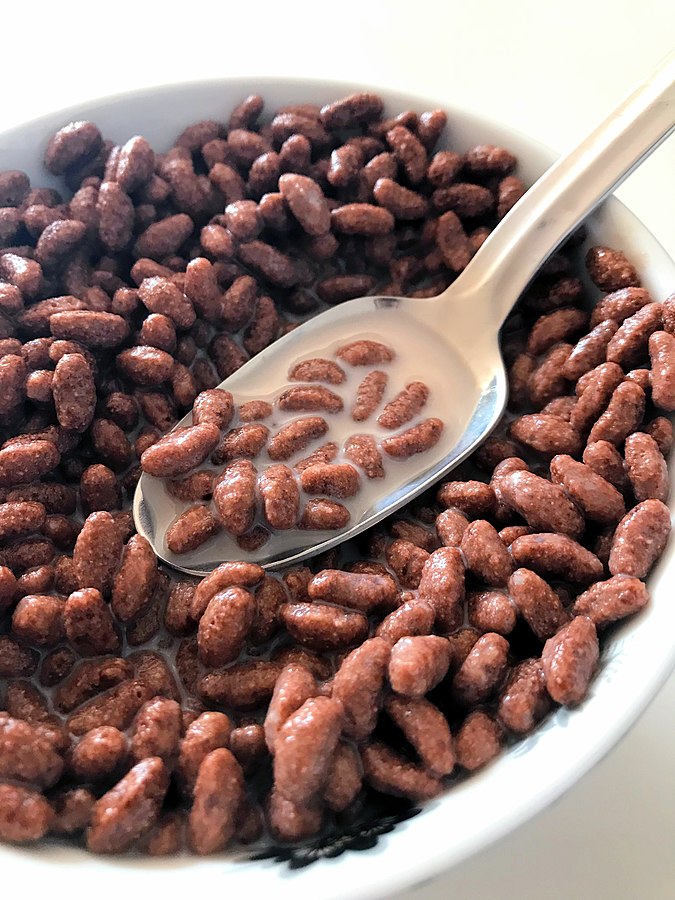
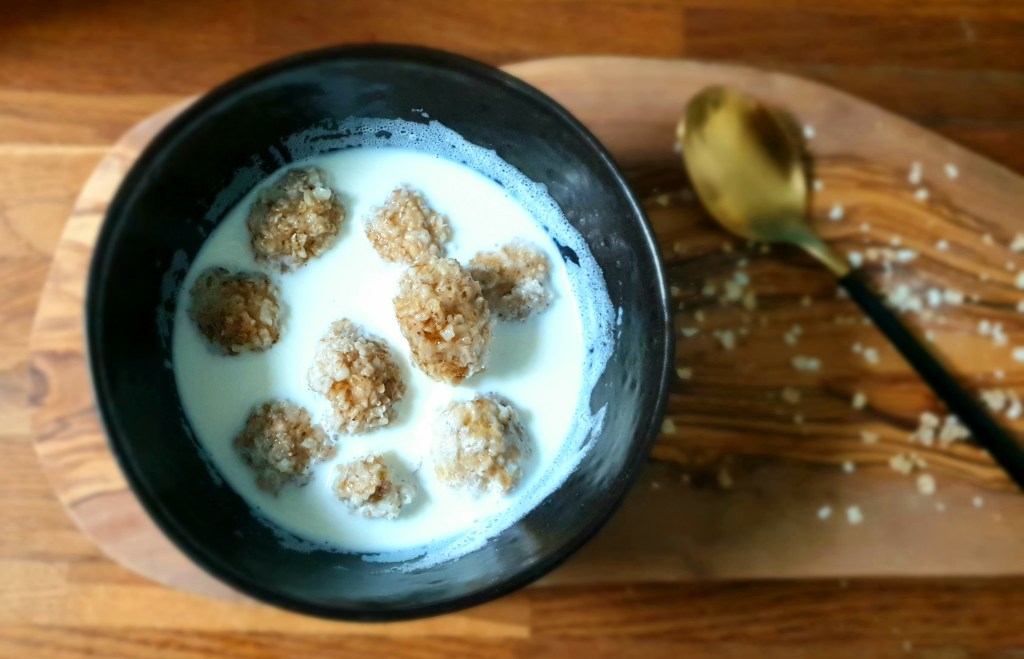
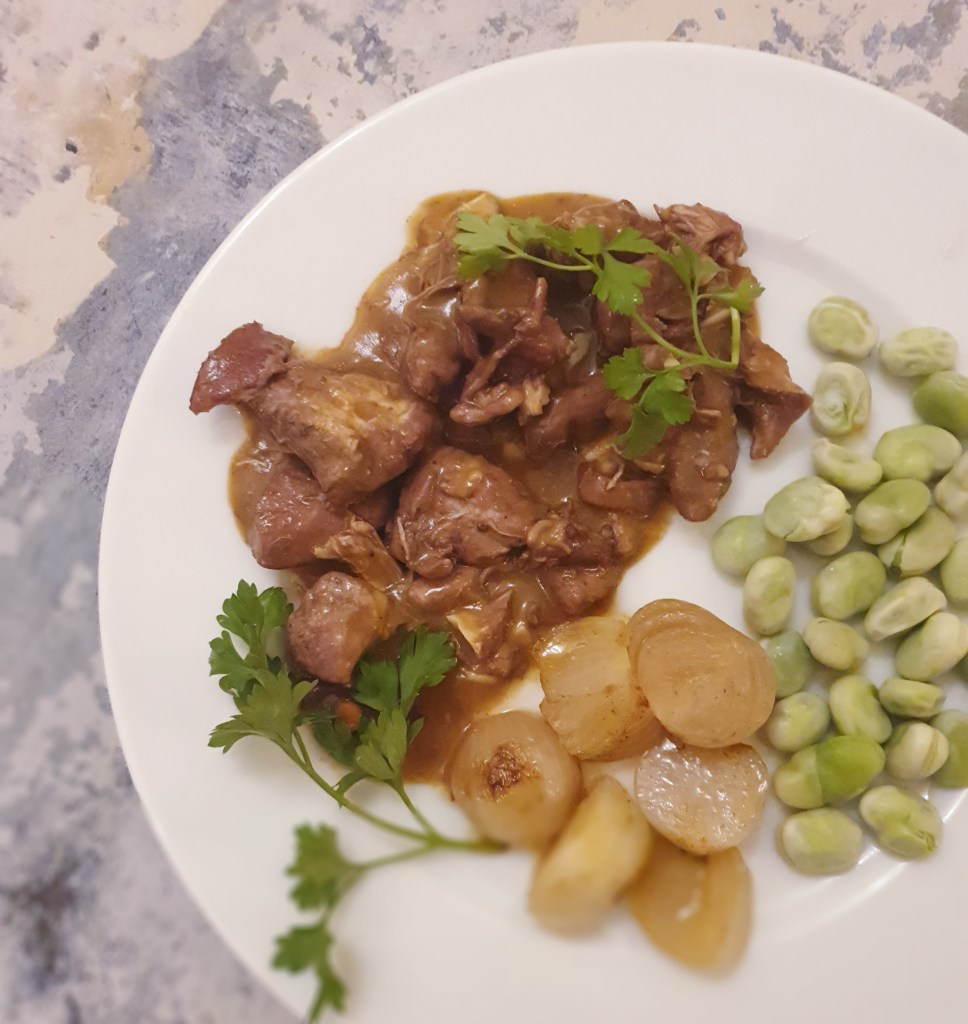
“The perineum of the year”: A round up of 2020

I didn’t come up with the phrase but it’s one I’ve embraced, much to my husband’s disgust. The perineum of the year: that bit in between Christmas and New Year when you can’t remember the last time you showered (let alone got dressed), when you’re left with only Strawberry Creams in the Quality Street tin, and when the entirety of your fridge/house/body smells of stuffing.

Someone in the household will, at some point in the next day or so, suggest going for a jog to start their January health regime early. Encourage them; you can crack into the Toblerone in peace while they’re gone.

And while you’re dribbling chocolate you might enjoy a round up of my top five best and worst experiments this year…

Top Experiments of 2020

Fanfares at the ready: three, two, one – go!

Number 5: Doucetes

Egg custard. Saffron pastry. Indulgence: medieval style.

These wobbly little gems were from the fifteenth century and were the first thing I’d made that felt like they could compete with modern sweets. They were buttery, creamy and rich and I’ve actually made a couple of batches of them since.

Don’t be alarmed by the appearance: they may look a little cellulite-heavy, but once you eat them they will banish all thoughts of cellulite until you next look in the mirror.

Number 4: Farts of Portingale

Do I really need to explain why this one’s on the list?

Number 3: Fish Banquet

I had no idea fish could taste so good. Someone who did, however, was Athenaeus: a 3rd century rhetorician who loved it so much he advised resorting to any method possible – buying, begging or stealing – to get a taste of premium quality seafood.

This was one of the few meals – and they have been few and far between, believe me – which made my husband actually appreciate this blog. The simplicity of the dish was its secret, but so too was the delightfully Mediterranean cooking method.

I enjoyed wrapping the prawns in fig leaves and burying them in hot coals to roast slowly. I enjoyed slicing the side dish of radishes so thinly they looked like little discs of stained glass in the sunlight. What I enjoyed slightly less was the horror I felt when the lady on the fish counter at Sainsburys told me the price of the tuna steaks she’d just cut for me and social awkwardness made me say “yes, that’s fine” instead of “sorry, are you mad? How much?”

Buy, beg or steal, you say?

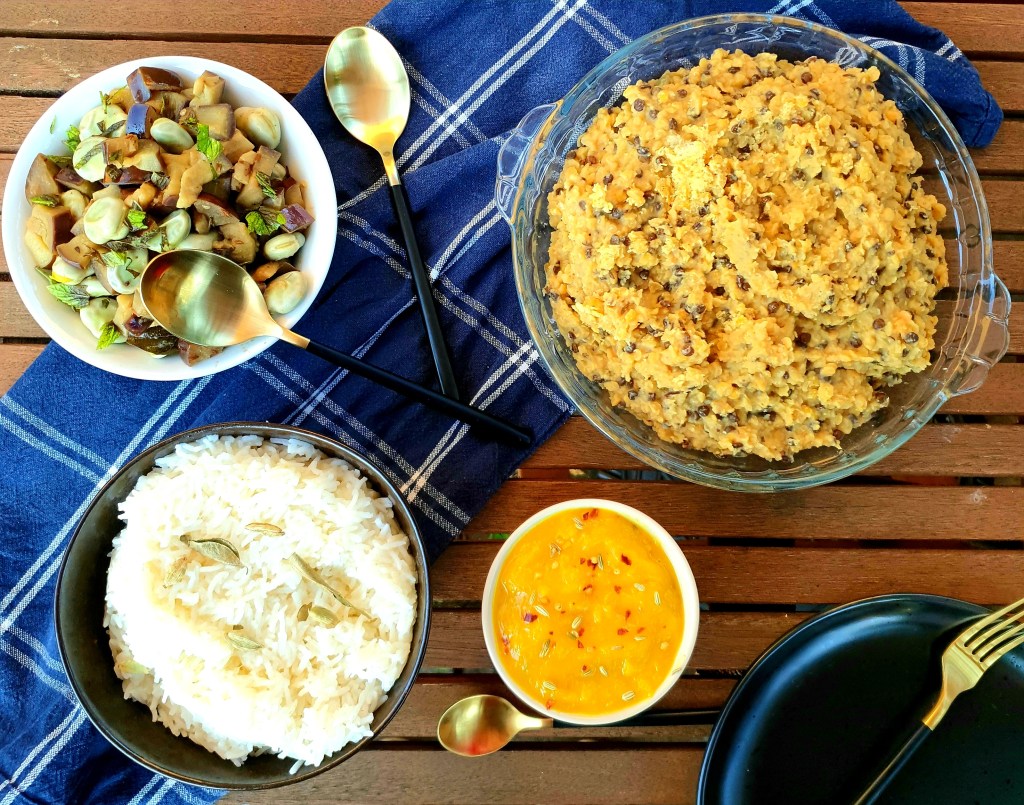
Number 2: A Bengali Meal

The most self indulgent thing I’ve written all year, but the one that seems to have resonated with quite a few people. It’s not perfect by any stretch of the imagination but it made me feel a little bit more connected to my family’s history and was also a great excuse to eat my body weight in ghee.
Number 1: Anglo-Saxon Bread

Bread? Just…bread? At number one?

This was one of the first things I made and it’s probably the thing I’ve made the most since. It never, ever ceases to amaze me how simple and ingenious it is: bread, water and a pinch of salt (if you want to be fancy.) And ta-da! A warm, filling, palm sized disc of bread that tastes good with literally everything I’ve tried so far.

This bread has helped a leftover stew for one stretch to two people as a midweek meal, when we couldn’t be bothered to wait for pasta or rice to cook. I have made cheese sandwiches out of this bread for my daughter’s lunch in the height of lockdown when we’d run out of Hovis but I felt too anxious to go outside and buy more. We’ve eaten this bread smothered in salty butter and dipped in jam at breakfast (admittedly that time it backfired because my daughter thought I was cooking pancakes and was very disappointed when she realised I was not.)

More than anything else, bread is the thing that I think connects us most to our past. Egg tarts are tastier but required more money, time, skill. Fish banquets are more beautiful, but not everyone had access to fresh fish. Farts sound funnier but… actually, I don’t have a comeback to that one.

But bread was eaten by everyone. The only real difference was whether you ate fine white bread made from wheat or some form of ‘lower class’ bread made with barley flour or worse.

The act of making bread – kneading – also hasn’t changed despite centuries of developments. Sure, you can use a bread maker or mixer if you like but you won’t get as good results (and it won’t be as fun) compared to just using your hands and feeling when it’s ready – when the tension in the dough’s just right, when the flour’s been completely combined…

Of course the beauty of this recipe is that it doesn’t require much kneading at all – if any. It was intended to be a quick meal to fuel a tired army, it could act as a reliable form of rent, or just as an easy lunch with a hunk of cheese for a hungry child. Whatever its use, bread was one of the few things that could unify people from across the social classes and it’s the thing that brought me closest to understanding people from the past.

“Just bread”, you say?

Worst experiments of 2020

Because this year has been a disaster in more ways than one…

Number 5: Stuffed Goat

Goat is a widely eaten and much loved meat for millions of people around the world. My own dad counts himself as someone who enjoyed a good goat curry when he was growing up. For this reason I thought I was ready to try it myself: I was not.

This was a top 5 worst experiment not so much because of the recipe itself but because it highlighted how far I still have to go until my cooking skills are anything higher than “mostly haphazard, occasionally decent” (genuine quote, by the way.)

Was it the fact I forgot the tin foil tent and didn’t baste the meat, thus rendering it tougher than leather, that ruined this experiment? Maybe. Perhaps it was the fact that half way through cooking this I decided now would be the perfect time to quickly attempt some minor DIY and remove the cot sides from my toddler’s bed – a task that was ended up being neither minor or quick, but which did mean I missed the timer when it went off.

Either way, this was not a triumph.

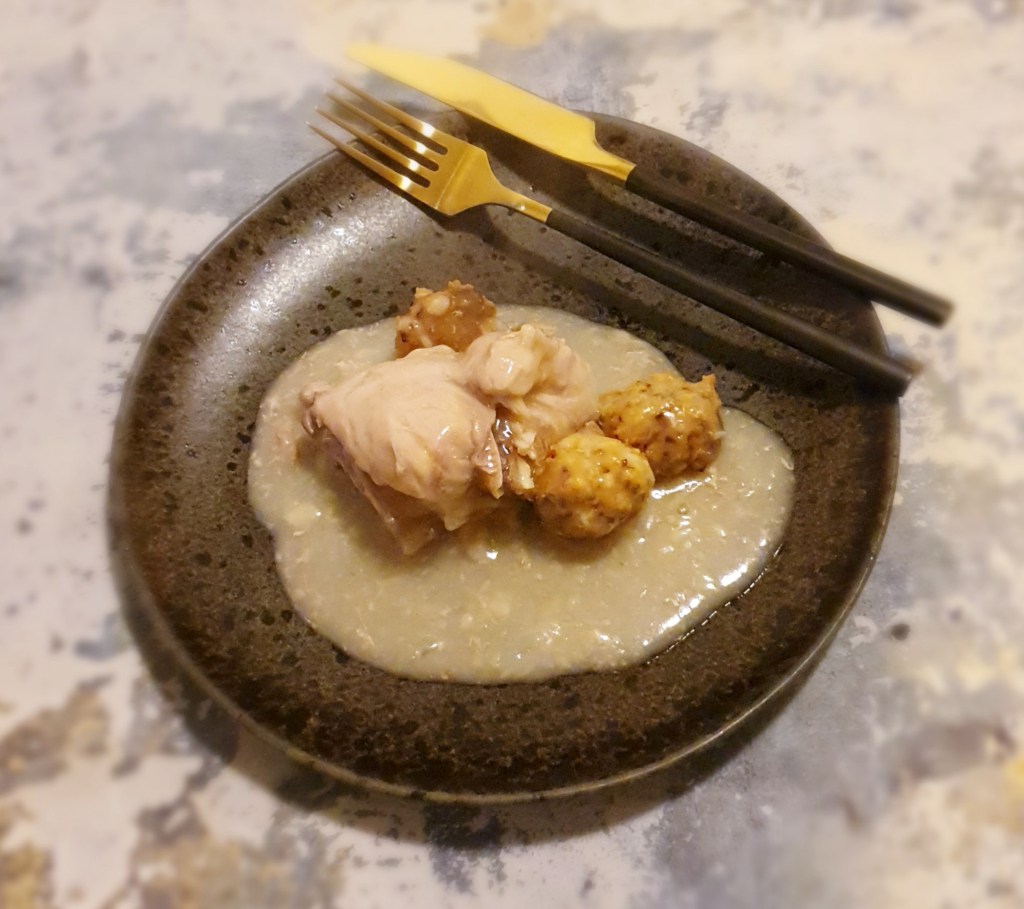
Number 4: Stewed Rabbit

Just slightly worse than the goat was the rabbit.

Again, my cooking skills probably didn’t help with the terrible outcome of this but the difference here is that I think the recipe was also, well, terrible.

When I started this blog I knew very little about historical cooking. Like many others, I was mistaken in thinking food of the past was either dishes of bland gruel or over-spiced rotting meat. Also like many others, I was mistaken in thinking that Mrs Beeton was some sort of Victorian culinary goddess, come to pull us out of our uninspired ways and bless us with the knowledge of flavour.

Well let me tell you: Mrs Beeton was the patron saint of bland and uninspired.

Harsh? Perhaps. But this rabbit dish managed to be one of the few that I ended up not serving to my husband out of a genuine fear he would divorce me if I tried.
Number 3: Turkey Twizzlers

Nothing has ever encapsulated the meaning of ‘rose tinted spectacles’ quite like turkey twizzlers.

I’m really loathe to stick this post in my top worst experiments because it’s actually one of my best pieces of writing (I think.) And yet the outcome of that day of cooking was so hideously disgusting, and my kitchen was so covered in fat and grease, that I can’t deny its place on this list.

These are also on the ‘worst of 2020’ list because the day I made these my mother-in-law had popped over for a socially distanced catch up in our garden. I panicked that she – elegant and sophisticated woman she is – would despair at her son’s choice of partner when she saw me making these, so I’m posting them here so she knows that I know they’re dreadful. Okay?

(A week or so after I published the original post, though, Bernard Matthews announced turkey twizzlers were making a come back. Coincidence? I think not…)

Number 2: Nut Custard

Oh God. Just thinking about this makes me want to be sick.

This was my first foray into the ancient desserts of Apicius and I was ill prepared. Nut custard looked like some sort of rotting alien body part. It had eggs in it, it had nuts, it had honey. It also had… fish sauce. The fish sauce was the thing that got me – even once it was baked I still thought I could smell and taste it at the back of my throat.

The editors of the recipe said that Apicius rarely gave measurements or quantities, which meant that “in the hands of an inexperienced operator [the recipe] would result in failure.” At the time I had scoffed and had carried on to failure – just as predicted. Despite being slightly less inexperienced than I was back in February, I have yet to reattempt this one.

Number 1: Egges in Moneshine

When I was seven I ate a spider web by accident. There’s not an interesting backstory, you’re just going to have to accept that it happened and it was an accident. I have no idea if the spider was part of my unexpected snack, but at the time it was the worst thing I’d ever eaten.

When I was at uni I was given a plate of deep fried chicken wings that were still raw and bloody inside. That was then the worst thing I’d ever eaten.

When I was 27 I ate stuffed goat, stewed rabbit, turkey twizzlers and nut custard and all of them were the worst thing I’d ever eaten.

But then I ate egges in moneshine.

And I would eat a thousand spider webs – spiders included – and a thousand raw chicken wings and a thousand nut custards to never, not ever, have to put egges in moneshine in my mouth again. If 2020 was a food, it would be egges in moneshine and God only knows how much we’ve all hated this year.

Thank you and Happy New Year

So that’s it! My first year done.

Thank you very much to everyone who has read, shared, commented and supported me on this blog. It started as an overeager New Year’s resolution and I never thought it would pick up any interest beyond my mum (and to be honest I think both she and I thought one of us would lose interest around February) but it seems a few people quite like it, so thank you.

I hope you have a very happy, warm, healthy New Year and I’ll see you in 2021 for lots more historical triumphs and disasters.

Ellie x

Reading lists (I’m a teacher, what did you expect?)

Below is a list of some of the best food history sites and blogs. No arguments – in fact, why are you still hanging around here?

  • British Food: A History – Dr Neil Buttery’s long running and exceptionally well researched and detailed blog on the the history of British food.
  • Foods of England – Fabulous site of the history of the forgotten foods of England, with recipes.
  • Food timeline – An incredible index of food by late food history librarian Lynne Olver.
  • Medieval Cookery – A huge database of recipes from the medieval period across Europe.
  • Monk’s Modern Medieval Cuisine – Written by Dr Christopher Monk who has an expert knowledge of the recipes in Forme of Cury, and also the etymology of modern and medieval food.
  • Pass the Flamingo – Excellent site on the recipes and history of ancient dishes.
  • Project Gutenberg – immense database of free texts including Apicius, Mrs Beeton’s Book of Household Management and Forme of Cury.
  • Silk Road Gourmet by Laura Kelley – a fantastic blog by author Laura Kelley, delving into the ancient texts and recipes of Mesopotamia and other ancient Asian countries and empires.
  • Tasting History – Something for YouTube fans! Brilliant channel bringing history and food to life.
  • Tavola Mediterranea – if there’s anything Farrell Monaco doesn’t know about Roman cuisine it’s not worth knowing – great website with recipes and history-inspired culinary tools to buy.
  • The Regency Cook – Paul Couchman, cook at the Regency Townhouse in Hove, runs a blog with recipes and brilliant cookery courses based on 1830’s techniques and recipes.
“All I want for Christmas is bread sauce”: A brief history.

The day of judgement is almost upon us.

Soon we will be called forth to follow the Christmas commandments of our lord and saviour Delia (or Nigella, whichever you prefer) and begin the rituals: the chopping, the stirring, the basting. We will sing the hymns of Wizzard and share communion of a bucks fizz (or two) well before 9am.

Whether you’re a ‘presents first thing in the morning’ kind of person or a masochist who waits until after lunch, there’s one thing you should know: the day is made or broken by the quality of the bread sauce.

It’s an opinion I haven’t seen too much online and yet it’s one my whole family shared when I was growing up. In fact, so seriously do my family take bread sauce that no one except mum was allowed to make it and the first year I took over my sister insisted mum make a ‘back up’ vat too.

‘Vat’ might seem an odd way to measure bread sauce – after all, it’s a once a year accompaniment, right? Just another sauce to go with the cranberry jelly and the gravy. Surely ‘jug’ would be better?

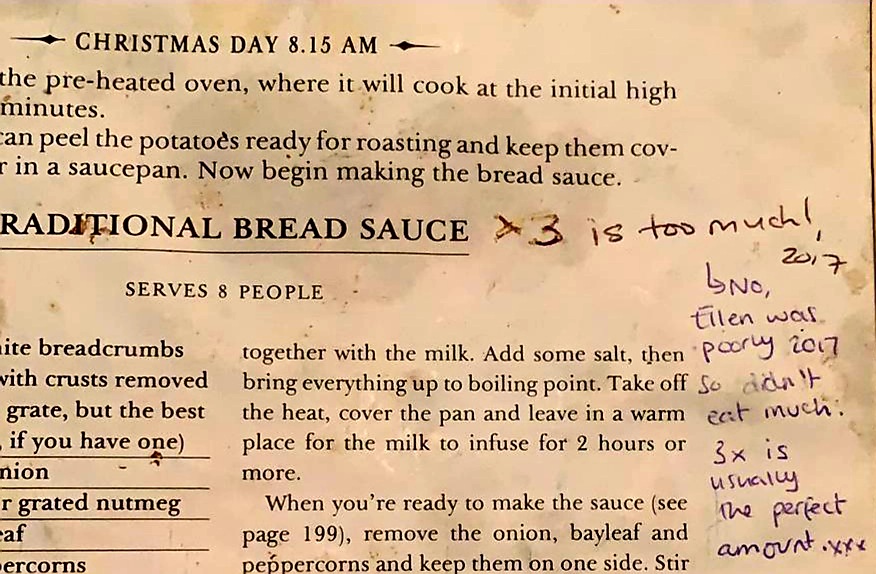
You might think so, but you’d be wrong; growing up our family of four tripled the recipe. The recipe that, as standard, served 8 people. For us, ‘vat’ is an entirely appropriate measurement – nay, the only appropriate measurement – when it comes to bread sauce.

Someone corrected my mother’s annotation that 3x the recipe was too much. Luckily, 2018 saw the return of my appetite and thus the return of triple portions.

That seems…excessive

Tis the season.

Anyway, I’d done an obligatory mince pie post to celebrate the festivities, but what I was really excited about was delving into the history of my very own reason for the season.

For the uninitiated, proper bread sauce contains nothing but bread, butter, milk and cream, an onion and some spices. It should look a little like porridge and taste creamy and mild and ever so slightly fragrant. Its flavours are best approximately 8-12 hours after lunch when it’s eaten cold from the fridge in gelatinous mounds off a silver spoon, or between two slices of cheap white bread which have been buttered and dotted with leftover stuffing bits. In short, if anything was going to prove the existence of God to me at this time of year, it’d be a perfect bowl of Delia’s bread sauce, not a nativity scene.

Using bread to thicken sauces was an ancient technique, but I was interested to see if there were any old recipes which made bread the central part of the sauce itself and what those recipes tasted like. Were any of them even remotely similar to modern bread sauce? Were they served alongside turkey? Was there any historical precedent for cooking up entire vats of the stuff, or was it just a bonkers tradition unique to my family?

Galentyne: 1390.

Take crustes of brede & grynde hem smale; do þerto poudour of galyngale, of canel, of gynger, and salt it; temper hyt with vyneger & drawe it vp þorow a straynour & messe hit forth.

Take crusts of bread and finely grind them; to this add powder of galangal, cinnamon and ginger, and salt it; temper it with vinegar, and blend it through a strainer, and serve it forth.

Forme of Cury. Text and translation copyright Christopher Monk 2020

Galentyne was the earliest English precursor to bread sauce I could find. Forme of Cury, where this recipe comes from, was compiled around 1390 and was the cook book for Richard II’s master cooks. Being a 14th century recipe, galentyne wasn’t intended to be eaten with turkey, but it also didn’t give any indication what it was an accompaniment to. Knowing how the rich ate in the 14th century it could have been anything: pork, beef, porpoise, swan, seal…

Dr. Christopher Monk, who has written a post about the various galentynes of Forme of Cury, points out that the word ‘galentyne’ is pretty hard to pin down. In some recipes it appears as a sauce, in others a jelly. It can be served hot, or cold. Some versions use vinegar, others use only wine, some both.

The first thing I noticed was a lack of quantities. This was totally standard for the 14th century and just as totally unhelpful as it sounds, especially given the only liquid in this recipe was vinegar.

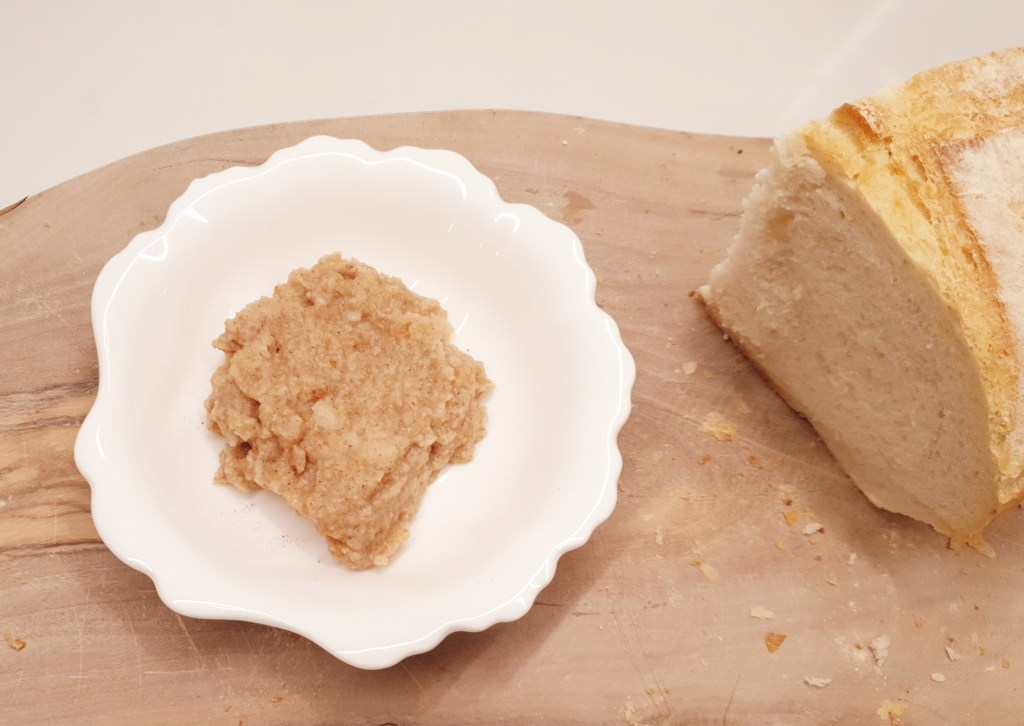
I blitzed a handful of white bread crusts with the ground spices and added tablespoon after tablespoon of white wine vinegar until I ended up with a fairly thick paste, which I pushed through a sieve before trying.

Perhaps I tried too much at first, because the first taste was like eating a tablespoon of acid. My lips tried to eat themselves as they curled back from the sourness and my eyes began to prickle but once the initial assault was over I began to appreciate the tartness and the aftertaste, which wasn’t too bad: slightly spicy and salty.

I even went back for more, this time a small smear on a bit of ham and it was actually delicious. It reminded me a bit of a pickle, the sort of thing you’d serve with chutneys and mustards and piccalilli; I reckon I’d make this to serve alongside a Christmas ham in future years.

You do not need to triple the recipe for this one.

Was it a good approximation of modern bread sauce, though? No, not even close. It had vaguely the right consistency and colour, but that’s where the similarities ended. I moved onto the next recipe.

Henry VIII’s rabbit sauce: 1594.

Fine Sauce for a roasted Rabbet: used to king Henrie the eight. TAKE a handfull of washed Parcelie, minced small, boil it with butter and vergious upon a chafingdish, season it with Sugar, and a litle pepper grose beaten: when it is readie, put in a few crums of white bread amongst the others let it boile againe til it be thick: then lay it in a platter, like the bredth of three fingers, lay of each side one rosted Cony or more so serue them.

The Good Huswifes Handmaide for the Kitchin, Thomas Dawson.

This seemed more like it; no mention of vinegar and plenty of butter. There was still a worrying lack of cream or milk to give the sauce a decent thick creaminess, but it was moving in the right direction and, as the recipe suggested it had been served to Henry VIII himself, it seemed promising that it’d be rich and filling at least.

I placed the chopped parsley, butter and verjuice in a pan and let it boil together for a minute or two. Verjuice is just the juice of unripe grapes. You can make it yourself, but it’s easier to buy a bottle “just to have in for historical experiments.” Once bought, the bottle will take up cupboard space in your kitchen and your husband will moan that it just adds to the clutter and never gets used.

As soon as the butter had melted I added sugar, pepper and a handful of breadcrumbs and…panicked. The recipe definitely said ‘sauce’, but the breadcrumbs soaked the liquid up like a sponge. It didn’t resemble a sauce at all, no matter how much more verjuice or butter I added, it just stayed a dense mass. I re-read the recipe; it suggested the ‘sauce’ be served “the breadth of three fingers” which suggested some sort of solidity but I was still a bit taken aback, especially as it was easier to cut with a knife rather than spoon onto a plate and looked alarmingly like pork stuffing.

A sausage of bread sauce, sire?

In terms of flavour, however, this was by far the most pleasant. It was rich and buttery, like a good bread sauce should be. Modern bread sauce has a slight sweetness to it, but this was far sweeter than I was used to because of the verjuice and added sugar.

The main flavour was parsley, which unfortunately wasn’t like a good bread sauce at all. Good bread sauce should be stodgy and carbohydrate heavy, with nary a hint of anything as healthy as a green herb in sight. Henry VIII’s nailed the stodginess (perhaps a little too well…) but the overeager abundance of parsley in this one meant it still wasn’t right. I moved on.

Gallendine sauce for a Turkey: 1653

Take some Claret Wine, and some grated Bread, and a sprig of Rosemary, a little beaten Cloves, a little beaten Cinnamon, and some Sugar.

A True Gentlewomans Delight, Elizabeth GreyCountess of Kent

Did I really want to make another version of galentyne again? No, of course not, and besides I was pretty sure I didn’t have enough vinegar left. But what intrigued me about this recipe was that it specified serving it with turkey, just like modern bread sauce.

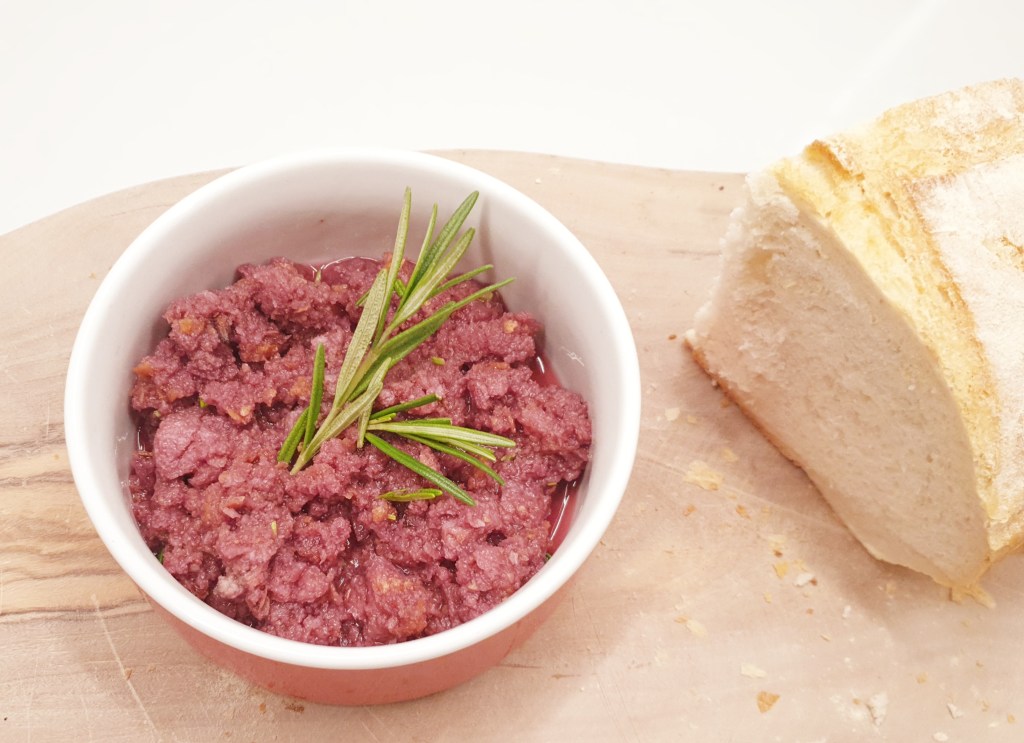
The first thing that struck me in this recipe was the addition of claret wine. True bread sauce should be white. I began to feel very nervous as I poured wine over my heap of breadcrumbs and watched them turn white to deepest red.

There was no cooking to be done here, so once the herbs and spices had been added I assumed it was done.

Bread would be a good tool for mopping up a murder scene, I think.

This was the most unpleasant of the lot, which surprised me. I think I’d assumed because it was the latest of the three it would somehow be the best – as if time would afford the creator of the recipe some additional skill or appreciation for good bread sauce. Of the three, however, this was the only one we ended up not being able to finish.

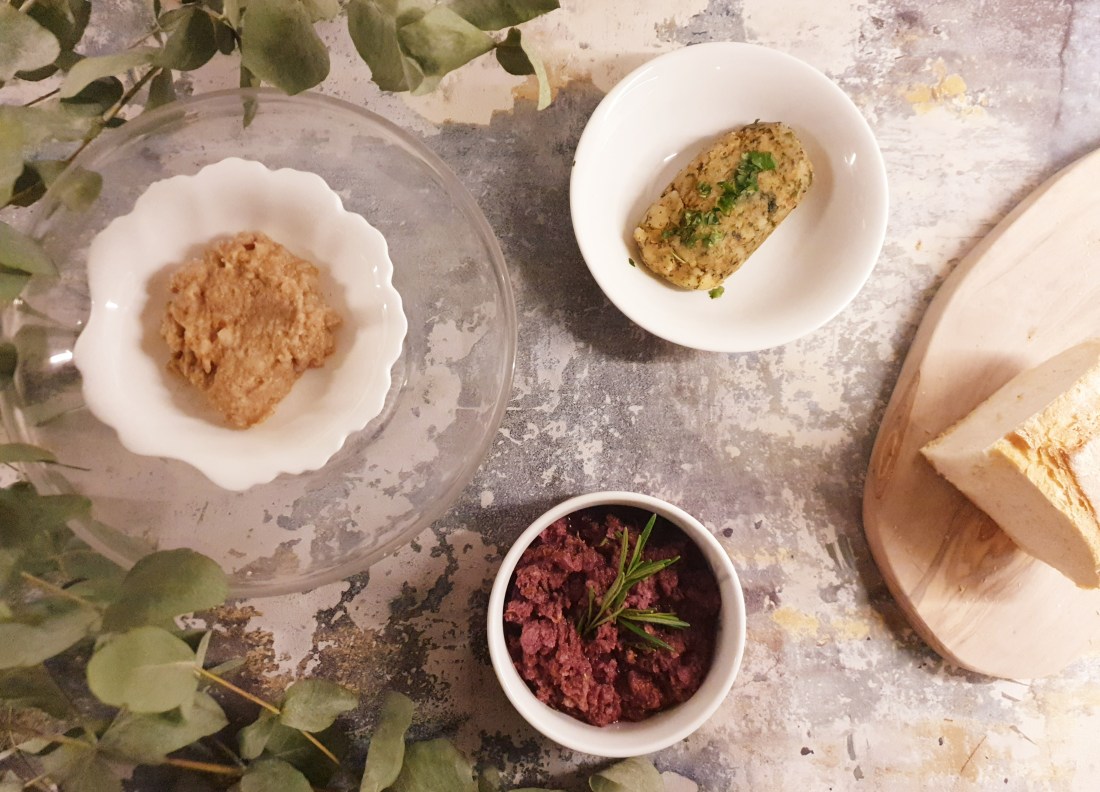
Consistency wise it was the closest to modern bread sauce, but appearance wise it was about as far away as you could get: bold and bright and covered in twigs. The taste was also nothing like bread sauce: it was just wine with soggy lumps of bread and the occasional sprig of rosemary poking you in the gums. No, thank you.

The verdict.

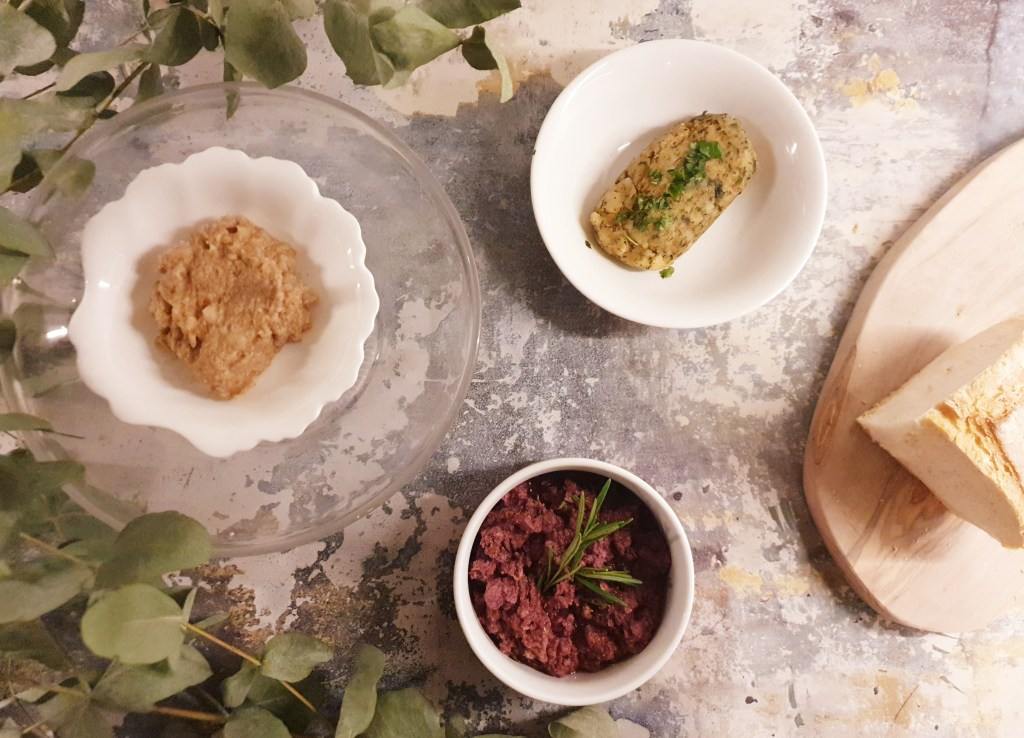
The closest taste to modern bread sauce was probably Henry VIII’s rabbit sauce. The addition of butter made it by far the creamiest of the lot but the appearance was more like a log of sausage meat than a sauce. None of them were very good matches – either too acidic, too solid or too alcoholic, which just goes to show that having bread as an ingredient does not a bread sauce make.

Three bowls of bread, none of them sauce.

By this point I was beginning to suspect that Delia had invented the perfect recipe for bread sauce through divine intervention rather than historical evolution… and then I found Hannah Glasse’s 1747 recipe:

Bread sauce for Roasted Partridge

Bread sauce…made thus: Take about a handful or two of crumbs of bread, put in a pint of milk or more, a small whole onion, a little whole white pepper, a little salt, and a bit of butter, boil it all well up; then take the onion out and beat it with a spoon.

The Art of Cookery, Hannah Glasse.

Given Delia’s militarily precise and inflexible timings for Christmas day lunch, I don’t know how much she’d approve of Hannah’s somewhat lackadaisical approach to the quantities and measurements here, but I couldn’t fault the foundations of the recipe. Bread? Check. Milk? Check. Butter? Check. Wine, vinegar, verjuice? No, no, no – thank God.

So, were any of the three I made worthy of triple portions? No. But, more importantly, did any of them make the cut for this year’s Christmas Day table? Also no – it’s meant to be a day of unbridled joy and pleasure for God’s sake.

For the day itself I’ll stick to Delia’s bread sauce recipe, but maybe now I’ll pause before dunking my head into the bowl and remind my husband and daughter of the rich history of the stuff – much to their delight, I’m sure. And if there’s one positive to the Christmas lockdown, it’s that my mum – who texted to tell me I had “better not let her down” with this post – wasn’t around to see some of the unfortunate origins of her beloved side dish.

Merry Christmas!

E x

“The principal season for the killing of hogs”: Christmas-Pyes 1728

We had a Christmas tradition when I was growing up. Perhaps tradition is the wrong word; superstition might be better. Mum would bring the mince pies out around the first week of December and they’d sit on the plate patiently while we all ignored them and ate biscuits and chocolate instead.

Eventually the yule log and gingerbread men would be gone and we had no option but to acknowledge the pies’ existence. The superstition went like this: you could eat as many as you liked, but you couldn’t speak a word until the last crumb had been licked from your lips. Each pie you ate silently bought a month of good luck for the coming year.

And…as I type that I realise it may have been a superstition invented by my mother to buy herself some peace and quiet during the school holidays. Regardless, mince pies seemed an obvious choice for my first ever Christmas post!

The secret is to use real Englishmen.

Why ‘mince’ pies?

The earliest recipes for mince pies (or pies that us modern folk would call mince pies) contained minced or shredded meat, as well as fruit and spices. Meatless mince pies are a relatively modern concept and began around the start of the 19th century, although suet was still a popular ingredient. Traditionally these pies would have been all kinds of shapes and sizes, often quite intricate but have today become boringly round.

Today’s mince pie experiments are of the meat-and-fruit variety and appear as ‘Christmas Pyes’ in Richard Bradley’s The Country Housewife and Lady’s Director. This was intended to be a useful manual for farmers and their families and contained not only recipes but practical farming advice and jobs to be done in each month. December, if you’re interested, is “the principal season for the killing hogs” – perfect for when you’ve run out of board games and need a festive family activity.

Killing hogs in December was all well and good and no one seemed to have a problem with this. The thing that seemed to really divide people, that seemed to get them properly foaming at the mouth, was the name of the pastries: Christmas pies.

Christmas pies – cute name or sign of the devil?

It all depended on who you asked.

Check any history textbook and it’ll show: the Puritans banned Christmas. It’s probably the only thing most of us remember from year 8 history lessons. Unfortunately, like most historical facts, it’s false. Or hugely exaggerated, at least. As Foods of England shows, nothing was outright or nationally banned at all; at some local levels certain individuals attempted to ensure 25th December was business as usual but these miserable souls were, for the most part, roundly ignored.

In 1650 – three years before before Oliver Cromwell became Lord Protector – the writer Robert Fletcher made fun of Puritans and their supposed hatred of Christmas – and fear of Catholic conspiracies – by writing an imaginary dialogue between two Puritanical “zealots” on the topic of Christmas and, yes, Christmas pies:

Christ-mass? Give me my beads: the name implies
A plot by its ingredients beef and pyes.
A feast Apocryphal,
A popish rite, kneaded in dough in the night…
An annual dark-lanthorn Jubile:
Catesby and Vaulx baked in conspiracie [sic]…”

Robert Fletcher, ‘Christmas Day; Or the Shutle of an inspired Weaver bolted against the Order of the Church for its Solemnity’

In 1720, just to really cement the idea that Christmas pies were to Puritans what bulbs of garlic are to vampires, Thomas Lewis wrote that fanatical Puritans in the civil war had decried Christmas pies as “abomination[s]”.

Then, in December 1733, The Gentlemen’s Magazine published an essay on Christmas pies by the curiously named Philo-Clericus. Despite proclaiming a “love” of them, he suggested Christmas pies were only “in vogue” during winter “owing to the barrenness of the season and the scarcity of fruit and milk to make tarts, custards and other desserts…” And as someone who would rather lick the crumbs from the yule log plate before eating a whole mince pie, I can kind of see his point.

Philo-Clericus goes on to describe how it wasn’t just Puritans, but Quakers too, who hated these festive treats. According to Phil, Quakers viewed Christmas pies as “an invention of the scarlet whore of Babylon, an hodge-podge of superstition, popery, the devil and all his works.”

I mean, how could I resist?

The recipe.

Take an Ox-Heart, and parboil it, or a Neat’s-Tongue, boil’d without drying or salting, or the Inside of a Surloin of Beef; chop this small, and put to each Pound two Pounds of clean Beef-Suet, cleaned of the Skins and Blood, and chop that as small as the former; then pare, and take the Cores out of eight large Apples, and chop them small, grate then a Two-penny-Loaf; and then add two or three Nutmegs grated, half an Ounce of fresh Cloves, as much Mace, a little Pepper and Salt, and a Pound and a half of Sugar; then grate in some Lemon and Orange-Peel, and squeeze the Juice of six Oranges, and two Lemons, with half a Pint of Sack, and pour this into the Mixture.

Take care to put in two Pounds of Currans to every Pound of Meat, and mix it well; then try a little of it over the Fire, in a Sauce-pan, and as it tastes, so add what you think proper to it: put this in an earthen glaz’d Pan, and press it down, and you may keep it till Candlemas, if you make it at Christmas.

Memorandum: When you put this into your Pyes, press it down, and it will be like a Paste.When you take these Pyes out of the Oven, put in a Glass of Brandy, or a Glass of Sack or White Wine, into them, and stir it in them.

Richard Bradley, The Country Housewife and Lady’s Director.

The method.

Ox heart and ox tongue were quite hard to come by. I don’t know how easy it is to get hold of them usually but for some weird reason, on the week of the 14th December, the shops and butchers were all more preoccupied with selling turkeys, ham or big joints of beef instead, so I used the inside of a sirloin steak for the meaty part of these.

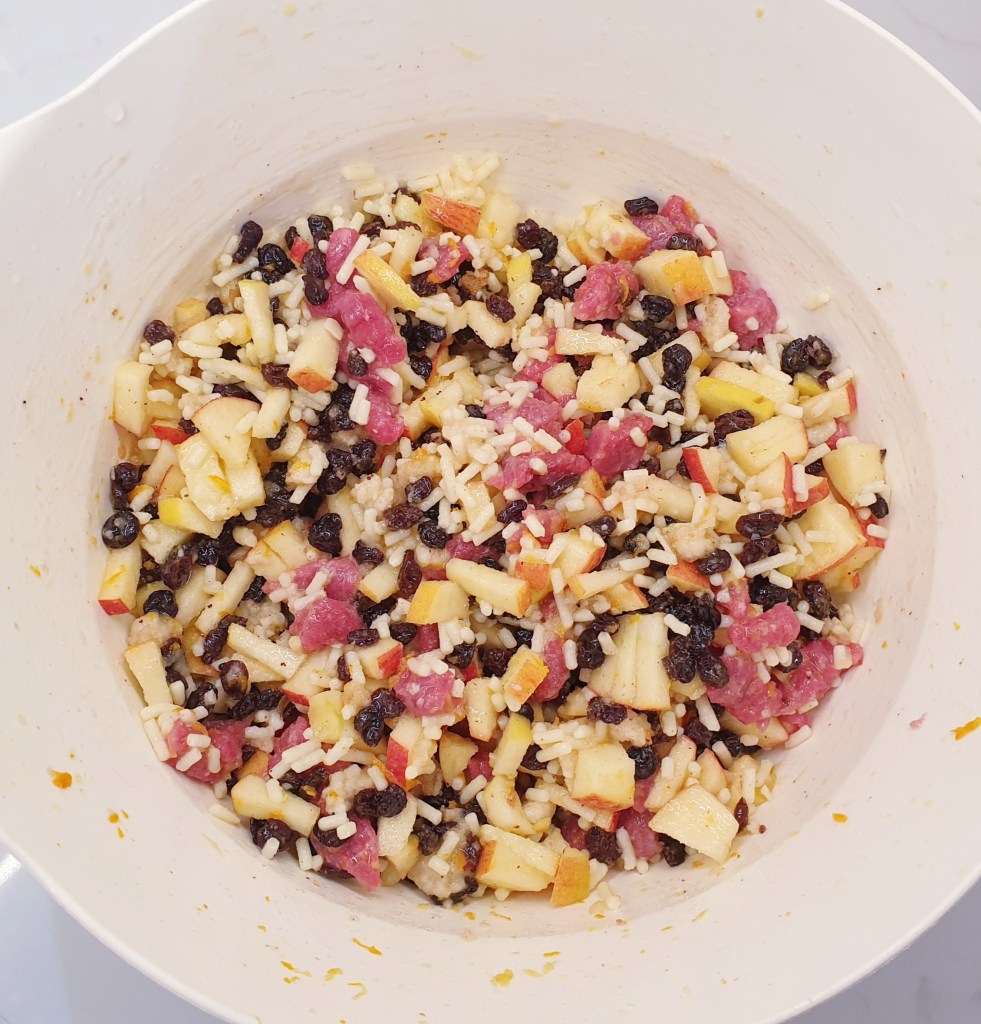
I added beef suet, chopped apple, breadcrumbs, spices, lemon and orange peel and a good glug of brandy to the chopped sirloin and then left the mixture overnight to mingle.

It looked a bit worrying, but it smelled amazing.

The second half of the recipe made it sound as though these pies were meant to be open to accommodate the addition of more alcohol after baking, but I chose to bake mine with a crust on top because, as I’ve stated numerous times before, I don’t believe a pie is a pie unless it has a full crust (top and bottom). The additional alcohol, I decided, would just have to be drunk as an accompaniment.

The recipe wasn’t clear which type of pastry should be used. By the 18th century, pastry had moved on a bit from just a basic flour and water mixture and, given the richness of the filling, I thought I needed something special.

Luckily, Richard Bradley had included a pastry section in his recipe book, and I selected the one I thought would go best – “sweet paste”.

If you would have a sweet Paste; then take half a pound of butter, and rub it into about a pound of flour, with two or three ounces of double-refined sugar powder’d, and make it a Paste, with cold milk, some sack and brandy. This is a very good one.

Richard Bradley, The Country Housewife and Lady’s Director.

A very good one it was indeed, with its sugar and double helping of yet more alcohol. As the smells of brandy and mincemeat and, er, minced meat mixed and wafted round the air as the pies were baking, I began to feel very merry. Perhaps it was the festive atmosphere or the several glugs of sherry I’d drunk to check it was okay to serve alongside the pies (always best to double check, I think), but I suddenly felt more Christmassy than I had done all December. By the time the buzzer went off I was practically ready to open the presents and carve the turkey.

The verdict.

My husband, lured downstairs by the smell of festive baking, couldn’t wait to get started.

“Don’t tell me what’s in them, I don’t want to know,” he said as he took a bite. “They smell better than anything else you’ve made so far and I don’t want you to ruin it for me.”

They didn’t just smell great, they tasted great too. Like, unbelievably good: buttery, spicy, fruity. The meat was more of an aftertaste rather than a flavour on its own, and the pastry was glorious – flaky and rich as Christmas pastry should be.

The abundance of spices and sugar and meat probably made these a treat to be enjoyed only by the rich at this time of year and, frankly, the alarming amount of butter and suet used which melted and bubbled up out of the pan as they cooked meant that modern day folk probably wouldn’t want to eat these all year round, either.

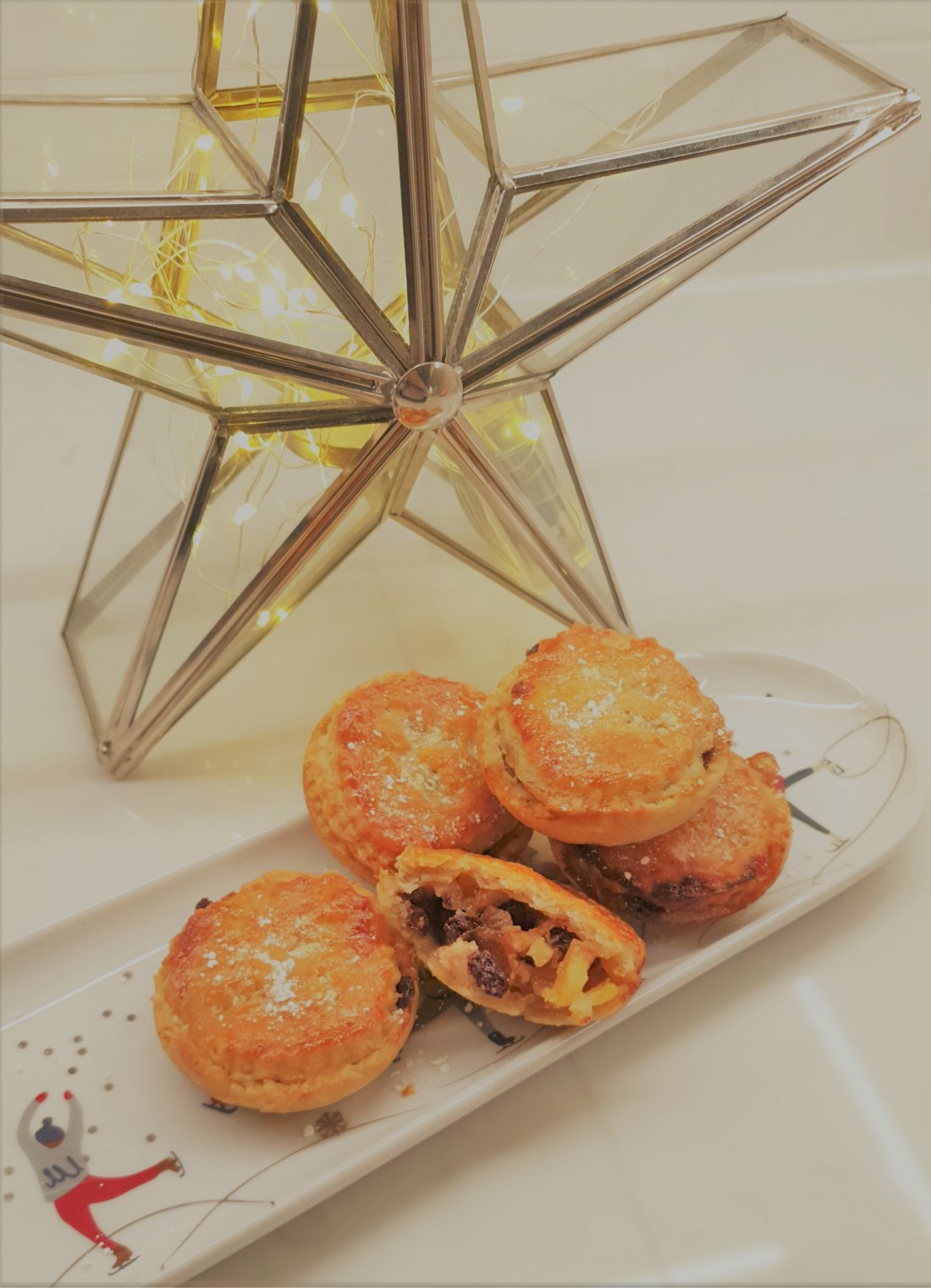
I made about 14 and even though I’m not a mince pie fan, they were all gone 48 hours later. I’m not 100% sure what the meat added, other than a slightly more savoury element than usual, but the addition of sirloin certainly didn’t detract from the pies either.

Even the little skater on the plate’s dancing with joy at how well these turned out.

Merry Christmas (in more ways than one…)

It’s unclear exactly when mince pie recipe writers dropped the meat element. Recipes in Mrs Beeton’s 1861 version still contained meat although it appears meaty mince pies were on the decline by this point as subsequent editions only printed versions for her meatless mince pies.

If like me you’re struggling to get properly ‘into’ Christmas this year – if you’ve had plans cancelled at the last minute, or the year’s been, frankly, a bit shit and you just want it all over with – but you want to give the Christmas spirit one last kick up the bum to try and get it going again, you could do a lot worse than giving these mince pies a go. And if they don’t manage to bring back the festive feeling they will at least get you a little too tipsy to mind! Merry Christmas!

E x

Christmas Pyes

For the mincemeat:
500g currants
200g shredded beef suet
160g sugar
2 apples, peeled, cored and diced
Zest of 1 lemon and its juice
Zest of 2 oranges and their juice
1 sirloin steak
1 small cob, grated into breadcrumbs
1/2 teaspoon mace
1 teaspoon nutmeg
Salt and pepper
4 or 5 cloves, crushed
5 or 6 tablespoons of brandy or sherry

For the pastry:
150g plain flour
75g butter
28g sugar
Milk or brandy or sherry

  1. Chop the sirloin steak up as small as you can.
  2. Add the steak to a bowl with the other mincemeat ingredients and mix. Leave to stand in a fridge overnight.
  3. For the pastry, rub flour, butter and sugar together.
  4. Add as much milk, brandy or sherry as you like to form to a sticky but still pliable dough.
  5. Roll the dough out on a floured surface to as thin as you can.
  6. Butter a mince pie tin or a standard muffin tin and cut out circles of dough to fit into the holes.
  7. Place a few spoons of mincemeat in each pastry case.
  8. Cut out slightly smaller circles to fit on top of the mince pies and place them on, pushing down at the edges to seal them.
  9. Brush with egg wash, slash a hole in the top of each pie with a knife and bake at 180 degrees for 25-30 minutes until golden brown.

War Widows and the Unknown Warrior: 11th November 1920

They shall grow not old, as we that are left grow old;
Age shall not weary them, nor the years condemn.
At the going down of the sun and in the morning
We will remember them.

Laurence Binyon, The Times, September 1914

No recipe today I’m afraid. Instead let’s talk about a tomb in Westminster Abbey that holds the body of a man with no known identity. Carved on the grave are the words:

“Beneath this stone rests the body
Of a British warrior
Unknown by name or rank
Brought from France to lie among
The most illustrious of the land…”

Tomb to the Unknown Warrior – a fallen WW1 soldier – was the idea of Rev. David Railton. Whilst serving as Army Chaplain on the Western Front, he noticed a grave marked with a rough cross on which a pencilled note “An Unknown Soldier of the Black Watch” was written. Using this experience, and taking inspiration from a similar idea that had been proposed in France in late 1916, he suggested that in order to commemorate the thousands who died across the British Empire, an unidentified deceased British soldier should be picked from a battlefield and buried “amongst the kings”. His idea was strongly supported by Prime Minister David Lloyd George and preparations took place.

On 11th November 1920, the casket containing the body of the soldier – picked at random from a selection of 4 possible men from a range of battlefields – was placed on a gun carriage of the Royal Horse Artillery and made its way through vast and silent crowds lining the streets of Westminster.

At this time of year, every year, I think back to what it must have been like to stand inside Westminster Abbey 100 years ago and watch the grave finally being capped with its black marble stone. I wonder what it must have been like for the servicemen who stood guard – most of whom had also fought in the war that claimed the life of the Unknown Warrior only a few years ago. I wonder what it was like for children who were too young to remember World War One and yet still had their entire childhoods shaped by the collective memory and trauma of it.

But mostly I wonder what it was like for the women. Specifically the wives and mothers who were left behind by a war that took everything from them and – it must have seemed by the end – gave precious little back.

The price of victory?

Sure, talk of triumph, freedom and liberty was all well and good for politicians and historians with distance from the fighting, but for the real people who had to experience the horror of reading the words ‘Regret To Inform You…’, of telling children their fathers wouldn’t be returning home, of folding and putting away clothes that would never be worn again…? Well, I can’t stop thinking about those people.

Perhaps it’s because it’s 100 years to the day that the Unknown Warrior was interred in his tomb, or maybe I’m just getting softer as I get older, but the thought of all those lives shattered into pieces – physically and emotionally – seems especially poignant this year. Because as well as the king and politicians and sombre crowd, the casket was also flanked by approximately 100 guests of honour: women who had suffered the heartbreaking experience of losing their husbands and all their sons in the war – “every woman so bereft, who applied for a place got it“. What must have been going through their heads as they watched the final journey of this casket, which represented so much to so many?

It’s important to note that it’s easy to get overly sentimental here. Interviews with widows, children and mothers, diary extracts and articles all show a deep sense of loss and desperation, but the grief of these women is not my grief; their loss was not my loss. We can’t imagine what emotions they felt at the time, nor imagine that they all experienced the same ones. All we can do is look at the records that history has left us and try to piece together what the short term reality for some may have been.

The life of a war widow.

Most women of the early 20th century, including many among the 100 at the interment of the Unknown Warrior, relied on their husbands to provide an income for the family. When the men went to war, many women began work in the factories and fields to fill the workplace spaces left behind. The number of women in the Civil Service rose from 33,000 in 1911, to 102,000 by 1921, though women’s wages were, on average, half those of their male counterparts.

When the war ended and the men returned back to work many women had to return home to a life of domesticity again. This was fine (except not really) if you had a returning husband who could pull in his pre-war wages, but if you’d lost your main earner and the job you’d been doing for the past 4 years was given back to a man, what were you supposed to do? Many widows had to continue to work, but for some – especially women with young children – that was impossible.

Fights broke out among employed women – some of whom were widowed – over who should be allowed to keep the jobs that were left. In October 1919, Isobel M Pazzey wrote in the Daily Herald: “No decent man would allow his wife to work, and no decent woman would do it if she knew the harm she was doing to the widows and single girls who are looking for work… Put the married women out, send them home to clean their houses and look after the man they married and give a mother’s care to their children. Give the single women and widows the work.” I imagine she wasn’t someone you’d spend too much time chatting with at the water cooler.

Charity…of a sort.

In 1916, Kitty Eckersley‘s husband Percy was killed in the Battle of the Somme. She was seven months pregnant at the time. “I felt I didn’t want to live. I had no wish to live at all because the world had come to an end for me. I had lost all that I loved.”

Women like Kitty were entitled to a state-funded pension and a dependents’ allowance, which helped support children under the age of 16. Charities like the British Legion also helped with further support for families that were really struggling following the wartime death of the man of the house. Pensions for widows were a relatively new concept, first used during the Boer War of 1881, and their use was ramped up during WW1.

There were caveats to the pensions, though. Women who married ex-soldiers who had been discharged and then died afterwards from wounds weren’t entitled to anything. In around 1920, Ellen Bambrough wrote to the government asking for support following her husband’s death the year before. Her husband had served in the war and had left her with two children to raise. The government, however, initially responded that his death was “not attributable” to the war – he had been struck down by the influenza epidemic of 1919 – and that therefore Ellen was not entitled to any financial support.

Similarly, women could have their pension withdrawn if it was felt they weren’t living morally – for example if they were regularly drunk, had an illegitimate child or dared to live out of wedlock with another man following the death of their husband. Neighbours could report widows to local authorities who had to the power to turn up, unannounced, at a woman’s house to investigate accusations of immorality.

In 1915, 25 year old Mabel Beadsworth‘s husband was killed in action, leaving her with two children under 5. Following the birth of an illegitimate child in 1916, her pension was stopped. After her boyfriend left her destitute in 1930, Mabel ended up in a workhouse. Desperate, she petitioned the government to reinstate her pension and her case was reopened (unsuccessfully), with much probing of her private life and public discussion of her “immorality” and “misconduct.” Reports from witnesses described her as a “disgrace to the name of woman” (that particular witness was her charming mother-in-law, by the way.)

The examples above highlight that post war widowhood wasn’t just a box to be ticked on official forms. In echoes of the Victorian notion of the ‘deserving and undeserving poor’, the status ‘widow’ was a tool by which the government could monitor and control women who were no longer under the control of men.

“Is the modern woman a hussy?”

In 1917 Rosamund Essex’s teacher told her female students: “I have come to tell you a terrible fact. Only one out of ten of you girls can ever hope to marry. This is not a guess of mine. It is a statistical fact. Nearly all the men who might have married you have been killed. You will have to make your way in the world as best you can. The war has made more openings for women than there were before. But there will still be a lot of prejudice. You will have to fight. You will have to struggle.

Rosamund’s teacher might have been exaggerating a bit, but her point still stood. Fewer men meant fewer marriages and fewer marriages meant that more women would have to fend for themselves in later life. For some this was a good thing, a chance for women to take control of their own lives. For others it signalled the end of society.

By the end of the war there was, if anything, a preoccupation among some conservative thinkers that some women might be moving on a little too fast. The word “flapper” began to be used to describe young women of the 1920’s who drank, danced and generally had fun with or without a husband.

In fact, some people at the time were worried that women were enjoying life without men so much so that in 1919 the Illustrated Sunday Herald ran the headline “Is the Modern Woman a Hussy?”

“Yes!” came the response from Dr. R. Murray-Leslie. Or at least it probably did, going by a lecture he delivered in 1920 criticising “the social butterfly type… the frivolous, scantily-clad, jazzing flapper, irresponsible and undisciplined, to whom a dance, a new hat, or a man with a car, were of more importance than the fate of nations.” I don’t know about you but it sounds to me like he’d just been stood up and was feeling pretty bitter about it all.

Admittedly, most of the accusations of frivolity and “loose morals” were aimed at younger women – though widows of any age who didn’t conform to social mourning expectations of the time were also accused of getting over their husbands a little too quickly. There was a real fear among conservative thinkers of the time that the huge numbers of men who had died in WW1 meant that young women, who previously would have married and had children, would now be allowed to run wild.

Final thoughts.

It’s obvious that only thinking about women who experienced the loss of their husbands in WW1 through a lens of permanent bereavement is dangerous, even if it does fit neatly into a patriotic package of remembrance. For many women who had experienced it, widowhood was a defining feature of their post-war lives and many never fully recovered from the trauma of their earlier loss. However, failing to think of the lives of widows beyond their widowhood threatens to romanticise women’s grief and labels them entirely in relation to the men they lost, even if they then went on to remarry. As seen, the process of applying for a widow’s pension was anything but romantic and women had to fight hard to acquire what was legally theirs.

WW1 heralded the start (and end) of many things. As more women moved into the workforce and women gradually became more and more enfranchised throughout the first half of the 20th century, traditional expectations very slowly ebbed away. Widow’s pensions were blunt instruments that were, in some senses, designed to embrace both changes.

On the one hand, there was a genuine intention behind the pensions issued to widows of WW1 to provide relief and support. This was born of an awareness of the scale of suffering and a sense of duty; as their husbands had died fighting for their country, the least their country could do was take care of the widows.

On the other hand, the pensions were still rooted in old Victorian ideals of morality and social order. At a time when many were worrying about the rise of the flapper, there was limited empathy among traditionalists for people who were seen to fall short of the old standards, and little to no understanding of how some socio-economic factors would impact on certain individuals’ ability to maintain a ‘moral’ lifestyle.

The widows of WW1 deserve to be remembered just as the soldiers do. Their stories are often cut short at the moment of their husband’s death, and yet their own lives didn’t end; they couldn’t end. Not when there was work to be found, children to be fed, letters and petitions to be written. The lives of these women continued for years afterwards and so, as I think about the Unknown Warrior and all he represents, I also think about the 100 women who accompanied him to his tomb, and I wonder what became of them afterwards.

E x

Credit here.

Lollipop Apples (A.K.A. Toffee Apples): 1924

“Remember, remember, the 5th November: gunpowder, treason and plot” is about the only thing people recall from key stage 3 history lessons. Well, that and “Richard of York gave battle in vain”, which doesn’t really count now that I think of it.

Ask any child in year 8 around this time of year and they’ll tell you that bonfire night commemorates the date that Guy Fawkes – an aggrieved Catholic intent on overthrowing the anti-Catholic James I – was caught under the houses of parliament holding a lit match atop a mountain of gunpowder, practicing his best ‘wasn’t me, guv!’ expression. Luckily for the king, he was caught in the nick of time and marched off to the Tower of London to be, er, questioned.

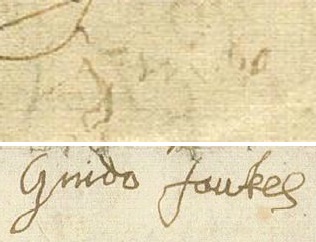
It’s often the torture – sorry, questioning – part that’s the most memorable (for 12 year olds, at least.) All that stuff with the rack and deformed signatures on forced confessions just really seems to focus year 8’s. Illegal methodology aside, Guy Fawkes was found guilty of treason and sentenced to be hanged, drawn and quartered on 31st January 1606.

Guy Fawkes’ confession signature. The top was written straight after his torture and the second 8 days afterwards. Credit here.

The end.

Well… no. For a start, it wasn’t Guy Fawkes who came up with the plot to blow up the king and houses of parliament. That was the brainchild of Robert Catesby – an influential and wealthy man from a Catholic family who had watched his father and brother in law imprisoned for their faith.

Enraged by years of persecution (and perhaps harbouring a desire for more power), Catesby scouted out a band of like minded rebels and managed to rent out the cellar directly under the houses of parliament. Convenient, right? They spent the next few months gradually filling the space with 36 barrels of premium grade gunpowder and then waited patiently for the right time.

Of course, this situation raises questions about the competency of James’ security; for a notoriously paranoid king, it seems crazy to think that his guards didn’t perform regular checks on the contents of the cellars underneath the most important building in England.

Anyway, poor Guy Fawkes was given the job of lighting the fuse and then legging it like crazy to Europe, safe in the knowledge of a job well done. Meanwhile another plotter, Sir Everard Digby, was due to abduct the king’s daughter at the time of the explosion and install her as puppet queen who the Catholics could control. Unfortunately for Guy Fawkes et al, the plot was uncovered at the last minute and the plotters were exposed, eventually captured and executed.

But is that the truth?

As I said, it seems crazy to assume the government didn’t know about 36 barrels of gunpowder quietly festering just feet below the nobs and nobesses of the land (but not really the nobesses, thanks to a no ladies rule). And in fact, it’s just that: crazy. Sure, James I might not have known about it himself but there are strong arguments to suggest his first minister Robert Cecil did and was keeping a close eye. In fact, an anonymous letter warning one MP to stay away from parliament on the fated night ended up in the hands of Cecil as early as 26th October, yet he chose not to act straight away. Perhaps he was waiting for the plot to continue until he could gather enough evidence to be certain of executions or, for the cynical observer, to catch the plotters at the eleventh hour to make himself and the government appear even more heroic to the public.

And so we gather by every year to remember Guy Fawke’s ill-fated foray into arson by watching a human shaped sack of hay burn on a giant bonfire while children sit on their parents’ shoulders, whining for hot dogs and toffee apples.

Nice segue.

It was, wasn’t it?

The term ‘toffee’ traditionally just referred to boiled sugar rather than the creamy, individually wrapped sweets grandmas keep in their pockets. Toffee apples’ simplicity and cheapness makes them a decent money spinner for food vendors on bonfire night, but also a family friendly treat; children can replenish the ebbing sugar rush of Halloween, and parents can soothe their own guilt with the knowledge that somewhere underneath the sugar and syrup is a lump of fruit. The trouble with this bargain, of course, is that most kids throw their toffee apples away once the hard sugary layer has been nibbled off to reveal a disconcertingly mushy apple on a stick.

The idea of preserving fruit in syrup or sugar is as old as time; the ancient Egyptians used honey to preserve all manner of things from food to, er, dead bodies. Toffee apples, while not quite as old as ancient Egypt, made use of that great tradition in a cheap and useful way by ensuring that the final few apple harvests of late October wouldn’t go to waste.

The Oxford Companion to Food suggests the phrase ‘toffee apple’ first crops up in a food context when the BEF Times mentioned them in its 1917 Christmas edition. However, as author Alan Davidson points out, the invention of the 2 inch medium mortar, nicknamed ‘the toffee apple’ in 1915 suggests the sweet treat was already well established in Britain.

What about the recipes?

Popular theory suggests that candy apples (please note the careful wording there!) were the invention of American sweet manufacturer William Kolb who – like Isaac Newton himself – was struck by inspiration when an apple accidentally dropped into a vat of boiling sugar syrup. Okay, maybe not exactly like Isaac Newton. Regardless, Kolb immediately saw the potential to make cash and rot teeth and lo, the toffee apple was born.

Kolb’s invention may have come in 1908, but the first printed recipe for anything resembling a toffee apple wasn’t published until around 1919 (if you have an earlier one please let me know!) It appeared in American book Rigby’s Reliable Candy Teacher under the less crowd pleasing name ‘Apples on a stick’.

Take small apples and stick in each one at the top, a small wooden skewer, such as butchers use to pin roasts. Now cook a batch of Molasses Taffy to 280 degress F. Then dip the apple in the hot batch so as to cover it completely. Let the surplus syrup drip off, then stand them on a slab until cold.

Rigby’s Reliable Candy Teacher, W.O. Rigby, 1919.

A 1908 recipe for molasses taffy read thusly:

…for molasses taffy boil to the soft ball 1 quart of New Orleans molasses, 1 tablespoonful of granulated sugar. Now stir in 2 tablespoonfuls of vinegar, ¼ pound of butter, and boil until it becomes hard and brittle in cold water.  Just before removing from the fire stir in ¼ teaspoonful of soda dissolved in hot water and pull.

Household discoveries: an encyclopaedia of practical recipes and processes, Sidney Morse, 1908.

My attempt(s)…

First I began by making my molasses taffy – an American term for a chewy toffee. I scaled down the sizes and boiled molasses with sugar until it hit 116 degrees Celsius: soft ball stage. Once that had been achieved I threw in some vinegar and butter and boiled it to 146 degrees Celsius: hard crack stage. Then, I dipped a green apple into the mixture and coated it well.

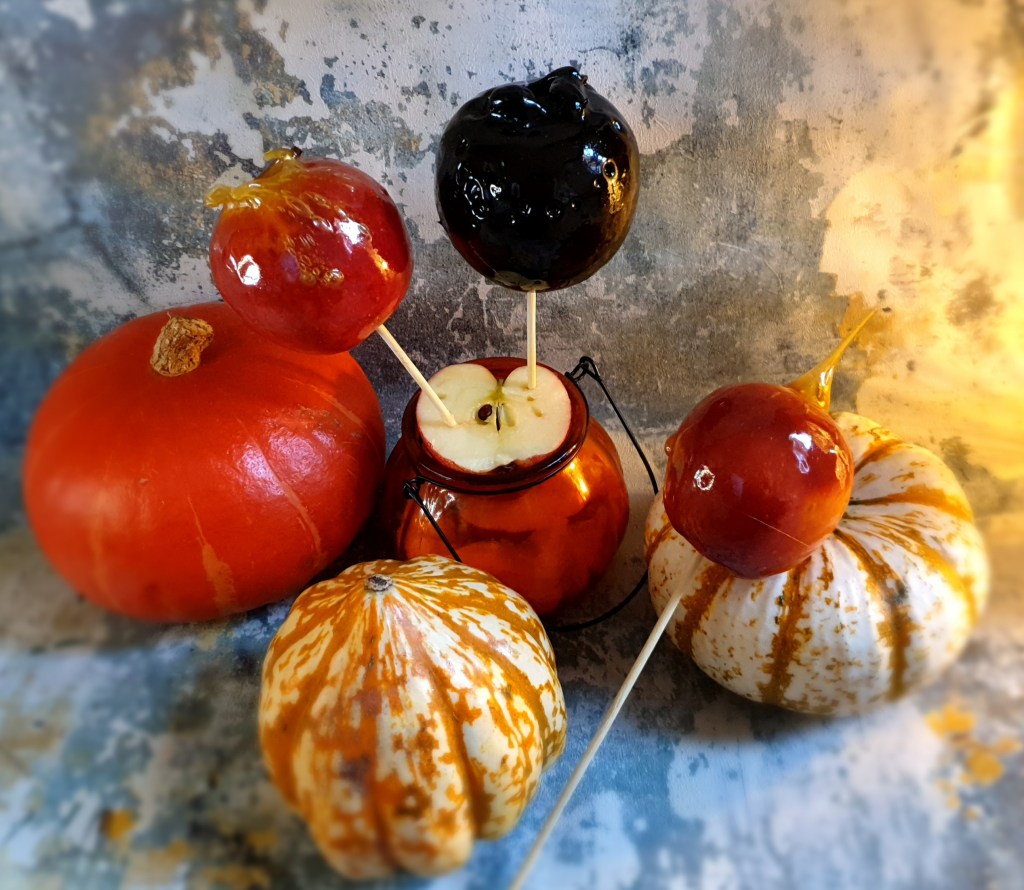
The apples looked impressively sleek and dark. True, they did also look a little like the poisoned apple in Snow White – kind of black and oozing – but even so, still quite magnificent.

You can keep any comparisons between me and the witch to yourself.

Unfortunately though they didn’t taste or feel anything like what I thought of when I thought of toffee apples. I had wanted a satisfying crack to the shell but these were still slightly chewy (though I think that was down to my dodgy thermometer reading.) I’d also hoped for a sweet tangy flavour, whereas these were decidedly more bitter in a treacly kind of way.

So I tried again, this time with a recipe from 1924 for ‘Lollipop Apples‘.

Select very small red apples, wash and dry them, put a stick or skewer in each, and dip them in the glace.
[To make glace] 1 pound sugar, 1/8 pound cream of tartar, 2/3 cupful water. Place all the ingredients in a small saucepan, stir only until the sugar has dissolved, then cook to 320 degrees.

Mrs. Allen on Cooking, Menus, Service, Ida C. Baley Allen, 1924.

This was more like it. I selected the reddest apples I could find and once my sugar had reached the hard crack stage, dipped the fruit in carefully.

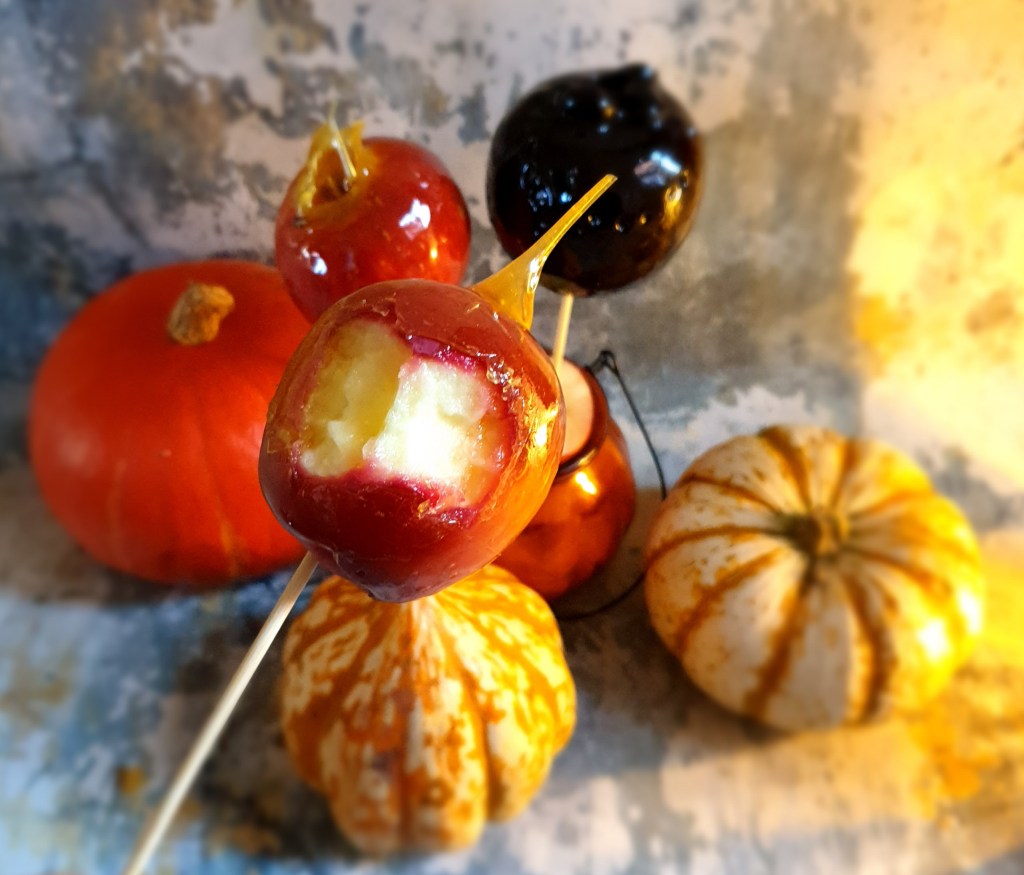
They certainly looked the part as I hung them from a tray to harden: red, glossy, and with a very satisfying tap when I knocked my knuckle against one. They tasted much better too, exactly as I remembered them from my childhood: first a sugary, caramelised sweetness as I bit into the shell and then a slightly sour type of sweetness from the apple. Unlike my childhood self, though, I found I actually wanted to finish my apple even after the sugar had been eaten. Hooray for personal growth!

I know that this year’s bonfire night is different to the bonfire night we might have hoped for but for those of us staying in tonight, I recommend giving these a go; they were truly delicious and comfortingly nostalgic. And hey, maybe if enough of us make them then next year when I ask year 8 what they know about bonfire night they’ll surprise me with a comprehensive historiography of toffee apples instead of the usual!

E x

Lollipop Apples

450g granulated sugar
56g cream of tartar
155 ml water
4-6 apples

  1. Place the sugar, cream of tartar and water in a pan and heat until it is boiling. Swill, don’t stir the pan.
  2. While the sugar is melting, skewer the apples from top to bottom with wooden skewers. Make sure the skewer goes through the full length of the apple.
  3. When the temperature reaches 146 degrees C, turn the heat off.
  4. Quickly dip the apples, one at a time, into the sugar until they are evenly coated all over.
  5. Place the apples on greaseproof paper and allow to harden for several minutes.

Ancient Egyptian(ish) Beer: c. 1500 B.C.

It’s one of the oldest drinks in the world. People have brewed it for millennia for a variety of reasons ranging from religious and solemn (as in sacred offerings or rituals), to the less noble but much more fun (as in going to the pub with friends – remember that?!)

Beer, or more accurately craft beer, is something that certain types of people take very seriously. You know the type, don’t pretend. Friends of mine who know about this stuff talk passionately about ‘hoppiness’ and ‘fermenting yeast’ while I nod along, desperately and hopelessly lost, wondering when’s the best time to mention that I can’t stand any of it – be it ale or lager, craft or commercial.

I’m sorry, it just tastes like soapy water to me. Perhaps I’ve never tried a good one, I hear you cry. My husband is quite into his hipster craft stuff, though, and even these brews – with their funky label designs and heritage signposting – still taste disgusting to me.

The thing is, though, I’ve been writing this blog for almost a year now. Stews and soups and pies and cakes are all well and good, but as time’s gone on, especially as I’ve looked at more ancient stuff, I can’t help but feel I’ve neglected a huge part of food history by ignoring beer. It was such an essential part of everyday life for our ancestors that I felt obligated to give it a go. And so I embarked on what was possibly the most half hearted, begrudging beer brewing process the world has ever seen.

A note on guesswork and adaptation

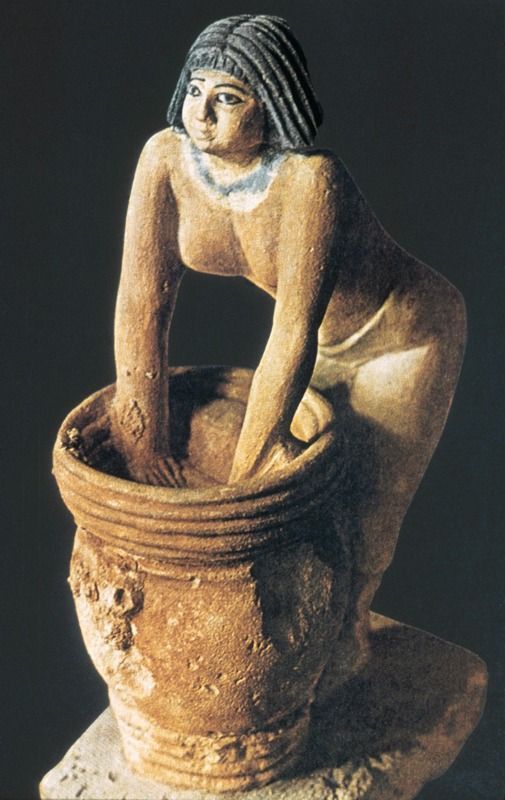
She looks like she loves her job. Credit here.

I’m dealing with ancient Egyptian beer here, for which there are no surviving recipes. Or if there are, they’re in hieroglyphs which is all, er, Greek to me. Equally, as I found beer brewing to be a totally alien concept, I chose to copy the process that Tasha Marks, Michaela Charles and Susan Boyle (no, not that one) set out when they recreated a version of ancient beer for the British Museum, rather than interpret it for myself.

These women talk a lot more about the science and history behind beer making (and their results are better too), so please do go and check out their post. I mean it; they have a video and everything. Andrew Coletti at Pass the Flamingo has also looked at ancient beer in brilliant depth with some great results, and I used his excellent blog post to guide me on the more practical aspects of this experiment.

The ancient Egyptians loved beer. Couldn’t get enough of the stuff. They had loads of names for it depending on how it was used, or who it was for, or who had made it. In fact, such was the Egyptian preoccupation with beer that they’re often praised as being among the first – if not the first – civilisation to really nail the brewing process. They can’t quite claim to be the inventors of beer, though – that accolade goes to the Sumerians.

Sumerian beer appears to have been a concoction so thick that it had to be drunk through a straw (another Sumerian invention), and was perhaps diplomatically described as an acquired taste “to certain palates” by the Greek writer Xenophon. The Egyptians refined the Sumerian method over time – still favouring the straw, but gradually moving away from a porridge like drink to a smoother, runnier liquid. That’s not to say it was thin or weak, though.

Beer: humanity’s salvation?

In fact, Egyptians relied on beer not being weak. According to one Egyptian myth, the sun god Ra became angry with the people of Egypt when they stopped following his laws. He calmly and logically weighed up his options and decided that in order to lovingly guide his people back to the ways of justice and order, a good old fashioned genocidal purging was needed. He sent his daughter Sekhmet to earth in the form of a lion. There, she ravaged the land and the people until Egypt ran crimson with blood.

At this point, Ra had a slightly-too-late change of heart, and took pity on the blood soaked earth. Perhaps he realised that he was in danger of ceasing to exist if all his followers were eaten? (Ooh, philosophy!) He called Sekhmet off, but she was so full of vengeance and bloodlust that she ignored his orders. Rather than send down another lion to devour the first lion he’d sent to devour the people (like some sort of divine, fly swallowing old lady), he decided to change tact. He poured a thousand jugs of pomegranate stained beer into the Nile, which turned the water red. Sekhmet, believing it to be blood, drank it all and became immediately so shitfaced that she passed out for several days straight. When she woke up, the hangover was presumably so intense that her desire for maiming and destroying had waned, and humanity was saved.

A thousand jugs, eh?

I was not about to make a thousand jugs of humanity-saving beer. Having heard horror stories of home brews gone wrong I was pretty sure that if anything my beer would end up threatening humanity’s existence. More specifically, one human’s existence. Mine.

The starting point for Marks, Charles and Boyle’s creation came from engravings on a clay tablet dating to c. 1800 B.C. This tablet was a hymn to Ninkasi – the Sumerian goddess of beer – who apparently brewed a fresh batch every day as part of her holy rituals. The tablet helpfully details the brewing process, and it was this process which acted as guidelines for the experiments. It’s worth noting here that though the inspiration is Sumerian, the technique (and most of the ingredients) are Egyptian, hence the title ‘ancient Egyptian beer’.

The hymn makes reference to ‘beer bread’ as a starting point in the brewing process. This was a common technique in Mesopotamia whereby leavened loaves were partially baked and then crumbled over pots. Water was poured over the crumbs and the whole mixture was left to ferment for a couple of days before being drunk as beer.

The Egyptians of the Old Kingdom followed this method too but by time of the New Kingdom a new method had emerged. Instead of making little loaves to start with, they made two mashes – a hot one and a cold one. Analysis on pots of ancient beer have shown that the cold mash was made with malted grains and the hot one with either malted or unmalted – the results were unclear. This is a good time to also point out that there were no hops used in the beer brewing process as hops weren’t used until around the 9th century.

The mashes were mixed together, strained, and left to ferment out in the open for a day or two. That was it – end of process. Despite the fact I tend to zone out after two minutes when anyone talks to me about beer, I’d managed to learn enough to know that the Egyptian way seemed suspiciously simple. Where was the carefully controlled heating? The sterilising and meticulous monitoring to prevent unwanted cross-contamination in the yeast? And, bloody hell, had anyone even thought about designing a quirky and original label for the bottle yet?!

The process begins…

First things first I had to get hold of some malted grains. My choice of grain was the only area I deviated from the British Museum’s version. I had a bag of einkorn grains in the cupboard (no, really, I did. My husband uses it as evidence every time he tries to show me that this blog has got out of control.) Einkorn was grown in Mesopotamia from as far back as 10,000 years ago and though there is some disagreement online about whether it was commonly used in Egypt, I decided to work with it because a) it was a fitting tribute to the origins of this experiment and b) when else was I going to use a bag of einkorn grain otherwise?

To start the malting process I placed the grains in a jug of water and left them to soak overnight. The next day I drained the water and spread the grains out in a tray. I sprinkled on a little more water so they were wet but not submerged, covered them with a cloth so that air could get to them but insects couldn’t, and left them on the windowsill for three days. After this time they had grown little tendrils, a bit like eyes on potatoes. After I baked them low and slow for a couple of hours they were ready to be ground.

A sample of sprouted vs. unsprouted grains.

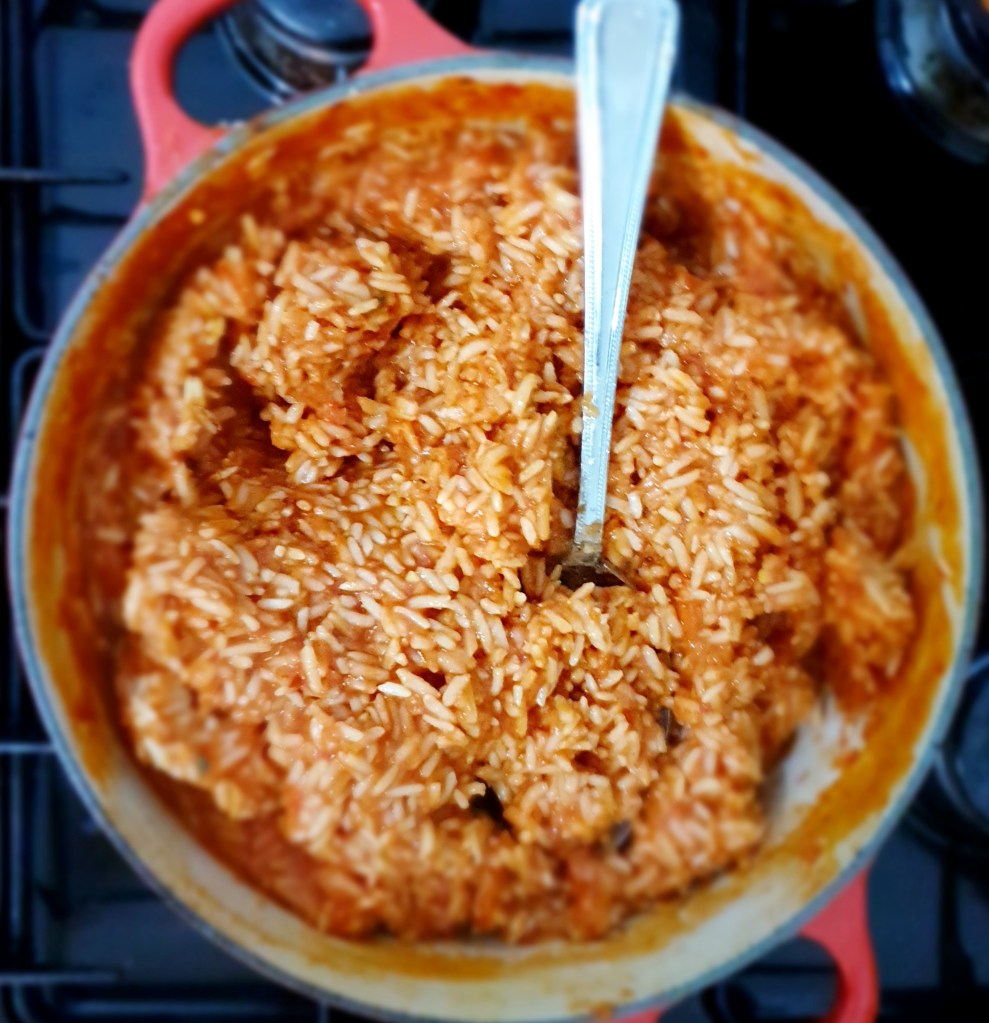
Despite my husband’s belief that my hobby has taken over our lives, I am yet to own a quernstone – it’s on my Christmas list. Because of this, I had to grind the grains little by little in a mortar and pestle. Let me tell you, for those of you who have never done this, it was Not Fun. It took well over half an hour to pulverise even just 100g of grain and at the end of it my FitBit told me I’d done 13 minutes of active cardio – a personal best if ever I saw one.

Ground and unground malted einkorn. I have a new found respect for bakers and brewers of pre-blender times.

For the unmalted mash I decided to do something different and used barley; a common and popular grain of ancient Egypt. I ground another 100g of this, sweating and swearing like I imagine all Egyptian brewers must have done (or perhaps not if they had the right tools – hint hint, J.)

The malted einkorn was then added to room temperature water while the barley was added to water that had recently boiled but was warm rather than hot. The barley was then heated further until it thickened to a porridge like consistency and smelled, well, porridgy and delicious. I mixed both mashes together in a large pan and left the lot to cool completely.

Homebase: the place for all your DIY, garden and ancient cookery needs

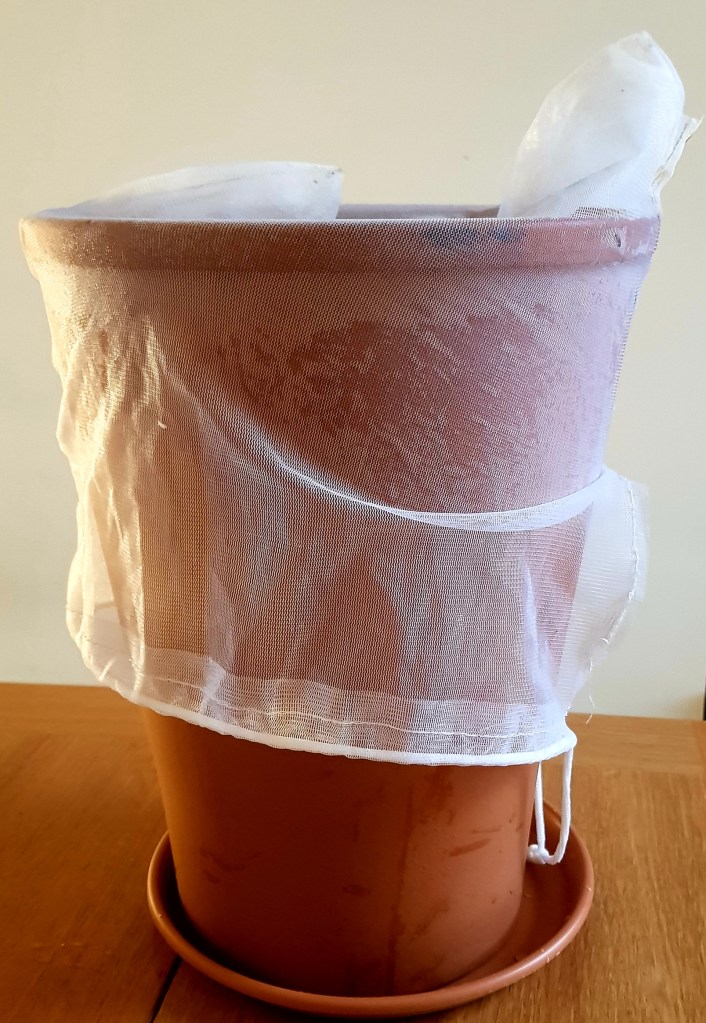
The Egyptians brewed their beer in ceramic vessels that looked like tall flowerpots. I didn’t need much more of an excuse, so popped off to Homebase to purchase a terracotta pot. The trouble was that all the pots had holes in the bottom of them to allow water to drain out of. As I explained to the bemused shop assistant, this simply wouldn’t do. Were there any plugs I could buy to stop the hole up? He offered me some sort of plastic tray and backed away slowly, but it didn’t really do the trick.

I was then struck with inspiration, perhaps sent from Ninkasi herself. I could stop up the hole by using a barley flour dough, mixed to the consistency of putty. It wouldn’t be adding anything that wasn’t already in the mixture, and should fill the gap nicely. For the first time ever, an improvised idea of mine worked! The hole suitably plugged and tested with water, I lay a circle of baking paper over the base as an extra precaution, and poured my two now-cool mashes through a sieve into the pot.

Following the method of Marks, Charles and Boyle, I added a date to speed up fermentation, and an aromatic spice mix of crushed roasted pistachios, rose petals, cumin, coriander and sesame seeds. I covered the pot with a thin cheesecloth and left it to fester – sorry, ferment – for a couple of days.

Waste not want not

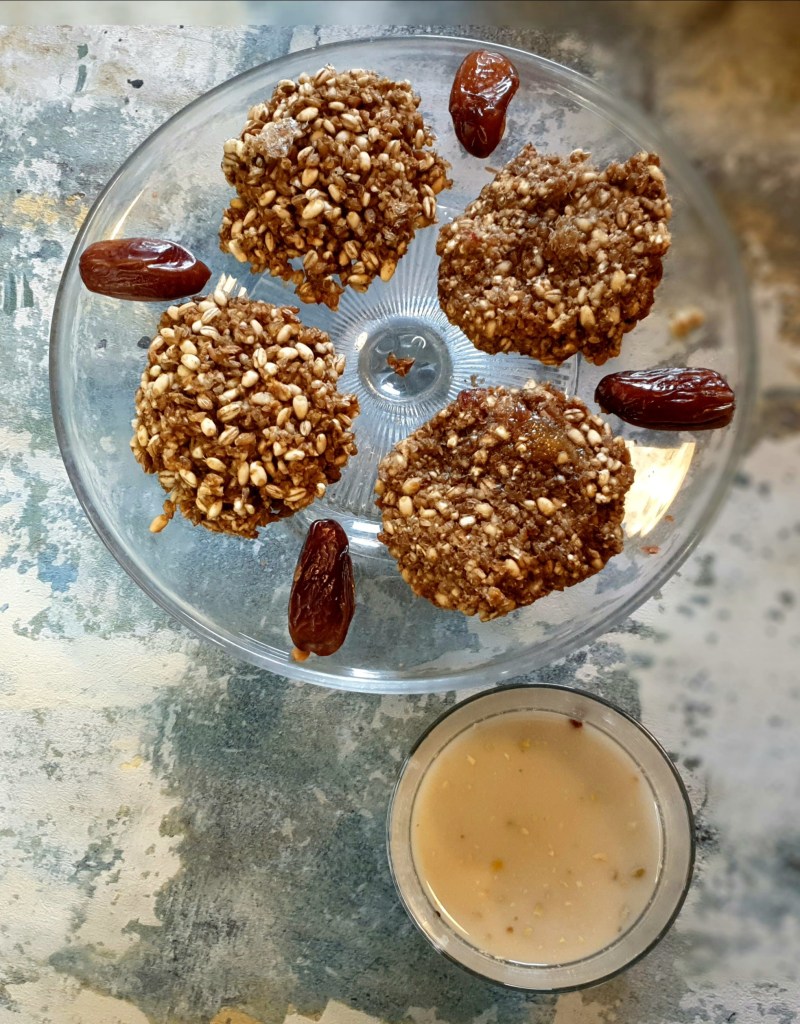
In the meantime I pondered what to do with my leftover grains sitting in the sieve and thought back to the beer bread. Despite having no proof I felt sure the ancient Egyptians – or any ancient civilisation used to facing droughts, famines or just slightly poor harvests – would have thought twice about throwing food away if it could be transformed into anything even vaguely edible.

I blitzed some dates to a pulp (in a blender, thanks. I wasn’t about to do anything by hand again), and combined the paste with the leftover grain dough. To this I sprinkled in a spoon of the spice mix and patted the mixture into four round discs, which were baked in a low oven for about an hour. They tasted decent enough – a bit molasses-y and nutty, with a powerful spicy punch from the coriander and cumin. I think they’d work well with a sharp cheese, although I ate one on its own without any fuss.

After two days I couldn’t put the terracotta pot sitting on my kitchen counter out of my thoughts any longer. The Egyptians drank their beer straight out of the pots with long straws but I hadn’t made enough to come up to a level that a straw could reach, so I ended up having to pour it into a glass and then wait for it to settle a bit. I somehow ended up with more sediment than drinkable liquid, but there was definitely something there.

The verdict

It smelled unpleasant. Kind of sour, kind of cheesy; not like something I’d normally want anywhere near my mouth. However, I was confident that I’d followed all the instructions and there was no visible mould at least, so I took a gulp.

This would cost you £5 in Shoreditch.

My first mouthful contained too much sediment – a gritty texture with a slight bread-dipped-in-vinegar flavour. I felt my salivary glands go into overtime to combat the sourness of it. Bugger, I thought, it’s gone bad. All that effort for no reward. I’d already eaten a chocolate bar to combat my 13 minutes of active cardio, so I really did have nothing to show for all my work at this point.

Once the sediment had died down a bit more I took a sip of the clearer liquid on top. This was a lot more palatable. It was lighter and thinner than the thick lumpy mixture at the bottom, for a start. It tasted sour, yes, but in a sharp way – a bit like a cheap white wine. The spices weren’t a prominent flavour, but I did pick up a hint of cumin. Whether that was my imagination playing tricks on me or the effects of overzealous seasoning is anyone’s guess, but it wasn’t unpleasant either way. Helen Strudwick explains “the quality of beer depended on both the skill of the brewer and the sugar content…” and while I wouldn’t say my skill was amazing, I didn’t use any added sugar (other than one measly date) and it turned out alright.

I have no idea what the alcohol content was, but research suggests the average Egyptian beer had a 3% – 4% alcohol content. Beer for workers was probably around 2% – the last thing a pharaoh wanted was wonky noses on all his sphinxes because his workers were too pissed to see straight. The content and quality was higher depending on who the beer was for (pharaohs got highest) and how the beer would be used (religious ceremonies got high quality beer, workers taking payment in beer got lower quality.)

As you can see, my enthusiasm for grinding barley was somewhat lacking.

At the end of all this my opinions on beer haven’t really changed. I’d still pick a sugary sweet cocktail over a pint, and I haven’t developed a passion for home brewing (much to my husband’s relief.) Yet it wasn’t as bad as I’d expected. It smelled awful, true, but it was light and drinkable and definitely alcoholic – which is about the limits of my appreciation for beer anyway. All in all, not bad.

E x

Ancient Egyptian(ish) Beer

200g sprouted grain (wheat, barley, einkorn, emmer – any will do)
200g unsprouted grain
1l water
1 date
Handful of pistachios
1/2 teaspoon coriander seeds
1/2 teaspoon cumin seeds
1/2 teaspoon sesame seeds
1 teaspoon rose petals

  1. Grind your sprouted grain to a coarse flour. Add about 500ml of room temperature water to the grain and stir well.
  2. Grind your unsprouted grain. Add 500ml of recently boiled water to the grain and stir. The water should be warm to touch, but not boiling.
  3. Heat the unsprouted grain and hot water mixture until it thickens to a porridge like consistency.
  4. Pour both mashes into a large pot and allow to cool completely.
  5. When the mashes have cooled together, place a sieve over a ceramic pot. Pour the mashes into the sieve and allow the liquid to drip into the ceramic pot.
  6. Toast and crush the spices and place them in a muslin bag or cloth. Place the spice bag in the pot with the liquid. Add the date to the pot.
  7. Cover the pot with a cheesecloth or similar and leave it at room temperature for no more than a couple of days.

Soutil Brouet d’Angleterre: c. 1300

Yesterday was the 954th anniversary of the Battle of Hastings, which was fought on 14th October 1066. But of course you knew that already, didn’t you? I bet you spent the whole day wishing everyone a Merry Battle of Hastings and couldn’t wait to see what William had left under the tree. Personally I think Battle of Hastings Day gets more and more commercialised every year, but my daughter loves it so we carry on with the tradition.

Fun fact: as well as being a hell of a year, 1066 is also the code to every school gate everywhere in the world. Okay, maybe not every school gate, but most of them. Two of them, at least. My sister used to play county badminton and would spend every weekend competing in school sports halls around the country. Usually these halls were opened before the athletes arrived but one day my dad and sister pulled up to find a gaggle of kids and parents standing forlornly outside the hall, locked out. The lights were on and inside there were the sounds of people warming up (competitors who had locked their competition out in an effort to forfeit the match?) but no one could get the door open.

My dad, a teacher himself and never one to let common sense or law stop him, marched through the crowd and stood in front of the locked door. He paused and then punched in the code 1-0-6-6. The lock clicked open and a surge of tracksuited kids rushed past him, followed by their parents – all of them ignoring the legality of what had just happened in favour of a styrofoam cup of instant coffee.

I know how this sounds, but it’s completely true. It was like a scene from an action movie, only the hero was a frazzled middle-aged man who just wanted to get in and sit down, and the adoring crowds watching him were mostly kids who needed a wee. Still, I think he probably had some sort of epic soundtrack playing in his head when the door swung open.

Once mum had forced him to explain himself and call the caretaker to suggest they update their security, he told us it was because his school used the same code and he thought it “might be worth a try.”*

Back to the battle?

You all know the story, let’s not pretend here – Bayeux Tapestry, arrow in the eye (or was it?) yada yada.

In an effort to keep this post to a reasonable length, you can find out here why most of the stuff you think you know about the Battle of Hastings is wrong. In short – Harold might not have been killed with an arrow and the Bayeux Tapestry uses a huge amount of artistic license with many of the events of the battle.

Not a real part of the tapestry but still a good excuse to post my favourite meme ever.

Once Harold had been suitably dispatched (be it by arrow, sword or death squad), William sat on the battlefield and had his first meal as Conqueror. Accounts tell us it was roasted meat, possibly mutton or beef, which he ate among the bodies of the dead and dying, having left the English soldiers to rot on the battlefield. Not quite what you’d call fine dining.

William was crowned King of England on Christmas Day 1066. Apparently the crowd cheered so loudly during his coronation that the Norman guards outside Westminster Abbey thought a fight had broken out, and set fire to Anglo Saxon houses in retaliation. It set an appropriate tone for William’s early years as king, and he wasted no time in enforcing his will over his new kingdom.

As the current Norman England GCSE spec will tell you, Norman lords replaced most of the Anglo Saxon nobility, the language of the rich became French, and motte and bailey castles were erected in most major towns as a both an enduring symbol of Norman power and a method of ensuring the English population behaved themselves. But though these changes had huge and long term effects on the country as a whole, day to day life for the average peasant didn’t change that much. There was still ploughing to be done and animals to be fed, it was just that now their local lords were all called Jean or Henri and there was a faint whiff of smoke in the air as William’s (or should that be Guillaume’s) soldiers burned rebellious towns to the ground in an effort to maintain Norman control.

Food in Norman England

It might be easy to think that, almost 1000 years later, we English are finally free of Norman influences. Sure, we might still visit the odd castle when we need to check our eyesight, but the everyday effects of William’s conquest have long gone, right?

Well, not quite. Not when it comes to food at least.

One popular theory for why we have words such as ‘pork’ today is that the French equivalent ‘porc’ was brought over to England after 1066 and used at the dining tables of the rich (who were usually French themselves, or otherwise Anglo Saxons trying to curry favour with their continental counterparts.) As time went on these Norman words filtered down the social classes to become part of everyday language, even in people who could not usually afford to eat meat regularly. There’s been a lot written about this theory online but I couldn’t find definitive ‘proof’ of it, so if anyone knows anything more about this etymological aspect of history please let me know!

What I did find evidence of was that consumption of pork increased in England in the years following 1066. A recent study concluded that though the Anglo Saxon diet of vegetables, cereals and meat such as beef and mutton remained largely intact, and that cooking methods among the poor remained virtually unchanged, certain foods such as pork and chicken rose in prominence.

It was this discovery that spurred me on to find a medieval French pork recipe in honour of 1066, the Battle of Hastings and our Norman overlords – and it was typing that last sentence that made me realise what a suck up I am; if I’d been around in 1066 I reckon I’d have been waiting at Pevensey Bay for William to arrive, holding a banner saying “WELCOME TO ENGLAND, PLEASE HELP YOURSELF!”

Subtle English Brouet

Soutil brouet d’Angleterre. Prené chastaingnez cuitez et pelés, et moiaux de eufs cuis et ung pou de foie de porc; broier tout ensemble, destrampés d’un pou de eaue tiede, coulez; affinez gingembre, canelle, garingal, poivre long, graine, de saffren; fetez boullir ensemble.

Subtle English brouet. Grind together chestnuts that have been cooked and peeled, egg yolks cooked in wine, and a little pork liver, moisten this with a little warm water and strain it. Grind ginger, cinnamon, cloves, long pepper, grains of paradise, galingale, spikenard, and saffron for colour, and boil everything together.

The Viander of Taillevent, An Edition of All Extant Manuscripts. Edited by Terence Scully.

The recipe comes from the early 14th century French work Le Viandier de Taillevent, which exists in four surviving manuscripts. It is generally attributed to Guillaume Tirel, master cook to Charles V of France, but the earliest version of the manuscript dates to around 10 years before Tirel’s birth, calling into question the true authorship.

There are a few pork recipes in Le Viandier and I pondered over which one to pick. Should I go for something simple, like roasted pork in a verjuice sauce or something a bit more ‘out there’, like boiled pork tripe? I know – it was a tough one.

A quick scan of the pork tripe recipe ensured my curiosity was cut short when I read that, once cooked, it would “smell of dung”. But another recipe underneath caught my eye: subtle English brouet.

From a 15th century version of Le Viandier. Credit here.

The recipe

It seemed fitting for the context: a French recipe with a possible English connection (incidentally, if anyone knows what the connection actually is, I’d be grateful if you could let me know!)

In this case the word ‘subtle’ didn’t relate to any complexity of the dish, but instead was intended to highlight how easy the dish was to digest. During this time the theory of the 4 humours was prevalent, (the belief that the body contained four liquids which, when imbalanced, caused illness), and foods were described as subtle to tell the reader they were not likely to cause a humoural imbalance. Could it have been that this dish was intended for invalids or those considered particularly vulnerable to illness? A medieval French dish to stave off sickness made on the 954th anniversary of the Battle of Hastings during a global pandemic – surely there had never been a more timely meal?!

Terence Scully went on to explain that the composition of the dish, with its finely ground and blended ingredients, would ensure a fairly homogeneous result. This might also account for the term ‘subtle’ – to distinguish it from other brouets which had chunks of meat or bread in them.

So what was a brouet? There are several brouet recipes in Le Viandier alone. The Middle English Compendium describes brouet as a meat or fish broth, sauce or stew. The addition of saffron in this particular recipe suggested I was looking to end up with a fairly smooth yellow soup.

The method

I began by poaching two egg yolks in white wine. While they were cooking, I blitzed some pork liver with some cooked and peeled chestnuts. When the eggs had cooked almost all the way through, I added them to the mixture.

I have to say that it did not look pleasant or fill me with hope. A combination of liver, eggs and nuts may have been considered subtle 700 years ago, but it seemed pretty bloody outrageous to my modern sensibilities. Nevertheless I persevered.

The whole mixture was tipped into a pan and I added a bit of water to loosen everything up – after all, this was meant to be some sort of broth. To this I added ground ginger, cinnamon, cloves, long pepper, ground grains of paradise, galangal paste, and saffron. The only thing I couldn’t get hold of in the original recipe was spikenard (no, I had no idea either), which seemed to be sold only as an “essential oil” on dubious websites, and since I didn’t fancy poisoning myself I decided to skip it. I left the lot to boil and hoped it would mellow out.

Left to right: grains of paradise, galangal paste, long pepper, saffron, cinnamon, ginger, cloves.

It seemed very stodgy in the pan, no matter how much water I added. I read through the recipe again and saw I was supposed to strain the liver mixture to ensure a very smooth, thin soup. So, once it was cooked, I dutifully mashed the lot through a sieve, which led to a thin broth collecting in the bowl alongside an amount of very smooth meat paste. The paste and broth were mixed together and I called my unsuspecting husband to lunch.

The verdict

Mmm…pungent offal broth.

Let’s face it: this dish wasn’t exactly a looker. In its favour, though, was the fact it did both smell and look like a broth for invalids – in that it was the sort of thing no well person would ever want to try.

“It’s very…medieval”, my husband said, pinching his nose.

I tried it. Despite its somewhat lacklustre appearance it wasn’t anywhere near as bad as I’d been expecting. I’m not an offal fan at all, but I found the taste of this quite bearable. The meat flavour was less intense and much sweeter than I’d expected, possibly because it was being masked by the chestnuts. It was still obviously offal, but in a relatively inoffensive way. The consistency was thin and smooth, but grainy – a bit like homemade pea and ham soup.

The second taste I noticed were the spices as a mixture of warming pepper and ginger gave way to saffron and cloves. Having such warming spices in the dish would have been a deliberate choice by the cook; in the 4 humour theory, pork was considered a cold and wet food, and spices such as ginger and pepper were hot and dry. Therefore the two ingredients were needed to balance each other out and ensure no one type of humour became corrupted – and therefore cause illness – once the dish was eaten.

Weirdly I think I liked this more than my husband did. That’s not to say I was slurping ladlefuls of the stuff, just that I could see how it would have been a warming and even comforting dish for the 14th century. My empathy only got me so far, though – after a few spoons I was done, and I don’t think I’d make it again in a hurry. Pungent offal broth, no matter how surprisingly sweet and spicy, just isn’t on my list of favoured foods.

And so another Battle of Hastings Day drew to a close. The decorations were returned to the attic for another year, the costumes were hung up at the back of the wardrobe. My daughter played with her new bow and arrow set, aiming for our eyes as we swung at her with swords and later we all settled down to look at pictures of the Bayeux Tapestry together. Classic.

E x

*This was a few years ago so the codes should have been updated now. Hopefully. It’ll be on someone’s To Do list at least.

Soutil Brouet d’Angleterre

2 egg yolks
150g cooked and peeled chestnuts
200g pork liver
White wine for poaching
Ground ginger
Ground cinnamon
Ground cloves
Ground long pepper
Ground grains of paradise
Ground galangal
Few strands of saffron

  1. Poach the egg yolks in the white wine.
  2. While the eggs are cooking, blend the liver and chestnuts together to form a paste.
  3. Once the egg yolks have almost cooked through, add them to the liver and chestnuts.
  4. Add some warm water to the mixture and blend together to form a smooth paste.
  5. Add the mixture to a pan and add the spices. Cook for 5-8 minutes or so, until the mixture is bubbling and hot throughout. Add more water if you think it’s getting too thick.
  6. Push the mixture through a sieve to get a thin consistency and serve.

Jollof Rice

October is Black History Month. For today’s recipe I wanted to learn about (and try to make) a dish I’ve never eaten before: Jollof Rice, a hugely popular and quintessentially West African food. I didn’t specifically set out to make Jollof rice when I began researching the history of West African food, but it was impossible to escape it – everywhere I turned, recipes for Jollof rice popped up, each proclaiming to be better than the last. It was too tempting to resist…

Firstly, let me start with a bit of a disclaimer by saying that I am not an expert in any way about the vast and various cuisines of West Africa. All I have done for this post is a bit of research, chatted to a few friends and colleagues who know how to cook Jollof Rice, and given it my best shot. If you want to find more African recipes or know more about the history of Jollof Rice (also here) then please do click on those links to see what people far more knowledgeable than me have to say.

I’ve written a bit about the cuisine of non-European food such as ancient Egypt and Persia, but it feels easier to write about this food when it’s framed in terms of ancient civilisations and the dishes either aren’t made anymore, or have changed significantly from the original.

This is one reason I tend to write mostly about the history of European food; it feels more familiar to me. Similarly, when I wrote about the history of my Indian grandad’s food it felt familiar because I was writing about my family first and foremost. It’s a totally daunting different feeling to be writing about the history of a food that is still loved by millions today. Jollof Rice is so treasured and fiercely defended that there are ongoing bitter online rivalries about which nation makes the best version. Seriously, the scrutiny on any recipe that claims to be for Jollof is fierce and the condemnation, if such a recipe is found lacking, is harsh.

Hence the disclaimer. I can’t pretend to fully understand the nuance and symbolism of Jollof Rice, I didn’t grow up eating it and I don’t have any stakes in the #jollofwars. Instead what I can do this Black History Month is to read, research and listen to others. I hope you’ll spend some time this October (and, to be honest, all year round!) doing the same.

What’s in a name?

When I naively typed ‘Jollof Rice recipe’ into Google I was immediately hit with over 3 million results. This was genuinely a bit terrifying to me; I enjoy variety up to a point, but after a quick look it seemed that each recipe on the first page was different from the last. The second page of hits yielded similarly overwhelming results too. People also had Strong Opinions on these recipes and the only thing I came away knowing for certain was that if I wanted authentic Jollof I should avoid Jamie Oliver’s recipe and Tesco’s ready-meal version at all possible costs.

At its most basic, Jollof Rice is a dish of rice that is cooked slowly in stock and a mixture of blended tomato, onion and pepper. Over time the rice absorbs the liquid and takes on a deep red hue. Many variations of Jollof Rice contain other things, such as peas, carrots, meat or fish – and it’s in these additions that disputes between what is ‘the best’ Jollof often focus their attention.

Sadly, there isn’t an original written Jollof recipe we can point to as the first version of this dish and as far as I could see there are literally hundreds of ways to prepare it. However, the consensus among many West Africans seems to be that Jollof Rice originated from the Wolof people, possibly some time during the Jolof (or Wolof) Empire – a collection of West African states including modern day Senegal and the Gambia, dating from 1350-1549.

Empires of West Africa. Credit here.

In Senegal today the Wolof people are the largest ethnic group, accounting for almost 40% of the country’s population and Wolof is the lingua franca of the country. The history of the Wolof people probably dates to around the 12th century when people migrated west following the collapse of the Empire of Ghana in c.1100, which was situated in present day Mali and Mauritania. In Wolof, Jollof Rice is called ‘benachin’, which translates as ‘one pot’ because everything is cooked in the same pot.

Yet despite the connection between names, Jollof Rice is the national dish of Nigeria, not Senegal. The national dish of Senegal is another rice dish, thiebou dieun. This dish contains more ingredients than the Jollof Rices of other countries and the main similarity seems to be that it is red and also contains rice and tomatoes.

So what are the ingredients of Jollof rice?

Well, rice. Duh. Also stock, onions, tomatoes and peppers. After that it gets…contentious.

Rice had been cultivated in Africa for around 3000 years and was an important part of West African cuisine long before the Jolof Empire existed. Judith A Carney writes that in the mid 15th century, an early Portuguese visitor described the cultivation of wetland rice on floodplains possibly near the Gambia: “They arrived sixty leagues beyond Cape Verde, where they met with a river which was of good width, and into it they entered with their caravels … they found much of the land sown, and many fields sown with rice…”

Onions were also a native crop, grown in North Africa from as far back as 5000 years ago. The ancient Egyptians held a special place for onions, with some arguing that the onions represented symbols of eternity because of the rings-within-rings. When Rameses IV died in c. 1160, onions were placed in his eye sockets. Don’t ask me why.

Detail from the tomb of Rameses IV. The hieroglyphs are actually a shopping list and read: “bread, cheese, onions and cat food.” Credit here.

However tomatoes and peppers, other key ingredients in Jollof Rice, weren’t introduced to Africa until the early 15th century when the Portuguese set up trading posts along the river Gambia. Therefore we can say with some confidence that if Jollof Rice (in its modern day form at least) was a creation of the Jolof Empire it wasn’t part of the cuisine until sometime around 1440, which is when Portuguese traders appear to have arrived in the Jolof Empire.

Initially the Portuguese trading posts were intended to develop trade links between Africa and Europe, though in reality they were more like garrisons and were designed to force West Africans to trade only with Portugal, rather than other European traders. In exchange for manufactured goods such as firearms and new foods, the Portuguese took items such as gold and terracotta. However, these actions later contributed to the beginnings of one of the most brutal and horrific atrocities in history: the transatlantic slave trade.

The legacy of the transatlantic slave trade

The transatlantic slave trade refers to the enslavement and transport of millions of Africans from their homeland to the Americas during the 16th to 19th centuries by European traders – notably the Portuguese, Dutch, English and French. To this day it is one of the worst periods of human history, involving suffering on an unimaginable and harrowing scale.

Map showing the Middle Passage and transatlantic slave trade. Credit here.

The effects of the slave trade echo through history into today’s societies and in his work How Europe Underdeveloped Africa, the late historian Walter Rodney argued there was a fundamental economic imbalance between some European and African countries as a result of Europe benefiting economically from enslaved human labour while Africa was bled of its citizens.

As well as people, Africa lost parts of its own food identity from the 16th to the 19th centuries as European colonisers took over land and systematically set about destroying the existing culture. According to the food historian Igor Cusack, it is near impossible to overestimate the colonial impact on African national cuisines. The West African dish groundnut stew, for example, came about partly because French colonisers destroyed many of the indigenous crops in Senegal and used almost all of the agricultural land there for groundnuts, which were then exported for profit. Likewise the use of broken rice in the aforementioned thiebou dieun is due to colonial rule where large quantities of poor quality rice were imported from French Indochina to Africa, with the best quality rice to going straight to France.

One more reason it’s challenging trying to gather early evidence of Jollof rice is because there aren’t many sources available. That’s not to say they don’t exist, just that either my research skills aren’t good enough, or that making pre-16th century African sources readily available to the general population of the UK hasn’t been prioritised by archives and libraries. Or it could be a combination of both (probably this one, to be honest.)

Much of West Africa’s history is also oral and told through stories and customs that are passed down through generations in the form of songs or folklore. Griots – akin to ancient Greek bards or epic poets – are one important way the history of West Africa was passed down.

A griot performing. Credit here.

Despite the issues I had with gathering reliable evidence about the history of pre-16th century African food, I did find this OpenEdition journals collection and this British Library article hugely helpful when researching the history of language, writing and food across the African continent.

Back to Jollof

What is clear is that in spite of the distorting influence of the slave trade and colonialism on the history of African food, Jollof Rice is a quintessentially West African dish. Its reach into numerous countries – both in Africa and across the world – under various names and versions, and the joy and love it generates by those who share its culture, is testament to that.

In lieu of a ‘first ever’ Jollof recipe, I settled for something arguably better: a Jollof recipe that had remained largely unchanged for a couple of generations, shared with me from an exceptionally generous colleague. Out of respect for him I am not publishing his family recipe, though I have included links to similar recipes that are already available online at the end of this post.

Full disclosure to anyone following the #jollofwars, though: it is a Nigerian version. This was actually perfect for me as my dad spent quite a bit of his childhood growing up in Lagos, so I felt like if I was going to make any type of Jollof recipe I’d have wanted to try a Nigerian one, just to see if it was similar to the ones he remembered.

Let’s make Jollof (finally.)

Cooking Jollof.

I actually made this Jollof twice because the first time I added an entire un-deseeded scotch bonnet to the tomato/pepper/onion purée and then spent the next 12 hours in the fetal position when I tried a teaspoon of it. I had though I wasn’t too bad with spice, but oh my god.

The second time I made it I avoided all the seeds in the scotch bonnet and added only the tiniest scraping of the flesh to the tomato mixture. This mixture was then added to a stock, which I made by hand following my colleague’s instructions, and then I added the rice.

Nigerian Jollof Rice is rinsed of all its starch, so I had to wash the rice I used multiple times until the water ran totally clear. Following the recipe, I then added the rice to the pot of stock and tomato purée and left it to cook, stirring it frequently to stop it sticking to the pan.

After a while it was done. The liquid had mostly been absorbed by the rice, which had turned a deep red colour. As per my colleague’s instructions, I served the Jollof alongside the chicken which had been used for the stock and which I had baked after removing it from the liquid.

Heaven on a plate.

This. Was. Incredible.

Spicy (but not too much this time) but surprisingly sweet, and with a deep savoury flavour in the background because of the stock used to cook the rice in. I think maaaaybe my Jollof was slightly wetter than it should have been (looking at other versions online they seem less sticky), but even if it was it didn’t seem to affect how good it tasted.

Before I made it I had tried to think of food I’d eaten before that might be similar, and had wondered if paella might fit the bill. After one bite I could see that though these two dishes shared common ingredients, they were clearly distinct from each other. Given that both West Africa and Spain have historical links to Portugal, it’s not surprising that comparisons are sometimes drawn between the two dishes, but the truth is there are clear differences. Paella has a more fishy and saffron-y flavour, whereas Jollof is peppery, more herby and meatier.

Ultimately I’d urge anyone who, like me, has never tried Jollof Rice before to give this a go. Set aside a few hours to really appreciate the process and you won’t be disappointed. Hold back on the scotch bonnet if you don’t enjoy breathing fire, though.

E x

Links

Jollof Rice/Thiebou Dieun Recipes:
Nigerian Jollof
Nigerian Jollof
Ghanaian Jollof
Ghanaian Jollof
Senegalese Thiebou Dieun

Lumpy Tums: 1857

I love cereal. I wanted a cereal bar at my wedding rather than an actual meal, but reactions ranged from laughter followed by “oh, you’re not joking?” to “I will literally take my gift back if you do that.”

I’m not talking any old cereal, though. Offer me a bowl of muesli and I will end our friendship right there on the spot. Same goes for plain Shredded Wheat, Special K or Fruit and Fibre (actually, anything with ‘fruit’ in the title.) No, good cereal has to be so sweet it could melt my face and it has to come in small pieces (piss off, Weetabix). There are many lists online ranking the top cereal choices but I have yet to find one that is truly accurate and so I present a world wide exclusive: the first correct ranking of the top five UK cereals.

The top 5 UK cereals…

  1. Cocopops. It’s a surprise to no one; this cheeky little contender has been top of my list since I could eat. I have never met a person who doesn’t like Cocopops – and I don’t want to. Cocopops are so small you can eat a half a family sized box in one go without feeling too bad, they transform your milk into chocolate milkshake and if you drizzle a spoon of double cream over the top of them they clump together and you get a mouthful of delicious chocolatey, creamy goodness.
  2. Frosties. I’m happy with branded or unbranded to be honest. These are my go to when I crave a sugar hit. I eat them straight out of the bag, standing over the sink like a first year undergrad student and not like the 28 year old married mother I am.
  3. Crunchy Nut Clusters. Here’s the thing – no one knows what these are. No one knows what makes the clusters taste like that. On the packet it just says ‘wheat and rice flakes’, but I’ve been eating wheat and rice for a long time now and I’ve never known them to taste as good as whatever these are. They could be little balls of crack cocaine for all I know. They probably are little balls of crack cocaine given how addictive they are.
  4. Bran Flakes with sugar and sprinkles. A controversial choice but hear me out. People love rebelling, right? Me too. But I don’t love actually getting into trouble. The most rebellious thing I’ve ever done is press the bell on a bus and then not get off when it stopped (and that was an accident anyway.) So here’s what you do: take the most boring, grown up cereal available – nothing more than dehydrated cardboard, really – and you slather it in full fat milk. Now it’s marginally more edible. Then you get a bag of really cheap uber refined white sugar and a ladle and you go to town on it. Once the Bran Flakes have mostly been covered, dig out some cake decorations: hundreds and thousands, silver balls, jelly diamonds – whatever you like. Decorate and serve. This one WILL get you in trouble with your dentist but you only have to see them twice a year anyway.
  5. Frosted shreddies. Not as good as their bog standard Frosties cousins, because once the sugariness has melted into the milk you are essentially just left with a bowl of pap, but still good in a pinch.

Runners up include Cinnamon Grahams (I will not call them Curiously Cinnamon – not now, not ever), mini chocolate Weetabix and Cookie Crisp (when eaten dry – as soon as you add milk to them they’re ruined.)

The king of cereal. Credit here.

…The worst UK cereals.

For balance I have also included the top 5 worst cereals.

  1. Muesli. There isn’t one adult alive who disagrees, no matter how zen and clean eating they are.
  2. Bircher muesli. See above.
  3. Literally anything with dried fruit. Dried fruit is really sugar dense, so why do these cereals try and market themselves as a healthy option? If you’re getting your sugary kicks from freeze dried strawberries or teeny tiny raisins then please stop, have a look at yourself, and get hold of some Frosties instead.
  4. Sugar Puffs. You’d think I’d be all about these, right? Nope. They taste burned, they’re too chewy and the monster on the front looks like a perv.
  5. Golden Nuggets. Just thinking about how soft and melty they go round the edges makes me feel a bit sick. It’s like eating foam.

What’s the point of this?

Just doing my job as an educator.

Sadly for them, the people of 19th century Britain didn’t have access to Cocopops or Frosties. They were lucky if they could get hold of some muesli. Imagine! Lucky!

The first ready to eat breakfast cereal was an American creation called Granula, in 1863. In Britain, ready to eat cereal didn’t appear until 1902 when Force brought Wheat Flakes over to the country from America. But that didn’t mean that the idea of eating something wholesome in milk in the morning was non existent until this point; evidence of porridge like meals have been found in Britain dating from 2500 years ago.

The secret to his sunniness is gin instead of milk. Credit here.

This is where Lumpy Tums comes in, with possibly the cutest name ever. The first reference to it is in Thomas Wright’s Dictionary of Obsolete and Provincial English: Containing Words from the English Writers, where it is called Lumpy-Jumms. In 1881 it crops up again in the Exeter and Plymouth Gazette Daily, being described as “the porridge of our forefathers”. Both references imply it is an incredibly simple but wholesome dish.

Lumpy Tums, still eaten in some parts of the UK, are made of oatmeal which is sprinkled with water, squeezed into firm balls and then boiled before being served in pools of hot milk. They were originally from the Peak District, where oats grew particularly well, but filtered down to the Midlands over time – anywhere where farming communities needed sustenance on a budget. The beauty of Lumpy Tums was that they were adaptable depending on individual circumstances; you could eat them with honey, butter, treacle or plain, but the core ingredients always stayed the same: oats and water.

I wonder what the collective noun for Lumpy Tums is. A lumpening? An oatery?

I have to admit that a bowl of boiled oat balls without anything added to it sounded like it belonged on my worst UK cereals list. As I read more of the Gazette’s opinion on Lumpy Tums, my concern grew: “It is not too much to say that we should not have subdued India, or peopled the Colonies, or destroyed the Armada, or won Gibraltar, or conquered Napoleon, charged at Balaclava, or stormed the gates of Delhi, but for porridge!” I didn’t have the desire to do any of this, but I appreciated the flex it took to attribute some of the brutalities of the British Empire to a hearty breakfast and not, say, pathologically racist ideologies of the time.

Anyway. I began tentatively (lest I became overwhelmed with an urge to invade South Asia or declare war on France) by weighing out 100g of Scottish oatmeal and adding 3 tablespoons of water. The mixture took some squidging, but eventually I was able to form small balls the “size of a nut”, as suggested. I had already heated a pan of water to boil so I cooked these in batches of five for about four or five minutes. Trying to remain positive about how simple and tasteless these seemed, I considered that they had already met one of my criteria for Good Cereal – small pieces.

I heated a bowl of milk to just below boiling and plopped the boiled Tums into it. They sat, a little underwhelming, in the pool of steaming milk. I deliberately chose full fat milk as this was closest to the type people would have had in the mid 19th century and I hoped adding a little creaminess would help improve the blandness.

The verdict.

An interesting way to eat porridge.

There’s not a lot to say about the taste; it was like eating balls of plain porridge. Inoffensive and warming, but not exciting. The texture was more interesting than the taste. I’d expected these to disintegrate in the boiling water but they held their shape well and could even be sliced clean in half. They were far chewier than regular porridge, which I quite liked. Eating them with hot milk was far better than eating them with cold milk – it just felt more right, somehow. Perhaps it was because the heat added another element to an otherwise fairly boring meal.

Fortunately for me, Lumpy Tums could also be enjoyed in ways other than plain. I experimented with honey and treacle, finding a good drizzle of honey improved the taste significantly, and eventually ended up on Paul Couchman – The Regency Cook‘s excellent Twitter account, which had fortuitously posted an excerpt of Hannah Glasse’s 1747 recipe for Hasty Pudding, another oatmeal and water concoction.

At the bottom of the excerpt, Glasse recommended eating Hasty Pudding with sugar and wine. I quickly spooned a liberal helping of sugar onto the Lumpy Tums (abstaining from wine as it was still fairly early and I was unsure whether a glass of wine mixed into a bowl of milk would work well or not) and finished them up.

As interesting a way to eat porridge as these were, I think at the end of the day (or the start of the day?) I’d still rather have a bowl of Cocopops.

E x

Lumpy Tums

100g oatmeal
3 tablespoons of water
A cereal bowl of milk
Sugar, honey or any other alternatives you prefer

  1. Bring a pan of water to the boil.
  2. Pour 3 tablespoons of cold water into the oatmeal and mix until it is combined and you can form solid round lumps by squeezing it in your hand.
  3. Roll the oatmeal into balls and gently place into a pan of boiling water.
  4. Cook each ball for four to five minutes and then remove with a slotted spoon. Leave to drain for a minute or two on a plate.
  5. Heat the milk to just below boiling and add it to a bowl.
  6. Place the Lumpy Tums into the boiling milk and add whatever toppings you like. Eat.
  7. Declare war on France.

Julia Child’s Coq au Vin: 1961

I’ve been meaning to do a recipe by Julia Child – an absolute stalwart of 20th century American cooking – for a while, but other things kept cropping up. Truthfully, I also felt a little daunted by her recipes, which seemed to go on for pages.

Child co-authored Mastering the Art of French Cooking with Simone Beck and Louisette Bertholle, but it was initially rejected because, at over 720 pages long, the publisher thought it read too much like an encyclopaedia than a recipe book. This was especially problematic given its target audience: inexperienced household cooks trying French cooking for the first time.

French cooks Beck and Betholle had collaborated with Le Cordon Blue trained Child because they wanted to create a French recipe book that would appeal to American audiences. It was hoped that Child would be able to offer appropriate translations and alternatives to ingredients that were hard to come by in America. To ensure the recipes could be replicated by anyone, no matter how inexperienced, the three authors placed a great deal of emphasis on precise measurements and detailed instructions. This approach helped make the book a success in the end (that’s putting it mildly: it sold over 100,000 copies within 5 years and spawned multiple editions), but at the cost of brevity and ‘lightness of touch’, which are now highly valued by lazy busy cooks like me. Hence my apprehension.

The Julia Child approach

In the end I shouldn’t have worried. The recipes may be long but, like the woman herself, they are also straightforward. In preparation for cooking Child’s Coq au Vin, I did a little bit of research and watched a clip of her making crepes to get over my irrational fear that everything she made was fiddly. She moved fast, but her approach to cooking was essentially the same as I’d grown up with: bung stuff in a pot in the right order, whisk it up a bit, and cook simply. There were no fancy gadgets used, no careful dressing of the plate with alarming smears of sauce or foam, no discussion of “dressing the plate” at all, actually. As the woman herself said about nouvelle cuisine: “It’s so beautifully arranged on the plate – you know someone’s fingers have been all over it.”

In interviews she came across as friendly and warm, and when I read she had coined the phrase “a party without a cake is just a meeting” and advised those who were wary of using lots of butter in cooking to “just use cream” instead, I knew I could follow her recipes with wholehearted confidence.

Julia Child’s kitchen on display at the National Museum of American History. One day they’ll make my kitchen a museum feature too, I’m sure. Credit here.

Coq au Vin…

…Is a dish that was made for autumn. It’s rich, it’s comforting, it’s hearty. It’s something my dad tries to make every year once the weather turns, but he calls it chicken stew and his usually includes half a tin of beans, or an opened jar of olives in an effort to “use them up”. Though dad’s chicken stew is delicious (see, I can be nice about my family!) it’s not always 100% authentic, and I’m fairly sure it’s a recipe he follows from his own instinct rather than Julia Child’s version.

I found Child’s instructions a little bit confusing initially as the ingredients were only listed as and when they were being used, rather than all at the start. This made shopping for them a bit frustrating; I had already been down the veg aisle to get garlic when I realised I’d need to return to it for onions, so I continued in the one way system until I could loop round to collect them. Aha, I thought, butter next. But then I read on and realised I’d need to go back again to collect herbs. Cue more shuffling down aisles I didn’t need to visit in the name of Being A Good Citizen. Okay, sure, a sensible and methodical cook would have prepared the recipe in advance so they could see what they needed from the shop before they arrived but we all know being sensible or methodical isn’t quite my style; I’ve clearly inherited my dad’s ‘see what’s in the house and stick it in a pan’ approach to cooking.

Julia Child’s version

To start with I sliced bacon into lardons and simmered it in water for 10 minutes. Child’s instructions were very exact – there wasn’t any of this vague ‘cook for approximately the time it takes to sing happy birthday twice, or until the bacon turns a dark shade of taupe and seems cooked-but-not-too-cooked’ malarky. It was the absolute opposite to some ancient and medieval recipes I’d done before, where no clear instructions were given at all, and I almost felt ungrateful for begrudging its rigidity.

Once simmered, the lardons were sautéed in butter and then removed from the pan. The chicken breast, cut into chunks, was browned in the fat of the lardons which were then re-added to the pan and cooked together for 10 minutes. I added 70ml of cognac to the pan and winced as I followed instructions to “avert your face [and] ignite the cognac with a lighted match.” I tried to set the dish on fire five times, but each time the match just fizzled out. Eventually I gave up and reconciled myself to the fact that I was just going to have to put up with the extra alcohol content. Shame.

After abandoning my attempts at flambéeing (which would have inevitably ended up with me losing my eyebrows anyway), I added wine, chicken stock, and other bits and bobs and left the lot to simmer for a while as I focused on the brown braised onions that Child recommended be served with the chicken. She recommended using pearl onions, which I couldn’t get hold of, so I used shallots instead. As well as onions and a sprig of parsley to garnish the plate, she also suggested serving the dish with sautéed mushrooms but I didn’t because, well, gross (and we also had some broad beans to use up instead.)

At this point I want to say that the house smelled like 1960’s France but I think, given the lack of cigarette smoke in the ingredient list, it probably didn’t. It still smelled bloody amazing, though.

When the chicken was done I took it out of the pan and placed it on a serving dish, covered with foil to keep it warm. I boiled the remaining liquid until it reduced to about a pint. I added some blended butter and flour – a beurre manié, apparently – to the liquid and whisked until it was thick enough to coat a spoon. The thickened sauce was poured onto the chicken, which was surrounded by onions, and served.

Such a restrained plate. I ate it out of the pan with a wooden spoon once I’d finished this.

The verdict

In a conclusion that will surprise exactly no one, this was delicious. It was one of the best things I’ve ever eaten, probably because it felt like over 50% of it was just alcohol or butter. The chicken was tender and fell away in chunks and the bacon just melted into the background. The sauce was thick and rich – tomato-y and winey – which only highlighted how buttery and sweet the onions were as an accompaniment. The whole thing was divine. Seriously. I know I can be a bit OTT, but it was. The next day it was still just as good eaten as leftovers and I actually had a mini argument with my husband when I realised he’d eaten more than his half.

Would I make this again? Do you have to even ask? True, at times it felt a little like I was cooking with a benign drill sergeant, and I was definitely much more tired by the end of it from double checking and the exact timings. I also found it a bit odd that the ingredients popped up when they were used, rather than listed at the start, because it made me feel like I was playing a stressful round of at-home Ready Steady Cook – suddenly lurching to get the flour out the cupboard and weigh it out whilst peeling shallots or whisking sauces. Overall, though, it was worth it.

E x

P.S. No, I haven’t seen the film…yet.

Julia Child’s Coq au Vin

For the Coq au Vin
85g bacon
1kg diced chicken
56g soft butter
70ml cognac
700ml red wine (Burgundy, Beaujolais, Chianti)
235ml chicken stock
1 dessert spoon tomato paste
2 cloves mashed garlic
Sprig of thyme
1 bay leaf
28g flour

For the braised onions
450g pearl onions or shallots
1.5 tablespoons butter
1.5 tablespoons olive oil
120ml of beef stock
1 bay leaf
Sprig of thyme

  1. Remove the rind from the bacon and cut into lardons.
  2. Simmer in 900ml of water for 10 minutes. Remove and pat dry.
  3. Fry the bacon in 28g of the butter until brown.
  4. Remove the bacon and add the diced chicken to the bacon grease. Add a pinch of salt and pepper and fry until brown.
  5. Return the bacon to the pan with the chicken, cover and cook for 10 minutes.
  6. Add the cognac and, if you like, set it on fire. Good luck.
  7. Add the wine, chicken stock, garlic, tomato paste, bay leaf and sprig of thyme and cover and cook for 30 minutes.
  8. Begin on the braised onions. Heat the oil and butter in a pan.
  9. Add the onions, whole, and cook for 10 minutes, coating them well.
  10. Pour over the stock, add the herbs, and cook for 40 minutes until the onions are soft but still hold their shape and most of the liquid has evaporated.
  11. Begin on the beurre manié. Mix the flour and remaining 28g of butter together to form a paste.
  12. Remove the chicken from the liquid and place on a serving bowl. Continue cooking the liquid until it has reduced to about a pint’s worth of liquid.
  13. Whisk the beurre manié into the liquid until it thickens enough to coat a spoon.
  14. Pour the thickened liquid over the chicken and serve with the onions.