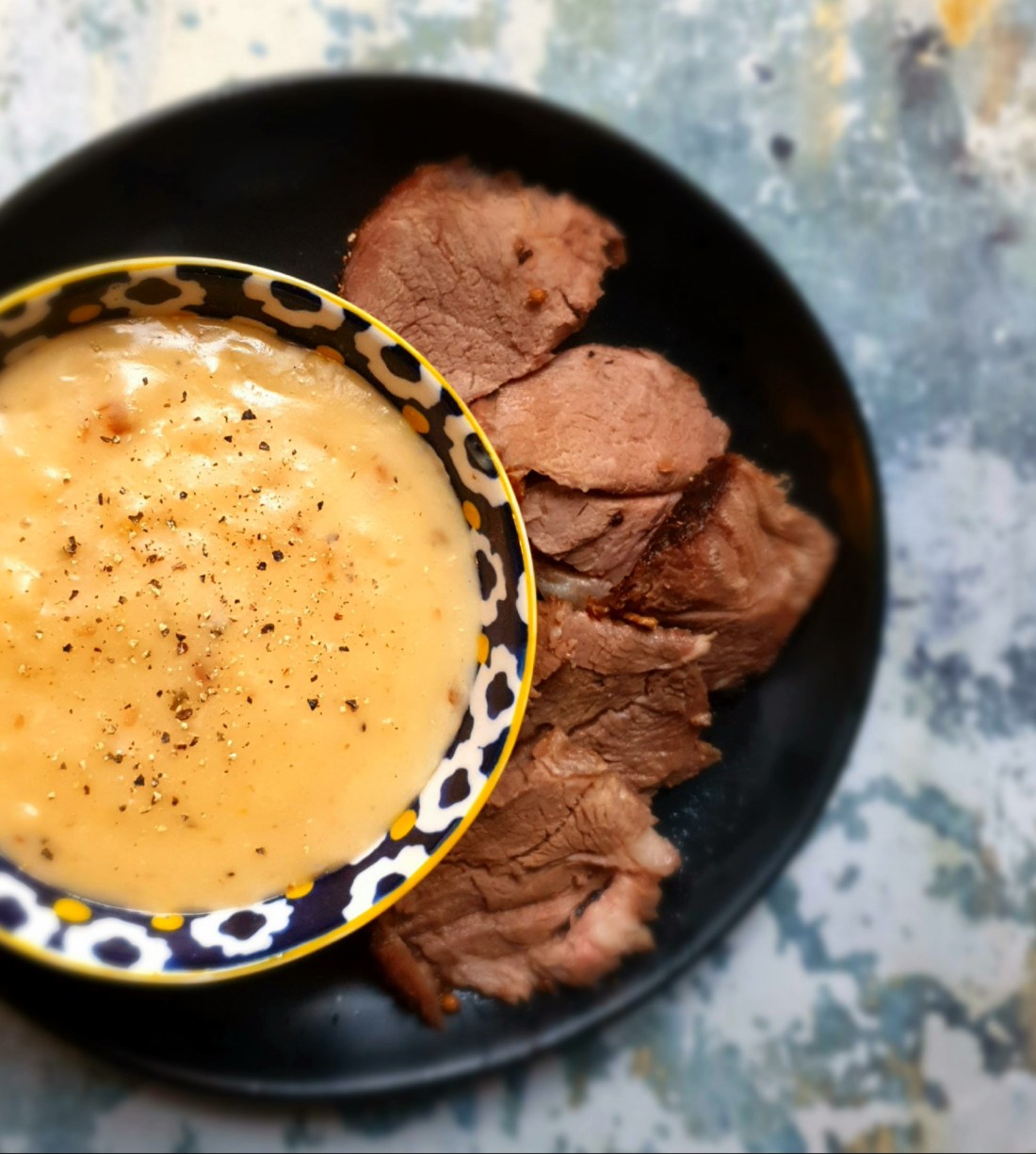
Stuffed Goat: 1st Century

Time for a Roman one.

I’m working my way up to dormice but I’m not quite there yet. One day, I promise. Maybe.

The Romans were, like most ancient civilisations, extremely resourceful when it came to food. I suppose if famine was a very real threat, and you didn’t have supermarkets to just pop in to for bits and bobs, you’d learn pretty damn quickly how to use every part of an animal or which flowers were pretty and edible. To the modern cook, the Romans do seem to have taken that survival instinct to the extreme though; they didn’t just know how to survive on the weird and wonderful – they seemed, at times, to revel in it. In 2005, archaeologists excavating a food quarter in ancient Pompeii discovered the bones of a giraffe leg – complete with butcher marks – in the gutter of an ancient diner. Similarly unnervingly, the most famous Roman cookbook, Apicius, had not one, but two recipes for roasted flamingo and added, as a footnote, that if one fancied, “parrot [may be] prepared in the same manner.”

Of course, that’s not to say that every Roman ate this sort of nonsense everyday. Far from it. Flamingo tongue, for example, was considered a delicacy even for the wealthy – and the poor were lucky if they got within 10 feet of the grease of the plate (I’m assuming; I don’t actually know how greasy flamingo tongue is?)

Most Romans ate a diet of fish and meat or cheese, legumes, vegetables and bread; fairly normal stuff. Dormice didn’t appear on menus as frequently as popular history would have you think. Though Apicius appears to have been a manual used by experienced cooks (including slave-cooks), only the wealthier classes would have had access to some of the more frivolous recipes in it, and even then some of these recipes would have been enjoyed only at very special occasions; like eating caviar as a canape instead of in a sandwich (unless you’re like my husband’s grandfather, who was given some caviar as a gift but had no idea what to do with it and unknowingly created the most expensive butty in the world for his work packed lunch…)

Cute, tiny and delicious… Credit here.

I’ve talked a little bit about the background of Apicius here, but the headlines are basically that it was an instructional work to guide the accomplished cook in the preparation and cooking of everyday meals – as well as meals for banquets – for their wealthy masters. The name Apicius has been attributed to the 1st century gourmet Marcus Gavius Apicius, though historians now doubt he wrote the manual himself. More likely is that thanks to his reputation as an unrelenting glutton of the most expensive food (Pliny wrote that Apicius was “equipped for every ingenuity of luxury”), his name became a byword for “gourmand” and seemed a fitting title for the work, which was probably composed by a series of educated cooks.

Goat isn’t anywhere near the same “unusual food” league as flamingo tongue or giraffe. In fact, it’s relatively common in parts of the UK with high African and Caribbean populations, and in other countries it’s as easy to get hold of as chicken is here. My dad, who lived for a few years in Nigeria as a boy, enjoyed it regularly in curries. Unfortunately for me, the nearest butcher that sold goat meat (I couldn’t find it on Sainsbury’s shelves) was in Leicester, which is still in a strict lockdown. Much as I love historical cooking, I wasn’t about to take a jolly into a city still very much in the grip of a pandemic, so looked elsewhere and found that I could get goat meat delivered from the Dorset Meat Company, an ethical grass-fed, outdoor-reared butcher in my second favourite county. Win!

And…I could end the post there. You’d all be thinking that this was a lovely, educational experiment using ingredients I was unfamiliar with to create a semi-authentic Roman meal. But you’d be wrong. So, so, dead wrong. I almost didn’t write this post up, believing that the end result was so disastrous that there was nothing anyone would gain from reading it. Alas, my ego and need for attention spurred me on.

The recipe I attempted was one of 10 possible recipes in Apicius for goat. It was essentially a roasted dish, with an accompanying sauce. Some of the other recipes were pretty simple, such as kid stew which was cooked in chunks with onion, wine and various herbs and if I’d only stuck to these ones, there may have been a very different outcome to this experiment. The recipe I chose to follow, however, lured me in because of its precise measurements and quantities. That’s right, it was that most rare of historical recipes: one with exact instructions. I should have known it was too good to be true.

Aliter haedus sive agnus syringiatus: lactis sextarium unum, mellis unc. IV, piperis unc. I, salis modicum, laseris modicum. Oleum acetabulum, liquaminis acetabulum, mellis acetabulum, dactilos tritos octo, vini boni heminam, amulum modice.

“Another kid or lamb syringiatus: one pint of milk, 4 ounces honey, 1 ounce pepper, a little salt, a little laser. Oil, liquamen, a spoon of honey, 8 [ounces] crushed dates, a good glass of wine, a little starch.

Apicius, Book VIII

(Huge apologies for dodgy translation, I used a combination of Google translate and already translated versions to try and get as accurate picture of the original recipe as I could.)

Anyway, Sally Grainger’s version seemed to have converted most of the original quantities to modern day equivalents, so I used her translation as guidance. The first thing to do was to roast the goat. Underneath the original recipe was another recipe which appears to have become disjoined from the first, but clearly belongs to it as it gives instructions for preparing the raw goat. I was to rub the meat with oil and pepper and sprinkle on liberal pinches of salt and coriander seeds before roasting. So far, so simple and even delicious; the smell of meat as it roasted with coriander was mouthwatering.

You know what a roast looks like.

Having never cooked goat before I’d done a little research and knew that there was a danger, thanks to the low fat content, of it becoming too dry and tough. In order to combat this, modern cooks (as well as Apicius!) advised regular basting throughout the cooking process. Some cooks even suggested cooking the meat in a tin foil tent to trap any escaping moisture. I rolled my not-technically-authentic foil out and dutifully shaped it so it would fit over the meat before setting regular timers on my phone to remind me to baste it.

The Romans took a lot of their understanding of insanity from the Ancient Greeks, and certain schools of thought taught that madness was a divine punishment; a common trope in Greek mythology or epics. The 1st century Roman physician Celsus subscribed to the belief that insanity could be visited upon a person by “phantoms” which could cause a person to descend in to one of two types of madness: the “depressed” or the “hilarious”.

I’m telling you this so you’ll understand why I decided, halfway through roasting the goat, to remove the cot sides from my toddler’s bed – a task that in itself took over half an hour – and then expected her to go to sleep without any issues. Whatever phantom it was that inspired me to do this was clearly a fan of schadenfreude.

I sat on the floor of the landing as the smell of roast goat grew stronger and shepherded my daughter back into her new bed when she appeared at her doorway, wildeyed and wailing, every 45 seconds. To add to the madness, the alarm on my phone went off every ten minutes to remind me to baste the meat. I ignored it nine times; the foil tent would have to do on its own.

After just over an hour and a half of battling the world’s most resistant toddler there was silence. I checked in on her: she had pulled her pillow and blanket onto the floor and had fallen asleep under the bed…we clearly had much work to do. The work would have to be done another night, though, because by this point it was almost 9pm and I hadn’t even started on the sauce to go with what I presumed was now incredibly burned goat.

As I headed back into the kitchen, I saw that the foil covering I’d been relying so heavily on to stop the meat from drying out had been left in a neat tent on the side – in my mad rush to take the cot-sides off my toddler’s bed I had forgotten to actually cover the goat with it. Any “hilarious” aspects of the phantom madness that had gripped me earlier began to fizzle away and were quickly replaced by “depressed” ones.

Truth be told, by this point I was ready to jack it all in and order a takeaway – I’d try a goat curry in the spirit of it all if necessary. But the masochist historian in me forced me to see this thing through to the bitter end, so I began work on the sauce.

I added the milk, pepper, honey and salt to a pan along with a little asafoetida. The ingredient “laser” was an ancient herb that has since become extinct, but was believed to be closely related to asafoetida, which made a reasonable substitute. While it was heating enough to dissolve the honey, I blitzed the dates with more honey, oil and liquamen – I used nam pla as a modern alternative. Nam pla has a very distinctive smell and despite being used in countless Thai recipes, it’s a smell I just can’t get used to. I fully understand that it transforms dishes with its umami flavour but once I smelt this I just couldn’t get the scent out of my unsophisticated nose and I knew I was going to struggle to eat dinner. Unfortunately for me, Grainger’s reading of the recipe called for a full 70ml of it – not an inconsiderable amount.

Once the dates and liquids had been transformed to a runny paste, I transferred it to a pan, added a small glass of wine and heated the mixture slightly. I strained the warmed milk and combined the two and stirred like a madwoman to try and stop it from curdling too much. Once I was sure I could stop stirring, I added a tablespoon of cornstarch to thicken it slightly over heat. I may have added too much because after a while the sauce became as thick as wallpaper paste, which did nothing to add to my anticipation of the meal.

The goat had been roasting on a low heat for about two hours now. I took it out, drained the pitiful amount of meat juice into the date sauce and rested the goat under foil to reach the warm but not hot temperature that it would have been served at.

Roman diners often ate roasted meat in slices and dipped each slice into small bowls of sauce, rather than cover the meat entirely. I decided to copy this method of serving: partly for authenticity reasons but also on the off chance that, if the goat wasn’t too tough, I didn’t ruin it by drenching it in cheesy smelling sauce. Despite being called stuffed goat, it actually wasn’t clear where the stuffing occured, and I wasn’t about to risk it by filling the meat with the dubious sauce.

At least the bowl was pretty.

We sat, apprehensive, in front of our plates until my husband went first and took a bite. He chewed thoughtfully. He chewed some more. After what felt like a solid minute of chewing, he stood up and wordlessly made his way to the kitchen to put some chips in the oven.

“Oh God, is it that bad?” I asked.

“No,” he lied (still chewing). “I just thought it would go with chips.”

I took a bite. The quality of the meat had been very good, so this tasted very similar to lamb with only a subtle “goaty” hint to it. However, my fears of it being too tough were right – it was so chewy that I felt like the stereotypical image of Henry VIII, tearing meat off in chunks with his teeth and eating with his mouth open, as I ate.

The sauce, though not as bad as I’d thought, failed to save the meal. It was too thick, for one, and clung to the meat rather than soaked it which therefore did nothing to alleviate the dryness. It was faintly sweet and creamy, but with an alcoholic tang. Though you couldn’t taste the fish sauce on its own, there was a lingering scent of it (I couldn’t work out if it was from the sauce or from remnants in my nose), and so with each bite there was a slightly cheesy retronasal smell that I found pretty off-putting.

In the end we continued determinedly through about 1/3 of the meal before giving up and sharing the bowl of chips. Late into the evening I made brownies, too; it seemed like that kind of night. I was determined not to waste the leftover goat, though, so I have plans to mince what was left and add it to a ragu.

Overall, the night did not end as I thought it would. My toddler was asleep on the floor, all the windows were open to drive the smell of fish sauce out and our dinner lay mostly uneaten on the side. I’m not saying an experiment with flamingo tongue would have been better, but it couldn’t have been much worse.

E x

Stuffed Goat

1kg goat (or lamb) leg
Small handful of coriander seeds
12g black peppercorns
300ml whole milk
110g honey
Pinch of asafoetida powder
4 dates
70ml fish sauce
70ml olive oil
150ml white wine
Tablespoon cornflour

  1. Rub the goat with olive oil and cover in salt, pepper and coriander seeds. Roast, under a foil tent, for 2 hours at 160 degrees C. Baste regularly.
  2. When the goat is roasted, take out and keep covered in foil. Begin the sauce.
  3. Crush 6 peppercorns and add them and the rest of the peppercorns to a pan with the milk. Add 40g of honey, the asafoetida and some salt. Heat gently.
  4. Grind the dates in a food processor with the rest of the honey, the fish sauce and oil. Transfer to a pan and add the wine. Heat.
  5. Strain the milk and add it to the date sauce, stirring whilst adding.
  6. Take the meat out of the oven and allow to rest a little. Pour the meat juices into the date sauce and stir.
  7. Transfer the sauce to small dishes, carve the meat and serve at just above room temperature.

Leche Lumbarde: 15th century

My husband had an important work call to make on Tuesday morning. You know the kind – the ones you have to put in your calendar so you absolutely do not forget about them. The kind people ask “are you all ready for it? Let me know if you need anything.” The kind that you spend weeks worrying about and might, just might, treat yourself to some sort of calorie laden confection as congratulations for getting through it once it’s over.

In my husband’s case, this was an extra large bag of Haribo. He’d bought it a week or so ago in anticipation of The Call and lovingly stashed it at the back of the cupboard behind the beans and spaghetti hoops where it waited patiently for its time to come.

Unfortunately, that time actually came three days too early when, in a fit of sudden dinnertime anxiety about our terrible eating habits, I raided the cupboard looking for rice, wholewheat pasta or lentils to make something wholesome and disappointing with. As I pushed aside a jar of alarmingly red tikka sauce I saw the Haribo bag lurking in the shadows, hoarding its gummy bears, fizzy cola bottles and sour cherries.

It wouldn’t be decent to describe what happened next. Needless to say, my husband ate a plate of wholewheat spaghetti on his own as for some reason I wasn’t too hungry anymore.

And that was the end of that. Until Monday evening, when my husband turned to me with gleaming anticipation in his eyes and told me how much he was looking forward to devouring the Haribo after he’d got through The Call in the morning. They were really helping him focus on the prep work, he said. He didn’t know what he’d do without them as a motivator, he said. If something, anything, should happen to them, he’d be utterly destroyed.

Okay, maybe not as dramatic as that. The point was, he was an earnest and very nervous man and I was a terrible wife.

Obviously I replaced the bag (I’m not a total monster), and The Call went well. But it got me thinking about how I could crowbar it into this blog and the answer came thusly: make some medieval sweets.

Yeah nice one, not a tenuous link at all.

In my defense, when reading through the recipe for these I was struck by how they might pass as a medieval version of gummy sweets. So not totally tenuous..?

Medieval people knew very well about the setting properties of gelatin: recipes in Forme of Cury describe the process of cooking pig’s feet, ears and snouts – along with calve’s feet – in a mixture of wine, water and vinegar to make an enticing dish called Gele of Flessh. What I couldn’t find any evidence of, however, was sweet jellies. And if there were no sweet jellies then it wasn’t too much to assume that gummy sweets were out of the question as well.

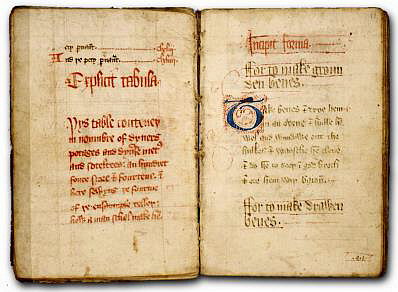
Forme of Cury, not telling me how to make jelly babies.

I knew that by the end of the 16th century marmalade was being made that resembled something akin to gummy sweets (rather than our modern version); Hugh Platt’s 1600 recipe for orange marmalade was supposed to be so thick it could be served in jellied lozenges. Likewise, the popular 17th century sweet quiddany – quince paste – was supposed to be so solid it could be set in moulds and turned out without losing its shape. But I couldn’t find much evidence of this type of solid-set jam being made in England during the middle ages. A medieval dish from Forme of Cury called Connate came close to these 17th century pastes, but it used lard and raw egg yolk to set it, rather than pectin alone.

What I did find was Leche Lumbarde. Thinking back to my year 9 Spanish lessons I was fairly confident, before reading the whole recipe, that this would include milk – so I almost didn’t bother, thinking it wouldn’t be anything like what I was searching for. In reality, the Leche Lumbarde I found contained no milk, but plenty of dates and sugar (or honey) cooked in wine and set into slices. Okay, it wasn’t a jelly baby or a fizzy cola bottle but it was about as close as I could get.

Other medieval recipes for Leche Lumbarde included meat, such as the 15th century version from Thomas Awkbarow’s Recipes which started off by boiling brawn to a pulp, and the Forme of Cury version, which involved ground pork. It may have been that the makers of Haribo tried an edition of brawn or pork flavour gummy worms, but the packet that my husband had been so looking forward to seemed to rely mostly on fruit flavours, so I skipped these versions in my search.

The recipe I used came from Two Fifteenth Century Cookery Books: Harleian MS. 279 & Harl. MS. 4016. Harlein MS. 279 seems to date from around 1430 and Harlein MS. 4016 dates from around 1450. The recipes within these manuscripts were heavily influenced by continental (especially French) cookery and many of the titles of the recipes have bastardised English names – the milk-based recipe Letlardes, for example, is clearly based off an earlier French one: Layt Lardé.

I still couldn’t shake the idea of the Spanish sounding name, though. And the more I thought about it, the more annoyed I was that I’d spent all that time in Spanish lessons only for history to deny that milk didn’t belong in recipes entitled “leche”. If many of the recipes in Two Fifteenth Century Cookery Books were based on recipes from France, then surely it wasn’t outside of the realms of possibility that some Spanish influence had crept in too? There must be a connection, I thought – there must be an original, milk-based Spanish recipe for Leche Lumbarde that had somehow become muddled on its way to England.

A 13th century Spanish cookbook called The Anonymous Andalusian Cookbook had a recipe for “A Sweet of Dates and Honey”, which was almost near identical to the recipe I had for Leche Lumbarde. Unfortunately, this recipe didn’t contain any milk, so wasn’t all that helpful in proving the milky origins of the dish. Furthermore, given that 13th century Andalucía wasn’t the region referred to as Andalucía today, but instead referred to all the regions in Spain under Arab Muslim control, it was likely that the original name of this dish (which had been lost) would have been Arabic, so unlikely to contain the Spanish word leche, anyway.

After hours of research I still couldn’t find anything. And then, in desperation, I stopped pushing the very limited Spanish and access to medieval Spanish cookbooks I had beyond their extremes and banged “leche” into the online Middle English Compendium to see if it could point me in the direction of anything I’d overlooked.

Leche” it sang back to me. “Of lesche, laiche, leske ‘a thin strip, a slice’. Cook. (a) A strip, slice; (b) any of a number of jellylike dishes prepared from various ingredients and usually cut into strips or slices.”

Oh.

I’d spent an afternoon chasing the belief that I was about to unearth the global transformation of a dish from its milky Spanish origins to a milk-less English sweet – a discovery that as far as I could see, no one else had made. For good reason, it turned out, because it didn’t bloody exist.

In this particular context, “leche” was truly nothing to do with milk at all. If I’d paid attention to the other, meaty versions of Leche Lumbarde I’d have seen that they too avoided milk. “Leche Lumbarde” was just another way of saying “sweet slices in the Lombardy fashion”. What the original Lombardy recipe that had inspired the 15th century English version looked like was anyone’s guess; I was too crushed to begin that particular treasure hunt and already on the way to the shop to buy yet more, consolatory, Haribo.*

What a fantastic waste of time. Are you going to cook now?

It was all turning into a bit of a disaster; I’d spent so much time chasing a misguided hunch that I had very little accurate history to talk about. In fact, I was at risk of having to include my dead-end research in lieu of proper information about the dish…

But onto the actual cooking. Milk or no milk, Leche Lumbarde was pleasingly easy to whip up and contained relatively few ingredients: dates, sugar, white wine and spices. Though the original recipe made it seem like there were lots of steps involved, in reality the last few sentences were guidance for what to do if the dish didn’t set properly; mine did, so I didn’t need to follow the end points.

Leche lumbarde. Take Dates, and do awey the stones; and seth hem in swete wyne; and take hem vppe, and grinde hem in a morter, and drawe hem thorgh a streynour with a litull swete wyne and sugur; and caste hem in a potte, and lete boyle til it be stiff; and then take hem vppe, and ley hem vp apon a borde; and then take pouder ginger, Canell, and wyn, and melle al togidre in thi honde, and make it so stiff that hit woll be leched; And if hit be not stiff ynowe, take hard yolkes of eyren and creme thereon, or elles grated brede, and make it thik ynogh; take Clarey, and caste thereto in maner of sirippe, whan thou shall serue hit forthe.

Two Fifteenth Century Cookbooks

First I heated dates in a pan of white wine – I chose a Pinot Grigio as the recipe specified “sweet” (though I’m not a big wine drinker and in reality it all tastes very similar to me; sorry!) The dates simmered for a couple of minutes until they were softened and just starting to fall apart. I added them – without the wine – to a blender and blitzed.

Why couldn’t it have been milk instead of wine?!

Once suitably pulverized, I added a spoonful of the now syrupy wine back to the dates, poured most of rest of the wine away (I set a couple of spoons aside for the final part of the recipe), and returned the dates to the pan. The recipe called for sugar to be added at this point but, like all medieval recipes, didn’t specify how much. I ended up settling for just under half the weight of the dates, aware that this was meant to be a sweet and should therefore be, well, sweet.

The date and sugar mixture was stirred into a thick paste and then heated until it bubbled. Though there was no indication of what temperature to cook it for other than until it was “stiff”, I checked with a food thermometer and took it off the heat at about 106 degrees C, to be sure it had at least passed the setting point of jam. In all honesty, it looked pretty thick and stiff before it reached this temperature but I wanted to make sure.

Once it was off the heat, I added a pinch of powdered ginger and a pinch of cinnamon, stirred it through and turned the whole lot out onto a covered board. It was still boiling hot, so rather than use my hands, as suggested, and risk melting the skin on my palms, I patted it into a rectangle with the flat side of a spatula.

It seemed like it was already thick enough to slice but if it wasn’t the recipe provided some strikingly helpful pointers, by medieval standards. To thicken up the mixture, it suggested, one could crumble in hard egg yolk or grated bread which would provide some additional setting qualities. As it was I only had to cool mine an hour before cutting it into slices (and shaping it into cola bottles).

So similar it’s like “Where’s Wally?” but with Haribo.

The final part of the recipe called for clarey – a type of spiced wine sweetened with honey – to be drizzled over the finished slices like a syrup. I added a spoon of honey to what was left of the date-infused wine I’d set aside earlier, added a little ginger and heated it. Once the honey had dissolved I let it cool a bit so it didn’t melt the sweets and drizzled a couple of teaspoons over the slices.

Did these taste like Haribo? No, not at all. Did they feel like Haribo? Also no. They were much stickier and softer than gummy sweets, so fans of very chewy sweets would be disappointed. In terms of taste, they were sweet but not painfully so; most of the flavour came from the dates, so it was a very sticky, jammy type of sweetness. It almost felt like eating the inside of a fig roll.

The wine made them richer and somehow smoother, but there was no discernible alcoholic taste. Similarly, the spices – ginger especially – gave each piece a kick, but it was a subtle heat rather than a strong flavour.

In the end I’d made a relatively small batch, enough for four medium/large slices (or leches, I guess.) It turned out that this size was right – pleasant as these date sweets were, they weren’t an acceptable replacement for real gummy bears or cola bottles and we found it hard to finish them in a way we’d never struggled with before with Haribo. I guess, if anything, this experiment taught me that replications, no matter how interesting, can never replace the authentic thing.

Oh – and that unless you have half a day to waste shouting at Google Translate and listening to the Spanish national anthem “to get into the right mindset”, it’s best to leave the proper research up to the experts.

E x

* If it turns out that I’ve made yet another mistake and that “Lumbarde” doesn’t, in fact, mean “in the Lombardy fashion” please be sure to highlight this by writing me a letter and popping it straight in the bin. Or, if you must let me know, email theforeignpantry@gmail.com along with a subscription to a years supply of Haribo.

Leche Lumbarde

100g pitted dates
200ml white wine
40g caster sugar
1/4 teaspoon powdered ginger
1/4 teaspoon ground cinnamon
(optional: tablespoon honey)
(optional: breadcrumbs or egg yolk)

  1. Heat the dates in simmering wine until they are soft.
  2. Remove dates from the wine and blend to a pulp. Set aside 3 tablespoons of wine and pour the rest away.
  3. Place dates back into the pan and add 1 tablespoon of the wine. Add the sugar and stir until all incorporated.
  4. Heat the date and sugar until it is thick and bubbling and can hold its own shape (about 105 degrees C.)
  5. Remove from heat and stir in the spices.
  6. If you don’t think the mixture is thick enough to cut when cooled, add in 50g of breadcrumbs or one hard boiled egg yolk, crumbled, and mix in thoroughly.
  7. Tip mixture onto a non stick surface and shape into a rectangle a couple of cm thick. Allow to cool entirely.
  8. Slice and, if adding the sauce, heat the remaining tablespoons of wine with a tablespoon of honey. Add a pinch of ground ginger and then drizzle over the slices.

Farts of Portingale: 1594

Settle down, settle down.

I’ll start by addressing the elephant in the room and dive right in to explain the name of this dish and answer the question everyone’s asking: Portingale simply means made in the “Portuguese-style”. In 1480 the merchant Martin Rodkyns imported 4,000 farts from Portugal at the surprisingly modest cost of 6s. 8d. (approximately £230 in today’s money) suggesting that supply of farts outstripped demand and/or farts weren’t valuable enough in their own right to tax heavily. Nevertheless, farts were clearly considered something of a treat and were served along with other “subtleties” at the enthronement feast of Archbishop Warham in 1504.

All clear? Excellent.

The second thing it’s probably good to get straight is that most 16th century culinary “farts” were small, lightly puffed up, air filled pastries. Naturally the name of this dish necessitates discussion of certain unpleasant wind-based bodily functions, so to avoid confusion over which type of fart is being discussed, I’ve tried to use “fart” when talking about today’s experiment, and the playground term “trump” to describe the revolting, odious, loathsome and uncouth blowing of hot air.

Part of what makes this dish so interesting is that the name is a bit of joke – both to us and to people of Renaissance England (this may be one of the few examples of humour surviving time travel to the 21st century!) The Middle English Dictionary shows that “fart” had been used to mean breaking wind since at least the 14th century – (in)famously in the Summoner’s Tale of the Canterbury Tales where a corrupt friar finds himself in the firing line of a particularly loud and noxious one – but its etymological roots go back much further than that.

So why, if the word “fart” meant what I’m halfheartedly calling “trump”, was it used in the title of a dish? Was it just an unfortunate typo that was repeated over and over again? If not, who was it who thought that a gazpacho of guffs; a fricassee of flatulence; a bowlful of bottom burps – call it what you want – was just what the diners of the country needed? Well, in this case it was Thomas Dawson; English foodie and writer of The Good Huswifes Handmaid for the Kitchen – a text on the main points of the preparation and presentation of meat.

Dawson’s entry for Farts of Portingale is infuriatingly cool; there are no puns and no tongue in cheek comments that lesser writers might resort to in order to make their writing seem more interesting and funny. (When my husband found out what I was making today he made me swear I wouldn’t make more than three fart jokes. I’m trying, I’m really trying.)

How to make Farts of Portingale.

Take a peece of a leg of Mutton, mince it smal and season it with cloues, mace pepper and salt, and dates minced with currans: then roll it into round rolles, and so into little balles, and so boyle them in a little beefe broth and so serue them foorth.

The Good Huswifes Handmaide for the Kitchen
“Alas,” she sighed. “All this meat and veg when all I really want is a good fart.”

You can see that in order to find any reason why these were called farts I had to dig a little deeper than Dawson’s recipe alone.

A second 16th century English recipe for farts that predated Dawson’s version by three years was markedly different; it included an early form of meringue, sugar and dough. Likewise, a 14th century French recipe called pets d’Espaigne also seems to have been some sort of bitesize pastry and meat treat and, jumping forward, the 1651 culinary text Le Cuisiner François included a recipe for small pastries called pets de poutain. The respective translation for both these dishes? “Spanish farts” and “whore’s farts.”

Even more interestingly, a lesser used French word for stuffing (which is essentially what Dawson’s recipe is) is farce. A very good linguist friend of mine (who probably never imagined she would need to use her skills to look up the linguist connections of the word “fart”) suggested that a humorous mistranslation of the French dish farce could be to blame for the English dish of “farts”, before the newly minted joke was translated back into French, pets. Whatever the truth, it’s clear the obsession with food-based farts wasn’t limited to English cuisine or any one type of meal.

The deputy chief editor of the OED, Dr. Philip Durkin, suggests that the common theme shared between these three dishes was that they all included dough which was intended to inflate slightly with hot air when cooking – could the puffed up quality be the inspiration for the name? It’s a possibly tenuous link, especially when you think about all the other historical puff pastry dishes that have existed separate from the “fart” motif, but it does highlight how difficult tracing the ideas and theories behind certain types of food can be. (Which is a fancy way of saying I give up and am happy to leave it to the experts to ponder!)

It would be easy to assume that Farts of Portingale was, as mentioned, a typo made by a careless (or teenage) writer that was then copied out over time – a slip up when writing a recipe for the similar sounding Portuguese tarts, perhaps. But given the prevalence of the equivalent word for “fart” in other European cuisines it seems unlikely – what’s more compelling is that the dish was actually part of a wider culinary theme. Furthermore, the use of crude humour in food isn’t uncommon; even today there exist recipes for French-Canadian “nun’s farts”, Italian palle di nonno (“Grandad’s balls”) and Sicilian cassatella di sant’Agata (“Saint Agatha’s breasts”.) Are we really prepared to believe that it’s only in the last few decades that humans have found mixing food and rude words together can create funny results, or that the people of medieval and Renaissance England didn’t find such crass things as farts amusing? (If you do it’s because you didn’t click on the Summoner’s Tale link. Gotcha.)

Anyway, after all this I was expecting to deal with a small pastry tidbit, in keeping with the other fart dishes I’d looked at. But instead I was met with another mystery: Dawson’s recipe made no reference to pastry at all. Was this because by Dawson’s time a fart could describe any dish of bitesize morsels? Or was it because the “fart” element wasn’t to do with puffed pastry after all, but something else? I had no idea. I also didn’t really care either; having spent a solid four hours destroying my internet history with searches like “farts in food” and “the history of farts”, I felt I’d reached the limits of my research ability.

Firstly, I blitzed some mutton in a food processor. To this mushed up mutton mince I added dates, currants, some powdered cloves, mace and salt and pepper. Once it was all incorporated I rolled the mixture into meatballs and brought a pan of good beef stock to simmer (unfortunately not homemade), which I plopped the balls – farts? – into one by one.

A plateful of farts – delightful.

Each fart cooked for between five and seven minutes, by which time they had lost their vibrant bloody and raw colours and had turned a wholly dull grey/brown. Certainly, they were reminiscent of the colour you might expect a fart or “trump” to be, though thankfully they didn’t smell like one.

It was unclear whether these were meant to be served in the beef stock or not. I double checked with the medieval French version of the same dish (petz d’Espaigne) in The Viandier of Taillevent which seemed to suggest serving the farts without any of the broth they’d cooked in. Dry farts, if you like.

I did my best to arrange them in an appetising fashion, but it’s actually very hard to take a meatball photo that induces salivation – unless you’re IKEA, of course. Needless to say, the name of the dish meant put these little meatballs on the back foot a bit, so I felt an obligation to increase their attractiveness when I served them.

Soft focus, pointless greenery, finickety plating: it’s the grandslam of wankerish food photos.

“You go first,” my husband said immediately.

I bit into one.

“It’s fine!” I said with what I hoped was enough enthusiasm to disguise the relief in my voice.

They really were “fine.” More than fine, actually. The cloves were the dominant spice flavour but in a bold rather than overpowering way. Both my husband and I agreed that because of this we couldn’t stop thinking about Christmas, which seemed a bit weird in the middle of July, but there you go.

Overall these were like moist balls of very festive stuffing. Having never eaten mutton before, I was curious what it would taste like but I found that in these small mouthfuls, boiled in beef stock, the flavour was like a slightly game-y, richer lamb.

They were also surprisingly sweet. I’m always amazed at the power of the humble date and how much fruity sugariness it can pack and it was no different here. Dried fruit like currants and dates were important in 16th century cooking, partly due to their ability to add subtle sweetness, and were regularly imported. During previous centuries these fruits had been the preserve of the nobility but, as Clarissa Dickson Wright notes, by the end of the 16th century some of these fruits could be found in various recipes of the wealthy middle classes too – recipes such as Farts of Portingale.

At the end of writing, I’m still not sure I’m any wiser as to why these were called farts, or what made them “Portuguese”. All I can do is hope that the reasons for the name are mostly innocent and not based on any digestive issues one may suffer hours after eating a plateful of them. Fingers crossed.

E x

Farts of Portingale

500g mutton or lamb, minced
1/4 teaspoon of powdered cloves
1/2 teaspoon powdered mace
A good pinch of salt and pepper
60g pitted dates
60g currants
1l beef stock

  1. In a blender, combine the mutton, spices, salt, pepper, dates and currants. Whizz until the dates and currants are minced and incorporated evenly through the mutton.
  2. Heat the beef stock until it is simmering.
  3. Roll the minced fart mixture into meatball sized portions and drop them into the beef stock – about six or seven at a time.
  4. Cook in stock for no more than seven minutes.
  5. Remove the farts with a slotted spoon and allow to drain on a warm plate while you cook the rest.

Chocolate Soufflé: 1861

It was world chocolate day yesterday, apparently. Normally these celebrations pass me by a bit – there’s a world meatball day, a coffee day, a hamburger day and a porridge day. Obviously I’m looking forward to 24th October – world tripe day – but mostly I’m a bit cynical and imagine that behind the merriment and random recipes there’s a big fat corporation greedily counting its money.

But it didn’t escape my attention that 7th July was designated world chocolate day. Call me boring, call me clichéd but that’s one food day I can get behind and you’ll be happy to know that I made sure to celebrate by eating as much of it as I could – chocolate biscuits, chocolate bars, chocolate cake, hot chocolate. All enjoyed with appropriate solemnity for the occasion, of course, and not at all gorged with reckless abandon as I attempted to prove the “share” part of a family sized bag of Buttons was more a guideline than a rule.

I’ve not done too many chocolate recipes, mostly because the glorious stuff wasn’t known about in Europe until the 16th century and so recipes containing it (in a modern format) are fairly limited. Its history is fascinating, though.

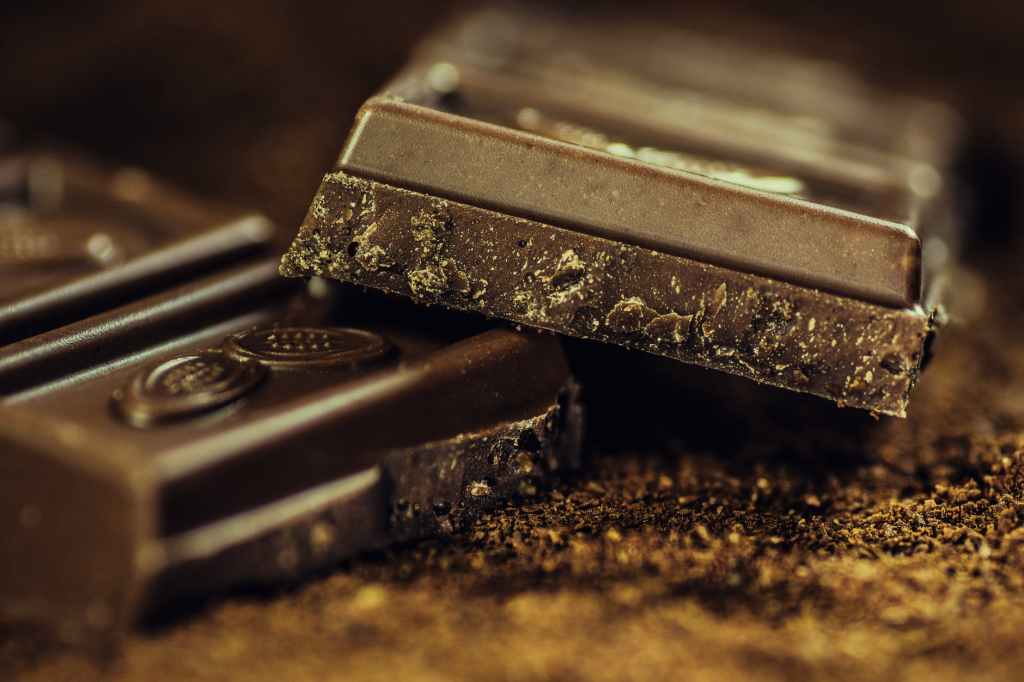
Who are these people that get paid to take photos of chocolate and how can I get that job?
Photo by Pixabay on Pexels.com

There’s a lot of terminology around chocolate but modern experts tend to refer to cacao as the unprocessed plant or bean while chocolate is the word for anything made from the processed beans. Whatever you call it, chocolate in all its forms was a highly prized item. In pre-colonial Mesoamerica, where it originated, cacao was used as a symbol of wealth; when Cortés arrived to plunder Tenochitlan in 1519, he and his men witnessed a ceremony where Montezuma II was served over 50 jars of chocolate to drink. Cortés and his men might not have fully grasped the awesome display of wealth they were seeing, but to other Mesoamericans the excessive amount of chocolate drink would have signified Montezuma’s extreme power because of the number of beans needed to make so many drinks. Similary, a 16th century document tells us that cacao was valuable enough to the Aztecs to use as currency – in 1543 40 cacao beans were paid daily to workers in maguey fields.

The Spaniards didn’t think much of chocolate at first, describing it as “a bitter drink for pigs“, but brought it back to Spain nonetheless where it continued to be largely disregarded until someone realised that if you added cane sugar or honey to it, it suddenly became an indulgent sweet drink. By the 17th century sweetened chocolate drinks were being enjoyed by the rich all over Europe for its taste but also for its supposed medicinal and aphrodisiac properties (Casanova was apparently a great fan.)

It wasn’t until 1828 that Coenraad van Houten invented the cocoa press, which separated out the cocoa fats from the bean and left a powder which could be added to milk, much like a modern day hot chocolate. This process also meant that chocolate could be mass produced, making it cheaper and more available to the wider public. In 1847 J. S. Fry and Sons realised that combining the fat and liqour from pressed cocoa and adding sugar could create a mouldable solid and voila! the chocolate bar was born.

These early bars were dark and were enjoyed in small quantities as the taste was still fairly strong and bitter. Cadbury’s had some initial success in 1861 with boxes of luxury chocolates, branded ‘Fancy Boxes’. The small chocolates in these boxes were branded as indulgent gifts and were designed to be enjoyed in small dainty mouthfuls (a scientific impossibility as experts* on chocolate consumption have since discovered.)

Eventually, in 1875, the Swiss chocolatier Daniel Peter had the novel idea of adding milk powder (after trying and failing with liquid milk, which caused the chocolate to seize) and created milk chocolate, which was an instant hit. Rival chocolate firms scrabbled around to imitate the creamy taste and in 1905 Cadbury’s released the first Dairy Milk bar, which boasted a higher percentage of milk than any other competitor brand.

Is all this background info just your excuse to try different types of chocolate?

No, actually.

I don’t like dark chocolate. It’s high up on the list of sophisticated tastes that adult palates are supposed to enjoy that I don’t, along with red wine and liquor, blue cheese; strong coffee. In theory I should be a beacon of health, right? In reality I’ve overcompensated for not liking these foods by developing a palate as fond of sugar and fizz as that of a child – frosted cereal, milkshakes, entire jars of Nutella on one slice of toast. Okay, fine – it’s the palate of a child with irresponsible parents. So what? I had a great childhood and my fillings light up a room when I smile.

Because of this I was only sort of excited to try Mrs Beeton’s recipe for chocolate soufflé, given that it was published in 1861 – a full 14 years before anyone had successfully manufactured milk chocolate. My husband, who’s a certified signed up Adult(TM), was, however, delighted by the idea of this experiment (even though I made it for breakfast in rebellious solidarity with my inner child.)

First I separated four eggs and added a few teaspoons of sugar and flour to the yolks. Mrs Beeton then told me to add 85g of “best chocolate”, which unfortunately meant dark chocolate. I used Bournville because even though it wasn’t sold until 1908 – and it definitely isn’t the best quality – it was what was most readily available at 8:00am when I decided to make soufflé. I just had to hope that the average bar of 2020 Bournville chocolate was as good as a very good bar of 1861 chocolate. It took forever to grate, but eventually I had a small pile of very finely grated chocolate, which I mixed into the egg yolks.

My next deviation from the original recipe was to use an electric whisk to whip the egg whites into stiff peaks. Stiff peaks formed, I folded the egg whites into the yolk and chocolate mixture trying not to beat all of the air out of it. The soufflé was then portioned out into buttered ramekins and baked for 20 minutes.

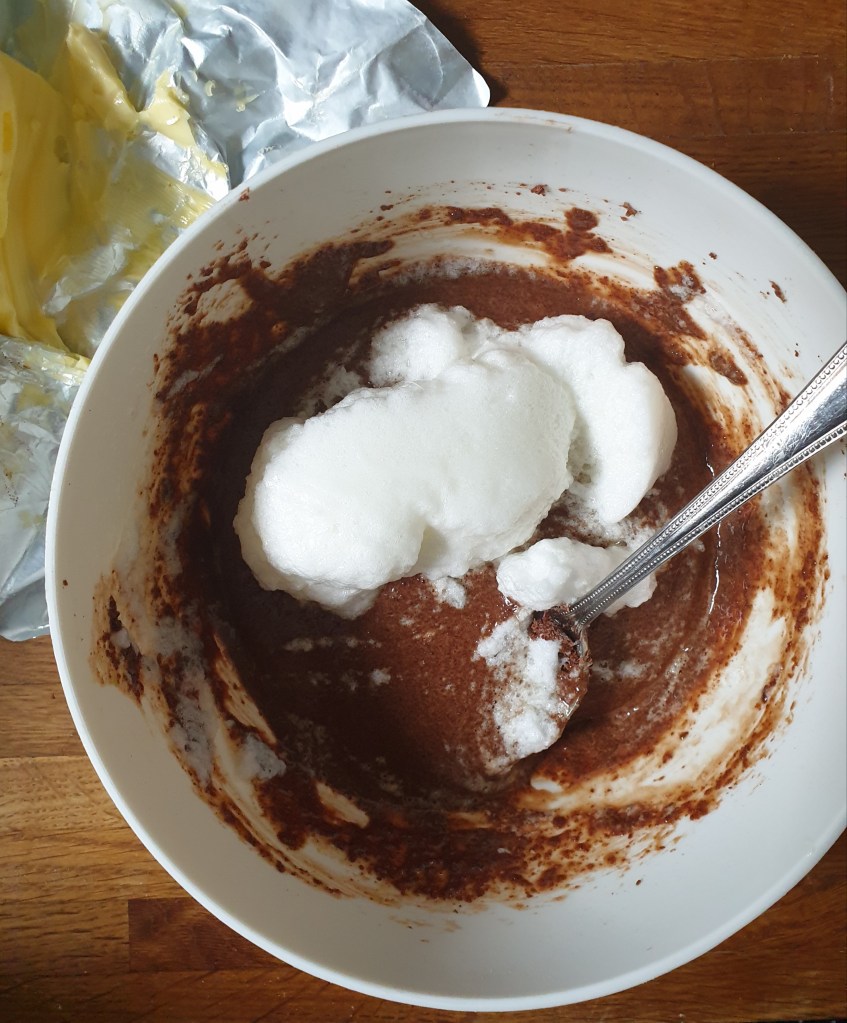
Little fluffy clouds in a pool of sewage.

Once they were in the oven I found I was filled with dread that they wouldn’t rise and I’d be left with two deflated eggy messes. I started to do initially nonchalant but increasingly neurotic soufflé inspections: I began by wandering into the kitchen every couple of minutes to check on the oven, pretending that I’d left the milk out or the hob on. Then there were a couple of innocent peeks through the door to check that they were rising properly and before I knew it I was kneeling on the floor, face pressed against the hot glass, hissing “rise my beauties, rise!”

And rise they did. The second wave of dread washed over me as I read “the proper appearance of this dish depends entirely on the expedition with which it is served…if allowed to stand after it comes from the oven, it will be entirely spoiled, as it falls almost immediately.”

Entirely. Spoiled.

Has a more terrifying phrase ever been written? And what was worse is that it seemed totally unavoidable – I could have absolutely nailed the recipe, even use the very best of best chocolate – and it would all be for nothing if I shuffled instead of sprinted to the table when serving it.

I prepped myself for the worst, took a deep breath and whisked the soufflé’s from the oven so fast I was at risk of breaking the sound barrier.

“Stand back!” I roared at my husband as I ran to the table to photo them before they deflated.

In the end Mrs Beeton had maybe exaggerated the delicate nature of soufflé; yes, they sunk slightly within a minute or so of being out of the oven, but they were hardly “spoiled.” At least, not spoiled enough to render them inedible for breakfast.

Totally forgot to add powdered sugar when they came out of the oven which entirely spoiled them.

Not only did they look like chocolate soufflés, but they damn well tasted like them too; rich and dark without being too sweet. My husband particularly enjoyed this aspect to them because he said it made them feel “healthier”. Inside they were light and airy, but as they deflated they got a bit gooier and more unguent.

I didn’t finish all of mine because, well, dark chocolate. But my husband, buoyed by the seemingly wholesome nature of these, managed to finish off his own and the rest of my ramekin. Dark chocolate soufflé for breakfast: approved by Real Adults.

World chocolate day might be over, but I’m already counting down the days to next year when I can make a (milk chocolate) version of these again. Also, if someone could tell me the shortcut for the acute accent so that I don’t have to keep copy and pasting the “é” every time I write “soufflé” in the future, I would be forever indebted to you.

E x

* It’s me; I’m the expert on chocolate consumption.

Chocolate Soufflé

85g dark chocolate, finely grated.
1 teaspoon plain flour
3 teaspoons caster sugar
4 eggs

  1. Preheat an oven to 160 degrees C.
  2. Separate the egg whites from the yolks.
  3. Whisk the egg yolks and add the grated chocolate. Mix.
  4. Add the flour and sugar to the chocolate and egg yolk and whisk together until fully incorporated.
  5. Whisk the egg whites to stiff peaks.
  6. Fold the egg white into the egg yolk. Make sure not to over-fold to prevent the air escaping.
  7. Butter two large ramekins and divide the soufflé mixture between them.
  8. Place the soufflés into the oven and cook for 20 minutes. Do not open the oven door during cooking.
  9. Remove the soufflés and dust with icing sugar. Serve immediately.

Meat Loaf: 1967

Before today I’d never made or eaten meatloaf before. Growing up, my whole experience of it came from watching American films from the 90’s where it was always presented as a bit of a disappointment: dry, bland and uninspired, occasionally with ketchup. None of my friends ate it either so it became something I thought of as semi-fictional, in a boring kind of way. I think there was only one film where meatloaf was made to seem dangerous and exciting, but it was part of a messy, short lived scene that ended with a pickaxe and bits of Meat Loaf all over the walls and floor. Other than creating some mildly conflicting emotions in 12 year old me (who, let’s face it, knew she shouldn’t be watching a DVD that featured so much leather and red lipstick on the front cover), this particular scene didn’t really change my opinion of the dish overall.

I’m unsure why I thought of meatloaf as this slightly ugly, dull meal in comparison to the fancy sounding terrine when they are such similar dishes. It’s probably because the word “terrine” evokes French elegance, upmarket restaurants and crisp white napkins whereas the word “meatloaf” sounds like something we’d all be fighting over in the dystopian wasteland of a nuclear winter as part of a futile effort to avoid resorting to cannibalism. Or maybe I’ve just thought about it too much.

“It’s really boring” I told my husband. “At least, I think it is. You probably won’t like it.” I showed him the ugly photo of lumpy meatloaf in Marguerite Pattern’s 1967 edition of Quick and Easy Cookbook in Colour.

“Well why are you making it then?”

I showed him the photo of Wurstel Sausage in Aspic which had been the alternative for my foray into the food of the 60’s and 70’s. He agreed I’d made the right decision.

A third 70’s dinner option. Credit here.

In theory meatloaf has been around for centuries because dishes of compressed minced meat have existed since ancient times. In Apicius there’s a recipe for Brain Sausage involving pulverised minced brain which is shaped and cooked in a pan and sliced into portions to be eaten cold. I would do anything for my love of historical cooking, but I won’t do that. I needed a modern, non-brain version to make instead.

Our modern idea of meatloaf first appeared in American print in 1899 – coincidentally just after the invention of the meat grinder. From then on it became a firm American staple, appearing in cookbooks and on dining tables for decades after. It wasn’t until 1939 that meatloaf made it to British print, however, by which time it had cemented its place as a versatile but fairly inelegant meal. The recipe I used for today’s meatloaf, taken from Quick and Easy Cookbook in Colour, appeared under the title “Made-up meat dishes” which did little to change my perception of meatloaf as something that wasn’t quite real, but I was prepared to change my mind. Besides, I was using my gran’s old cookbook which bore tell tale splatter marks from when meatloaf had been all the rage in the 70’s.

First I melted 1 oz. of margarine in a pan, added two chopped onions and cooked them until they were soft but not brown. I then added 3 oz. of mushrooms, flour and milk to form a white sauce and cooked until thickened. So far, so easy. I was actually quite pleased to see that the first two ingredients were vegetables and not meat; it somehow made the unappetising image in the book a little less daunting.

Once the onion/mushroom/white sauce mixture cooled slightly I added a combination of minced beef and sausage meat, a teaspoon of Worcestershire sauce, two eggs, 3 oz. bread crumbs, a teaspoon of mixed herbs and 1 oz. of parmesan cheese (“Oh, you’re making a fancy meatloaf then”, my mum said when she found out the ingredients.) I then added 3 tablespoons of tomato puree which gave everything a disconcerting pinky/orange hue and reminded me of Rocky Horror again, before squidging it all into a loaf tin and baking for just over an hour.

Hmmm.

The thing I hadn’t appreciated about meatloaf is that it’s often meant to be served cold. Patten’s recipe called for the meatloaf to be chilled in the fridge for a couple of hours once cooked before being sliced and served with a salad. I had intended to serve this for dinner, and by the time it was done it was already 7pm. I didn’t think my family would appreciate waiting another two or three hours for a meal that I’d done nothing but complain about since starting. It’s fair to say expectations weren’t high and tacking on an additional countdown to inevitable disappointment wasn’t something I fancied doing to my family – so I served it hot.

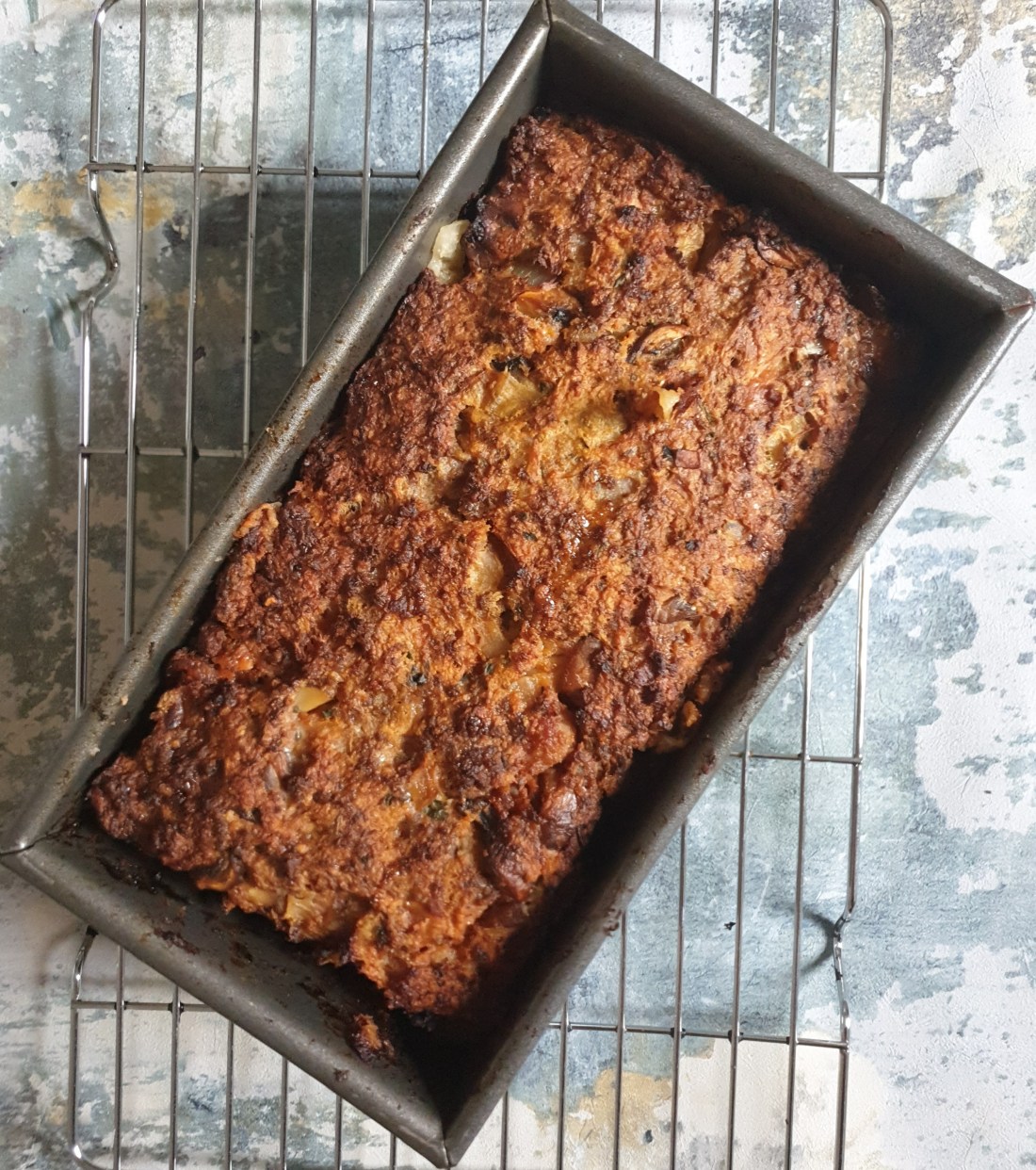
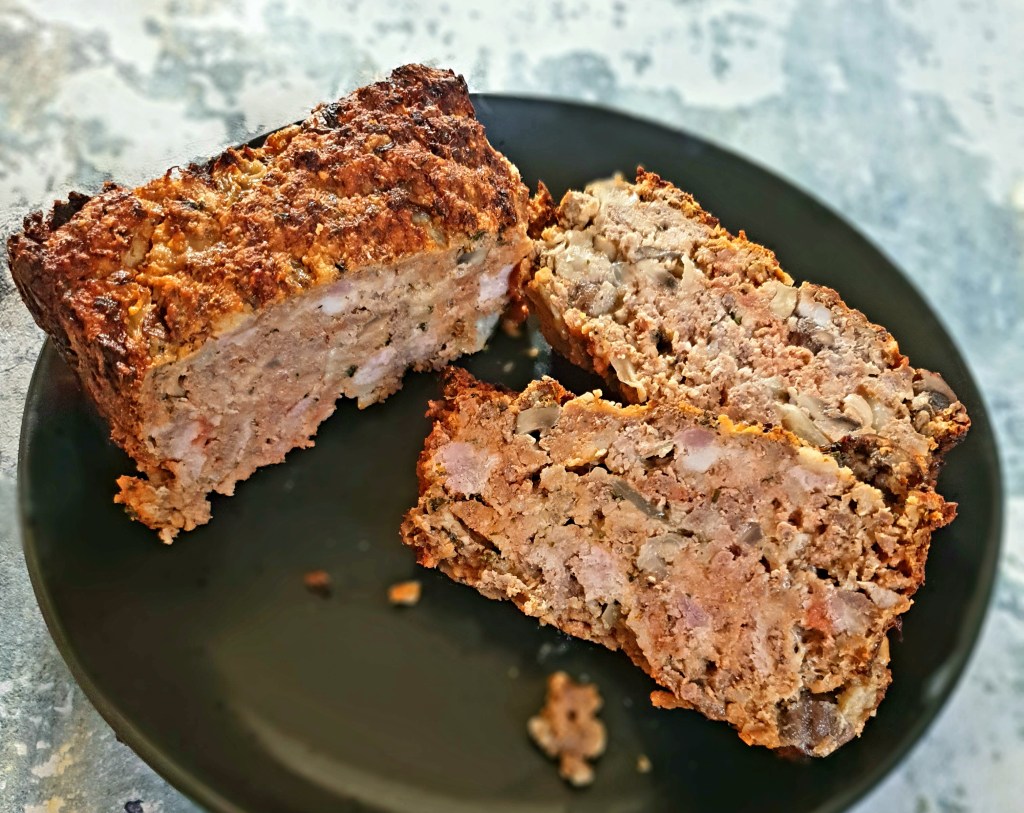
Sliced warm, it didn’t quite keep its intended loaf shape – entirely my fault, but not very helpful in boosting the overall attractiveness of the meal. That said, it didn’t look as awful as I’d imagined a whole tin of squashed meat would. There was a pretty satisfying brown and crunchy top to the meatloaf which, once broken, revealed a surprisingly tender and moist interior. I was delighted to find that the crumbly dryness I’d been expecting was no where to be seen – it was like eating a lasagne without pasta and was quite delicious.

The mushrooms and white sauce lent the whole thing a pleasantly silky texture as well as preventing dryness. The tomato paste gave a surprisingly strong “vegetable” taste that threatened to distract from the beef and sausage meat, a combination that worked quite well, although I would have preferred more sausage meat than Patten used in her recipe.

I wanted to see what it tasted like cold, though, so a couple of hours later I cut a slice from the refrigerated leftovers. The flavours had intensified, with the beef becoming more prominent in particular and the tomato taking a welcomed backseat. The texture had become a little chunkier and less smooth too – it was somehow more robust. Overall I think I preferred it cold, as Patten had intended.

Tastier but still kind of ugly when cold.

Despite my limited pop culture references leading me to believe meatloaf was a bland meal, I didn’t find it bland at all and my husband and daughter seemed to wolf it down. However, the overall presentation and fact that it was best eaten cold meant that it would be out of place at a dinner party.

If I was going to a picnic though, and wanted something that tasted great but didn’t make me look too try-hard, I would absolutely make this again. Likewise, I could see this being a much enjoyed family meal if I had time to prepare, cook and chill it properly. And that, I think, is the beauty of meatloaf. It’s not trying to be anything more than it is – occasional family meal, satisfying picnic lunch, theatrical aging rock star – it’s all good.

E x

Meat Loaf

28g margarine
2 onions
85g mushrooms
28g plain flour
1/4 pint of milk
2 eggs
Teaspoon Worcestershire sauce
Teaspoon salt
Teaspoon mixed herbs
28g Parmesan cheese
1 tablespoon chopped parsley
3 tablespoons tomato puree
85g pork sausage meat
450g minced beef
85g breadcrumbs

  1. Melt margarine in a saucepan and add the onions, chopped. Cook until soft but not brown.
  2. Dice the mushrooms and add to the softened onions. Cook for 1 minute.
  3. Add the flour and stir through the mushrooms for 1 minute. Keep stirring to prevent lumps forming.
  4. Once the flour has been absorbed, add the milk and stir constantly until the sauce is thick.
  5. Remove from heat and allow to cool to room temperature.
  6. Heat the oven to 200 degrees C.
  7. Add the remaining ingredients to the onions and mushrooms and mix thoroughly.
  8. Press the meatloaf mixture into a loaf tin and bake for 1 hour – 1.5 hours.
  9. Remove from oven and allow to cool in the tin before transferring to a wire tray. Wrap the meatloaf in greaseproof paper and place in the fridge for 2 or 3 hours before cutting into slices.

Globi: c. 160 B.C.

How do you pronounce ‘globi’? Is it glob-ee? Glow-bee? Glob-eye? Does it really matter when they all sound just as unappetizing as each other? When I saw the title of today’s experiment I assumed it would be for some sort of hideous fish, oozing mucous and slime and served on piles of raw seaweed – that sort of thing. I don’t know why I bothered to read the rest of the recipe, to be honest.

Luckily for me, it turned out that globi weren’t anything to do with mucous-y fish at all. In fact, once you got over the unfortunate name they actually sounded quite delicious: balls of fried cheese covered in honey and poppy seeds. ‘Globi’, meaning spherical in Latin, was therefore a description of the dish’s appearance rather than a gooey sea creature.

The recipe was from Cato the Elder’s De Agri Cultura, the oldest surviving work of Latin prose, which I found in The Classical Cookbook. It’s written in Cato’s usual uptight and stoic way and was intended to be a useful manual of the rules of farming and agricultural management for those rich enough to own large farms (or be looking to expand smaller farms), or those who wanted to create profitable agricultural businesses. The average large Roman farm would usually be staffed by slaves, as many profitable businesses in Ancient Rome were, and so parts of De Agri Cultura are also concerned with how to manage the slave-labourers. It’s here we can see the more jarring elements of Cato’s writing; he talks about the slaves on the farm as if they were any old farm tool rather than people, and advises masters to work slaves constantly before selling them alongside “worn-out” animals and objects when they become too weak, old or sick:

“Sell worn-out oxen, blemished cattle…old tools, an old slave, a sickly slave and whatever else is superfluous.”

De Agri Cultura, 2.7

Really nice guy, right? Though Cato’s thoughts on slavery should be viewed within the context of the Roman Republic – a society built on the belief that slavery was a necessary element to a successful civilization – his opinions were still considered extreme by some. As Rebecca Gove notes, the poet Seneca, for example, viewed slaves as conquered people who needed to be supervised in order to ensure efficiency, but deserved more dignity and compassion than was given to animals, warning overly harsh masters that “[Slaves] are not enemies when we acquire them; we make them enemies.” That doesn’t mean Seneca was sympathetic to slaves, just that he thought they worked better when they were well treated.

When he wasn’t advocating the sale of exhausted humans in the name of good farm management, Cato could be found loudly supporting laws designed to restrict women’s wealth. I know, I was shocked too. The Lex Oppia was the first in a number of sumptuary laws established in 215 BC which specifically banned women from owning more than half an ounce of gold, wearing purple clothes or ride in a carriage in the city of Rome (or any town within a mile of Rome). This might seem shocking now, but sumptuary laws were a very common way of controlling the status quo and maintaining social order and continued for centuries after the Roman Republic – and not just in Rome, either.

There’s a bit of debate surrounding the Lex Oppia and whether it was a “true” sumptuary law or whether, because it was introduced during the peak of Second Punic War between the Roman Republic and the Carthaginian empire, it’s better to view it as an emergency wartime measure to protect the wealth of Rome. Either way, by 195 BC the people of Rome, having beaten the Carthaginians, felt it was time to repeal the law.

But who argued that women simply couldn’t be allowed to grow their wealth and wear fancy clothes again? Why, our man of the people – Cato. His reasons for upholding the law were varied but centered mainly around the argument that women would instantly resort to competitive dressing which would shame those who couldn’t afford the best clothes. Alternatively, he argued that all women were afflicted with an insatiable desire to spend money – an urge he likened to an incurable disease – and therefore the Lex Oppia was a kindly restrictive measure to prevent the poor unrestrained dears bankrupting themselves.

Not a fan of Cato, we get it.

I know, I know: it’s anachronistic to apply modern sensibilities to the past… sorry. Still, when he wasn’t working his slaves to the point of death or stopping women from wearing silk underpants or whatever it was he had a problem with, Cato came up with some pretty decent recipes.

I’d covered his libum (also from De Agri Cultura) with success so I had high hopes for globi in spite of their dubious name.

To begin with I needed ricotta cheese. Now that I’m a bit more experienced at cooking I thought I’d try and make my own. I felt pretty cocky about this; cheese-making always seemed so difficult and something that “real” cooks did. I swanned off to alert my husband to my newly acquired status as master chef.

“Oh yeah? Ricotta’s pretty easy isn’t it? Do you want any help?”

Not the reaction I’d hoped for.

I heated 1 litre of full fat milk until it was just under boiling and added 30ml of white wine vinegar. The Roman author Varro wrote about cheese making, stating that fig sap and vinegar could be used to coagulate milk into soft cheese. I didn’t have any fig sap and when I asked my mum if I could cut a twig off the ailing and temperamental fig sapling she’s been attempting to grow for years she hung up on me. So I just had to hope that the vinegar alone would do the trick.

Every instinct in my body told me not to eat this.

True, it looked like a yoghurt I once left in my locker over the summer holiday but I was confident it would all work out for the best. After ten minutes of it coagulating I poured it into an old muslin cloth and left it to drain overnight.

The next morning I had been rewarded with 150g grams of creamy, cheesy ricotta. Success! I added 80g of semolina to the cheese and mixed it together to form a thick paste, which I shaped into large olive sized balls.

Each ball fried in a pan of olive oil until it was golden brown before being transferred to a kitchen roll covered plate to mop up the excess oil. The globi were then drizzled with honey and rolled in poppy seeds before being “artfully” arranged on a plate.

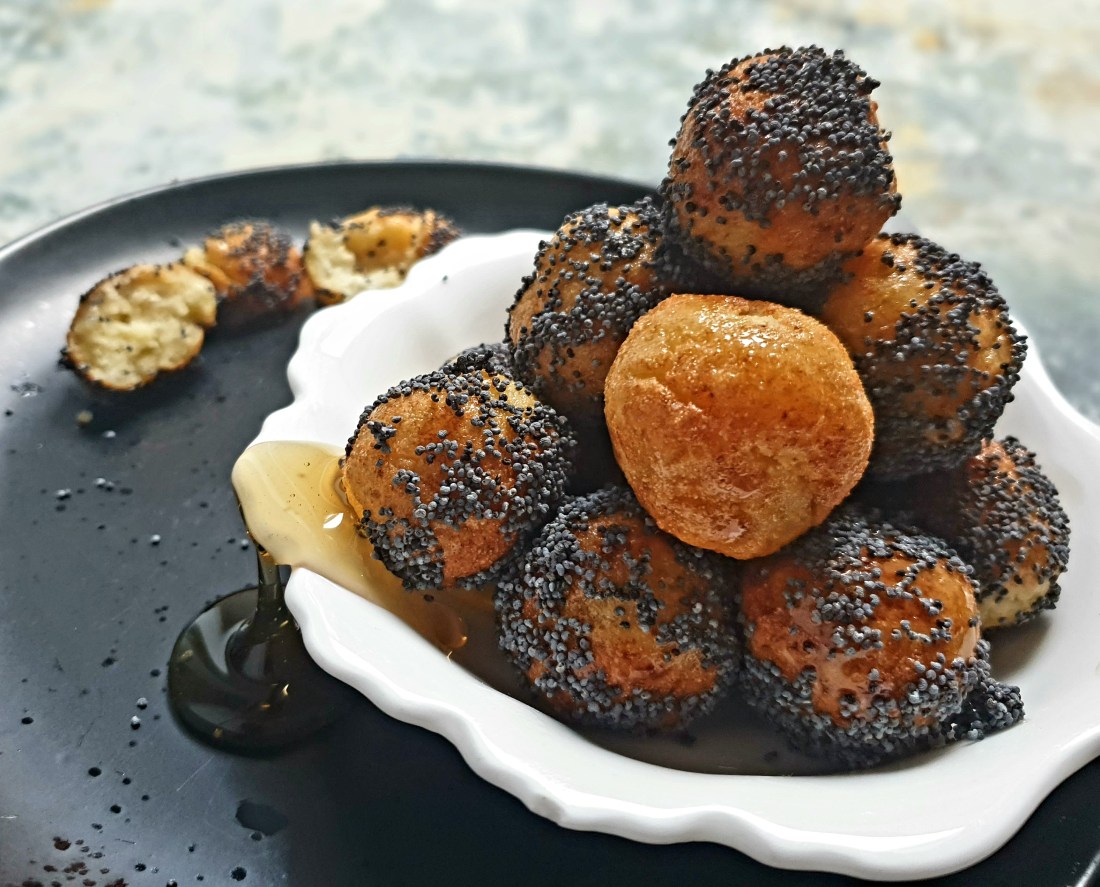
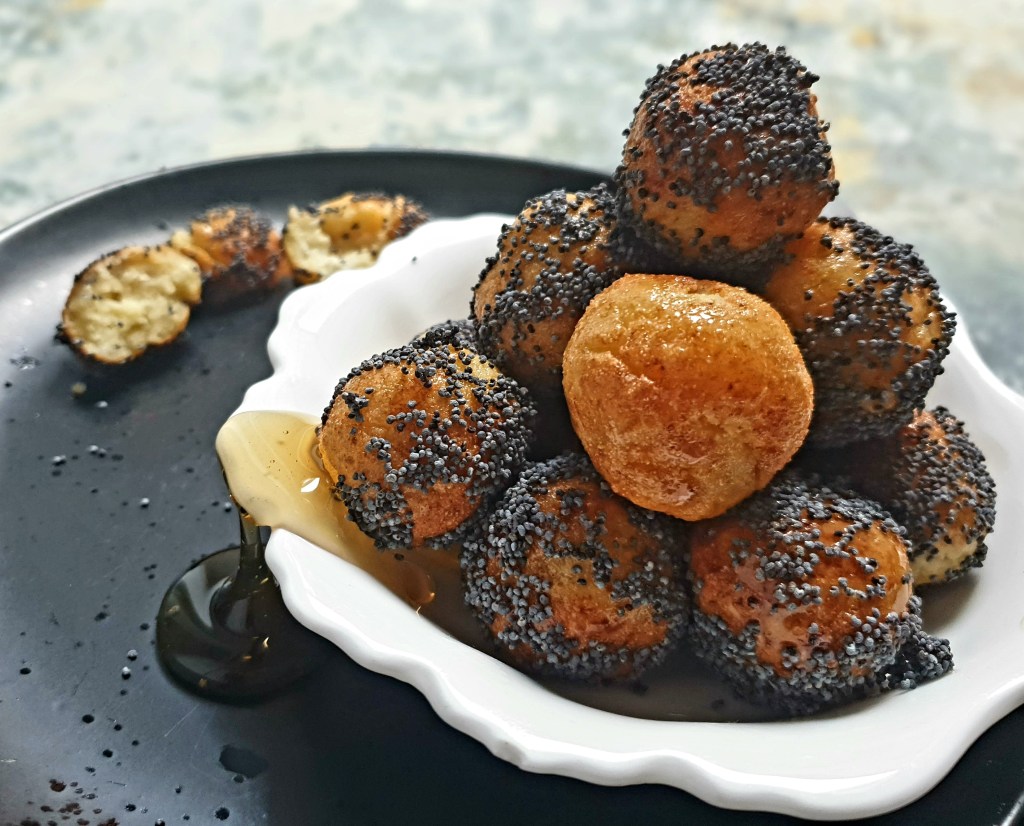
Looks fancy, right? I had to lie on the cold kitchen floor and get my husband to squat above them, squeezing honey onto the plate to get just the right kind of drip. Less fancy now, I bet.

As you can see, they look pretty great. Elegant and easy – they only had to be tasty and I’d have pulled off a cooking hat trick. And they were!

The globi themselves were quite creamy and mild in a savoury kind of way, which made them very different to modern sweets. All of the sweetness came from the honey and the beauty of that meant they could be sweetened to personal taste by having only enough of it drizzled on to get the poppy seeds to stick, or by being served with a side bowl of it to dunk them in. It’s probably not a surprise to anyone that I opted for the sweeter option.

Texture wise they were slightly gritty, thanks to the semolina, but it was a grittiness that was enveloped in smooth ricotta, so it wasn’t very noticeable and certainly not unpleasant.

In the end I was actually a little put out by how easy it was to make these. What with the cheese-making and the frying, I’d sort of assumed these would safely earn me my place in the hallowed halls of advanced cookery but I felt a bit of a fraud by the end. Still, as I handed my husband the honey and told him to help with the photos I pretended to wipe sweat off my brow and sighed with the imaginary effort of it all.

I think he bought it because afterwards he offered to do the washing up and I got to sit on the sofa with my feet up, dipping globi into warm honey with reckless glee. Win!

E x

Globi

150g ricotta (or you can make your own by heating 1l of full fat milk until just below boiling and adding 30ml of white wine vinegar. Stir for a few minutes then leave to coagulate. After 15 minutes, pour the mixture into a cheesecloth with a bowl under it to collect the whey. Leave it for at least 30 minutes, or overnight for a firmer cheese.)
80g semolina
Olive oil for fying
Honey to taste
75g poppy seeds

  1. Mix ricotta and semolina together to form a paste.
  2. Heat olive oil in a frying pan until it is glassy and sizzles when globi are placed in it.
  3. Fry each globi, two at a time, in the oil until golden brown.
  4. Drain the globi on kitchen roll, then drizzle over as much honey as you like.
  5. Roll the globi in poppy seeds and enjoy.

A Bengali Meal: 16th century

Today’s post is weirdly long and personal, so if you’d prefer to switch off now I won’t blame you. We always think people are more interested in our backstories than they actually are, and I’ve definitely fallen into that trap with this post. Go and watch the TV. Go outside and enjoy the sun. Hell, lie down and stare at the ceiling for 10 minutes – I can guarantee it will be a more interesting use of your time.

For hardcore fans (hi dad), or those too lazy to click off – don’t say I didn’t warn you.

My grandad was born in India, in West Bengal in the 1930’s. Back then it wasn’t called West Bengal; it wasn’t until 1947 that Bengal was partitioned, with the Eastern section becoming part of the newly created Pakistan and the Western section, the part my grandad’s family lived in, remaining in India. Grandad used to say he remembered sitting on the roof of his parents’ house watching a seemingly never ending line of Hindu migrants – his family – who had found themselves on the “wrong” side of partition, walking down the road towards the house and wondering what on earth they were going to do. All these displaced aunts, uncles, cousins…where would they sleep? Would there be enough food? Would they be staying long?

Grandad aged 8 and getting ready for a festival. Have you ever seen a less excited child?

A few years later he moved to Britain to do post-grad research having already graduated from the University of Calcutta. The post-grad also allowed him to avoid the threat of an arranged marriage he didn’t want to be a part of. In Britain he worked as an inventor and sent sketches of his inventions to be turned into blueprints at the draft department of the company he worked for. After a year or so, one of the draughtswomen made a mistake with the measurements and he visited the department to help fix it. Six months later he was engaged – this time of his own volition – to the draughtswoman who had cocked up the measurements (though she maintained it was his dodgy drawing that was at fault.) The rest of his time was spent convincing his new mother in law that a mixed marriage wasn’t the end of the world and that yes, actually, people with darker skin and foreign names (the horror!) could be just as intelligent, funny and kind as the white people she met with to drink tea and judge others. In his case, more so. Great grandma came round to having “one of those Indians” in the family eventually…

Britain wasn’t always hugely accepting of immigrants in the 50’s. Or 60’s. Or 70’s. Or… you get the picture. I know there were some dark periods for grandad and so, to try and lessen the target on him and his family he Anglicized as much of himself as he could. He changed his name to one that sounded more English. He rarely spoke Bengali again and didn’t teach it to his children. He accepted jobs at engineering firms that required him to regularly relocate to new countries in order to “get rid” of him while still benefiting from his labour. He took it all in his stride and ironically ended up with a work history so rich and international that by today’s standards it would be akin to that of a successful global businessman.
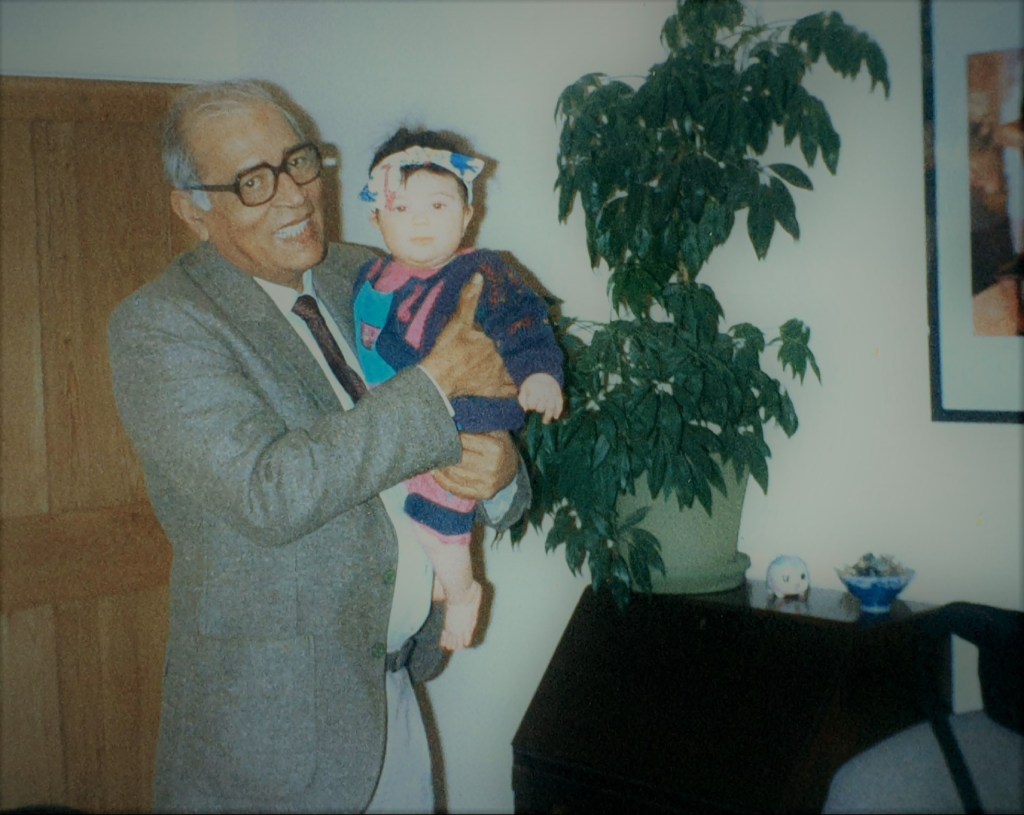
By the time he retired he had become a public serving and well respected member of the community and he began to revisit his Bengali roots. When my sister and I visited as children he’d tell us folk stories from his own childhood, play old Indian records for us and we’d try on my aunt’s bindis and saris. We’d have brilliant but bizarre “fusion” dinners of samosas, dal and spag bol followed by rasmalai and apple crumble and there were always plates of Bengali sweets bought from the Asian market which he’d encourage us to wolf down before our parents came to collect us. At the time I thought this was the greatest thing ever but now I’ve had a child and can imagine the sugar-hyped car journey home, it seems like an unbelievably evil thing to do to my mum and dad.

Adorable but irresponsible actions aside, I only knew him as grandad. Sweetie junkie, “Big Giant”, king of farting and blaming it on the dog – this one’s for you. Miss you.

Medieval India…

…was not like medieval England, I have realised (give me my PhD now.) I admit, this might seem obvious to everyone given the thousands of miles between Britain and India – not to mention the size difference in land mass. But it’s more than that. Even the term “medieval India” is problematic because from a British-centred world view it implies conformity with Western dates, which isn’t necessarily the case. What’s called “medieval India” spans from roughly the 6th-18th centuries CE, with numerous and complex eras as part of this lengthy time period.

Whereas post-10th century medieval England was ruled over by one king and one king only, the same was not true for India, which maintained local and regional dynasties throughout this period. Some historians, such as Ram Sharan Sharma, have drawn comparisons with the European feudal system; local Indian rulers were given power and land in exchange for service and loyalty to the dynasty. These dynasties were shaped and developed by various cultural traditions, including agriculture, but also by religion. It’s impossible to overstate the complexity of the history of religion in India, but if you thought religion in medieval and Renaissance England was fraught and exhausting, you’re going to want to take a breather before seeing what was going on in India at the same time.

It won’t be a surprise to learn that the cuisine of 16th century India wasn’t unified either. As a vast country benefiting from lots of different climates, the people of Bengal – which I’m focusing on – would have had access to different ingredients than the people of, say, Punjab.

Early 11th century texts such as the Charyapadas describe Bengal as being a region of fishing, hunting and of growing rice – but make no reference to dal at all. In fact, it’s not until the 15th century that dal is mentioned as a dish. Chitrita Banerji commented that the abundance of fish in Bengal made dal unnecessary as a source of protein and that its introduction to Bengali cuisine in the 15th century coincided with the Bengali emergence of the Vasishnava Bhakti sect – a branch of Hinduism that promotes vegetarianism.

Fortunate is the man whose wife serves him on a banana leaf some hot rice with ghee, mourala fish, fried leaves of the jute plant, and some hot milk on the side.

From the Bengali text Prakritapaingala, c. 1400

To this day Bengal remains a region devoted to rice, fish and sweets. There’s even a proverb: Machhe bhaate Bangali – a Bengali is made of rice and fish. Pre-colonial Bengali cuisine was also exceptional among other Indian cuisines because it evolved a set-course structure, with one dish being served after another, while other regions favoured serving dishes at the same time. A Bengali meal would generally start with Shukto: a bitter dish, followed by Shak: leafy veg, followed by Dal: pulses, followed by vegetable or meat dishes, followed by Chatni: chutney, before finishing with sweet dishes.

There are a few “medieval” Indian cookbooks – but most references to food and meals comes from literary works of the time such as the one I’m using today, the Chandimangal. The Chandimangal is a mangal kavya – a narrative poem about the deities as they established their cults on earth. The genre was hugely important to “medieval” Bengali literature and flourished during the 13th-18th centuries. In the Chandimangal there are literally hundreds of references to food – all described in vivid detail from the tantalising “jhasha fish in tamarind sauce” to the unappetizing “nasty porridge made from old rice-dust” to the downright confusing: “[Dhanapati] ate yogurt and treacle with a crunching noise.”

20th century painting of scenes in the Chandimangal by Ajit Chitrakar. Credit: V&A Museum.

It’s important to remember the foods of the Chandimangal represent the diet of the wealthy – the Brahmins and Kshatriyas of the Hindu caste system. Ordinary Hindus – Vaishyas and Shudras – wouldn’t have had everyday access to the wealth of meat, spices, fruit and sugar mentioned in the text (and the “untouchable” Dalits would never have had any access at all.) As is often the case in this time period, the voices of the poor have unfortunately been lost.

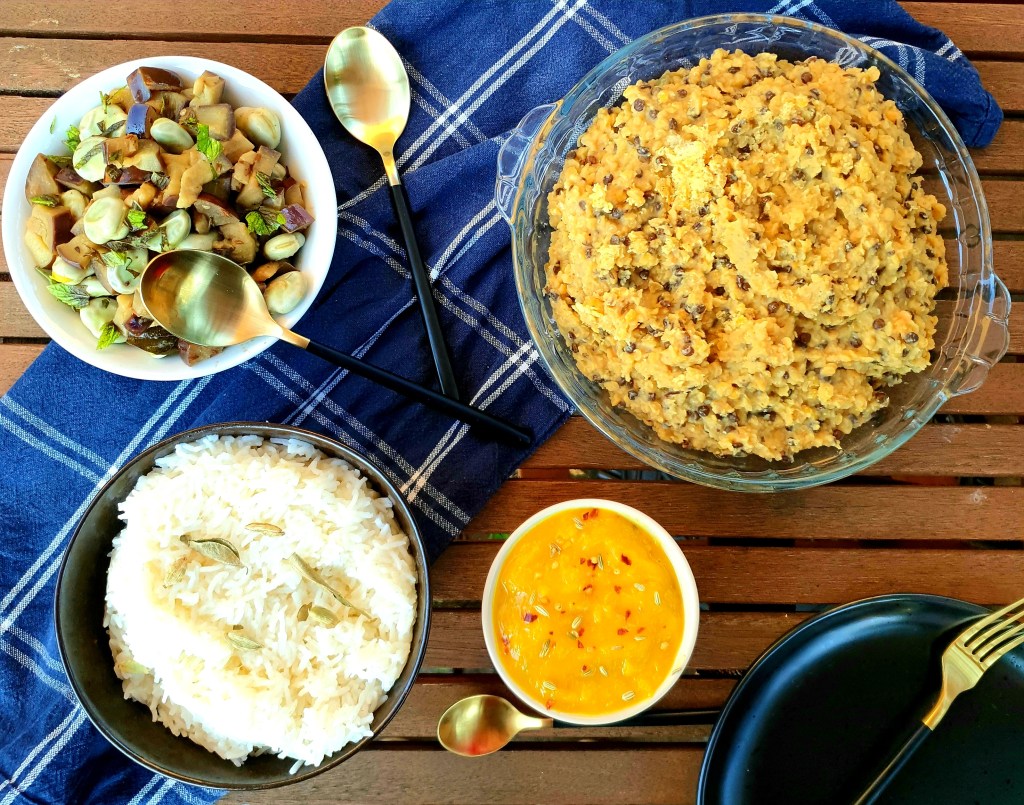
I really wanted to recreate some of the fish dishes but it was impossible to get hold of any of the fish mentioned in the Chandimangal in my area of the UK – I’m not even sure Heston Blumenthal has access to clownfish, which are lovely fried in mustard oil, apparently. In the end it was whittled down to seven dishes from the text – a 16th century Bengali feast in honour of my grandad.

Dal.

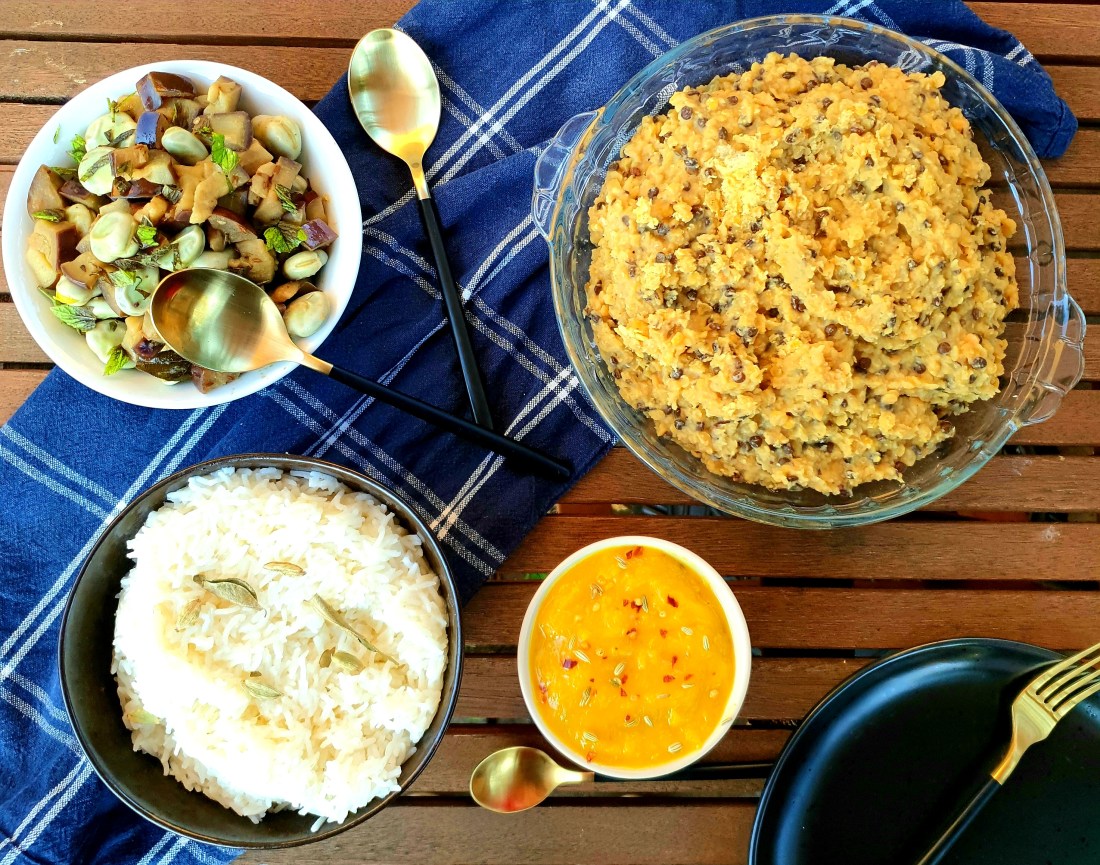
The first thing I wanted to get started was the dal. The Chandimangal recipe for red lentil dal was so simple I could have wept tears of joy. Red lentils, black gram, cardamom, cloves and a pinch of pepper. That was it!

When I make dal in ordinary circumstances I often add chopped onion but very early Indian texts don’t mention onions at all. Since 1500 BCE, onions, which had been introduced to India from South West Asia and Afghanistan, were seen as the food of hated rival tribal populations and foreigners and though they grew well in India, they weren’t mentioned in any of the Vedas at all. As Colleen Taylor Sen speculates, this may have been because they were associated with “despised indigenous people” or were seen as unclean because of their smell and eye watering properties. The avoidance of onions would continue well into the 16th century where they were used more often, but always with a whiff of taboo. A quick check of the Chandimangal showed me that onions were entirely absent in the text, so I knew it wasn’t a hidden ingredient to add at my discretion, but rather one which had been deliberately omitted.

I heated the spices in a little ghee to release the flavour while the lentils cooked in salted water. Once they were soft the whole lot was mixed and seasoned with a pinch of long pepper – a type of pepper native to India and which is sometimes called Bengal pepper; I took this as a pretty solid sign it would have been used in this dal. (Also I’d bought a tin of it for a previous experiment at a stupid price and wanted to prove to my husband that it hadn’t been “yet another expensive ingredient you’ll never use again.” I know he loves this hobby of mine really…)

Shukto.

Next it was the Shukto – the bitter dish usually served at the start of a meal. I heated asafoetida, fenugreek and cumin in ghee before frying broad beans and diced aubergine. The text also mentioned the addition of neem leaves, which I didn’t have, so I used curry leaves instead to mimic the appearance of neem leaves and moved on to the next dish. So far, so simple.

Mango Chutney.

After this it was time for mango chutney. All I had to go on in the text was that it was meant to be “yellow coloured”. “Well it’s just chutney,” I thought to myself. “How much could it have changed in the past 500 years, really?”

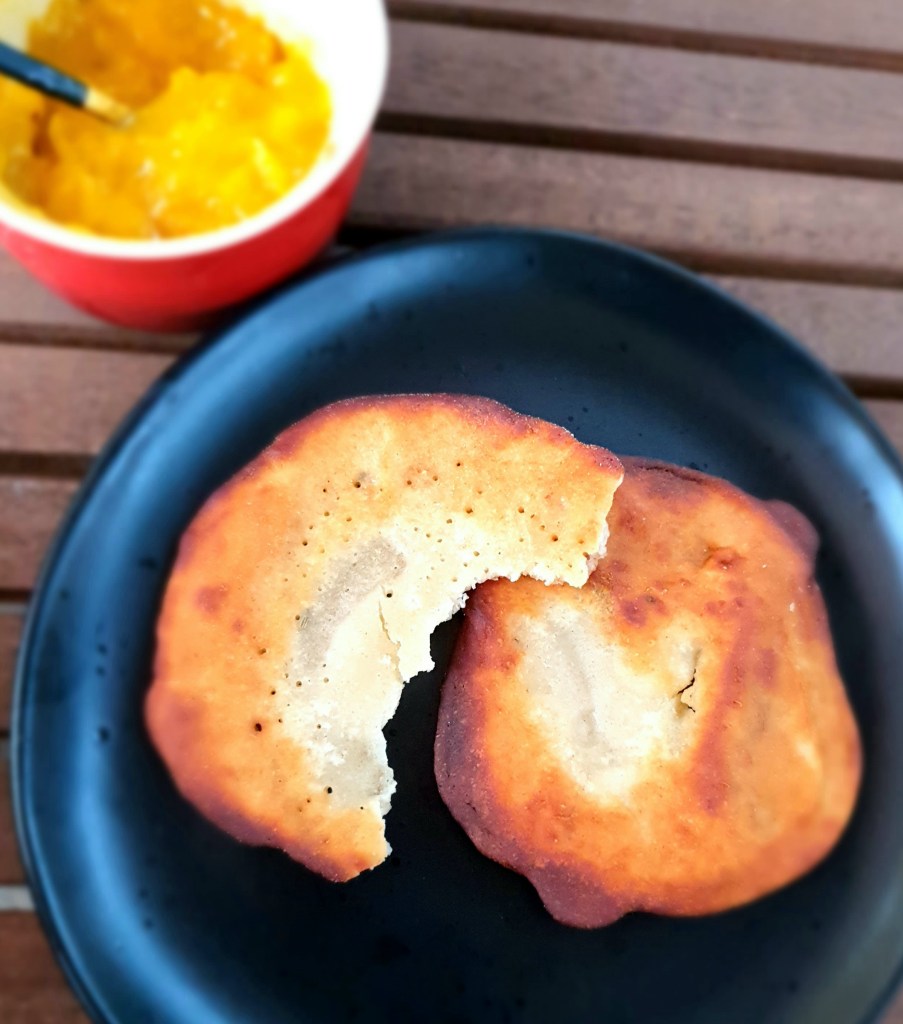
Turns out the answer is: a lot. Loads. There are over 28 million hits if you Google “mango chutney recipe”. I had to find a recipe that used only ingredients mentioned in the Chandimangal, or sort of make it up. I opted for a mix of both. After peeling and chopping two mangoes, I ground mustard seeds in a pestle and mortar until they were an oily mush, which I heated in a large frying pan. To this I added turmeric, fennel seeds and ginger that I’d pounded into a fibrous paste. Once it was heated through I added the mangoes, some salt and sugar and covered with a cup of water, leaving it to reduce for about an hour until it was a lovely thick golden yellow. This was the part of the meal I was looking forward to the most.

Liquid gold.

Shor Bhaja.

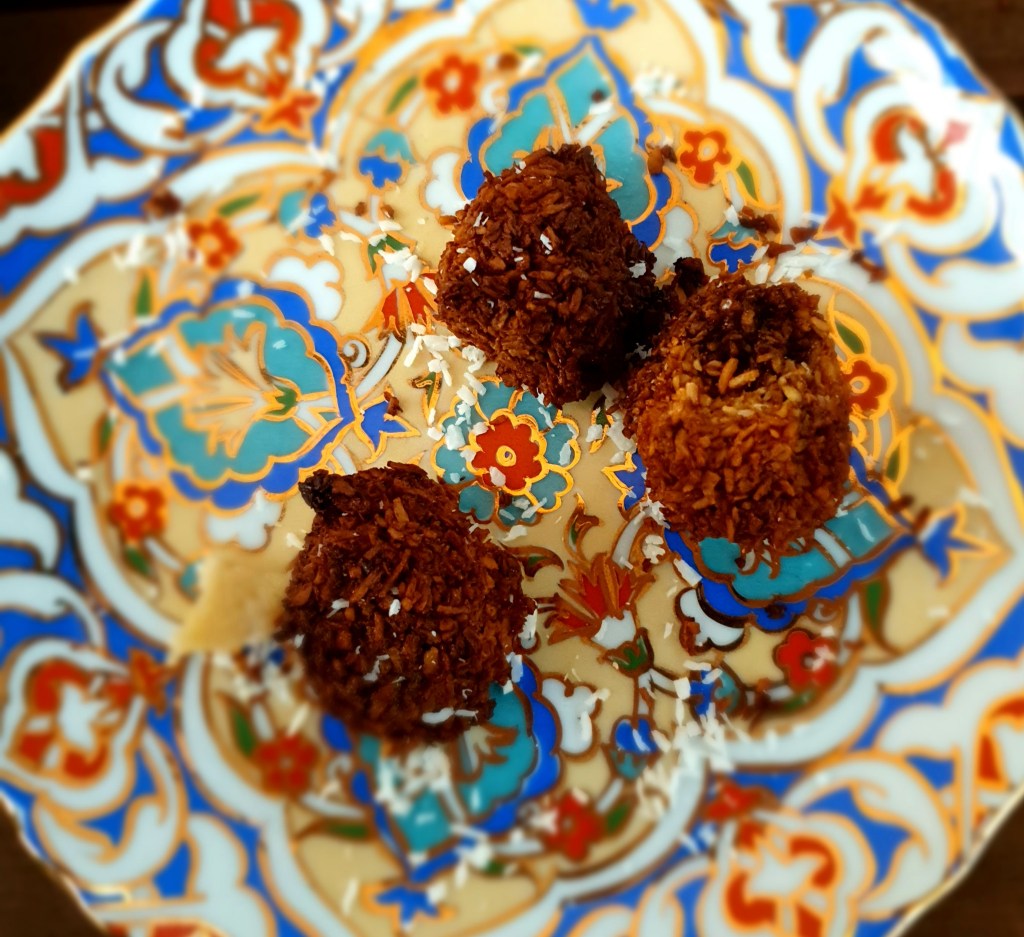
At least, it was the part I was looking forward to the most until I saw what I could make for pudding: Condensed. Milk. Sweets. These were mentioned numerous times and I got so excited when I saw them. People who know me for five minutes will know that I think of condensed milk as being a Very Positive – nay, an entirely necessary – part of life, but the milk sweets in the Chandimangal didn’t require any English condensed milk at all. It was a much more literal meaning – condensing a pan of milk down to cream by boiling the liquid off, exactly as shor bhaja are made today.

First I brought a litre of full fat milk to just simmering and as the cream floated to the surface I gently pushed it to the edge of the pan where it clung to the sides, drying. Once the creamy dregs stuck to the pan had dried out I scraped them out and onto a plate, where they sat like scrambled egg, congealing in a quiet and disgusting way. I couldn’t help notice that after twenty minutes I had the most minute scrapings on the plate and still a litre of milk to get through. Still, I was sure things would pick up soon.

Three and a half hours later I scraped off the last creamy dreg. My feet ached. My back ached. I hadn’t left the pan for longer than two minutes – it was 25 degrees out but in my little kitchen, with steam rising off the pan and a window that only half opened, it felt like 250 degrees. In the time it would have taken me to make eight trays of muffins (and eat them all), I had just enough cream solids to fit in my palm. What kind of sick culinary joke was this?

I angrily shaped the cream into a rectangle and cut out ten small squares, which were then dusted in rice flour and fried in ghee until golden brown. I ignored the alarming amounts of ghee seeping off the fried shor bhaja as they sat on sheets of kitchen paper, and got to work on the sugar syrup. As ancient Bengal had been famous for its superior quality of cane sugar, I mixed golden caster with water and added cardamom pods to flavour the syrup, which were mentioned in other sweets in the Chandimangal so may have been used here too.

Cream, fried in ghee, drowning in syrup. I do not see a problem with this.

Balls of coconut and molasses.

The next sweet dish mentioned was blessedly easy – coconut and molasses. To half a bag of desiccated coconut I added four teaspoons of molasses and rolled it into golf sized balls. I wasn’t sure whether they should be cooked or eaten raw so I tried one and winced at the pungent treacly flavour. I ended up baking them for 10 minutes or so to toast the coconut which I hoped would lessen the strength of the molasses.

Balls of syrup and fruit or nuts had been around for millennia and it’s likely that these coconut and molasses concoctions had been influenced by earlier dishes. From tablets dating to about 1750 BCE, we can see the existence of mersu – a popular ancient Babylonian dish of dates and nuts chopped up and rolled into balls. In 529 BCE the Achaemenid Persians took control of Babylon, formally ending the Babylonian empire. The Persians preferred to assimilate conquered civilisations into their empire rather than destroy them, so production of Babylonian food like mersu continued under early Achaemenid rule. As a form of taxation from the regions they conquered, Persian kings would insist on lavish banquets being laid out whenever they visited. Herodotus tells us that Xerxes demanded such lavish banquets wherever he went that if he stayed in one region for longer than a day he risked bankrupting the area (my kind of guy.) Herodotus also tells us that the Persians were excessive in their love of sweet food, so when Darius I invaded the Indus Valley in 518 BCE and incorporated parts of India into the Persian Empire, it’s likely he brought sweets like mersu with him, which may have been the inspiration for these coconut balls.
Though these were just coconut in sugar, somehow they still weren’t the sweetest thing on the table.

Sweet rice pancakes.

The final dish to be made was sweet rice pancakes. These were mentioned several times and it wasn’t always clear what their function was. Sometimes it seemed like they were being eaten as a dessert, sometimes as a snack and sometimes they were eaten with chutney. I decided to serve them with the other desserts, but they may have had multiple functions in a meal rather than just pudding.

Modern day Bengali rice flour pancakes are called patishapta and look a bit like crepes stuffed with coconut and thick milk filling. I’ve never tried one, but they sound delicious. The only thing stopping me making them for this experiment was that there was no mention of a pancake filling in the Chandimangal. In fact, from the references to being eaten with chutney it made me think that the pancake shouldn’t be too crepe-like, but more of a sturdy tool to scoop chutney and sauce up with.

The modern day malpua pancake seemed to fit this description and an early form of it called apūpa had been eaten by people since the Vedic period. Malpua are incredibly popular in West Bengal today and there are many variations of them. More importantly, malpua can be enjoyed with a variety of dishes, which fits in with the slightly ambiguous use of them in the Chandimangal.

In order to be as historically accurate as possible I mixed rice flour with a little barley flour, since barley and rice (not wheat) had been staple crops of Bengal since ancient times, then added milk, jaggery and fennel seeds and mixed it into a thick batter. After letting it rest for a couple of hours, I heated up yet more ghee in a deep frying pan until it was very hot and spooned a large dollop of malpua batter into the sizzling fat. Each side was fried for two minutes before being lifted out and left to drain on kitchen roll. Traditionally, malpua are served with syrup, but there wasn’t a reference to syrup being eaten with them in the Chandimangal, so I didn’t make one.

Delicious with or without chutney or syrup.

Going to tell us what it all tasted like?

I’ll try and wrap it up quickly.

It was all delicious.

Too quick?

Rather than serve the dishes one by one I chose to break Bengali tradition and served the savoury dishes all together, followed by the sweets. It just seemed easier and to be honest I’d chosen the hottest day of the year to spend in the kitchen over pans of boiling ghee and milk, so I didn’t have the energy to keep trotting back and forth with bowls of food.

Despite its moniker as “the bitter dish” the shukto wasn’t bitter at all. It was pleasant and aromatic, but bitter it certainly wasn’t. I wonder if aubergines of 16th century India were more strongly flavoured than they are today. Sprouts have famously been cultivated so that the bitter ones die out; could something similar have happened to aubergines? If anyone knows (or has any fancy theories), let me know.

The dal was glorious, as dals often are. I was worried it would be a bit bland but it wasn’t at all. Creamy, thick and rich with a lovely fragrant cardamom and clove heat to it, this was something we ended up eating cold the next day for lunch.

The mango chutney went particularly well with the dal. It was nothing like shop bought chutneys, which are often very sugary. This had a fruity sweetness to it and was much thicker than shop bought chutneys. It also packed a punch! There was a definite heat and firey aftertaste that built slowly at the back of the throat thanks to the mustard oil and a sprinkling of dried chili flakes. After making this it’s very obvious to me why chutney was served as a dish on its own; I could have eaten a whole bowl of it without needing anything extra.

A bowl of white rice with ghee made a good accompaniment to the meal and was mentioned numerous times in the Chandimangal. It’s unlikely the rice of 16th century Bengal would have been basmati rice, though, as basmati would struggle to grow in the Bengali climate, more likely it would have been boro or aman – neither of which were available to me.

So good I can’t even think of a funny thing to say.

Then it was time for the desserts.

The shor bhaja were obviously what I was most intrigued by – cream fried in butter with sugar syrup sauce? I made sure I had paramedics on speed dial for when the heart attack began, and took a bite. It was unlike any Western food I’d eaten. So hard to describe. Imagine taking the crust off clotted cream, then deep frying it (I know that’s already hard to imagine) so you get that buttery doughnut fried taste. Instead of rolling the shor bhaja in sugar like a doughnut, though, they were dipped into lightly cardamom spiced syrup which glazed each piece and oozed into every pore. Thank God the four hours’ work only yielded ten delicious pieces because these were literally lethal.

Baking the coconut and molasses balls had done little to alter the taste, but they were much drier than when raw. They weren’t unpleasant but were definitely an acquired taste, as treacle can be. I could only manage half a ball but my husband, who has invincible teeth, ate four in one go.

And finally: the rice flour malpua. These were a bit of a standout, actually. Faintly sweet but with a subtle anise-like flavour in the background, these pancakes were incredibly moreish. They were crisp and buttery on the outside but snapped open to reveal soft pillowy centres of sweet rice-y goodness. On their own they were delicious, but with mango chutney they were divine.

Heaven on two plates, at least.

So what would grandad have made of all this? Well, though he loved eating Bengali food, he wasn’t much good at cooking it himself. When my dad brought my mum home to meet his family for the first time, grandad said he’d cook a curry to mark the occasion. And he did – with a chicken and a jar of HP Curry Sauce.

Happy eating – I’m off to lie down for a week.

E x

Dal

320g red lentils
250g black lentils
7 or 8 cardamom pods
7 or 8 cloves
Ghee
Black pepper/Long pepper

  1. Cook the lentils in water until soft – about 20 – 25 minutes.
  2. While the lentils are cooking, heat the spices in a pan with the ghee to allow the flavours to mingle. Bash the cardamom pods a little to release the seeds.
  3. When the lentils are done and the spices have been heating gentle, add the lentils to the ghee. You may want to remove the spices from the ghee before hand to save you having to watch out for them during the meal.
  4. Sprinkle over a little pepper and serve.

Shukto

1 aubergine
500g broad beans (unpodded)
1 teaspoon asafoetida
1 teaspoon fenugreek
1 teaspoon cumin seeds
Ghee

  1. Heat the spices in ghee to release the flavours.
  2. Dice the aubergine and pod the broad beans (but keep them whole.)
  3. When the spices are heated, add the aubergine and broad beans and fry for 7 or 8 minutes.

Mango Chutney

2 mangoes
2 teaspoons mustard seeds
Thumb’s worth of ginger
1 table spoon vegetable oil
Fennel seeds
Turmeric
30g sugar
Salt
Water

  1. Peel and chop the mango into slices and cover with a pinch of salt.
  2. Crush the mustard seeds in a pestle and mortar to form a paste. Add the paste to a pan with the vegetable oil and fennel seeds and heat.
  3. Pound the ginger to a fibrous paste and add it to the mustard oil. Heat for 2 or 3 minutes.
  4. Add the mangoes and turmeric and cook for 10 minutes on a low flame.
  5. Add just enough water to cover the mangoes and add the sugar.
  6. Cook until the water has reduced and the chutney is the desired consistency.

Shor bhaja

1 litre gold top milk
250g sugar
150g water
4 or 5 cardamom pods
Plain flour (a tablespoon or so)
Ghee for frying

  1. Make a sugar syrup by boiling sugar, water and cardamom pods together until it reaches syrup consistency (about 110 degrees c). Set aside.
  2. Put the milk in a non stick pan and bring to just below simmering.
  3. As the cream rises to the top, gently push it to the sides of the pan so that it clings to the side and begins to dry out.
  4. Once dried, scrape the cream from the sides of the pan and transfer to a plate.
  5. Repeat the process until the milk has evaporated and you have a pile of cream solids. It will take approximately 3 – 4 hours. In between skimming the cream off and waiting for it to rise again, gently scrape a spoon along the bottom of the pan to help prevent milk from burning on the bottom.
  6. Once you have got all the cream solids, shape it into a rectangle and cut into small squares.
  7. Dust each square with a little flour.
  8. Heat ghee in a frying pan until very hot.
  9. Add the shor bhaja one at a time and fry on each side until golden brown.
  10. Transfer the cooked shor bhaja to a plate and drizzle over the sugar syrup.

Coconut and Molasses Balls

600g desiccated coconut
4 or 5 teaspoons molasses

  1. Preheat an oven to 150 degrees C.
  2. Combine coconut and molasses in a bowl and rub together using your hands. You may find using a rubbing motion with fingers and thumbs helpful, as when making crumble topping.
  3. When the mixture can be rolled into balls, roll out golf ball sized portions and bake in the oven for no more than 12 minutes until the coconut is toasted.

Rice Pancakes

180g rice flour
90g barley (or plain) flour
1 1/2 teaspoons fennel seeds
300ml milk
45g sugar
Ghee for frying

  1. Combine flour, sugar and fennel seeds in a bowl.
  2. Gradually add the milk and combine until a thick pancake batter is formed.
  3. Heat ghee until very hot.
  4. Drop one dessert spoon of batter into the ghee and spread it out to the size of a small saucer.
  5. Fry on each side for 2-3 minutes until golden brown.

White-Pot: 1615

If you’ve looked out of a window lately you could be forgiven for thinking we’ve jumped forward several months to the start of drizzly autumn. Where I live we’ve had thunderstorms and the mass reappearance of winter coats as people stand outside shivering, waiting to be called into the shop so they can buy ice lollies they’ll seemingly never get to use in defiance of this most wintry of Junes.

It was time for a bit of comfort food. It will surprise approximately none of you to learn I have strong feelings on what counts as comfort food. Roast dinners, mashed potato, pasta: yes. Soup, anything with fruit, herbal tea: no. Why would anyone ever think those things counted?

Rice pudding is an emphatically comforting treat. Creamy, indulgent, adaptable without ever betraying the fundamental principles that make it so good; it is everything I needed to beat the dreariness of last week’s weather.

I knew that rice pudding-y things had been around for centuries in various forms; the ancient Romans used rice pottage as a dish to settle upset stomachs and there are several medieval recipes for boiled rice mixed with almond milk which might then be served sweetened or unsweetened. Archaeologists have even found evidence that a sticky rice, sugar and, er, blood mixture was used as mortar on 2000 year old buildings. Not comforting, as such, but interesting!

Interesting or not, I was still in need of comfort food and I was fairly sure there had to exist a historical rice pudding that fell somewhere between ‘pap for invalids’ and ‘tough enough to hold walls up’. And then I found it: white-pot.

Not the most comforting name I’ll admit. White-pot was clearly named after its appearance and an early appearance of it as a sweet dish rather than an ambiguous pottage is in Gervase Markham’s The English Huswife. It followed in the footsteps of medieval recipes for blancmanger – literally white food – which were simple, mild, pale dishes. A couple of versions of blancmanger in the 14th century cookbook Forme of Cury contained rice, while other blancmanger dishes might not contain any rice at all and resembled something akin to the modern dish blancmange.

For such a wordy book there was a distinct lack of helpful measurements or quantities. Credit: here.

Rice was a relatively luxurious ingredient in England until fairly recently thanks to the fact it was difficult to grow and had to be imported and so the recipe in English Huswife wasn’t intended to be eaten by the ‘ordinary folk’.

There’s a lot of debate about whether rice was first cultivated in China or India – since I don’t know anything at all about this particular part of history, I’m not going to elaborate too much on it but you can check the argument out here. What is known is that despite its ancient Asian origins, by the late middle ages rice was also being grown in some European countries such as Portugal, Italy and France.

Markham’s white-pot recipe seemed deceptively simple and delicious which fitted the first two of my criteria for comfort food. It was a good start. There were no quantities given so I adapted the recipe as I saw fit to make enough to feed a family of 3.

First I mixed 400ml of double cream with a dessert spoon of sugar, half a teaspoon of rosewater and one cinnamon stick and heated it all in a pan until it began to simmer. I then turned the heat off and left it until it was totally cooled and the cinnamon had had time to infuse. Once this had happened, I added 100g of arborio rice to the cream. This type of short grain rice most closely matched the type that was imported from Europe to England during the 16th and 17th centuries and had better properties for a dessert dish than long grain rice. Also, I wanted to make risotto for dinner.

I then added two egg yolks and the white of one egg, 50g of currants, another dessert spoon of sugar, a pinch of ground cinnamon and a pinch of salt. It went into an oven proof dish and baked for just under two hours. Just before this point I hesitated: technically the presence of currants meant this meal belonged to the “anything with fruit” genre, which I’ve already explained doesn’t count as comfort food, but I figured the overwhelming quantity of cream balanced out any health benefits from the currants, so continued.

After a couple of hours the white-pot was done. The house smelled amazing – like hot milk and spices – and as the rain poured down the windows I really forgot we were half way though the first month of summer. I quickly portioned the pudding into three bowls and presented it to my husband and daughter, who had been clustered round the oven for the past ten minutes (I had assumed it was because my cooking smelled so good, but my husband later told me it was just because it was the warmest place in the house.)

Captured in the light of a sunbeam. Easily my most nobbish attempt at arty photography so far.

Overall, this was pretty good. It was surprisingly dark given its name but was by far the richest rice pudding I’d ever tasted, thanks to the fact it was basically just eggs and cream. I found that a normal sized bowl was a bit too much in this case and I’m still trying to work out if that means it was the perfect example of comfort food or if it went a bit too far…

In terms of taste, it was much more fragrant than modern puds; the Tudors loved an opportunity to use rosewater and the old adage ‘a little goes a long way’ directly originates from 16th and 17th century cooks’ overzealous use of it.* The currants gave a mellow fruity sweetness like a sort of Tudor precursor to huge dollops of jam, and it mingled well with the cinnamon throughout.

It was also very thick – the ratio of rice to cream may have been slightly off so I’ve upped the liquid in the recipe below. I don’t mind really thick rice pudding but my husband and daughter overruled me and suggested others might not share my obviously superior stodge preferences.

Anyway, it looks like we’re in for some good weather soon which means I’ll probably end up bowing to peer pressure and go back to eating salads and other *summery food* this time next week (let’s just pretend for the sake of this bit that I’d eat things like that, okay?) But even if that’s what the future hold for me, I’m glad I got the chance to have one final comfort food blowout.

E x

*Nope.

White-Pot

400ml double cream
300ml whole milk
100g pudding rice
3 dessert spoons of sugar
1 cinnamon stick
2 egg yolks and 1 egg white
Half a teaspoon of ground cinnamon
Half a teaspoon of rosewater
50g currants

  1. Add the milk, cream, 1 dessert spoon of sugar, the rose water and the cinnamon stick to a pan and bring to a simmer.
  2. Turn off the heat and leave to cool entirely.
  3. When totally cold, remove the cinnamon stick.
  4. Add the egg yolks and white, the pudding rice, the currants, the rest of the sugar and the ground cinnamon to the mixture and fully incorporate.
  5. Transfer to a buttered oven proof dish and bake at 160 degrees for about two hours. Check on the pudding regularly to check the top isn’t burning and cover with foil if so.

Modern Chicken Pie: 1864

When planning today’s experiment I suddenly realised I hadn’t done a savoury Victorian recipe in quite a while. In my defense, Victorian food (barring cakes and puddings) doesn’t have the greatest reputation so it was hard to get excited about it. As Talia Schaffer points out, certain Victorian cooks like A. B. Marshall advised boiling food until it no longer resembled its original form and tasted of nothing. This was to avoid scandal befalling the diners; in a society obsessed with morality, strong flavours were believed to ignite sexual arousal – something that was largely condemned in polite Victorian society.

Or was it? Though the Victorian era tends to conjure up images of stuffy and repressed men and women glancing furtively at one another across candlelit parlours (as though making eye contact over a plate of macaroons was a particularly deviant crime), that’s not quite the full story. Of course certain groups fell into this category, but there’s also a lot of evidence to suggest that Victorian sexuality wasn’t all repressed and buttoned up; there are many accounts of couples enjoying all elements of their relationship and of same-sex relationships which were ‘allowed’ to flourish in relative privacy (up until 1885, at least, after which any homosexual act – private or public – became illegal.)

The trouble was that many Victorians had never been very good at speaking publically and openly about sex, and so any sexually liberated voices were trampled on by the overpowering moralism of the abstinence crowd. As the century wore on these various groups became louder and more opposed to what they saw as the degeneration of society; social moralists who believed sex caused “enfeeblement” in men even went so far as to promote the wearing of male anti-masturbation devices to ensure that men were not regularly depleting themselves of energy and brainpower by… well, you know.

Though the final few years of the 19th century saw a radical clash of ideas around sexuality, it was the prim and proper (and largely upper class) image of Victorian Britain that won out in popular culture and in the culture of the kitchen. Victorian food became immortalised in images of milk jelly or gristly lumps of unseasoned meat and as it did, so too did society’s belief that Victorian Britain was full of sexually frustrated aristocrats with no outlet other than long-winded poetry and endless walks in the countryside.

This post has not begun the way I thought it would…

Yeah, me neither.

Back to pies?

The ‘Victorians-hated-flavour-because-they-hated-sex’ myth can also be busted by looking at a range of recipes. Sure, a quick flip through the pages of the quintessential Victorian Mrs Beeton’s Household Management shows us that pretty bland recipes for the likes of tapioca and kale broth existed, but as well as being recommended for invalids (who were supposed to eat plain things to aid recovery) these recipes are interspersed with more exciting ones for things like chocolate cream and cake so laden with booze it was literally called “Tipsy cake”.

Powerhouse of the Victorian culinary scene though she was, Mrs Beeton wasn’t the only celebrity chef and today’s experiment is from another well-known 19th century cook: Eliza Acton.

Acton’s Modern Cookery for Private Families was originally published in 1845 but became so successful that it had been reprinted 13 times by 1853. Even modern day cooks praise Acton for her writing and recipes; Delia Smith commented that Acton was “the best writer of recipes in the English language” and food writer Bee Wilson referred to her as “my heroine” in 2011.

It seemed as though I was looking in the right place if I wanted to challenge the idea of Victorian food as being dull and bland. I flipped through the pages searching for something that would be a tasty thing to eat for dinner without tipping me into the abyss of moral corruption. Then I found it: chicken pie. Not just any chicken pie either: modern chicken pie. Acton didn’t explain what made this pie modern but it may have been the ingredients used; modern chicken pie contained a heady mixture of spiced chicken and sausage meat whereas an alternative recipe for “common chicken pie” didn’t have any sausage meat at all – not even a little bit – which must have appealed to the anti-sex members of Victorian society.

Don’t you dare do a ‘sausage meat’ joke. Your mother reads this blog.

Although Acton’s modern chicken pie recipe looked pretty tasty on its own, I still wanted more ‘wow’ factor to really put an end to the bland food myth. Over the next couple of pages I found instructions to make a raised pie – a type of pie that was generally taller and more ornate than standard pies and wasn’t baked in a tin or dish. Raised pies were the showstopper challenge on the Great British Bake Off 2017 pastry week episode, so it seemed a fitting choice. Acton also recommended that any of her pie recipes could be used for raised pies but cautioned that for an inexperienced pie baker (such as me) it was best to start by making a small one first, as the technique of hand moulding the case might take practice.

Following Acton’s method, I began on the pie crust. After making a dough of flour, melted butter and hot water I began to shape my pastry case by rolling it into a large mound and then pushing down to hollow out the centre so that it resembled a clay pot on a pottery wheel. One technique that’s sometimes used today is to shape the dough around a cake tin or pie dolly to ensure smooth edges and lines, allowing it to firm up and then removing it from the tin or dolly before baking. Acton also mentioned that it was difficult to achieve good results by “using the fingers only” and that usually only French cooks excelled at a totally free-hand form of pie making, which to me suggested that inexperienced cooks sometimes relied on props. Anyway, I counted myself as an inexperienced cook and shaped my dough round a small spring-form cake tin and popped it into the fridge to firm up for 20 minutes while I worked on the filling.

I could say I spent time making my own sausage meat but that would be a lie. I don’t feel too bad though as Acton’s recipe for sausage meat was lean pork, fat, sage, salt and pepper and these were the only ingredients listed in the sausage meat I bought. I also don’t have a meat grinder so any sausage meat I made was liable to be quite coarse, which Acton expressly mentioned as being a problem and something cooks should take great care to avoid.

Once I’d carefully unwrapped the parcel of sausage meat, I chopped two chicken breasts up into small chunks and seasoned them with cayenne pepper, salt, pounded mace and nutmeg. Things were definitely not looking bland! In fact, I was pretty impressed with how well the pie was holding its shape and how colourful the cayenne stained chicken was. It was then time to fill the pie with alternating layers of sausage meat and chicken before topping it and brushing with egg wash.

After one and a half hours it was done. It smelled delicious and, amazingly, it had held its shape and looked pretty impressive – if I do say so myself.

I desperately wanted to cut into it to see if I’d be greeted with neat layers or (as I half expected) pools of grey water and amorphous meaty mush, but I waited until it had cooled a little to give everything time to settle.

After five minutes I cut into the pastry which gave a heartening crack as it split open to reveal… distinct layers of sausage meat and chicken, still moist and steaming, yes! It was definitely time to taste it.

Stick an 18+ certificate on that and you’ve got some Victorian smut right there.

The next time someone comments that Victorian food was all overcooked meat and milky mush I’m going to send them a copy of this recipe. I’m going to print out and frame this recipe – one copy for each room in my house. Hell, I’m going to tattoo this recipe onto me so I never forget it. This. Was. Excellent.

Okay, so the pastry was a little thicker than perhaps Acton had intended, but it didn’t matter because it was surprisingly rich considering it was just three ingredients. However, it was the filling that really stood out. Chicken and pork work really well together anyway, but encasing them in pastry and allowed them to steam in their own juices for a couple of hours was a revelation. Each bite was tender and not at all dry, as pies without gravy can sometimes be. The sausage meat was subtle and slightly peppery, but the chicken was the stand out star. Faintly spicy with a slightly sharp aromatic after taste from the mace, this was not your usual meat pie. It was, in all honesty, one of the best pies I’ve ever eaten. In an instant I understood why some people could consider food a gateway to degeneracy because there was nothing dignified about the way I shovelled it into my mouth.

It was also incredibly filling – I cut two ordinary slices for both me and my husband but because the pie had a bit more height than normal we could only manage about 3/4 of a slice each. Luckily, Acton recommended that the pie could be enjoyed hot or cold so though it’s unorthodox, we’ll be having more of it for breakfast tomorrow.

Unfortunately for Acton her fame, reputation and glorious pies were eclipsed by Mrs Beeton when Household Management was published in 1861. Fans of Acton might take a little morbid comfort in the knowledge that Eliza had been dead for two years by this point, though, so didn’t live to see her fame dwindle in comparison to Beeton’s rising star. Slightly meaner fans who enjoy seeing Mrs B’s recipes lambasted (or who just enjoy it when I cook something that ends up inedible) might want to click here for an example of stereotypical bland Victorian fare.

Comparative fame or not, it’s clear that Acton’s chicken pie wins hands down out of the Victorian recipes I’ve tried so far. Myth-busting and delicious, this is one dish I’ll definitely make again and would really encourage anyone who likes pie to give it a go – raised or not.

E x

Modern Chicken Pie

2 large chicken breasts
300g sausage meat
500g plain flour
250g butter
Teaspoon cayenne pepper
1/2 teaspoon ground mace
A good grating of nutmeg
A good pinch of salt

  1. Preheat the oven to 200 degrees C.
  2. Melt the butter in hot water and gradually add it to the flour until it forms a dough. Set aside about 150g worth for the lid.
  3. Knead the rest of the dough into a lump and then, as if pushing down on clay on a pottery wheel, hollow out the centre to form a rough shaped case. Don’t push all the way through the dough as you want to ensure the filling doesn’t leak out of the sides or bottom.
  4. Continue shaping the pastry case by pushing the dough down and kneading up the sides until it is about 5 inches in diameter and 4 or 5 inches tall. You may want to use a bowl or small cake tin to help give it a neat form.
  5. When the pastry is the required size and shape, pop it into the fridge to firm up for about 20 minutes.
  6. Chop the chicken into small lumps and place in a large bowl.
  7. Add the salt, mace, nutmeg and cayenne to the chicken and make sure each piece is coated.
  8. Remove the pastry case from the fridge and push a layer of sausage meat into the base. Sprinkle with water and then add a layer of chicken. Repeat each step until the case is filled (I managed two layers of chicken and three of sausage meat.)
  9. Roll out the dough set aside at the start to a small disk and place on top of the pie. Make sure the edges are sealed by crimping them or pinching them to the edge.
  10. Make a slit in the top of the pie to allow steam out of the pie when cooking and brush the pastry all over with egg yolk wash. You can add some pastry decorations at this point if you want to.
  11. Bake. After an hour, check that the pie crust isn’t turning too brown and if it is, cover it with foil. Turn the oven to 180 degrees C and continue baking for another hour after which time the pie should be cooked.

Rock Buns: c. 1946

Today’s experiment and blog post can both be filed under “super quick”, which you’ll find next to the folder marked “can’t be arsed.”

You know those days when it feels like you have ten thousand and one things to do but no energy, time or patience for them? Well so far it’s been that kind of month. Maybe it’s because we’re onto week eight thousand of “lockdown” (are we still calling it that?), maybe it’s because my husband and I are stuck in a cycle of lasagne-spaghetti-ravioli dinners because we were both silently hoping the other one would step up and attempt to cook something without pasta, maybe it’s just because it’s June and I’m still checking to see if I need a coat before going out. I don’t know, I’m tired.

Rock buns (or rock cakes, as they’re more commonly called) are the sort of cakes we’re all familiar with from childhood. Having been coaxed into a trip to see grandparents by the promise of cake once there, rock buns are exactly the sort of non-iced, non-chocolate “treat” you’d end up being presented with. Or at least, that’s how I remembered them.

These rock buns are taken from a World War Two Ministry of Food leaflet – a government produced pamphlet to provide households with filling and nutritious recipes during the height of rationing. With eggs, butter and sugar all on ration by 1946, today’s experiment threatened to hark back to the days of disappointing afternoon tea at gran’s.

Oh you can afford fancy fonts but you can’t afford a couple of commas, Ministry of Food?

The recipe reflected the constrictions of the time; no eggs, very little sugar and margarine instead of butter. Reading it, there was also a distinct lack of descriptive language – whereas modern cake recipes usually tell us about the intoxicating smells, the golden hues, the nuttiness that dances lightly on the tip of the tongue etc, etc – this one really didn’t.

In fact, the whole thing was three sentences long. There was not one simile, not one metaphor, not even a charming anecdote, to make it more appetising. Clearly poetic writing skills were also on ration in 1946.

“Make the foundation recipe with the addition of 4oz. dried fruit and 1/2 teaspoon mixed spice added with sugar.”

I did as I was asked by mixing up a batch of the plain cake foundation recipe that formed the base of many of the cakes in the leaflet. At four sentences long, this was practically an essay and took a whopping 10 minutes to complete, but I persevered.

To the foundation mix I added the required dried fruit and spice and then just enough milk and water solution to help it form an incredibly dry dough (about two tablespoons.) I then rolled it into golf ball sized lumps and popped it into “a hot oven” for about 10-15 minutes as instructed. After 15 minutes the rock buns were still a bit anaemic looking so I left them for another 5 minutes or so while I went back to Googling “family dinner ideas – not pasta.”

Finally, they were done. About time too – I’d given up a full half an hour of my afternoon on these and was almost on my knees with exhaustion. I presented the fruits of my 30 minute labour to my husband and daughter with about the same levels of enthusiasm and energy as the author of the recipe had when writing it down.

“Here you go, sweetheart,” I told my girl. “Here are some disappointing cakes mummy made. What do you think?” I turned to grab the bin in anticipation…

And stopped; no one was complaining. My husband was already reaching for a second and nodding appreciatively. I bit into mine.

I don’t know whether I was just an obnoxious child (likely) or my gran was a terrible baker – but these were nothing like how I remembered. Where was the cardboard flavour? The burnt and crumbly currants that left a bitter aftertaste for hours? The crust so hard your teeth cracked with every bite?

Though these lived up to their name in terms of appearance, once the hard outer layer was broken into they were surprisingly soft and scone-like. The currants were plump and juicy and even as someone who dislikes dried fruit in cakes I found I didn’t mind them here. In fact, they were kind of necessary because they added a moistness that stopped the rock buns from becoming too dry.

In terms of flavour, the mixed spice shone through – perhaps because there was a lack of other flavouring – but it was very subtle and worked well with the currants. Unsurprisingly the rock buns weren’t very sweet; again I was reminded of a plain scone and were it not for a commitment to authenticity I think a big dollop of strawberry jam would work well with them (jam was on ration from 1941 to 1950.)

Less than 10 minutes after this was taken every single one had been eaten.

Sure, these rock buns lacked the appeal of an icing covered fairy cake and they weren’t as rich as chocolate fudge cake, but they were still incredibly moreish and I was surprised that for such a simple recipe they were so delicious. I found myself reaching for a second and then a third in a very unrestrained, un-1946 kind of way. It may have taken no time at all to whip a batch of them up, but it took even less time to devour them and with each one I felt my mood lift a little.

Gran, if you’re reading this – I’m on my way over. Get baking.

E x

Rock Buns

115g plain flour
115g self raising flour
45g margarine
45g sugar
50g currants
1 teaspoon vanilla essence
1/2 teaspoon mixed spice
Pinch of salt
A tablespoon of milk or water

  1. Preheat the oven to 200 degrees c.
  2. Combine the flour, sugar, currants, salt and mixed spice in a bowl.
  3. Add the margarine and vanilla and combine.
  4. Add the milk or water until the mixture just sticks together.
  5. Roll the mixture out in golf ball size balls and place on a baking tray. Leave space between each one as they will expand a bit as they cook.
  6. Cook for 15-20 minutes until they turn golden brown.