Lenticulam De Castaneis: 1st century

That’s lentils and chestnuts to you and me.

Today’s experiment is from a work entitled De Re Coquinaria (now often just referred to as Apicius), a 1st century Roman text full of recipes and instructions for the Roman cook. Though often attributed to the gourmand Marcus Gavius Apicius, there’s actually not a lot of evidence that this was the case. Apicius lived a life of luxury, sampling the finest food and drink the ancient world had to offer and generally sashaying around the Mediterranean like a 1st century Rich Kid of Instagram. According to Pliny, Apicius considered himself an expert in top quality food: he advised that red mullet tasted best when it was drowned in a bath of fish sauce made out of red mullet blood and that pork liver was sweetest if the pigs were gently fed dried figs (aww) and then killed by overdosing on honeyed wine (argh), in a similar manner to foie gras. His devotion to excessive animal cruelty gourmet dining was extreme. Seneca wrote that having spent 100 million sestertii on his kitchen, Apicius realised he was soon to be bankrupt and could no longer afford top-dollar food… so he chose to poison himself to death rather than, I don’t know, get a job? When I say bankrupt, by the way, I mean bankruptcy according to the standards of the uber wealthy: by Seneca’s own admission Apicuis still had 10 million sestercii left in his account.

Sally Grainger, author of Cooking Apicius, notes that the intended audience (and therefore writer/s) of the recipes in Apicius may well have been experienced cooks, including slave-cooks, rather than elite gourmands. It’s easy to think of slavery in Ancient Rome as being a one-size-fits-all type of situation; that there was no differentiation in status, ability or lifestyle between the slave population, but this was wrong. Slave-cooks had a higher status than slaves working as labourers and, as highly trained members of rich households, were expensive and valuable to their master. Their skills not only covered food preparation (including inventory and budgeting for ingredients), but also included reading and writing – which it’s often wrongly assumed all slaves weren’t taught in ancient Rome. It’s no secret that wealthy ambitious Romans used wining and dining as ways of networking, so it was imperative that the food served at banquets for the political elite be of excellent quality. In order to achieve that quality a rich Roman master would have to invest in the education and wellbeing of his cooks.

That’s not to say that slave-cooks were routinely educated to a very high level. The language of Apicius is ‘Vulgar Latin’: the Latin of everyday workers. There is none of the refinement or polished poetry – ‘Classical Latin’ – in the recipes that one would expect to see if they had been written by a man as educated and elite as Apicius. The recipes in Apicius are particularly no-frills in terms of writing style. In addition to this there are also almost no quantities at all, no timings, no measurements. In some cases there are entire steps in the cooking process that are missed out – all of this suggests that the author expected his readers to be competent enough that they could fill in the culinary blanks without needing poetic devices to elevate any appreciation of the food. In short, it was a functional manual for the labouring masses rather than a literary work for the elite.

Going to talk about lentils or chestnuts any time soon?

Lenticulam de castaneis – which Google translate tells me actually means, in a weirdly jaunty way, “a spot of chestnuts” – is a deceptively delicious dish to make. Essentially it’s meant to be a meal of boiled lentils with a sort of mashed chestnut pureé addition, as Cathy K. Kaufman advises in Cooking in Ancient Civilizations.

The trouble with this recipe – which despite Google’s overly nonchalent reading translates as lentils and chestnuts – is that it doesn’t mention lentils. Not once. Not under a euphemism or assumed name. Not even in passing. It’s just a recipe for chestnut mush, which does admittedly sound quite nice in a foraging/back to nature kind of way, but doesn’t constitute a whole meal in my book.

The recipe that comes after this one is called ‘Lentils another way’. Putting aside that we’re yet to receive the first way, this second recipe appears to follow on from the first and provides clear instructions on how to prepare lentils, but nothing about chestnuts. It may be that both recipes were originally part of one whole recipe that somehow become fragmented over time, or that they were indeed two separate recipes and the author assumed cooks would be competent enough to prepare lentils without needing instructions, but either way I used both for this experiment.

I began with the chestnut pureé. The chestnuts I had bought had already been cooked, so I just put them in a pan and added a splash of water to heat them through in.

To the chestnuts I added crushed black pepper, cumin, coriander seeds, mint and dried rue. The recipe also called for ‘laser root’ and ‘fleabane’ to be added. ‘Laser root’ was also known as silphium – a highly prized plant used in ancient cookery that we don’t have in today’s world. It was considered so useful and precious that it became literally worth its weight in gold. Its sap was dried and grated over food and its petals were crushed for their perfume. Its stalks were eaten as a vegetable and, like all disgusting yet inexplicably expensive things, its juice was considered a powerful aphrodisiac. Pliny the Elder wrote that in his lifetime only a single stalk was discovered, such was its rarity. The stalk was picked and sent to the emperor Nero, but history is quiet on whether it was used for edible or bedible (ha) reasons.

I, like everyone else in the world, didn’t have any ‘laser root’. I also didn’t have any ‘fleabane’ – a furry kind of daisy – mostly because its names made me suspicious that it was a fictional herb from the Harry Potter universe rather than an actual ingredient, but also because it wasn’t stocked in Sainsbury’s herbs and spices aisle. I guess Apicius was more of a Waitrose kind of guy.

A needlessly large close up of some herbs and spices I probably won’t use again for months. You know how it is.

To this chestnut and herb mixture I added a little white wine vinegar and honey. For my version of liquamen – Roman fish sauce – I used nam pla, which is made in exactly the same way by fermenting the whole fish – including its guts and bones rather than just its blood – and is an excellent substitution if you lack the nasal capacity to ferment your own fish guts at home. I added olive oil and heated the lot until it had just started to bubble. The recipe then said to “taste to see if something is missing, and if so, put it in…” Something like, oh I don’t know, lentils? It was time to start on recipe two.

Lentils were enjoyed all across the ancient world and not just in Italy. I used red lentils for this because they were what we had in, though I think the Romans probably would have used the more commonly available brown lentil. Having said that, red lentils may have been used too and were actually perfect for this dish, which talked of reducing them to a purée, as one of their properties is forming into a thick paste when cooked.

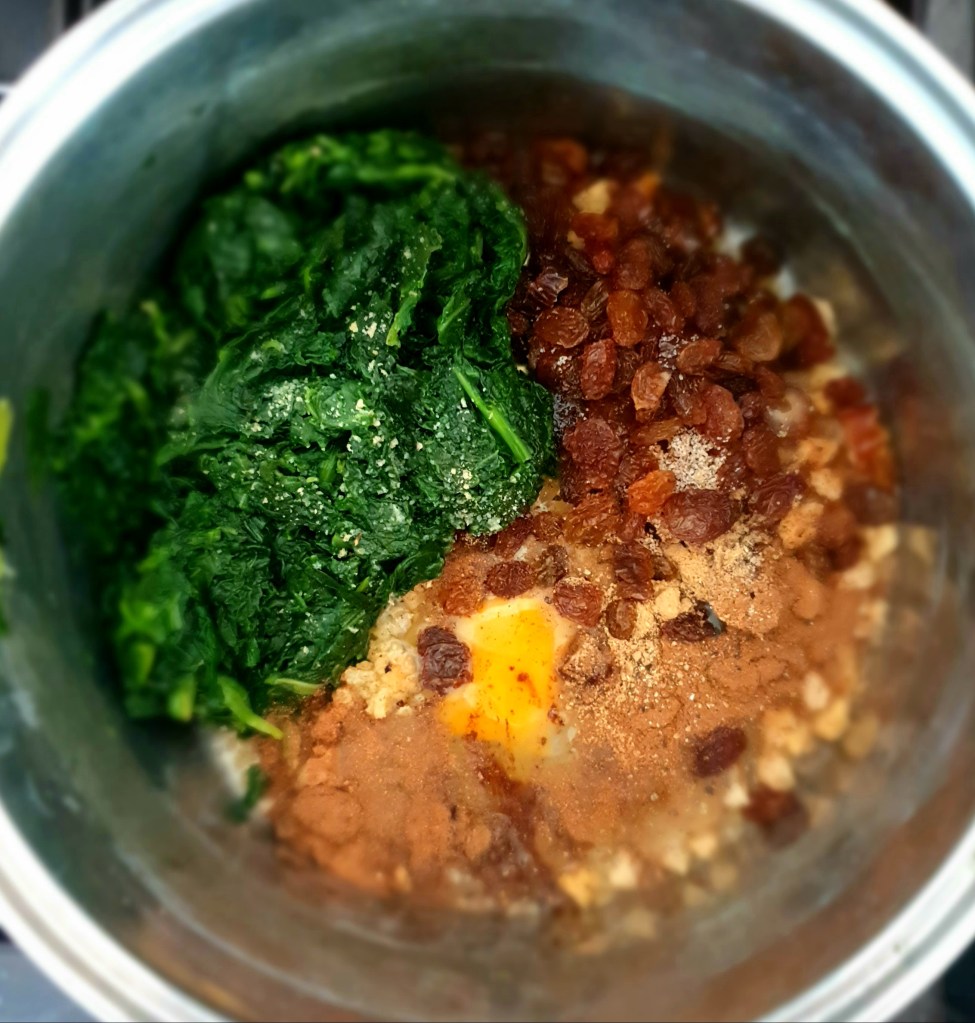
Having boiled about 180g of lentils until they were almost cooked, I added chopped leek, coriander and various herbs with honey, vinegar and liquamen to them and stirred over a low heat until all combined and cooked. The recipe then said to “bind with roux”, which seemed odd given that it was all pretty much bound anyway but perhaps furthers my theory that brown lentils, which don’t form a paste when cooked, were the Roman lentils of choice. In any case, I added a tablespoon of roux in an effort to keep as closely to the instructions as possible.
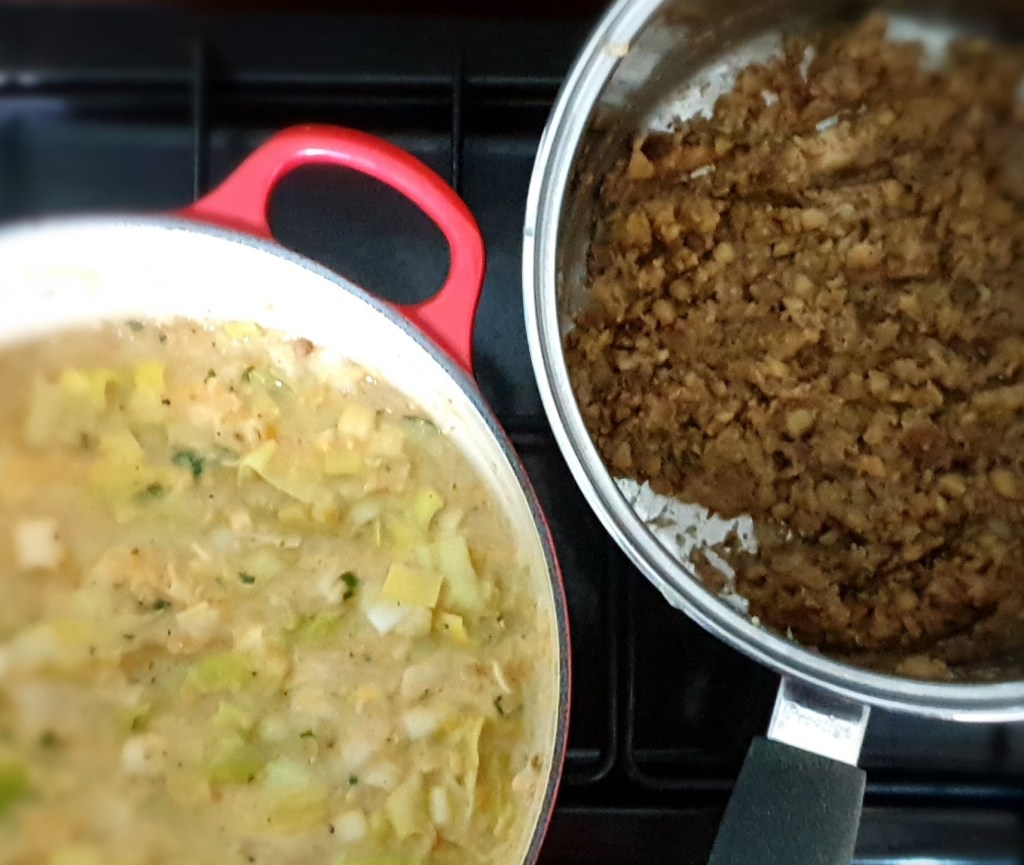
To quote Beyoncé: “To the left, to the left. Lentil/leek purée in the pan to the left.” (Chestnuts to the right.)

I had a choice in terms of serving suggestions: serve it as two dishes – as written out in the recipes – or as one combined dish. Kaufman suggested the chestnut and lentils should be combined in one dish and because she is “a scholar-chef and Adjunct Chef-Instructor, Institute of Culinary Education, in New York City” and I am just a greedy armchair historian with too much time, I took her word for it.

Now would be an honest time to admit that I’d been a bit worried about this meal. My last foray into Roman cooking using liquamen had not ended well – in fact, I still feel a bit queasy when I think of it. However, this time was different. Oh boy, was it different. This was good – really, really good.

Thanks to the roux, which I’d incorrectly assumed wouldn’t do much, the lentils were very creamy and rich. The leeks, which were just cooked through but still had a bit of a crunch, had an alium tang that cut through the creaminess and worked really well with the sharpness of the vinegar and herbs. In comparison, the chestnut puree was sweeter than I’d expected – maybe I’d added a touch too much honey? – and there was a slightly fiery aftertaste in the back of the throat because of the pepper and coriander seeds, which was delicious swirled through the lentils in a marbled effect.
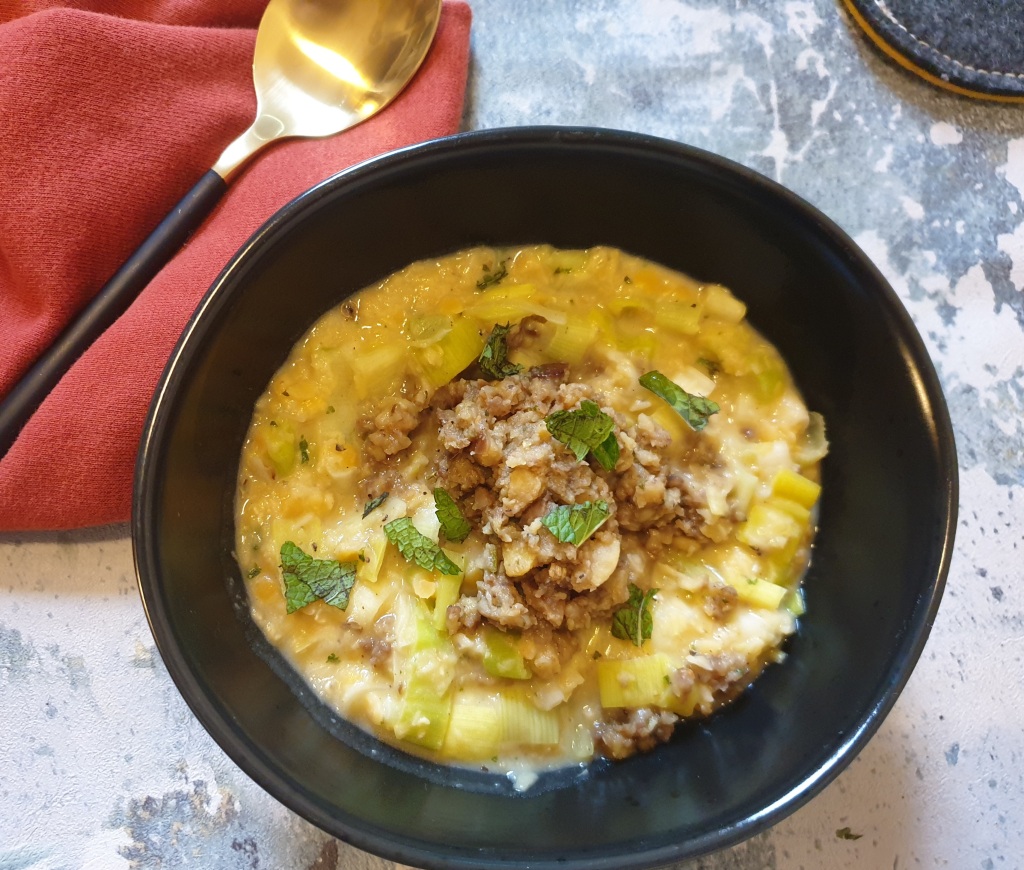
Yes, I ate it with a spoon. It seemed like that kind of a meal.

The recipe may not have been written by Apicius but it would definitely have been one he would have enjoyed, I’m sure. It was also kind of nice that it had the added bonus of not requiring any animal to be drowned in the blood of its kin. In the end the quantities made enough for two very large lunches or three modest ones, so obviously I chucked a cheese sandwich at my toddler, and my husband and I enjoyed a huge portion each. Delicious!

E x

Lenticulam de castaneis

160g cooked chestnuts
180g lentils (any is fine, really)
1 medium leek
Black pepper
Coriander seeds
Cumin seeds
Rue (or sorrel, chicory or any other bitter herb. Certain people – including pregnant women – may want to avoid using rue.)
Mint
White wine vinegar
Nam Pla
Honey
Plain flour
Olive oil

  1. Heat the chestnuts in a pan with a little water – a couple of tablespoons. In another pan, add boiling water to the lentils and cook.
  2. In a mortar, grind a few good twists of black pepper with a good pinch of coriander seeds, cumin seeds, rue (or other herbs) and a couple of leaves of mint.
  3. To the herbs and spices add a teaspoon of white wine vinegar, half a teaspoon of honey and half a teaspoon of nam pla. Set aside.
  4. When the chestnuts are heated through, mash them to a pulp with a masher and add the herb and spice mixture. Stir and then remove from the heat.
  5. By now the lentils should be almost cooked through (after about 10-15 minutes), add the leek, finely chopped, to the water with the lentils and continue cooking for another 10 minutes or so.
  6. While the lentils and leek continues cooking, start on the roux. Heat 1 tablespoon of olive oil in a pan and add 2 tablespoons of plain flour. Over a low heat, whisk this together and add about 125ml of milk. Whisk constantly until the roux thickens to the consistency of buttercream, then take off the heat. You may need to add more milk or flour to achieve this thickness.
  7. In a mortar crush coriander seeds, cumin seeds, rue (or other herbs) and a couple of leaves of mint, as you did in step 2 (without the pepper). Add a teaspoon of white wine vinegar, half a teaspoon of honey and half a teaspoon of nam pla.
  8. Once the lentils have cooked, drain them and add the herb and spice mixture to the pan. Stir to combine.
  9. Take a couple of tablespoons of the roux and stir it through the lentils, making sure it’s combined. You can add more, if you like, to create a creamier texture.
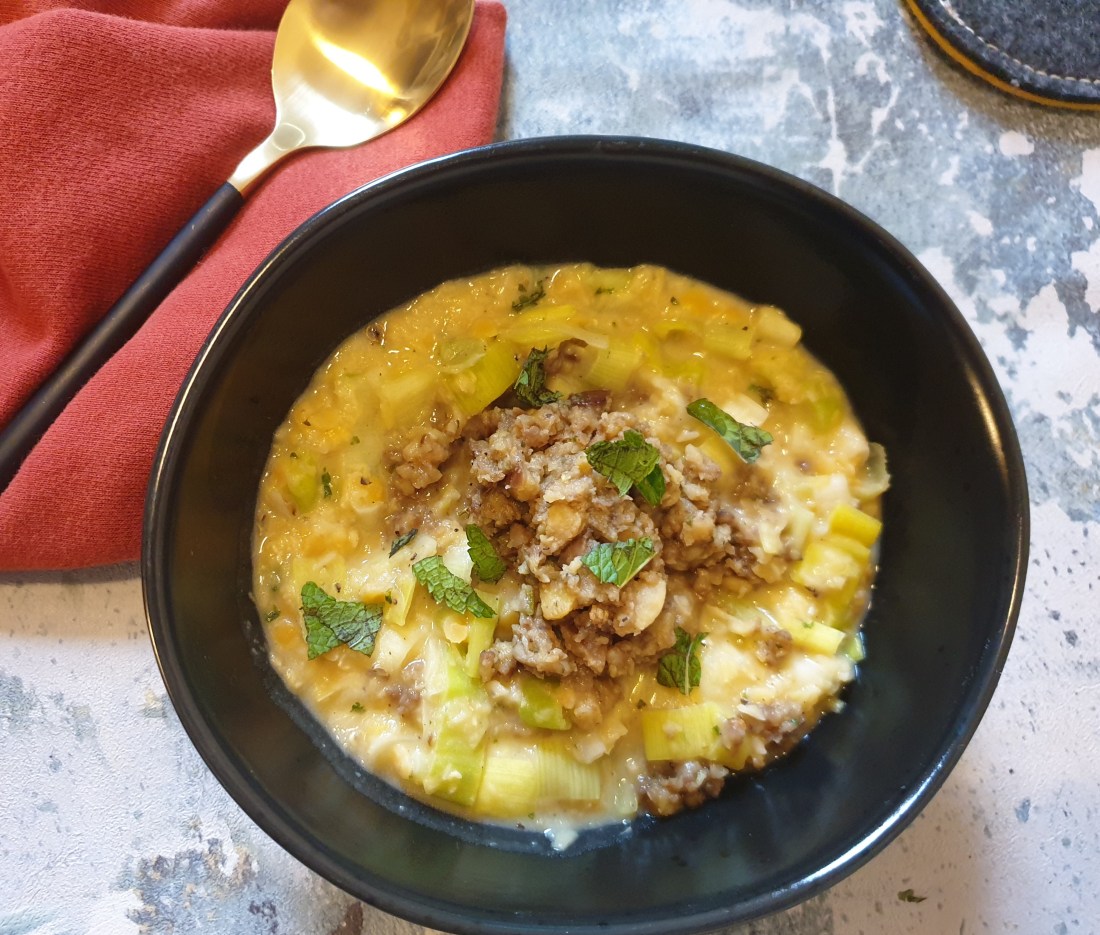
  10. Pour the chestnut purée into the lentils and stir through, making sure not to combine it too thoroughly. You could leave a dollop of it on top.
  11. Chop some mint finely and sprinkle on top.
Marchpane: 1615

Have you ever become involved in something so far beyond your skills or ability that you can see no way out of it? Something that at the time of starting seemed like a great idea or a funny story for later – like starting a marathon in flip flops or becoming president despite any political experience – but that after less than two minutes reveals itself to be a horrible, tragic mistake.

For me, my mistake was marzipan. More specifically, it was attempting to build a replica of old St Paul’s cathedral out of marzipan using a 17th century recipe on a Saturday night. Don’t tell me I don’t know how to have fun at the weekend.

Let me explain. I’d been flicking through Terry Breverton’s The Tudor Kitchen and had been really intrigued by a whole chapter on Tudor sweets and banqueting. During the 16th and 17th centuries, banqueting guests would enjoy a feast of predominately savoury dishes served all together. After enjoying this meal of many dishes and side dishes, they would then move to another room where a second meal – the banquet – waited for them made up exclusively of sweets, candied fruit and nuts, and sugar plate. The intention of the sugar banquet was to delight guests with sweet treats disguised as other things, such as gloves made out of sugar paste (no, I don’t know why), as well as impressing them with the variety and expensiveness of the sugar and spices laid out. In fact, a clue that banquets were more about showing off than about actually enjoying the food is in the word itself; we get the word banquet from bancetto, Italian for bench, because the sweets served at a banquet would be laid out on a long table to make it easier for guests to view.

Sugar banquet recreation from the Fitzwilliam Museum Feast and Fast Exhibition. Everything on the table (yes, even the plates) is made from sugar.

In the Tudor and Stuart mind, no banquet was complete with marzipan.

Gervase Markham, whose recipe for marchpane inspired today’s experiment, wrote in his 1615 work The English Huswife that marchpane – stiffened marzipan – should have “the first place, the middle place, and the last place” of a banquet, which highlights how important the stuff was to Tudor and Stuart feasting.

I was intrigued; my experience of marzipan was that it was a necessity in order to make fruit cakes marginally more edible. Sure, it was nice enough at Christmas but was it good enough to serve in great blocks during feasts? I remembered asking my mum for a cake shaped like a hotdog and covered in coloured marzipan for a BBQ birthday party, but even the memory of this highly sophisticated cake left me unconvinced that I’d want it three times during the same meal.

A little bit more research told me that Tudor marchpane was a very different creation to modern day marzipan, in terms of usage. Whereas modern marzipan is often hidden under thick sheets of painfully sweet icing, the Tudors made it a centrepiece of the meal by carving it into elaborate shapes and covered it in nothing but a bit of gilding, if it could be afforded. Occasionally it would be dyed with natural dyes like parsley or sandalwood, but its main function was to be edible table decoration; Markham wasn’t serving blocks of plain marzipan to expectant guests at all. I suddenly wished I could go back in time to 11 year old me as she explained to her friends why a marzipan hotdog cake was better than a ‘Colin the Caterpillar’ cake and tell her not to worry; in requesting a marzipan sculpture as my birthday centrepiece I was actually celebrating a longstanding tradition and not just being “a bit of a weirdo” as my sister put it.

Other than hotdogs, what other things can marzipan be shaped like?

Elizabeth I was certainly one Tudor monarch who would have appreciated the marchpane hotdog. Long famed for her sweet tooth, a German traveller commented that Elizabeth’s teeth were black which was a “defect the English seem subject to, from their too great use of sugar.” When she died at the age of 69 years old, it was reported that she had lost most of these rotten teeth.

One of the many sweet foods that Elizabeth was partial to was marzipan. And marzipan shaped like famous buildings was considered the height of fashion. At some point in her reign the Queen had been presented with a gift of a marzipan replica of St Paul’s Cathedral. It was likely that such a creation, in all its intricacies, would have required a team of expert cooks and taken years of practice to master. In my overambitious and egotistical way I attempted to recreate it in one evening, in my tiny kitchen, having had no confectionery training whatsoever. What could go wrong? Well pretty much everything, it turned out.

In lieu of a team of expert cooks I roped my husband into holding up walls while the sugar syrup cement dried. He also had to act as a scapegoat for anything that went wrong (he later told me it was the most fraught and unpleasant evening of our married life), and provide soothing glasses of gin before crucial moments during the construction. When it inevitably all collapsed after several hours’ work and my husband pointedly asked if this was what I’d truly meant when I’d told him I had an “exciting Saturday night project planned for the both of us”, I decided to switch tack.

R.I.P. marzipan Old St Paul’s.

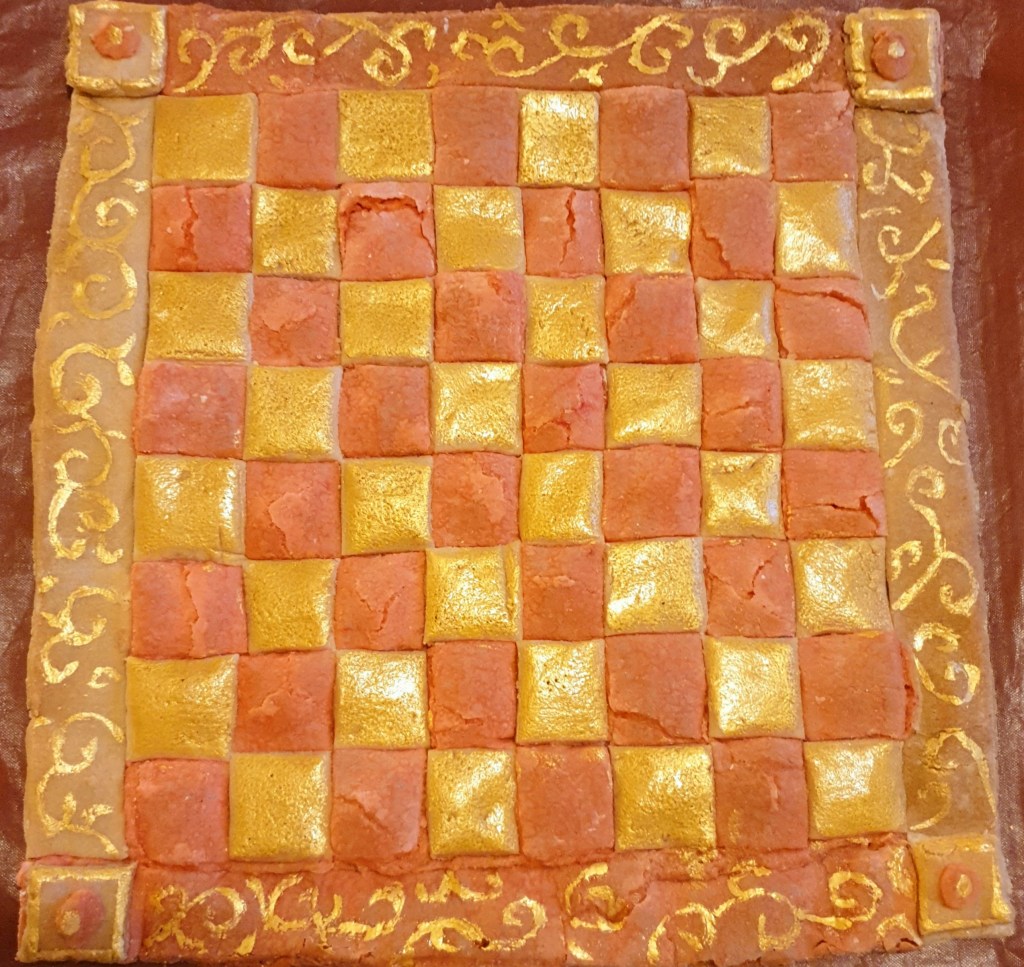
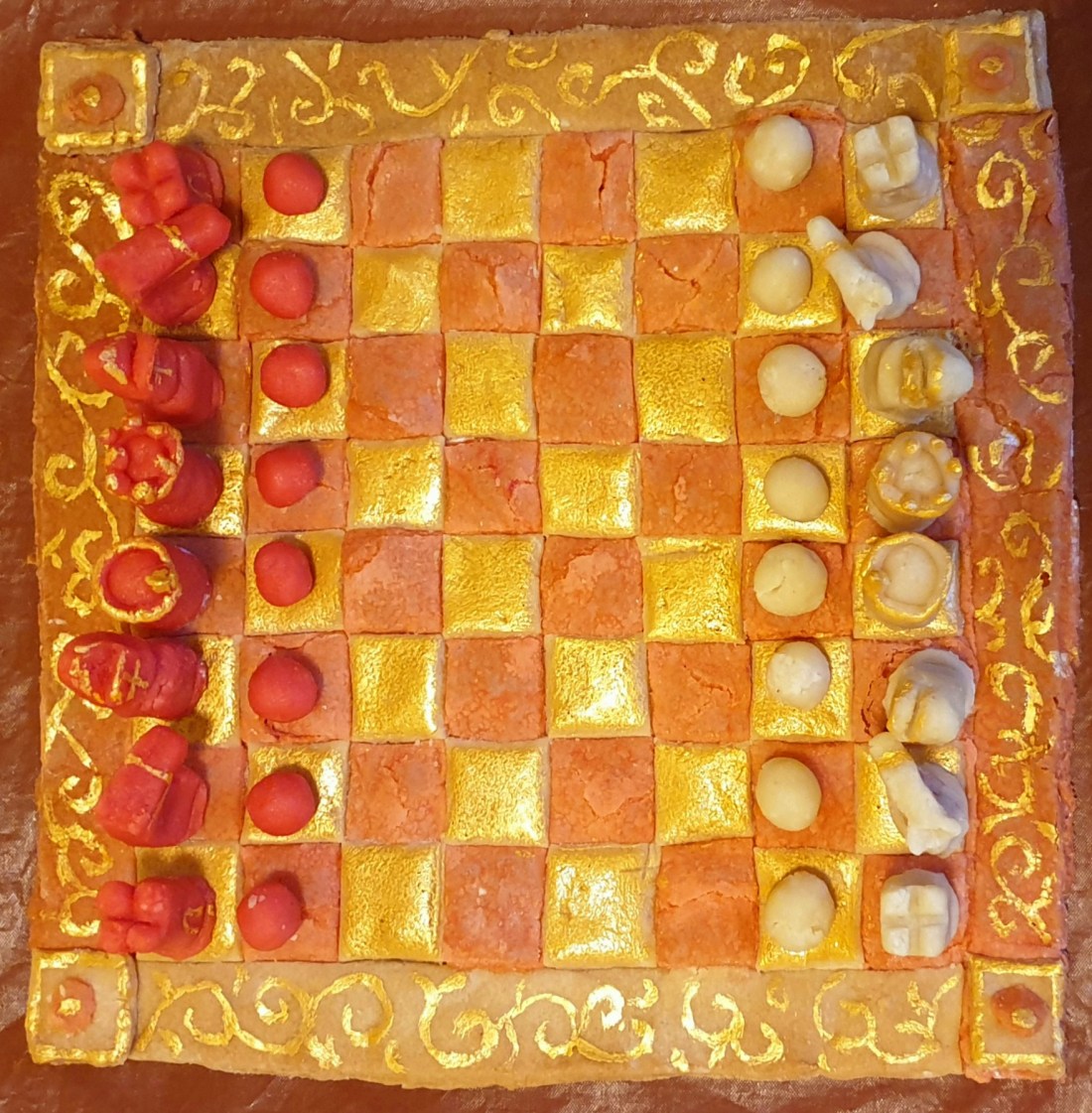
In 1562 Elizabeth received a New Year’s gift from her master cook, George Webster, of a “faire marchpane being a chessboard”. This seemed a lot more manageable, mainly because chessboards tend to be flatter than cathedrals, so once the dust had settled I tentatively told my husband that I’d be attempting a second marzipan creation again in the morning.

As he preemptively booked us for marriage counselling, I got to work. Markham’s recipe was very simple, with an emphasis on the quality of ingredients used, not the quantity. All I needed was ground almonds (Markham advised using Jordan almonds and grinding them to a pulp, but Sainsbury’s didn’t offer me that much choice), very finely sifted sugar (I used icing sugar to achieve the levels of fineness needed) and rose water.

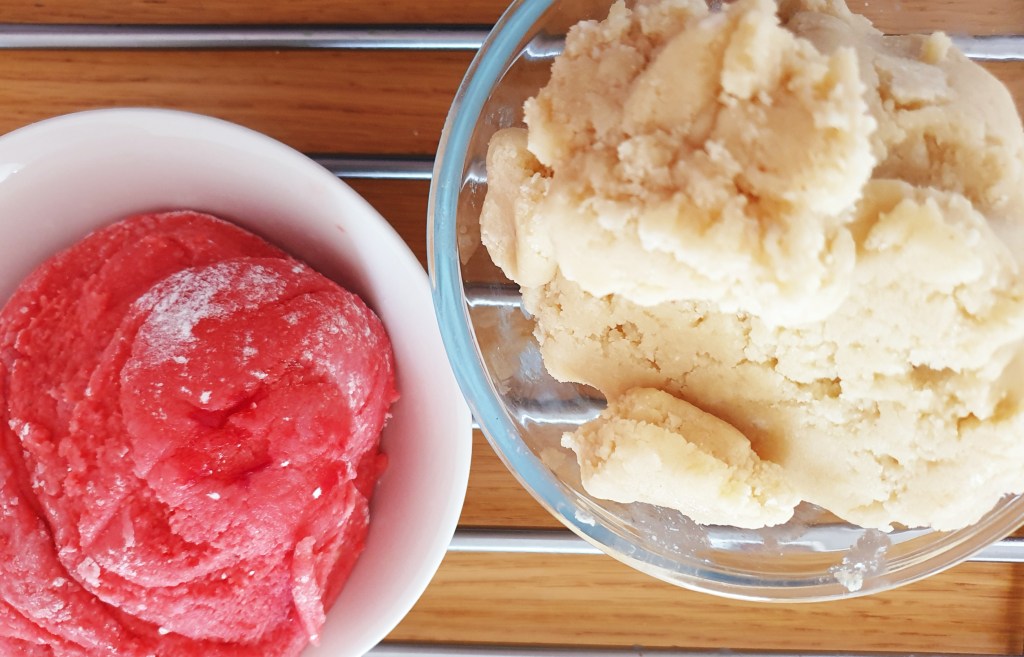
I combined the almonds and sugar in equal quantities – 400g of each – and added two teaspoons of rose water. Then, kneading as if it were a bread dough, I began to work the mixture together, adding a little water to help it stick, until I had a stiff and cohesive block of marzipan.

I was then faced with a dilemma: what colour the dough should be. Despite our modern images of them, chess boards weren’t always white and black – quite often they would be white and any other darker colour, most often red. The important thing was to get a deep contrast between a light colour and a darker one.

A 1534 inventory of the belongings of Catherine of Aragon recorded that she possessed “two chess sets, with red and white chessmen.” I don’t know how Elizabeth would have felt about the use of her father’s first wife as inspiration for my marzipan chess set (especially given that Catherine never accepted Henry’s marriage to Elizabeth’s mother, Anne Boleyn), but by the time I’d really thought about it, half the marzipan had been soaked in beetroot juice so it was too late to get hung up on whether or not Elizabeth would have appreciated this detail.

It’s not play-doh and mashed potato, I promise.

First up to be made was the chessboard.

I cut out 64 individual 3cm by 3cm squares – 32 red and 32 white. It took forever and I began to panic that I was embarking on another Cathedral Palaver. I considered employing an expert team of cooks, such as George Webster would have used, but one half of my team had barricaded himself in the bedroom and refused to come out until this attempt was over and the other half just wanted to lick icing sugar off everything. Nevertheless, I continued on and arranged the squares like a chessboard before cutting out a border. To make the marzipan stiff I baked it in a low oven for half an hour or so.

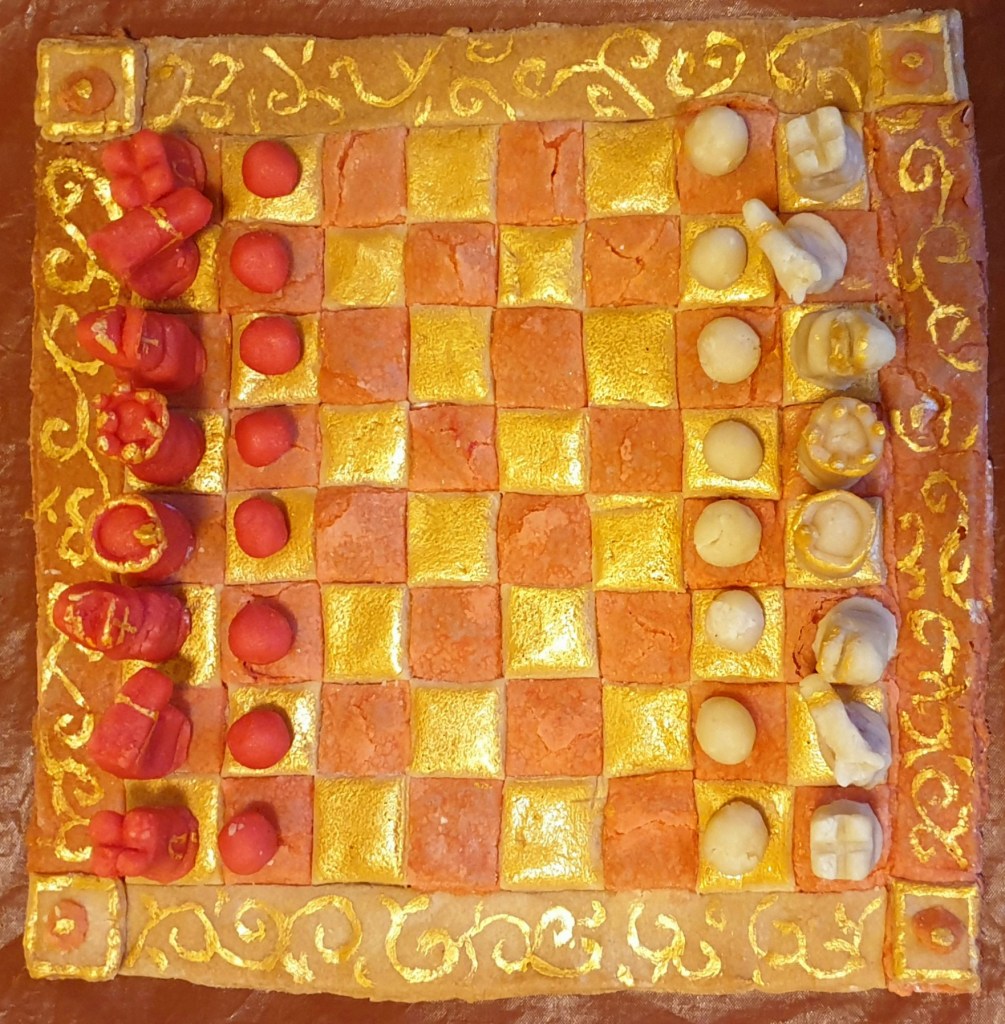
As the board baked I started on the figurines. This was by far the most fiddly and annoying bit. In my head they were beautiful elegant carvings with crisp lines and sharp edged. In reality each one ended up as a nondescript, blobby mess. I must have practiced the knights eighteen times before they stopped looking like deformed hippos and began to resemble at least something related to horses.

It didn’t help that the beetroot juice had made the red dough more sticky. Every bit stuck to my fingers and each piece was pulled slightly out of shape each time I tried to set it down. I wasn’t basing my pieces on any particular set because it was surprisingly difficult to find pictures of Tudor chess sets online. All I could find was paintings from the time which indicated that the pieces looked broadly similar to modern day sets so that’s what I aimed for.

I put the figurines in the oven and began to decorate the chessboard, which had been cooling for a while. During the baking process it had puffed up a bit, a little like pastry, but once cooled it had flattened out a little.

It’s likely Elizabeth’s chessboard would have been decorated with gold leaf to give a red and gold contrast that highlighted her wealth and luxury. I didn’t have any gold leaf and even if I had I’d never be able to afford enough to cover each square properly. What I did have, however, was edible gold metallic paint leftover from a birthday cake I made last month. It wasn’t as elegant as gold leaf but it did the same job and soon my chessboard gleamed regally.

This is probably the thing I’m most proud of in my life. Yes, I know I have a child.

At this point, as I was basking in the glory of my chessboard, my husband informed me that the figures in the oven had melted.

As I sprinted to the oven I wondered whether George Webster died from stress brought on by the highs and lows of creating marzipan nonsenses like this? I don’t know, but if my own experience is accurate, it’s very likely. I felt my blood pressure rising as I peeked into the oven and saw that the figures were well and truly ruined. With a heavy heart, I remade them, hippo-horses and all. Instead of putting them in the oven this time, though, I stuck them in my very un-Tudor fridge to firm them up a bit.

Once they were a bit firmer and the horses were less…droopy, it was time to daub them in their own gold paint and arrange them on the board to see how they whole thing came together. It didn’t look too bad!

Even after Googling the correct layout I still got the kings and queens mixed up.

True, some of the proportions of the pieces were a bit off, and there were some definite lumps and bumps that I doubt would have made the cut on Elizabeth’s board, but overall I was quite happy with it. I could definitely see how something like this could be worthy of being a centrepiece at a banquet. Yes, part of me still wanted to have a glorious 3D model of St Paul’s Cathedral as my showstopper, but the chessboard was a decent alternative.

In terms of taste it was less sweet than modern marzipan is and much nuttier, possibly because the baking had enhanced some of the almond flavour. It was also much more fragrant than modern marzipan thanks to the rosewater in it. The two flavours combined – almond and rose – made a very pleasant pairing with neither overpowering the other.

The texture of the marzipan was also different to what I was used to. There was no limpness to it at all – it was like a well baked biscuit. It cracked and broke easily so had to be handled with care, but was surprisingly light once baked, a bit like meringue. I actually preferred it to modern marzipan.

So after all this what was the chessboard the centrepiece for? Some fancy Tudor inspired meal? A homecooked feast? No. After all the time and effort, all the stress and tears, all the endless wiping sugar off the kitchen table and trying to stop my daughter licking every worksurface, the great marchpane chessboard ended up being the centrepiece for…a Chinese takeaway.

Perfection.

E x

Marchpane

300g ground almonds
300g icing sugar
1 teaspoon of rose water

  1. Combine all the ingredients together in a large bowl.
  2. Knead it all into a dough using your hands. Add a little water, drop by drop, if needed.
  3. Roll the marchpane out into what ever shape you want no thicker than 0.5cm.
  4. Place on a baking tray sprinkled with icing sugar or covered with a non-stick sheet and bake at 120 degrees c for 30 minutes, or until the marchpane is just starting to colour at the edges.

Tartlettes: 1390

I’ve recently become aware that a lot of my latest posts have focused on sweet treats and desserts and that I’ve rather overlooked the savoury elements of history.

I would apologise for this except that I’ve yet to meet anyone who, when offered a choice between stuffed dormouse or honey cake would pick the former. For me, cakes and desserts are the pinnacle of a meal; the main course is something to get through in order to qualify for the good stuff at the end. I’m very aware that people who prefer savoury to sweet exist – they’re the sort of degenerates who pick a cheese board for pudding – but I refuse to have anything to do with them. The same goes for people who think fruit salad counts as a proper dessert too, by the way. I had an aunt who, having been placed on pudding duty for a family meal, brought along a bowl of fruit salad. We were all very polite at the time but I made sure she was crossed off the Christmas card list before the starters were even served.

That seems unnecessarily harsh. Hurry up and get to the point.

The point is this blog can’t just be about sweet things. Much as I would have loved if it people in the past partook purely of parfait and profiteroles, I do have to admit there was an abundance of savoury foods too – even if lots of these sounded sweet (looking at you, pease pudding) and I feel a duty to try some of these savoury items too.

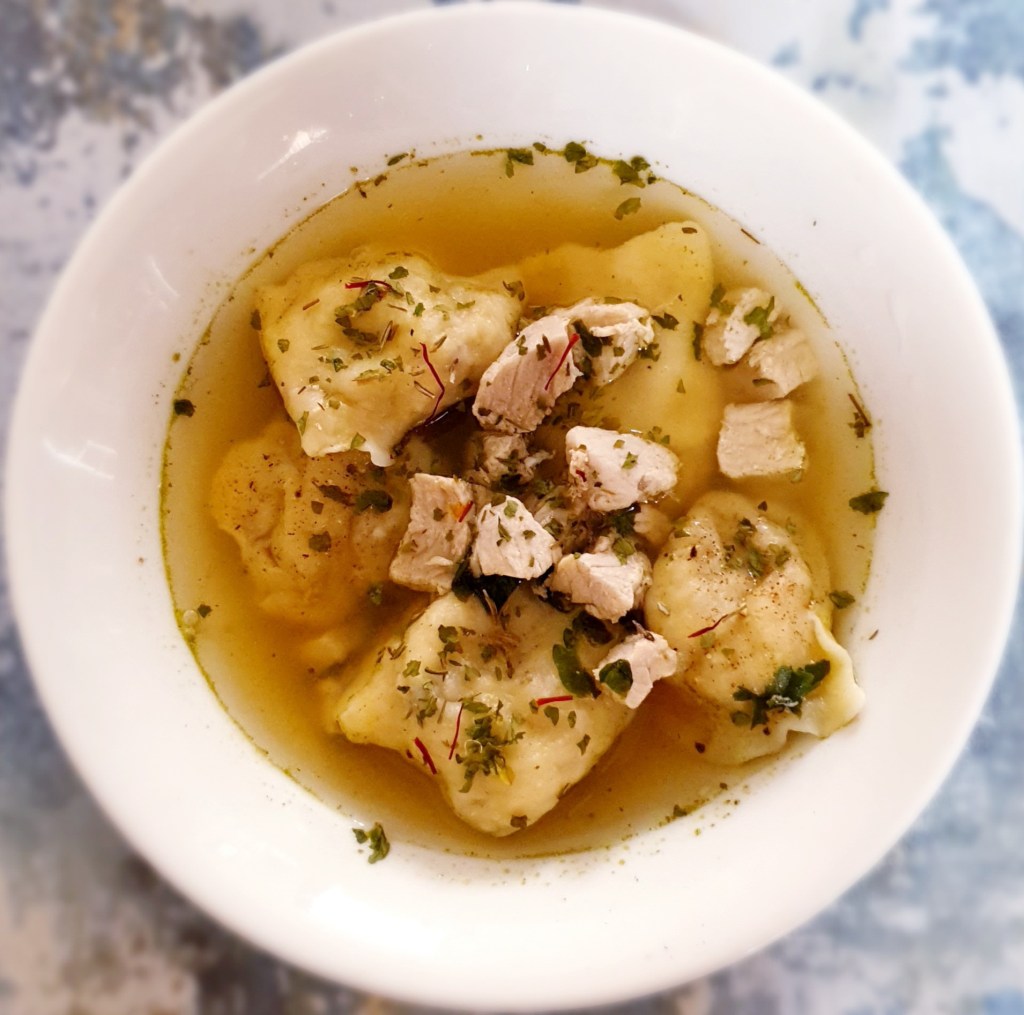
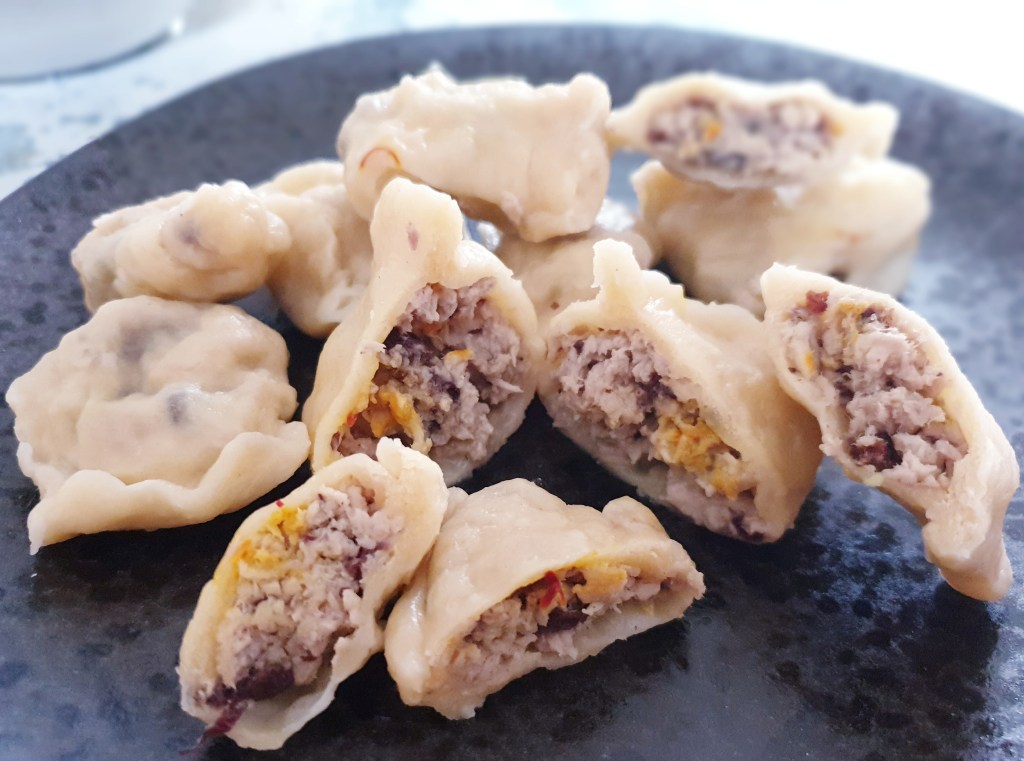
Savoury items such as Tartlettes. When I imagined these I thought of mini quiches, maybe with some caramelised red onion and goats’ cheese: delicious. In fact, a better way to think of them was like meaty pasta shells served in broth. Still delicious, but a bit of a shift from what I’d imagined.

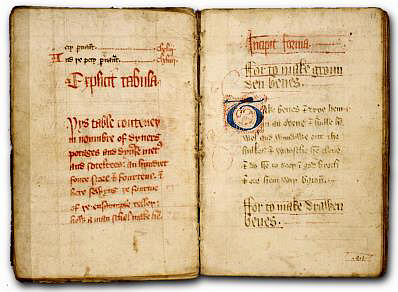
The recipe is from Forme of Cury, which I’ve spoken about a little before in previous posts, but was the cookbook of Richard II’s master cook. When cooking for the king only the finest ingredients could be used, both for reasons of taste and status – woe betide anyone trying to serve him penny sweets and supermarket own-brand crisps.

Richard II shortly after being served a sub-standard cheese toastie. Not impressed. Credit here.

I started with the Tartlettes filling first and boiled some diced pork leg until I was sure it was cooked through. It didn’t take too long and though it wasn’t the most appetising thing to watch lumps of pinky grey meat bubbling round in a pot, I did my best not to think about all the medieval puddings I could have been making instead.

While the pork was boiling I read through the rest of the recipe. It’s a good job I did because it highlighted just how different medieval recipes were to modern ones and saved me a bit of headache later. After six months of running this blog I’d just about come to terms with the fact that a medieval recipe containing exact quantities and measurements was about as likely as Richard II himself supporting the peasants during the revolt of 1381. What I still hadn’t fully clocked was just how illogical medieval instructions could be. For instance, at the start of the the recipe the instructions said to grind the pork up with eggs and spices. But at the very end of the recipe, once all the ingredients had been used up, the author suddenly instructed the cook to take some leftover pork that hadn’t been mixed with eggs and spices and use it to make a broth, despite no indication that some of the pork needed to be set aside for said broth at the beginning of the recipe.

Anyway, because I’d checked ahead I set some boiled pork aside and began to blitz the rest of the pork with saffron, an egg and “raisons of couraunce” which several medieval cookery glossaries (online resources which I now spend more time on than Facebook) assured me were currants. To this I added powder forte, a very common medieval mixture of strong spices, for which there doesn’t appear to be a universal recipe. Dr Monk’s blog and this website offered a couple of versions of powder forte from Libro di cucina/ Libro per cuoco, a roughly contemporary European cookbook. I used black pepper, long pepper (which I had to order online), cloves and nutmeg to make my own powder forte and added it to the mixture.

Next, I made the dough. Maggie Black and other blogs I found which covered the same dish used filo pastry as their dough. While filo pastry was certainly around during the medieval era, I had my doubts that it was what the author intended; the recipe itself gave little indication that filo was the dough to use. For starters, filo pastry might not be super hard to make, but it does require a fair few steps: making the dough, portioning it out, rolling each portion to an incredibly thin sheet, coating each sheet in melted butter and placing each sheet on top of one another. The instructions didn’t mention any of these steps at all, apart from rolling out a (single) “foile of dowgh” and, while it’s true medieval pastry instructions were often vague, the author of Forme of Cury stands out as being concerned with making sure the recipes in their work were as clear as possible (for medieval standards). In short, despite Forme of Cury being a manuscript intended to highlight the wealth and lifestyle of the king, there does also appear to be a genuine effort made on the part of the author to make sure the recipes could be prepared and replicated in other wealthy households with care and accuracy. Surely if filo pastry was required, the author would have at least mentioned placing the sheets of dough on top of each other?

The second thing that made me doubt we were dealing with filo pastry was that the recipe for Tartlettes immediately followed a recipe for ‘Loseyns‘ – an early form of lasagne, which uses similar terminology (“thynne folyes”) when making dried pasta sheets. This was when I began to think I was dealing with a medieval stuffed pasta and I became convinced I was right after checking this website and seeing that the previously mentioned Libro di cucina/ Libro per cuoco cookbook had a very similar recipe (slightly off-puttingly called “Little tarts of Scabwort”) which, when translated, instructed a cook to take the prepared meat and egg paste and place it in “small tortelli in sheets of yellow pasta”. Tomayto, tomahto, tortelli, tortellini – right?

And finally, one hundred or so years after Tartlettes was written down in Forme of Cury, a recipe for ‘Ravioles‘ appeared in Recipes from John Crophill’s Commonplace Book which was near identical to the recipe for Tartlettes – mashed pork (with added capon this time), eggs and strong spices stuffed into a “paste” and served in broth – I mean, come on!

We get it – pasta not pastry. For goodness’ sake, move on.

Anyway, having not cut a long story short, I made pasta instead of filo pastry. I followed the same recipe in Forme of Cury for ‘Loseyns’, but added two egg yolks and some saffron because I figured if I was cooking for Richard II he’d want a richer pasta than just flour and water, and because the recipe in Libro di cucina/ Libro per cuoco talked about the pasta being yellow, which implied the addition of egg yolks and saffron.

I then attempted to stuff small teaspoon amounts of pork filling into the pasta and seal them closed. To start with I was aiming for nicely uniform circles but it quickly became apparent that I possessed neither the skills nor the patience for this and my pasta shells soon resembled a jumble of mismatched rejects from a ravioli factory. Though I’d tried very hard to roll my pasta out nice and thin, and not overstuff my shells, I ended up with more filling than pasta – so I froze what was left to use as stuffing mixture next time I do a roast. I’m sure my family will be delighted at the encroachment of my hobby into their everyday, non-history meals, or “safe-to-eat-meals” as they’ve started to call them.

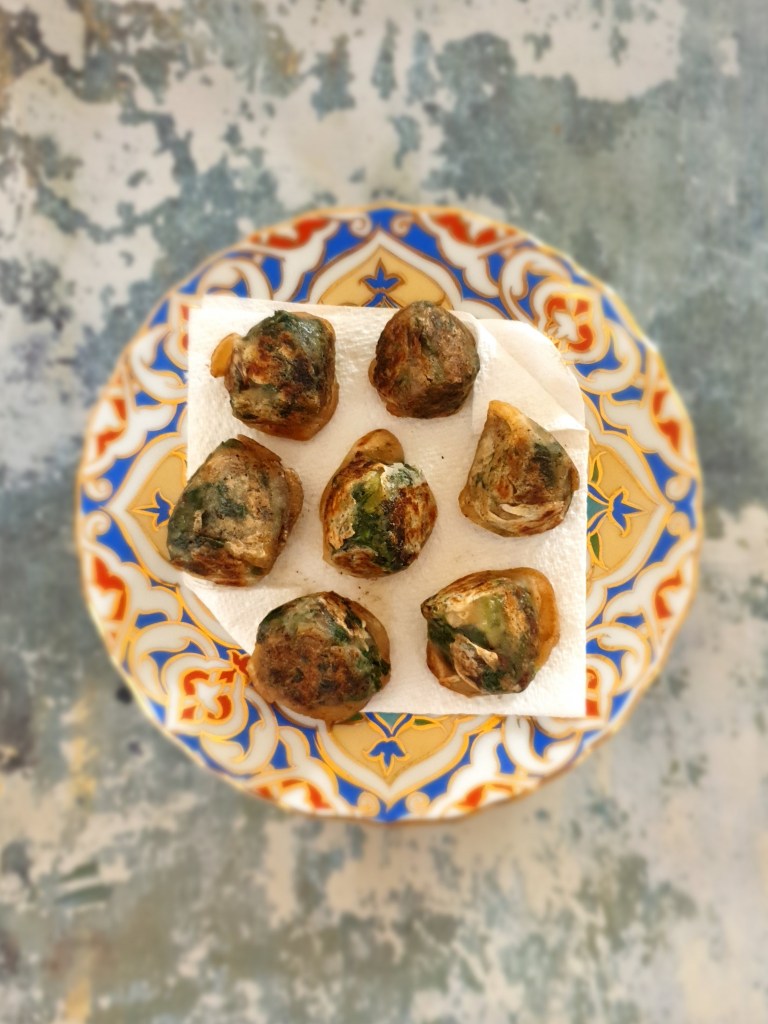
Tartlettes made, I quickly whipped up the sauce using the leftover pork I’d so smugly put aside earlier. I call it sauce, but broth is far more accurate. It was made with a pint of homemade vegetable stock, a splash of white wine, some chopped herbs and the pork, which I diced. I then heated a pan of salted water until it was boiling, dropped the Tartlettes into the seething water and cooked them for 6 or 7 minutes. It was hard to tell when they were done but I followed the basic principle of cooking fresh pasta shells and figured they were cooked when they began to bob to the surface. I fished the Tartlettes out with a slotted spoon and dropped them into a bowl before being sprinkling them with powder douce and salt. A ladle or so of pork broth was poured over them and then they were ready to eat.

Soupy, porky, pasta goodness.

So, what did this taste like? In a word: heavenly. No, seriously – it was fantastic.

The Tartlettes themselves were slightly thicker than conventional pasta shells because of my poor rolling-out skills; we broke our rolling pin, I didn’t buy a new one and so had to use a wine bottle instead which wasn’t ideal. Despite the extra thickness, I don’t think they suffered for it. The pasta was rich and tasted pretty fragrant because of the saffron, so having a slightly thicker shell was no bad thing. Boiling them for 6 or 7 minutes was a good time because they weren’t rubbery or overdone either.

The pork filling was a mix of sweet and salty. It tasted very much like a sweeter version of Christmas stuffing – you know, the pork and apricot or pork and apple types. The currants gave it a sweet lift without any sugariness and the spices kept it grounded with just a little peppery heat. When you cut one open there was a surprisingly colourful effect from the saffron strands and ground currants. With the deep golden vegetable and pork broth the combination, both in terms of taste and aesthetics, was fabulous.

Little malformed dumplings, I’ll still love you even if the ravioli factory threw you out.

In fact, this was so good that once I’d finished my bowl my immediate thoughts were ones of disappointment that I hadn’t made more, rather than of anticipation at what was for pudding. Offer me a choice between a stuffed dormouse or a honey cake and I’ll still pick the honey cake. But offer me a choice between a stuffed Tartlette or a honey cake? Well now, that’s a tough one.

E x

Tartlettes

450g diced pork leg
30g currants
A good pinch of powder forte mixture (or a good few twists of black pepper, a couple of ground cloves and a little grating of nutmeg)
1 egg
Saffron
Salt

For the pasta:
200-250g white flour
2 egg yolks
Warm water
Saffron

For the broth:
1 pint of vegetable stock
Salt

  1. Boil the pork until cooked through. Depending on how large the chunks of meat are this might not take too long.
  2. Set aside about 1/3 of the pork to use for the broth later.
  3. Mince the remaining pork in a blender with the currants, saffron, salt, spices and egg until it forms a coarse paste.
  4. Begin on the pasta. Add the egg yolks to the flour and combine.
  5. Add the saffron to a little warm water until the colour seeps and then add the water, with the saffron strands, to the flour and eggs until a dry dough is formed. Knead the dough a little to ensure it is an even light yellow throughout. If you find the dough is too soft to roll out and cut easily you may need to add more flour.
  6. Roll the pasta out to as thin as you can – ideally no thicker than 2 or 3mm. If you have a pasta machine, use it – there’s no need to be a martyr here.
  7. Cut the sheet of pasta into rectangles – I made about 20 but the total number will depend on how thin you got your pasta, you might be able to make more.
  8. Place no more than a teaspoon of pork mixture onto one end of each pasta rectangle and seal it shut by pinching the edges. It’s really important it’s sealed all the way round otherwise the mixture will bubble out when you cook them.
  9. Begin on the broth. Add a pint of vegetable stock to a pan and simmer. Add a splash of white wine and some chopped herbs. I used parsley, thyme and sage.
  10. Dice the left over pork into small pieces and add to the simmering broth along with a good pinch of salt.
  11. Begin to cook the pasta. Heat a pan of well salted water until it’s bubbling. Add the pasta shells a few at a time for 6 or 7 minutes, or until they begin to bob up to the surface and have turned slightly more pale in colour.
  12. Remove cooked pasta shells from the pasta water with a slotted spoon and place in bowls. Sprinkle over a small pinch of salt and some powder douce and pour a ladle of the pork broth, with the diced pork, over the top.

Crispe Pancakes: 19th century

I didn’t go to uni in Wales.

It’s an odd statement to begin with, sure, but it’s something that has brought endless shame and disappointment to my parents who both went to Aberystwth Abersythwith Aberystwyth university.

I remember one summer they took me and my sister on a long and winding car trip to their old stomping ground which basically consisted of us standing in drizzle while they oohed and ahhed over university buildings saying things like “oh look darling, didn’t this used to be maths?” and “gosh I can’t believe that’s still standing!” The whole trip culminated in a maddening journey where we walked, shivering, along the seafront to kick an old post – sorry, bar – for no reason whatsoever. As an eleven year old whose friends were all sending me postcards of their fortnights in Mallorca and Tenerife it was not the highlight of my summer holiday.

Ten years later my sister proudly made her way to Aberysy…Aberysywt… the same uni too, where she met her boyfriend who also had two brothers who had studied there. Cue more dizzying car trips to visit her and engage in more nonsensical violence against public railings once we got there. But now I was outnumbered – when my sister suggested we walk up something very high and steep called Constitution Hill (because, speaking from experience, you need an iron constitution to survive it) everyone got very excited instead of quite rightly asking if she’d gone mad. Later that very same day she offered to show us round the uni. The catch? To get there we had to walk up another seemingly never ending hill. Cue more gleeful hand clapping as I stood there, still dripping in sweat, wondering when we’d get to come down from all these hills (the answer was never – to this day I’m convinced that Aber operates like some sort of Penrose staircase; always going up, up, forever and exhaustingly up.) Those Aberystwyth sunsets though? Phew.

Did…did my sister go to uni at Hogwarts?!
Photo: Wikimedia Commons. Credit here.

Needless to say I was very interested when I was contacted a month or so ago by an archivist at the Ceredigion Archives who introduced me to their records of life in Wales (including lots of Aber life) and most notably a 19th century recipe book from the Webley-Parry papers. Finally, here was my chance to earn my family’s respect!

The Webley-Parry family were landed gentry from Cardiganshire, and the Ceredigion Archives houses many papers relating to various members of the family through the 18th and 19th centuries. The recipe book from today’s experiment contains handwritten everyday tips, hints and recipes for the Webley-Parry family written by different authors from different times, most likely the cooks of rich households who shared recipes with each other. There are loads of interesting recipes in the archives that have been digitally uploaded – for roasts, tea biscuits (which one archivist has already made), wines and something called ‘Shrub’. Today I chose pancakes because it was Sunday – a day made for ‘fancy breakfast’ (read: cereal out of a bowl rather than stood over the sink gobbling dry fistfuls of it).

Interestingly, this was the first recipe I’ve recreated from an original source. I had to spend a while deciphering the handwriting but I think I managed to follow most of the instructions accurately with the right ingredients. If you think I’ve made a mistake please let me know by writing me a letter and popping it straight into the recycling bin.

I’ve written about making pancakes before, and the recipe here struck me as being similar to medieval ‘Crespes’, so I was interested to see what the differences were.

Before we start I will admit to one tiny mistake; the last instruction said to fry the pancakes in lard “as you do fritters”. This was what made them so crispy, I assume. I misread the handwriting and thought it said fry in lard “as you do kittens.” I was alarmed; I had never fried a kitten in lard (or any other cooking oil) and wasn’t sure of the best way, so carried on cooking them in in ordinary amounts of butter. By the time I’d worked out what it meant most of the batter had been used up so I was only able to fry two as if they were fritters.

First I took a pint of flour and added six egg yolks and two egg whites to it. A ridiculous amount of eggs, I agree, but at least now I have an excuse to make meringue. To make it into a batter I added warm water, sherry and mixed together before adding a little salt and mixed spice.

The recipe then said to add the mixture to a small pan and “bake them, but not too much” (helpful) before frying them in lard (like fritters, not kittens.) Because, as discussed, I wasn’t entirely sure of the handwritten instructions, I ended up cooking most of them like conventional crepes (in a little bit of butter until cooked on each side) – which resulted in very tasty but much floppier pancakes than what was intended.

Tasty but, unfortunately, not accurate. Try again.

The last two, however, I was able to recreate more closely to the original. The “bake them, but not too much” instruction confused me – if I baked what was left one at a time in a pan in the oven I’d be there all day baking and frying, waiting for the pan to cool before discarding butter and baking and frying all over again. If I just poured the batter out into pancake size blobs onto a baking tray and baked them surely it would all pool into one big pancake which I’d then not be able to fry? I ended up ‘baking’ them in a dry pan over a low flame until the wetness of the batter had disappeared but there were no dark spots.

Then it was time to fry them properly. I removed my barely baked pancakes and dolloped about half a packet of butter into the hot pan. After I’d opened a window, gulped down a few lungfuls of fresh air and blinked the smoke out of my eyes I tried again with the remaining butter (that’s right – I wasted a whole packet for this) in a cold pan heated slowly over time. Once the butter was hot, but not so hot it sent the town’s fire brigade to my front door, I cautiously placed one of the pancakes into the pool. It puffed up a little bit like a chapati, but not all the way round, and after about 30 seconds I flipped it over to cook on the other side.

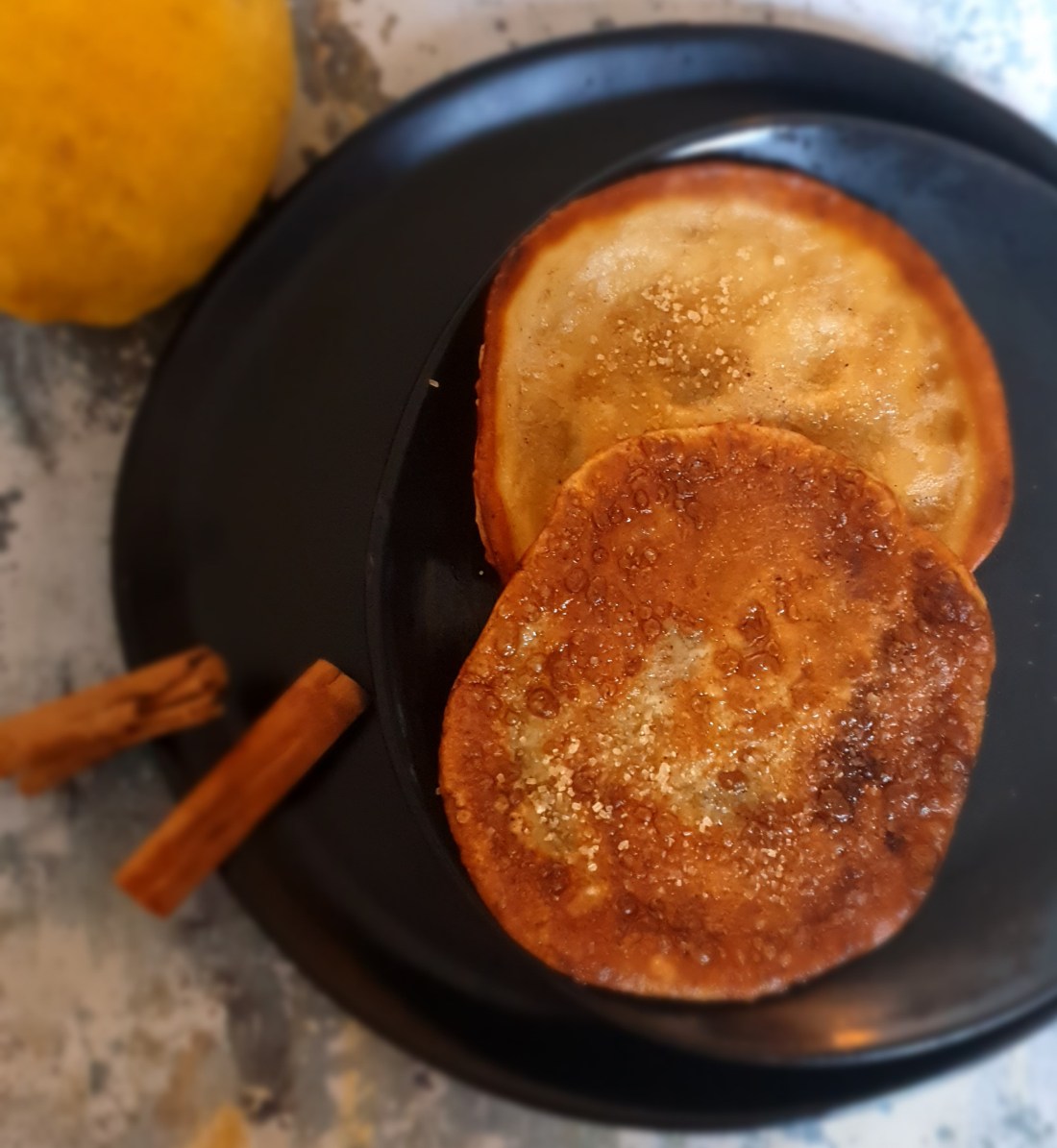
Sunburned pancakes…mmmm.

So, what were these pancakes like? Well, the first lot which I hadn’t cooked in a whole packet of butter were absolutely delicious. Rich and quite eggy without being cloying and with a definite hit of sherry – they were like a very fancy modern pancake. The mixed spice added a lovely warming hit which meant that (and I never thought I’d say this) they had enough flavour that I found myself wondering if I’d even need sugar and lemon to complete the dish at all. As somewhat of a pancake purist, to put it mildly, the idea of serving a crepe pancake without lemon and sugar was anathema to me – yet here I was quite happily forking this delicately spiced, slightly alcoholic pancake into my mouth while the expectant lemon sat un-squeezed and un-needed.

The properly fried ones were something slightly different, however. As my husband put it, they were like “concentrated pancake.” The taste was a lot more overpowering – the sherry was gone, replaced with a butteriness that seeped into every taste bud. The spice was still there, but it was fighting more to be heard and with the fried ones I found myself wanting the citric tartness of a lemon to cut through the grease. Were they crispy, though, as the recipe promised they would be? Well, not really. They were certainly crispier than the other ones, but once you bit through an initial crust-like layer, they were still soft inside. I also think they needed to be eaten immediately to enjoy maximum crispiness – again, much like a chapati, they began to deflate quickly once off the heat.

While I’m still not 100% sold on the fried ones, the first batch I made were truly delicious and I have to thank Ceredigion Archives for bringing the recipe book to my attention – these just might become my new Sunday ‘fancy breakfast’, they were lovely and I will definitely be making them again.

So am I sad I missed out on the chance to study at Aber? I mean, sure. It’s true I’ll never be an authentic Aberystwythian(?), not least because I lack the levels of fitness required to live anywhere that’s not dead on sea level. But in making these pancakes and delving into the Ceredigion Archives I sort of feel like I got a little glimpse into a small sliver of the history of Wales and Aberystwyth (spelled it right first time round – get in!)

Unlike my parents and sister I may not have studied or lived in Wales – but if it’s as good as these pancakes I get why my family was, and is, so charmed by the country.

Ond nid af i fyny’r bryn hwnnw eilwers.*

E x

*I don’t speak Welsh so this is the work of Google translate. I know what I was trying to say but please forgive me if it’s been translated as “hurry spatula fourteen eels” or some other nonsensical slogan – you know what Google translate can be like.

Crispe Pancakes

1 pint of plain flour
6 egg yolks
2 egg whites
A sherry glass of sherry
A pinch of mixed spice
Warm water
Lardto fry

  1. Combine flour, eggs, sherry and spice together to form a dough.
  2. Add warm water to create a consistency of double cream.
  3. Cook the pancakes until just cooked through but not browned in a pan.
  4. In another pan, melt a good spoonful of butter – you want to be able to cover the pancake in it.
  5. Place the pancake into the melted hot butter and fry until it puffs up. Flip over and fry again.
  6. Repeat for the remaining pancakes.

Marrow and Pineapple Marmalade: c. 1929

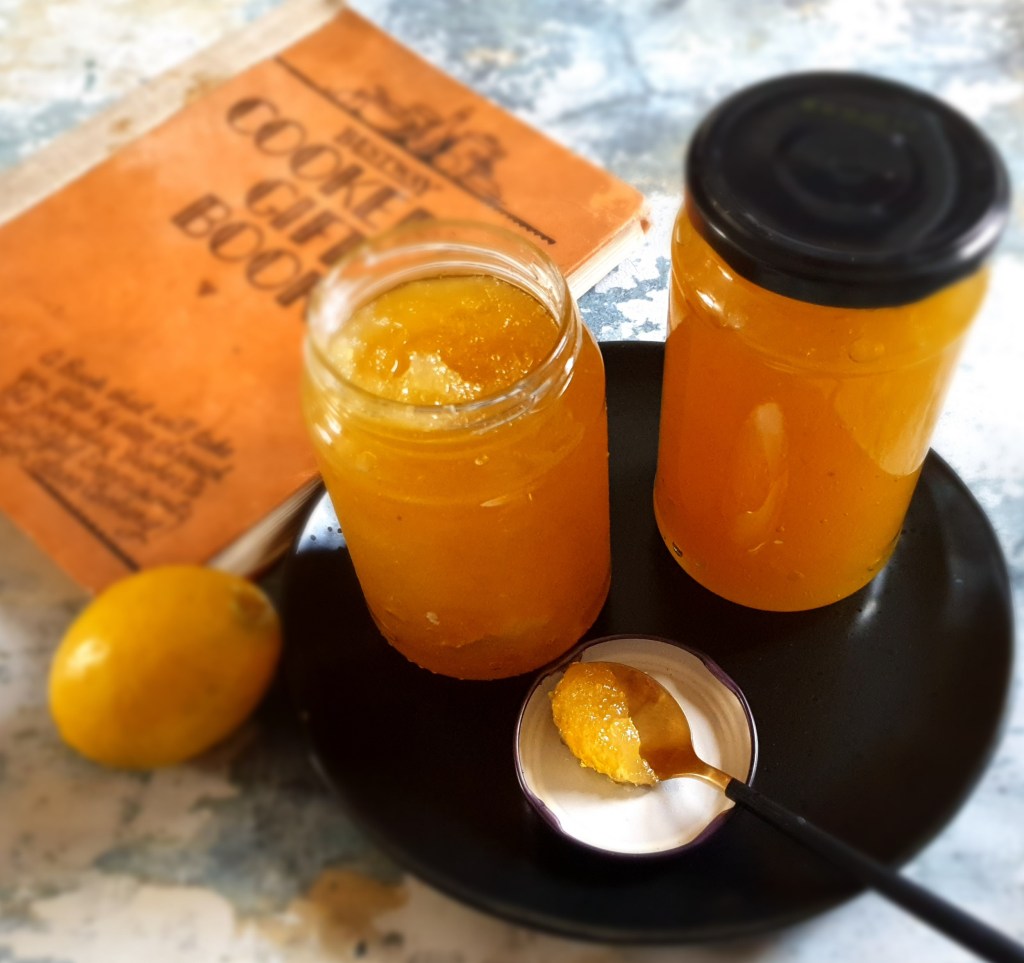
A couple of weeks ago I got a gift. And, to pinch a Tim Minchin lyric, “like most gifts you get it was a book.” Actually, it was several books (and for any Minchin fans who were wondering – no, none of them were the Bible.)

My gift was a bundle of retro cookbooks from Lyalls Book Shop containing such gems as Dainty Dishes and Cyril Scott’s Crude Black Molasses: The Natural “Wonder-Food” – a pamphlet dedicated to promoting black molasses as an alternative medicine for almost all injuries and illnesses known to man. Scott, a composer and musician, also published other ‘medical’ works including Victory Over Cancer Without Radium or Surgery. This publication gave Scott a chance to flex his medical credentials as a “musical composer with a taste for philosophy and therapeutics”, which must have come as a blessed relief to the doctors of the time who Scott describes as being knowledgeable but “not necessarily wise or even skilful” and who had become “so cluttered up with accumulations of academic learning” they could therefore no longer see the simple and obvious facts surrounding the causes and treatments of cancer. He sold himself as a layperson who, unlike medics with “professional prejudices” (you know, like using cutting edge science to treat people), was blissfully unburdened with any medical training whatsoever and was therefore perfectly positioned to advise the public on the kinds of cancer treatment available to them – the more molasses involved, the better. An unfortunately prolific writer, Scott also published other works such as The Art of Making a Perfect Husband (actually I might get that one) and a 1956 opus magnum entitled Constipation and Commonsense.

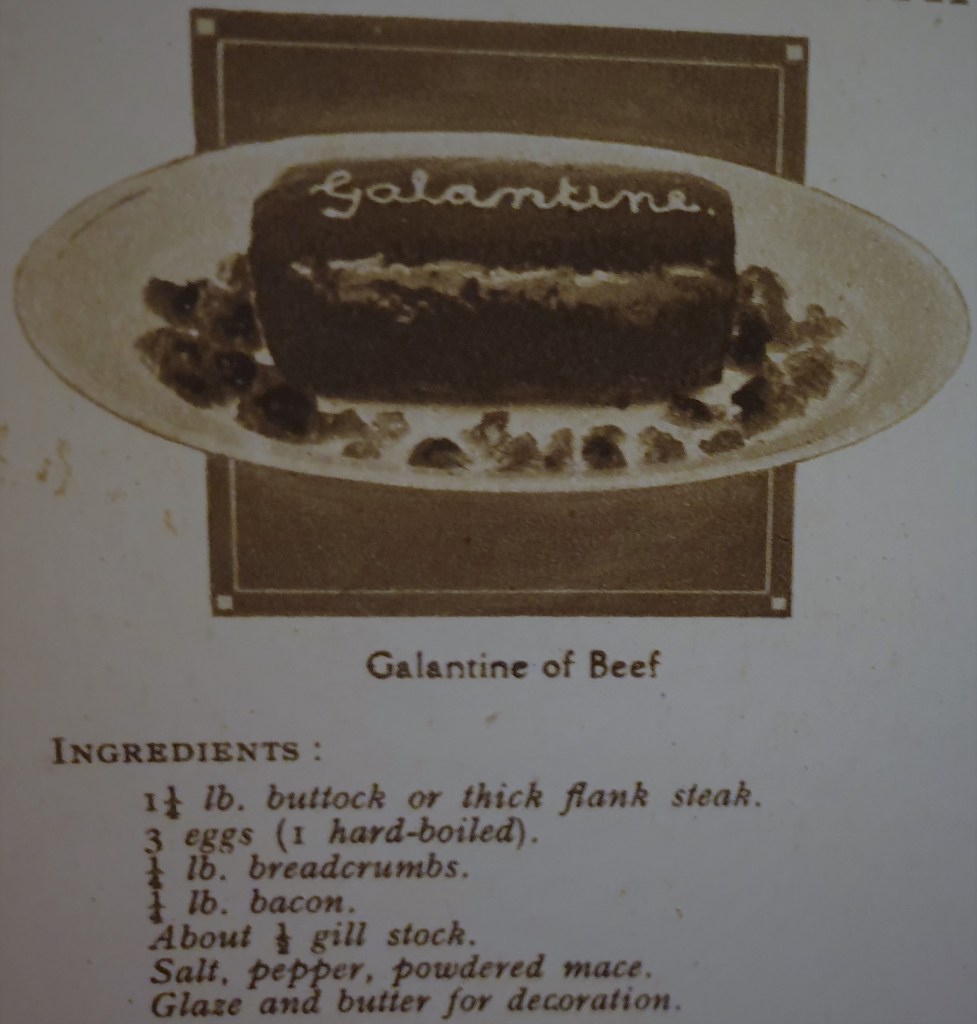
But among the comedy was a Bestway Cookery Gift Book that promised to take me “step by step through the Everyday Dishes to Delightful Experiments in high class Cookery!” I couldn’t find too much info about the Bestway series (my book was a fourth book) but it seems that the offices of the “Best Way” series published a yearly book of recipes during the 20s and 30s for housewives. The books covering a range of recipes ranging from simple household staples like sandwich cakes to more challenging dishes such as Galantine of Beef (an inexcusable serving suggestion implied this dish should be served with the word ‘galantine’ piped over it in butter forced through an icing bag.)

The answer to all those times you asked your teacher when you’d ever need to know how to pipe butter in cursive.

The Bestway Cookery Gift Book was pretty functional and contained very few tips and tricks about its recipes – unlike modern cookbooks that are 30% anecdotes about how the author’s treasured and very secret family recipes were passed down faithfully through the generations only to end up reprinted in six languages.

The closest I could find by way of an introduction to today’s recipe was a paragraph called “Jam-Making Hints” which was confusingly formatted like an acrostic so that I spent a disproportionate amount of time trying to work out how to pronounce ‘UANKT BWP’ and what it meant. It actually turned out that each point was meant to be an easily remembered tip in jam making, like the world’s most impossible mnemonic; so far I just have Underdressed Androids Never Kick The Ball Without Permission which, I found out, was not a helpful jam making tip in the slightest.

Alternative suggestions in the comments, please.

Anyway, on to the jam. Straight away it was a farce. When doing these sorts of experiments I like to aim for as much authenticity as I possibly can and I start with a score of 100 and mentally deduct points for every alteration or mistake I make. Usually I end up with around 70 points left over but today I’m proud to announce I hit a new personal best: 40.

“4lbs marrow” was the first ingredient. Nowhere was selling marrows but I did have three large courgettes in. A quick Google told me that marrows were basically courgettes that had been allowed to go over (sort of) so I figured there wouldn’t be too much harm in using these instead. Minus 20 points for substitute ingredient.

I also didn’t have 4lbs of them so I had to half the recipe. Later I’d find out that this was a good thing, but at the time it felt like I was tipping further into the void and I deducted another five points. Once the ‘marrows’ had been peeled and chopped I saw I was supposed to pass them through a mincer, which we didn’t have. What we did have, though, was a blender which achieved a perhaps slightly too mushy result, but was infinitely quicker than trying to chop the courgettes by hand into mincemeat (or should that be minceveg?). Minus a further 10 points.

The recipe then instructed me to put my minced marrow into a bowl and “sprinkle with sugar and leave overnight.” So just how much sugar should I sprinkle on? Why, just over 1kg of course. It wasn’t so much a sprinkling as an avalanche but I was 35 points down already and had already seen that the words “preserving pan” appeared in later instructions (I don’t have one) so couldn’t afford to fritter away any more points. I delicately dumped sprinkled an entire bag of sugar over the courgette mess and left it overnight.

Despite the recipe recommending I return to complete the next stages “in the morning”, I actually forgot it was there until the next afternoon by which time the mixture was exceptionally stiff, almost like fondant icing, and a very faint green colour. The next stage was to add 1 large tin of pineapple, minced, to the courgette and sugar mixture. Ever so helpfully the recipe gave no indication how large “1 large tin” actually was.

At this point in the day there was a big government announcement about an advisor who had broken lockdown rules but wouldn’t be punished for it. I was therefore a bit distracted when adding my pineapple which explains why I accidentally forgot to half the amount to match the courgette and sugar, and estimated that 1 large tin was about the size of 2 small ones (which was what we had in) and added those, blended, to the mixture. Minus 15 points for incorrect quantities and over blending of pineapple, resulting in lumpy juice rather than finely minced fruit (but plus 100 for being able to stick to lockdown guidelines for 10 weeks even when those in charge can’t, am I right?)

It was now time to heat everything in my non-existent preserving pan. There seemed to be an awful lot of mixture and I doubted whether it would all fit in any of my saucepans so I chose to cook the jam in my ever reliable and ever inauthentic wok, which I’ve used to help Anglo-Saxon and ancient Persian bread rise, but have never actually used to cook a stir fry in. Yes, yes I know – minus 10 points. The trouble with cooking jam in a wok, I found, was that it didn’t heat evenly. I knew I was trying to get to about 105 degrees C for it to set, but after 15 minutes or so some parts of the wok were nearing 105 degrees and others were struggling to get past 100. I decided to transfer half of the mixture to a pan and cook it in batches, which worked much better.

After skimming off the scum and adding the juice and rind of a lemon, it was time to take the mixture off the heat. It looked pretty dubious. I don’t know a lot about jam, but I do know it relies on pectin to make it set, which is mostly present in the skins of fruits, particularly hard fruits. Not only had I used two very soft fruits, but I’d also peeled them thoroughly beforehand. The majority of the pectin was therefore coming from one measly lemon which, I now noticed, had a used by date of May 16th. I don’t know if that affected the levels of pectin in it, but with the way this whole thing was going it felt like this would only be a bad thing. I wasn’t sure my jam would set as firmly as I was used to but short of actually following the recipe properly by using the correct ingredients, quantities and methods, I felt I’d done all I could.

Amazingly, one thing I had done properly was sterilise some jars to put my jam in. The trouble was that both jars were old pickled onion jars and had retained some of their vinegar-y smell despite my best hot water and soap efforts. In a last minute attempt to find jars that didn’t have such an offensive whiff about them I raided my fridge for almost empty or gone off jars of something – anything – that I could use instead. There was nothing I could justify eating up or throwing out yet. And, I’m sorry to say, the only thing that came close was yet another jar of pickled onions sat forlorn and forgotten at the back of the fridge, left over from Christmas.

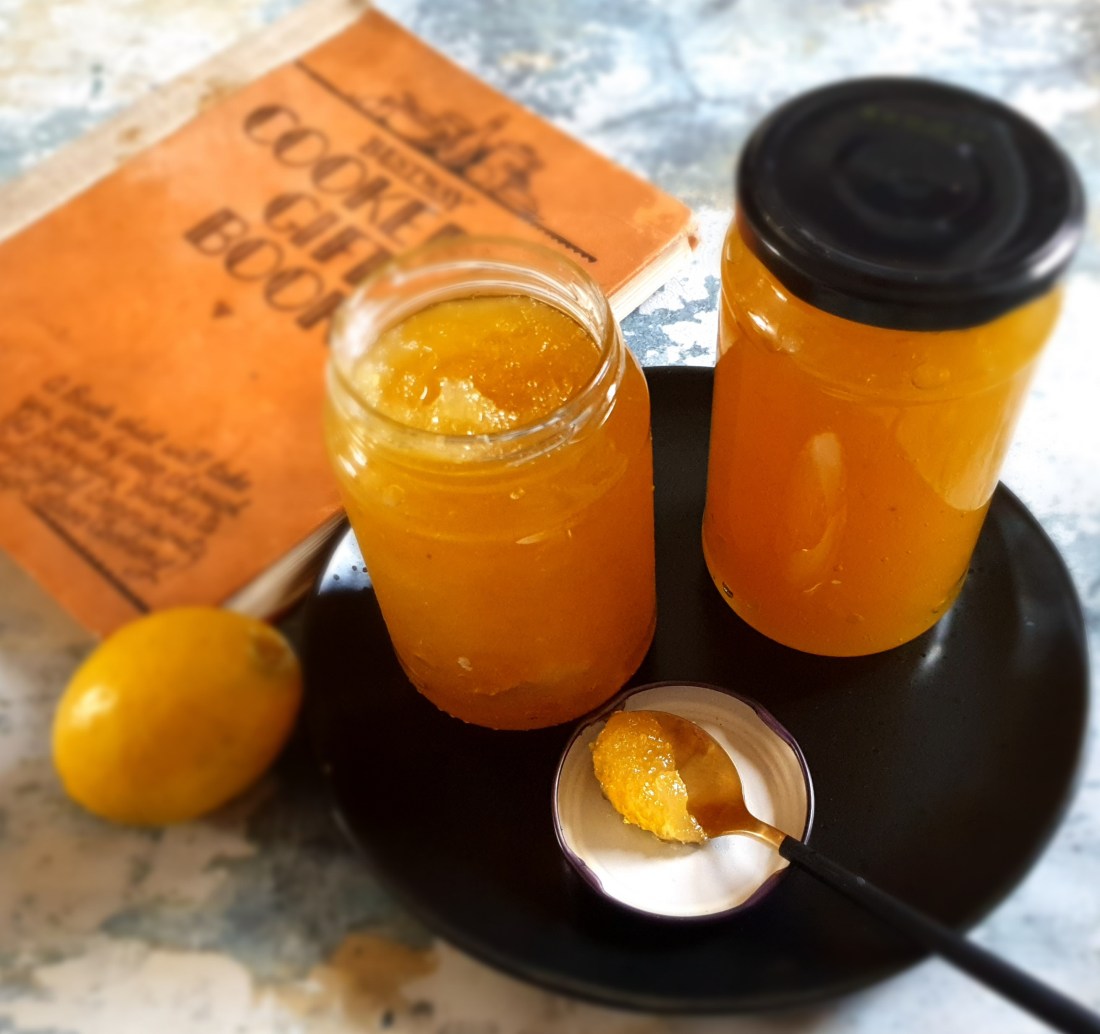
I spooned my jam, which had by now thickened to the consistency of wallpaper paste into the jars and sealed them, leaving a little in the pan for taste testing.

Mmm that sweet, sweet jam and pickled onion flavour!

It’s very hard to explain what this jam was like. Texture wise, it was lumpy and a bit grainy. Not unpleasant, necessarily, but not at all refined. Taste wise, it was…weird. That’s the only way I can describe it. It was sweet – very sweet – but in a plain way. I couldn’t really taste the pineapple, other than a bit of a tropically tang on the tip of the tongue, but my husband said he definitely could, so it may depend on individual palates how much comes through.

Mostly though, it tasted of very sweet courgette and I couldn’t see when you’d eat this. On toast? In puddings? Not really – it’s not fruity or acidic enough for toast or puddings or anything that needs either of those things to cut through. With cheese and crackers, like a sweet chutney or quince jam? No – it’s far too sweet for that and not spicy enough either to add an interesting dimension. The only thing I could see this being used in because you wanted to (rather than because you had to use it up) was possibly as a filling for a lemon cake that had a lemon buttercream icing on top to provide some sourness to the relative sweet blandness. Hardly a jam for all seasons, then. Now you may want to argue that some of this disappointment was down to my lackadaisical approach to this recipe, and you may be right. But, just like an aforementioned advisor, I believe that I acted responsibly, legally and with integrity at all stages of this recipe and will therefore not be taking any real responsibility for its shortcomings.

So overall what did I learn from all this?

One – as a family, we eat too many pickled onions.
Two – Like a musical composer with a taste for philosophy and ethics dipping his unqualified toe into the world of medicine, I did not posses the skills or tools needed to make this jam a true success. I ended up losing points in almost every category, like some sort of inverse jam-based Torville and Dean (weird analogy, right?) despite this recipe not actually being that hard to pull off.

Ultimately I wouldn’t recommend you make this unless you make a lot of lemon cakes (and even then, remember, that’s an untested recipe) or you really just want to try it for yourself. The concept was interesting and in the end it wasn’t bad or inedible, it just doesn’t have a clear role in recipes. With more pineapple and less marrow, perhaps it could be more of a traditional fruity jam but as it stands this is one that I’m happy to leave in the recipe books.

E x

P.S. in the end I actually was able to think of a better mnemonic – one to perfectly combine the farces of politics and jam: Unelected Advisors Needn’t Keep To Basic W.H.O. Protocol.

Marrow and Pineapple Jam

900g of marrow when prepared
1kg of sugar
500g of drained tinned pineapple
Rind and juice of 2 lemon

You will need to sterlise 2 or 3 jars for this recipe. I recommend sterilising them while the mixture is cooking which means they will be ready by the time it’s done.

  1. Peel and blend the marrow to a coarse pulp.
  2. Cover the marrow with sugar and leave for 12 hours.
  3. After 12 hours, chop or blitz the pineapple finely and add to the marrow and sugar.
  4. Over a low heat, cook the marrow, sugar and pineapple together until the sugar has dissolved.
  5. Once the sugar has dissolved, bring the mixture to a boil, skimming any scum from the surface.
  6. When the mixture reaches 105 degrees C, remove from the heat and pour into pre sterilised jars.

Moretum: 1st century CE

Salve, suckers!

Actually, I apologise. That was really inappropriate and I shouldn’t have said it; I meant salvete, suckers.

I’m going to go ahead and slap a big warning on this one for anyone who might come within 6 feet of me in the next few days: don’t. Seriously, this isn’t a joke. Especially if you’re a ‘sleeps all day, turns into a bat and drinks people’s blood by night’ kind of a person.

In fact, if there was ever a recipe made for enforced self-isolation, it’s this one. Containing a whopping four bulbs of garlic, this is one dish that’s not for the faint of heart or faint of nose.

Luckily, we love garlic in this house and (obviously) have no parties to go to where – had we eaten this beforehand – we might have been written out of the social calendar for the next decade. True, in recent times the closest I’ve come to having a ‘social calendar’ is booking my daughter’s parents’ evening slot at her nursery but you get the picture.

Today’s dish is Moretum. No, it’s not just something I see in the mirror after a heavy cake binging session, but is actually a Roman cheese paste mixed with herbs that was eaten through the Roman Republic (c. 509 – 27 BC) and into the Imperial periods (27 BC – 476 CE.) The word moretum translates to ‘salad’ (if we believe the notoriously hit-and-miss abilities of Google translate) and was enjoyed with bread. Since the main kitchen tool used in the preparation of Moretum was a mortar and pestle, there may also be a linguistic link between the recipe and the method of mixing the ingredients together. I don’t know though, and Google translate also tells me that the Latin word for mortar was mortarium, which translates as ‘trough’ – not very well linked to ‘salad’ after all.

As with previous Roman recipes, I’ve found that Farrell Monaco’s website (where she covers not one but three Moretum recipes – including the one I’m trying today) has been invaluable for advice and information. As always, if you prefer your historical cooking to be done by someone who a) knows what they’re talking about and b) has the tools and ability to carry out the cooking with as much historical accuracy as possible, then you should definitely head on over to her brilliant site. If, however, you just like the schadenfreude of reading about a woman bashing four bulbs of garlic to smithereens with a rolling pin (we’d lost our pestle) while her husband and daughter flee the kitchen, gasping for fresh air and vowing never to be in the same room as her again, read on.

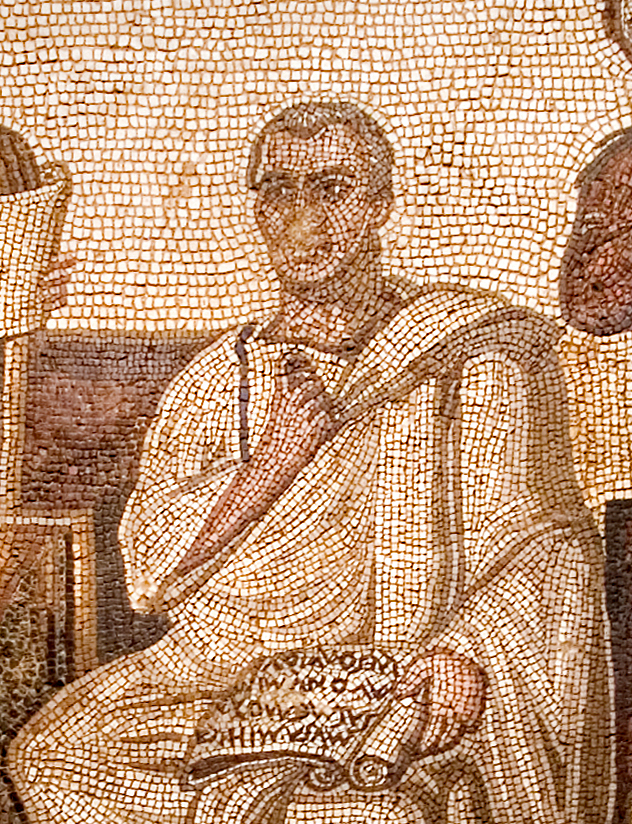
The recipe I’m using isn’t really from a recipe book at all. It’s from a collection of poems from the 1st century CE called the Appendix Vergiliana – specifically one poem simply entitled ‘Moretum’. Yep, it’s my idea of great poetry: an ode to cheese.

Virgil: Author of the Appendix Vergiliana?

Except it’s not really. The author (whoever he may be – despite the name, there is debate around whether Virgil or other unknown author(s) wrote the poems in Appendix Vergiliana) isn’t really writing a love song to the Roman equivalent of Boursin (however much Boursin deserves such exaltation.) No, what we have here is a pastoral poem – a mode of literature which Terry Gifford summed up as having a focus on countryside lifestyles whist highlighting the contrast between urban and rural. Virgil himself popularized pastorals in his Eclogues, which maybe explains why, if the poem Moretum was written by a copycat, they chose the pastoral mode rather than any other. Traditionally, a pastoral poem would paint an idyllic image of rural living and simple country folk. Reading it though, I was struck by how unappealing it all sounded. The main character is portrayed as sweaty, sweary and smelly. He lives a life he doesn’t seem too happy with – unable to even afford meat and going round and round in a cycle of hard toil and sleep; hardly the blissful existence most pastorals painted. If anything, I ended up reading the poem as a satire of a pastoral – but that might be my poor literary judgement.

In fact, to say I lack a sophisticated appreciation for literary art is putting it mildly; I find cracker jokes funny and am naturally wary of people who say not all poetry has be written in rhyming couplet. The problem is, if it’s more advanced than a limerick out of a children’s book I lack the required nuance to ‘get’ it and
I’m not good with free verse poetry that
Does this sort of thing
in an
Arty kind of way –
It makes me panic, I mean:
Which words should I
Emphasise?
(And why do none of them rhyme?)

So here’s my no-frills, no-nuance breakdown of Moretum: a peasant farmer called Symilus wakes up and begins his day’s chores. These include lighting the fire, milling grain, making bread, picking the ingredients for Moretum, making the Moretum and ploughing. He’s not alone, old Symilus, though. He lives with a slave woman from Africa called Scybale who is described in uncomfortable and intrusive detail – notes on her hair, facial features, skin colour, breasts, stomach and legs made for jarring reading in the 21st century. For eight lines the author daydreams through a voyeuristic fantasy and though I’m sure someone will come along to tell me that this was/is a valid literary trope and we shouldn’t push our modern sensibilities onto past cultures (fair) it doesn’t stop my initial reaction to it.

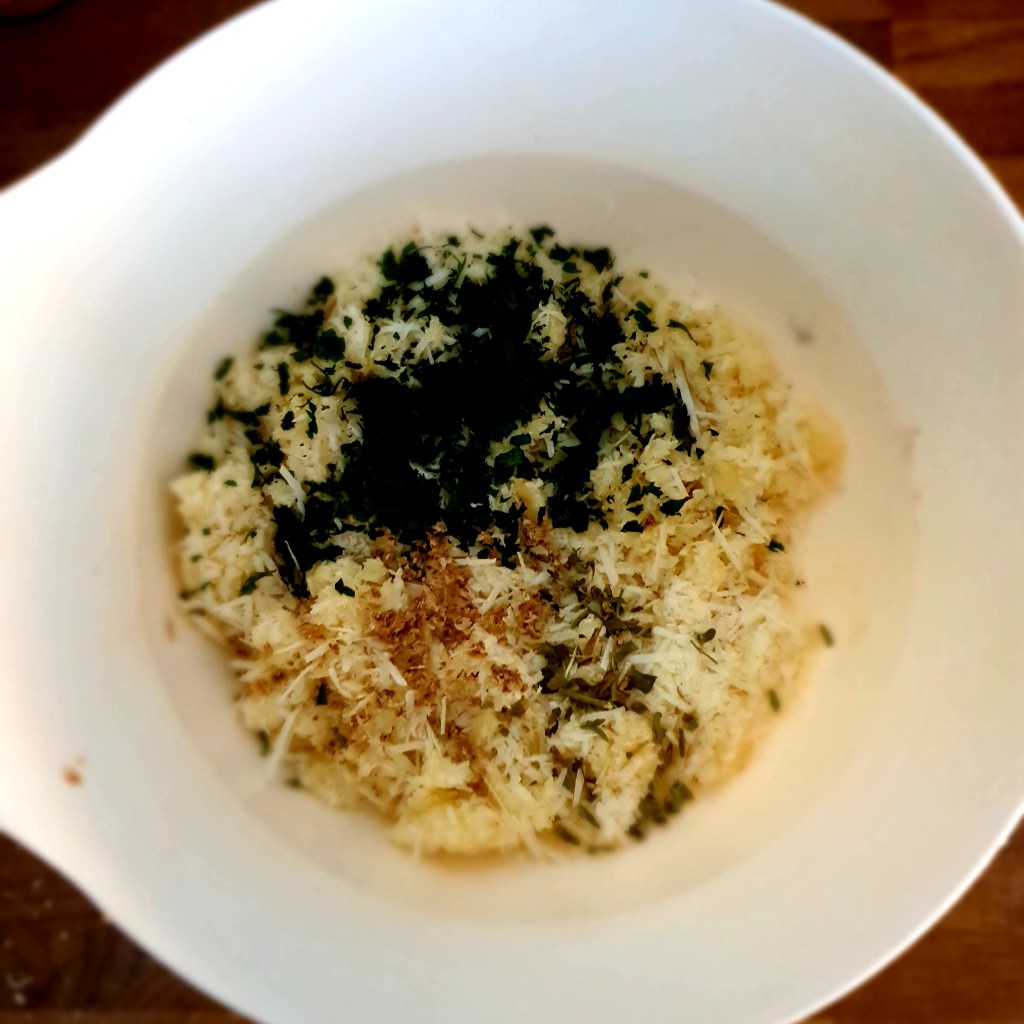
All that aside, the poem does give a very detailed breakdown of how Moretum was made, which I tried to follow as closely as possible. First, I peeled four bulbs of garlic and placed them in the mortar with salt and and entire block (170g) of grated pecorino cheese (the poem doesn’t specify how much or which cheese Symilus used but it does refer to a cheese “hard from taking up the salt” and “hanging” by a rope which suggests a salty, hard cheese. Not only does pecorino fit these criteria, it was also a stalwart of the Roman army and is still (mostly) made following original methods, making it an ideal choice for my experiment today.

Now I understood why Symilus hated his life and “cursed his early meal” when making it; this was bloody hard work. It took well over 20 minutes to pulverize the garlic cloves in a mortar (even after I’d finally located the pestle but but not before I ruined our rolling pin) and I ended up with a blister in the middle of my palm. I’ve never looked at a kitchen appliance with as much longing as I have when I gazed at our mixer, with its shiny blades and never-before-used grater attachment. But I stayed strong; if I was going to do this at all I was going to do it no less than 75% properly and I’d already lost most of my leeway because I’d grated my cheese to make it easier, instead of bashing it up in chunks too.

To the finally mashed garlic and cheese I added parsley, rue and ground coriander seeds. The rue was dried, not fresh, so wouldn’t have been exactly the same, but I’m pretty sure the general bitter flavour was still there. It’s safe to use rue in food quantities (i.e. a couple of pinches) but some people, particularly pregnant women or breastfeeding mothers, should not eat it. More info here.

The smell. Good God, the smell.

Once the ingredients were in the pot (I had to transfer them out of the mortar because it was too small), Symilus began to mix all the ingredients together with his right fist while his left hand “‘neath his hairy groin” stopped his tunic from flapping into it all. What a delightful image. What a lucky woman Scybale was to live with such an appealing sounding man.

The mixture turned quite green, matching the description in the poem where Symilus notices the white from the garlic and cheese mingling with the green from the herbs, and smelled pungent. Very pungent. Even with the window and doors open I knew we wouldn’t be rid of the smell for days. I hoped to God it was worth it.

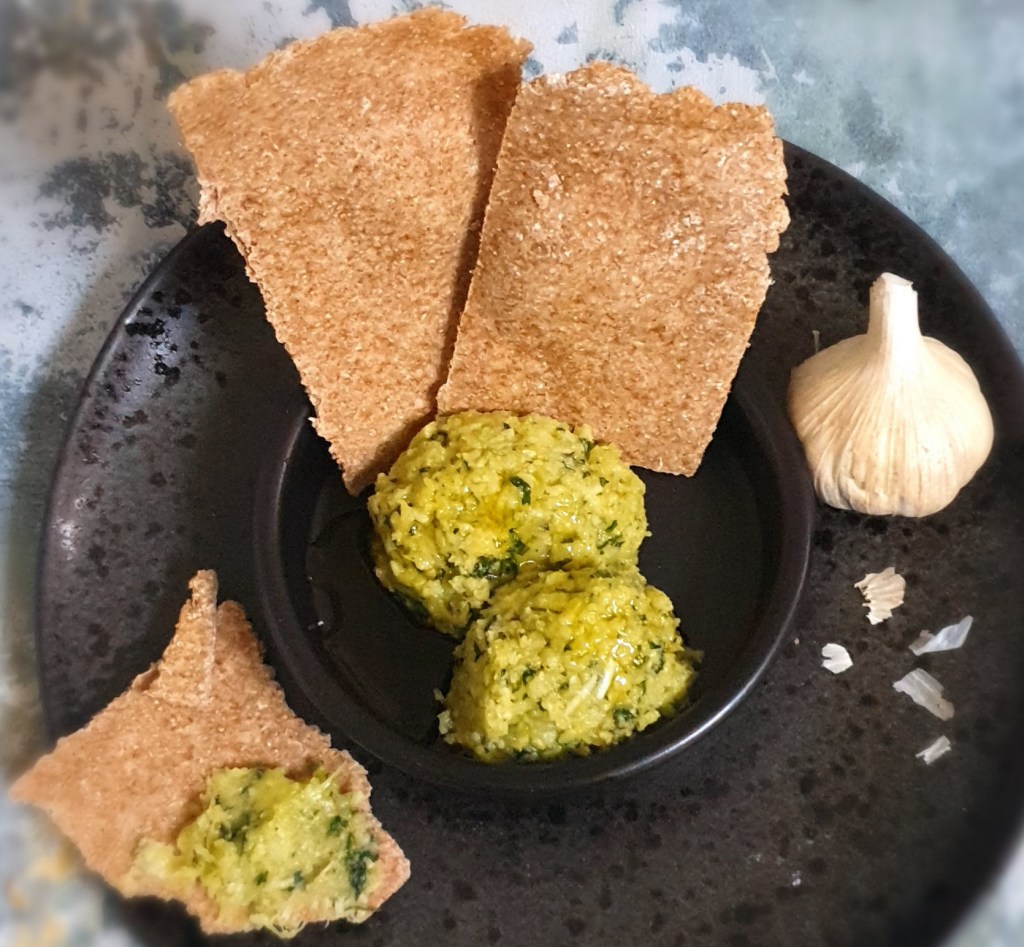
Eventually the mixture formed a stiff coarse paste. I added enough olive oil to loosen it up to the consistency of, well, Boursin (I promise I don’t get royalties from them or have shares in the company) and some white wine vinegar, as per the poem’s instructions and shaped it a little of it into a pleasing ball to serve along with some Roman flat bread (also mentioned in the poem – recipe is also below). Then there was no putting it off any more – it was time to try it.

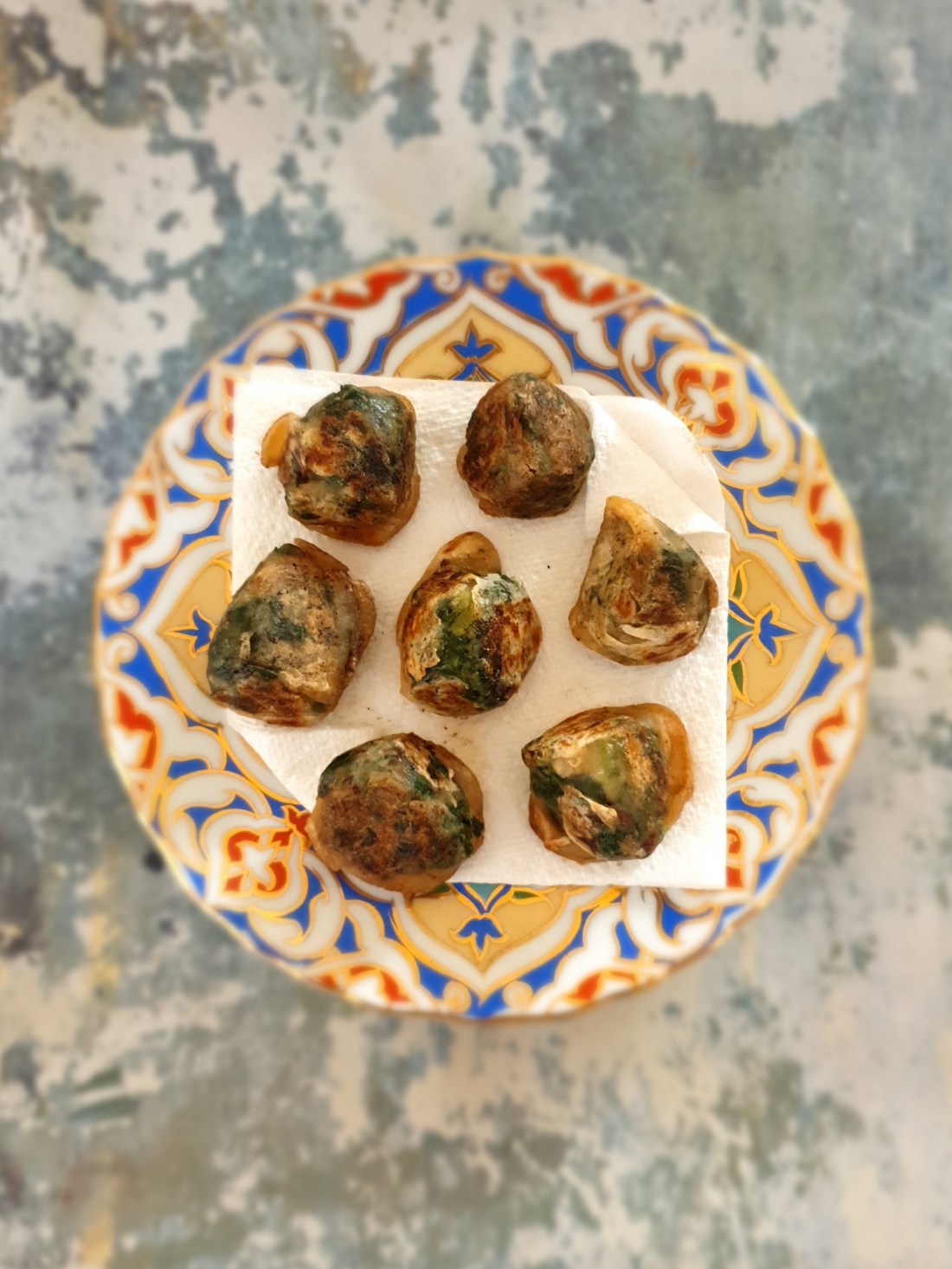
My unsuspecting husband said these looked like veggie meatballs so I dared him to eat one whole. He’s not allowed to open his mouth for a month now.

What did it taste of? Garlic. There was just no getting away from that. But until you try it I don’t think you can know just how garlicky garlic can be. We’re used to eating it in a cooked form, which somewhat mellows it. This was raw mashed quadruple garlic and boy did I know it – it brought tears to my eyes. The first mouthful was so overwhelming I actually didn’t take anything in apart from Oh my God this is very garlicky quickly followed by why is it so spicy?! and Bloody hell I can see my own breath.

But once the heat from the first mouthful had died down, I was able to think about it more. It was fairly creamy, because of the cheese, but in the tangy way parmesan or other aged hard cheeses are (rather than the creaminess of soft cheese) and though I couldn’t really taste the herbs they did make it look more appetising. I think this could have taken even more cheese, so in the recipe below I’ve recommended two blocks of pecorino (yes, I know) and you can scale it down if you need to. The recipe is from the original poem and makes far too much for the average family to enjoy in one go, so I’d half it if you didn’t want any left over and you were feeding a (hungry) family of 4.

Garlic may have been the overriding flavour but once you got used to it, it was very moreish. I actually ended up standing in the kitchen absentmindedly dipping slice after slice of flatbread into the bowl as I watched my husband and daughter playing in the garden among the flowerbeds together (see, I can do pastoral scenes too.)

The best way I could describe it was like a very, very, very strong thick garlic butter (the olive oil obviously acting as the butter element). It was not, however, a meal. No wonder Symilus couldn’t find a partner if he was scoffing a plate of this for his lunch each day. But it was too good to just throw out once we’d tried a bit. So I froze what was left in an ice cube tray for individual portions – I reckon that one large cube or two small ones stirred into pasta would make a strong but delicious garlicky sauce for a family of 4.

I would absolutely make this again. Perhaps in smaller quantities, though, and only if I knew I didn’t have to speak to anyone the day after eating it. I recommend making Symilus’ flatbread too to go with it – it was the perfect subtle companion, offering a nutty but otherwise quite plain base for the Moretum to do its thing. I’ve yet to try the frozen Moretum but I have high hopes it’ll do well – let me know if you can think of any other cooking ideas for it other than pasta sauce.

And to the manufacturers of Boursin – if you’re reading this and now you’re thinking of making a Moretum inspired version; I would like 20% of the profits (and there will be profits) which I’ll accept in the form of money and/or wheels of your original Garlic and Herb.

E x

Moretum (half this recipe if you only want enough for 4)

For the Moretum:
4 bulbs of garlic
340g of pecorino cheese
A large handful of finely chopped parsley
One or two pinches of dried rue (or a few leaves of chopped fresh rue – but no more than a few leaves of fresh because rue can be toxic in large quantities and DO NOT use any at all if you are pregnant or breastfeeding)
1/2 teaspoon of freshly ground coriander seeds
Olive oil
White wine vinegar
Couple of pinches of salt

For the flatbreads:
320g spelt flour (or wholewheat flour)
Approx. 100ml warm water
Salt

  1. Make the flatbreads first. Heat the oven to 165 degrees C.
  2. Mix flour, salt and water until it forms a stiff dough. You may need more water – add as much as you need to get a stiff dough.
  3. Knead the dough and then turn out onto a floured surface. Roll it out to no more than 1/2 centimetre thickness.
  4. Cut the dough into equal rectangles or squares and place on a baking tray. Bake in the oven for 20 minutes. They should be crisp when you remove them. If they aren’t, bake a bit longer.
  5. Peel the garlic and place the peeled cloves into a mortar. Pulverize them until they are a coarse paste. It will take much longer than you think. Alternatively, whizz them in a blender for a few seconds.
  6. Grate the cheese into the mashed garlic and add the herbs and salt.
  7. Mix everything together, making sure the herbs and salt are well incorporated.
  8. Add olive oil to loosen the mixture to a consistency you like, and a couple of teaspoons of white wine vinegar. Mix well.
  9. Transfer to a bowl and enjoy with the flatbreads.


Payn Ragoun: c.1390

It’s another medieval one! It’s another sweet one! It’s another one where I don’t really have much idea of what it is I’m supposed to be doing!

Right from the start I’m going to attribute at least half of today’s success to Dr. Christopher Monk – a man whose knowledge of medieval cuisine (particularly the cuisine in The Forme of Cury, from which this recipe is taken) is as impressive as his patience with over-enthusiastic amateurs contacting him with screen shots of recipes they don’t understand, begging for help. He could have said no. He could have done that thing where the message pops up in notifications but you ignore it forever because you don’t want to engage with such nonsense (don’t pretend you don’t know what I’m talking about – we’ve all done it. My husband’s still waiting for my response to a photo of him trying on something he called “dress shorts” in Debenhams changing room in 2017. He didn’t buy them in the end, which I guess shows that actually this approach can work sometimes.)

To put it bluntly, he could have told me to find a hobby that didn’t so often require at least some basic understanding of Middle English and other “extinct” languages. And believe me for I speak from bitter experience – knowing all the spells in Harry Potter only gets you so far with Latin. But instead he shared his translation and notes on the recipe and offered advice and encouragement. I’ve called on his expertise before and I’m sure I will again (unless he has the commonsense to block me on Twitter), so I make no apologies for the first section of this entry basically being a big thank you to Dr. Monk.

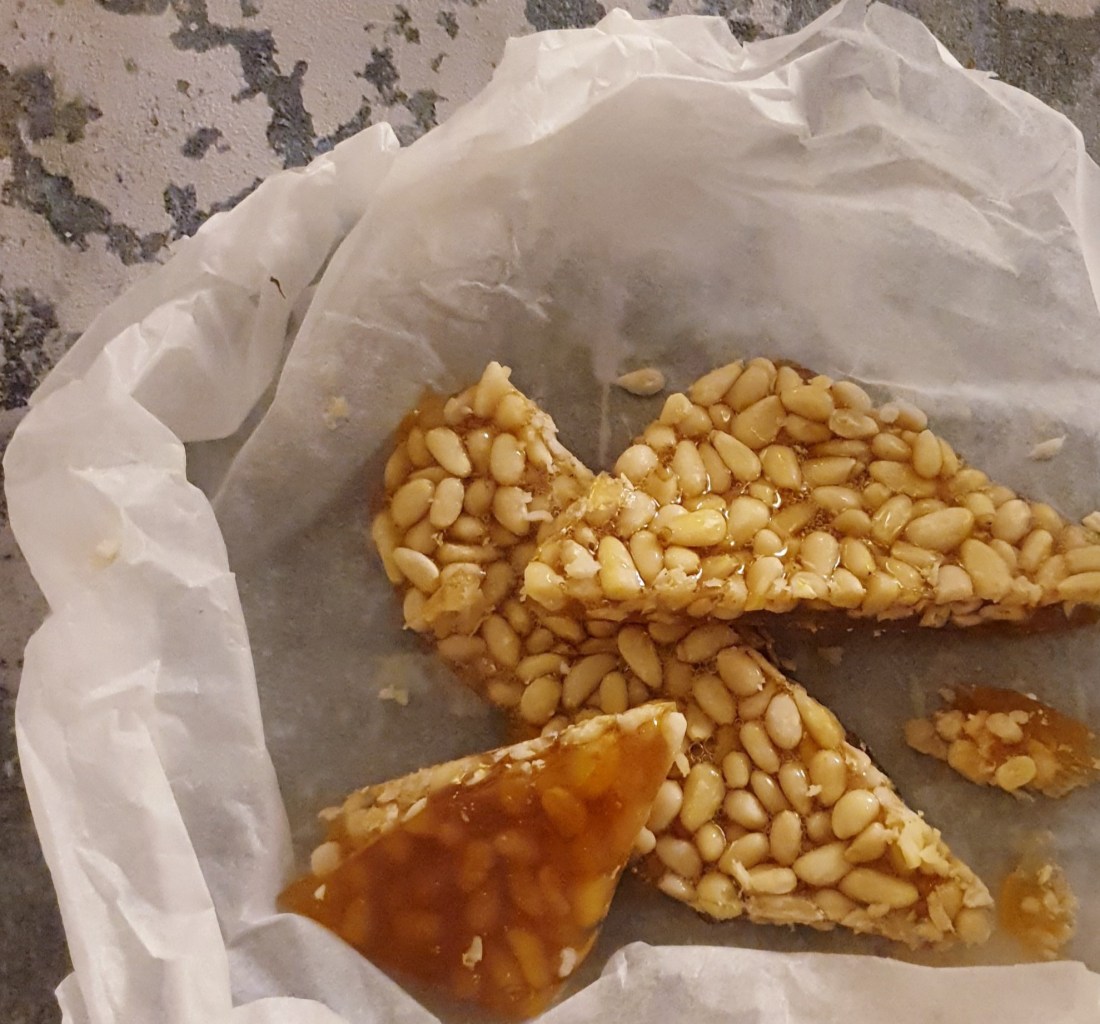
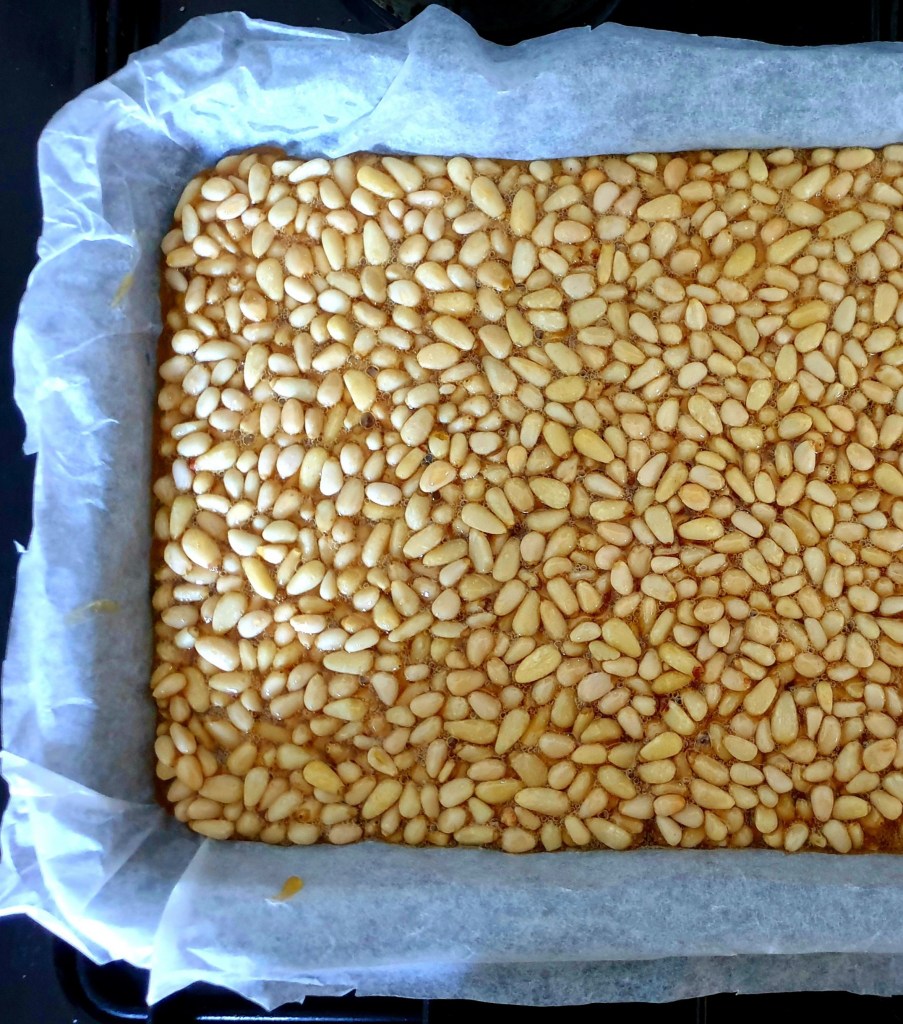
Payn Ragoun is a mystery in itself to me. Entitled “Pine Nut Candy” in Maggie Black’s The Medieval Cookbook, there is much in the original that confused me. The word “ragoun”, for example. What did it mean? Was a ragoun a style of cooking or was it a way of serving food? I wondered if it was just a word that had become lost with in time that used to mean a particular dish, like a pie, and medieval tables once groaned under the weight of strawberry ragouns and apples ragouns as well as pine nut ragouns. I decided to do a little etymological investigation, which basically meant typing “Ragoun: what does it mean?!” into Google like a madwoman until I hit on something useful. Or rather, I hit on something that just directed me right back to where I started. The University of Michigan Library’s online Middle English Compendium (yep, that’s a thing) had this explanation for the word “ragoun”:

“The name of a dish made with honey, sugar and bread.”

The associated quotations took me directly back to the recipe I was looking at, which didn’t do too much to clarify what this dish was meant to be. The compendium told me that the word “ragoun” possibly came from the Old French word “regon” meaning a mixture of wheat and rye. So, though I still felt a little nonplussed by what a ragoun was supposed to actually look like, my confidence levels rose as I turned to my husband, who hadn’t asked at all, and triumphantly exclaimed “well, at least I know it’s got bread in it.”

Reader, it did not contain bread. Let me explain…

The second thing that had confused me was the word “thriddendele” in the translation of the recipe I had. Maggie Black had explained this was a “mystery ingredient” (she translated the word “thriddendele” as meaning an anonymous “third item”) which she had taken to mean breadcrumbs. This seemed completely logical and fit in with my tenuous understanding of “ragoun” and the word “payn” in the dish’s title (meaning bread, from the French pain.) But this was where my lack of understanding of Middle English – and to be honest, modern English – came in handy. I had misread Maggie Black’s entry and thought she had meant that the word “thriddendele” was the word for the mystery ingredient itself. I wasn’t happy with my lack of knowledge of this ingredient – if it was going to be the third item in this dish I damn well wanted to know for sure what it was. And so, with all the puffed up indignation of a woman who has no idea what she’s doing but already spent money on most of the ingredients, I messaged Dr. Monk for help.

Firstly, he clarified, the dish seemed to be a type of soft toffee with pine nuts and ginger mixed in. There was a reference in the recipe to “take up a drop thereof with thy finger and put it in a little water and look if it hangs together” which indicated a method similar to the confectioner’s technique of checking when sugar has reached the “soft ball” stage for fudge.

Secondly, “thriddendele” wasn’t the name of an ingredient in its own right (as Maggie Black had also pointed out but I’d been too dense to realise) – it was from an Old English word meaning “third deal” as in part or portion. The instructions in my book may have translated “thriddendele” as an instruction to add breadcrumbs as the third part of the recipe because of how the original sentence was structured: “add thereto pine[nuts] the thriddendele (third part) & powdour gyngeuer.” However, word order wasn’t fixed in Old English, like it is today (this is also the case in Latin; Wand, Accio! would work just as well as Accio, Wand! by the way. As would Leviosa Wingardium, it just sounds a bit rubbish and means Hermione couldn’t do the special voice.) The shifting word order means that though the recipe was written “add thereto pine[nuts] the thriddendele (third part)” it could just as well read “add thereto the thriddendele (third part) pine[nuts].” Which actually makes much more sense as a cook – especially when you fall down the etymological rabbit hole and see that “thriddendele” can also mean one third of a whole – meaning, in this case, the word “thriddendele” sort of acts as two instructions; to add a final third ingredient (pine nuts) in a particular quantity (equal thirds to honey and sugar.)

Just in case you were wondering what would happen if you searched “thriddendele” in Google images.

The absence of bread and presence of pine nuts as the “thriddendele” becomes even more compelling after a quick analysis of modern understandings of the word “bread” versus medieval understandings of the word “bread”. To go back to the Middle English compendium, the word “payn” could mean a literal loaf of bread as we would recognise it today. But there was a secondary use of “payn” which just meant something of a breadlike consistency, such as pastry. Even more interestingly – that wasn’t a yawn, was it? – the compendium links this “breadlike consistency” use of the word “payn” back to the word “ragoun” as an example of a dish that matches this description. Payn Ragoun therefore wasn’t a dish made with bread; it was a dish that mimicked the consistency of bread, or bread dough.

I though this was meant to be a food blog, not an English blog?

Right. And before we move on – if there are any academics out there, or even just anyone who knows their stuff about words and… well, stuff, I guess, and thinks I’ve gone off on a huge incorrect tangent in my non-academic analysis, please let me know (nicely!) and I’ll correct it. If I can be bothered, that is, and if I can do it in a way that makes me look like I’ve grown to have the intellectual prowess of both Stephens combined (Hawking and Fry, FYI).

So, I knew I was working with equal parts honey, sugar and pine nuts. The question was how much was equal? “Thriddendele” could often mean one third of a gallon, which was about 1.5l. This was an obviously unacceptable amount for anybody who valued not having cavities in their teeth, so I scaled it down a bit and decided to switch to measurements in grams rather than ml which made everything a lot simpler.

I melted 250g of honey with 250g of sugar. This bit caused me some problems too, if I’m honest, as the recipe called for “Cyprus sugar”. This was the best quality available at the time, made in Cyprus, which had a thriving sugar industry during the 14th and 15th centuries and was considered the cream of the crop in England thanks to the many stages the cane went though to extract the molasses. The Forme of Cury was written by Richard II’s master cooks and though it was intended to be used as an instructional book for everyday dishes, it was also supposed to show off the king’s fabulous wealth and the skill of his cooks. Dishes such as “common pottages” were all well and good for the merely well off, but any dish requiring one third of a gallon of Cyprus sugar was firmly in the realm of the rich, thank you very much.

I was faced with a problem: did I stay true to the taste of the recipe – even if that meant using a non-regal unrefined sugar in an effort match the levels of refinement at the time – or did I try to copy the intent of the recipe and use the most highly processed white sugar I could? In the end I settled for an unrefined golden sugar made from 100% cane (not sugar beet). In all honesty, it was pretty much all the Co-op had on the shelf anyway, other than a packet of “Schwartz Hot Chilli Con Carne Mix” which I’m fairly sure had just been put in the wrong place.

Sugar and honey bubbling away, it was soon time to test the mixture. The author of the recipe had, presumably, a very dark sense of humour and advised dipping a finger into the seething mix of melted sugar to “take up a drop…in a little water” and see if it held its shape. I can imagine him laughing wickedly at the idea of trainee cooks taking his advice and screeching in pain as their flesh melded with molten syrup. In case you want to recreate this recipe yourself and it’s not obvious enough: do not touch boiling sugar with your fingers. Or hands. Or, (and I really shouldn’t have to spell this out), any part of your body at all, you absolute weirdo. I used a sugar thermometer – not technically authentic but far more likely not to land me in A&E and continued to boil the honey and sugar together until it reached the “soft ball” stage and registered 112 degrees C. I was a bit put out not to reach the vastly more amusing “soft crack” and “hard crack” stage but I think Richard II’s cooks were less immature than I am.

Once I’d reached the correct temperature, 250g of pinenuts were added, along with a good pinch of ginger, and stirred in. (I’m aware that is a hugely expensive amount and the fact I used a mixture of pine nuts from old open bags we had in already and a bag of specially bought ones might have skewed my perception on the overall cost of this dish, but it would still work with any similar cheaper hard nut.) The whole mixture was poured out onto a greaseproof paper lined baking tin and allowed to cool for a few hours.

I know, I was excited about this too.

The author of the recipe suggested serving this alongside “fryed meat, on flessh days or on fisshe days”, showing the medieval tradition of serving sweet foods alongside savoury, but we just decided to cut it into fudge like rectangles and eat it as it was instead.

My first thought were that it wasn’t as sweet as I’d expected. Obviously it was sweet, but it wasn’t that tooth-aching sweet you can get from fudge. It was quite woody because of the pine nuts, and very mellow. A bit like nougat is, but less smooth. The ginger was warm rather than overpowering and spicy, which worked really well. However, my results will be different from any others because a lot of the actual flavour came from the honey, which is dependent on local flowers and the nectar the bees use. Using a locally produced honey, my Payn Ragoun wasn’t overly floral or perfumed, but I can imagine that certain honeys would yield different results. Thyme honey, for example, would have a much stronger aromatic flavour.

I also think I should have cooked it for slightly longer. It held its shape when cut into rectangles, but in an oozy way. It would only take a hot afternoon to transform this back into liquid stickiness so cooking it to a “firm ball” stage (118-120 degrees C) might help a little more with that.

One for me and one for you…and one more for me.

In fact, I was sure this would be brilliant as a brittle. The instructions were vague at best about how long the mixture should boil for and, though the reference to testing a ball of mixture in water seems to correlate to the soft ball stage, there’s nothing to indicate it had to be that. It’s not outside of the realms of possibility that a cook got distracted (or had to go and plunge his hand into a bucket of cold water after trying the medieval soft ball method) and let the mixture bubble a bit longer. Furthermore, some of the recipes in Forme of Cury are similar to those found in the 14th century French/Italian cookbook Liber de Coquina, which had links to Arabic cooking. Why does that matter? Because centuries earlier Arabic cooks had been busy experimenting with sugar and were among the first to develop hard candy. By the 12th century there were clear signs of hard candy in some European recipes. While hard candy might not have been common in England by 1390, surely it would have been something the cooks of Richard II, who must have been reading other contemporary Arabic influenced works such as Liber de Coquina, would have known about? So I saved a bit of the mixture over and let it cook longer – to the hard crack (teehee) stage.

As expected, the brittle version of Payn Ragoun was even better than the fudge version. I love brittle, so didn’t mind that I was still chewing on a small piece of it two hours after I’d started, or that with each bite I could feel my teeth loosening from my gums. The brittle version seemed less sugary but more honeyed than the fudge version too, so if you prefer less sweet sweets, let your mixture boil for longer.

Just glorious.

Overall, this was a great sweet treat to make. It was surprisingly quick and easy to rustle up, if you don’t panic over melted sugar, and tasted very, very good. If you have honey and sugar in you should definitely try this – add pine nuts for a medieval version or experiment with other nuts – hazelnuts were used in medieval England too – or bits of fruit added at the last minute (just avoid super soft fruits like banana – though why would you add banana to anything anyway?!). I could even see a slab of this plain with flakes of sea salt scattered over the top of it as it cools working well too. I’d recommend the brittle version over the fudge, but it’s so easy to make you could just do two versions anyway.

Enjoy. And please, for the love of God, don’t stick your fingers in melted sugar. Just… don’t.

E x

Payn Ragoun

250g honey
250g golden caster sugar
250g pine nuts (or a combination of similar hard nuts such as almond
Pinch of ground ginger

  1. Line a small baking tray (I chose 28cm x 18cm) with greaseproof paper.
  2. Measure out all the ingredients before you start.
  3. Heat the honey and sugar in a pan over a low flame, swirling it occasionally to stop it clumping. Using a thermometer, or the cold water test, cook the sugar to 118 degrees C. If you want to make brittle keep cooking it until a thermometer reaches 146-1154 degrees C.
  4. When the sugar has reached the right temperature, take it off the heat and stir the pine nuts and ginger in until fully mixed. You will want to be a bit quick in doing this to stop the sugar and honey solidifying too soon.
  5. Pour the honey, sugar and pine nut mixture into the lined baking tray and leave to set somewhere cool, like a cupboard (not a fridge).
  6. After it is set, cut it into chunks with a sharp knife and enjoy. You should store it in greaseproof paper in an airtight container for lasting freshness.

Fritters of Spinnedge: 1596

The quest to eat more vegetables in the Foreign Pantry household is at risk of veering into saga territory. It should be straightforward, after all – two thirds of the household are adults fully aware of the five a day rule and there are (sadly) no reports of broccoli shortages in the shops. And yet. And yet.

I’ve spoken before about my good intentions and, for the sake of my daughter (whose first full sentence was “more biscuits now?”) we do keep some of the green stuff in the fridge and a bowl of f-r-u-i-t somewhere under piles of letter and papers on the table, but it’s not like I’m a natural herbivore, to put it lightly. You know those smug families with fridges full of veg organised in rainbow order, who always seem primed to tell you about a “fabulous new aubergine recipe” they discovered at the weekend? That’s not me. My fridge is arranged in whatever way will fit the most cheese in, and I had to use spellcheck to make sure I’d spelled ‘aubergine’ correctly just now (but ask me about a brownie recipe and I’ll give you five.)

Which goes some way to explaining how I ended up here: covered in beer and batter, frying balls of spinach in ever increasing quantities of butter. Hey, at least it’s a start.

Today’s recipe is from Thomas Dawson’s The Good Huswifes Jewell, an influential late Elizabethan recipe book written at a time of growing culinary curiosity when rich households began to collect cookery books to keep up with the fashions of courtly kitchens. As with many other similar cookery books of the time, The Good Huswifes Jewell contains recipes for herbal treatments for illness as well as recipes for food.

The Elizabethan era was a unique one: continuing to build on the foundations of the Tudor dynasty but with veins of medieval tradition still running throughout it, much of what went on in Elizabethan kitchens was a fusion of old and new. Clear instructions for cooking and measurements in recipes, for example, began to be used with some regularity during the Elizabethan era, which marked a shift from the medieval ‘chuck it in and hope’ approach to quantities of ingredients. Similarly, the food historian Ken Albala noted that Jewell was the first English cookbook to provide a recipe for sweet potato and used simpler flavour combinations than had been used in medieval recipes. Yet some things didn’t change; making use of seasonal ingredients was still key and combining sweet and savoury elements in one dish remained a favoured technique.

This is something that Fritters of Spinnedge highlights very well: if you asked anyone in 21st century Britain whether spinach fritters fried in beer batter was a sweet or savoury food I think most people would answer savoury. But Dawson’s recipe for spinach fritters, nestled between recipes for spit roasted mutton and boiled pigeons, is distinctly sweet. And, frankly, delicious. I’ve yet to find a better way to eat spinach.

First I boiled spinach for a few minutes just until it was wilted, before straining the liquid off it and and adding a small handful of breadcrumbs. To this I added an egg, a teaspoon of sugar, cinnamon, ground ginger and pepper. Dawson then instructed me to add dates “minced fine” and currants, and then combine everything together. It looked wonderful. It smelt great. Maybe this could be our way to vegetable nirvana?

So far, so healthy.

Maybe not. After making my spinach and date mix, I had to roll the mixture into small balls to be fried. This bit took a while; despite my judicious spinach straining efforts there was still a lot of water left over so each ball had to begin in a vice like grip to squeeze excess moisture out before being shaped. It took a long time and gave me mild carpal tunnel syndrome; I’d started making fritters about golf ball size but worried they were too large to cook through so ended up downsizing to conker size. This made the process much longer and wetter than I would have liked and I wondered if maybe I just wasn’t cut out for a life of vegetables after all. Like, maybe it’s in my DNA to resist greenery whenever I encounter it and by putting so much effort into these bloody balls I was actually fighting my own inherent nature? Nevertheless I struggled on heroically, buoyed by a promise I made myself of a congratulatory hot chocolate if I completed the task successfully.

Balls finally shaped it was time to make the batter. Dawson suggested an ale and flour mixture, which I wasn’t about to argue with. Ale was the main drink of the fifteenth century and the first half of the sixteenth, after which beer began to take over. Ale tended to be sweeter than beer and was commonly brewed by women as part of regular household food production. Very good ale-brewers (AKA “ale-wives”) with a head for business could also make extra money selling their excess ale from their house, although commercially produced ale was subject to testing by local tasters (cushy job, right?) and anyone found selling sub-standard or watered down ale could face a hefty fine. The ale taster in Worcester during the reign of Elizabeth I was given the very onerous task of visiting “every brewer’s house in this city…and there to taste their ale whether it be good and wholesome for man’s body, and whether they make it from time to time according to the price fixed.”

Good ale could take a couple of days to produce, and I had as long as my daughter’s nap would last, so I had to duck out of becoming an “ale-wife” on this occasion and instead use what we had in: Doombar amber ale. I don’t actually drink beer myself, but I know some people get very het up about what counts as ‘good’ beer, so if Doombar doesn’t meet your exacting standards please direct all your outrage towards my husband, not me. Thanks.

I made up a thick batter of ale and flour and heated a frying pan with a knob of butter. Dawson didn’t give instructions for what the fat should be when frying the fritters, but in another recipe for “Fritter Stuffe” he mentions frying with butter, so I assumed he wouldn’t complain about it being used here either. Once each fritter ball had been coated with the batter it was plopped onto the pan and turned regularly in the butter to ensure it cooked on all sides. It wasn’t quite deep fat frying but apparently it was still smoky enough to set off our fire alarm, which momentarily woke our daughter, thereby threatening to ruin my fragile and newly found appreciation of vegetables. For some reason my husband had foreseen the possibility of this happening (casting no aspersions on my cooking ability, I’m sure) and was able to do the tea-towel dance under the alarm fast enough to switch it off before the toddler woke properly.

Fritters fried and toddler soothed back to slumber, it was time to taste test. Admittedly, it wasn’t an attractive dish. Plopped onto a plate with no arranging they looked like burnt sprouts oozing grease like there was no tomorrow. It wasn’t a fantastic advertisement for a new healthier lifestyle and I wondered if this had once been an Elizabethan version of avent-garde dining that had gone very wrong. Still, there was only one way to test…

…and thank the fritter gods I did. These were great! Okay, faffy and fiddly to make and ugly at the end, but really quite delicious. Definitely not healthy, though; the first taste was of buttery, beer-y batter which melted as soon as it hit the tongue.

I tried, I really tried. The plate, the napkin, the aerial angle – these really are just breathtakingly un-photogenic.

The spinach mixture was sweet, but not in a sugary, synthetic way. It was almost middle Eastern in its flavour combinations – the dates and currants lending a syrupy, treacle like element. Overall most of the spices were subtle, but the pepper was quite prominent and gave a kick to the back of the throat that lingered for a while after all of the fritter had been eaten.

Okay, so is this a feasible way to get more vegetables into your diet on a regular basis? No. Absolutely not. Not only does it take a bit of time to complete all the steps and roll out the spinach mixture into individual balls, it’s not really a healthy way to eat vegetables either (which sort of defeats the point.) But would I make it again? Yes! And that is definitely something to celebrate, if only because now I’m able to be one of those smug people who has a fab new spinach recipe to share with the aubergine lot.

But so what if these take a bit more time to prepare and are a little wonky to look at? They taste great and, at the very least, are a fun way to fritter away an afternoon (sorry).

E x

Fritters of Spinnedge

225g fresh or frozen spinach
1 egg
2 tablespoons of breadcrumbs
Teaspoon of sugar
6 or 7 dates
30g currants
1/2 teaspoon of cinnamon
1/2 teaspoon ginger
1/2 teaspoon pepper

For the batter:
75g plain flour
30ml light or amber ale

  1. Boil the spinach until wilted or defrosted. Strain it and shred it finely.
  2. Beat the egg and add it to the spinach along with the breadcrumbs and spices.
  3. Finely chop the dates and add them, with the currants, to the mixture. Mix all together until fully combined and sticky.
  4. Make balls the size of small conkers from the spinach mixture.
  5. Make the batter by mixing the flour and ale together and whisking until there are no lumps.
  6. In a frying pan, melt a large knob of butter until sizzling.
  7. Dip the balls into the batter and place them into the pan of butter. They should begin sizzling immediately and you will have to turn them on all sides to ensure they are cooked through.
  8. Eat straight away – these are better hot and fresh.

Libum: 160 B.C.

Who likes cheesecake?

Because I don’t want to live in a world the alternative is true, I’m going to assume that most of you said you did – good. Well, you’re in luck: today’s recipe from Cato the Elder’s De Agri Cultura could be seen as a type of blueprint cheesecake – one of the very earliest forms.

Before you get excited I should quickly read you the small print because there are a couple of caveats to this cheesecake recipe. For one: does it look like cheesecake? No. Does it smell or taste like a cheesecake? Also no. Essentially what we’re dealing with is a cheesecake in the sense that it has cheese in it and is shaped like a cake but really that’s where the similarities end. Libum may translate as ‘cake’ but rather than matching our modern day idea of cake as something sweet, the notion of ‘cake’ here just relates to the round shape. Some people (my husband is one of them) still use the term cake in this way today – a cake of soap, for example, which is why my toddler spent most of the night hiccuping up bubbles.

That’s not to say that ancient cakes couldn’t be sweet – far from it. Liba may not have contained any sweeteners in the dough, but that didn’t stop people serving them drowned in honey or pomegranate syrup. The Greek writer Athenaeus, writing some 350 years after Cato wrote the recipe for Libum also tells of basynias – boiled dough filled with a honey and date stuffing – and elaphos – dough shaped like deers cooked with honey and sesame – for the festival of elaphebolia.

Back in Cato’s De Agri Cultura we find a large number of different cakes listed, included the alarming entitled ‘placenta’ cake – but his concern with listing these cakes isn’t frivolous. In fact, as Nicola Humble points out in a book that encapsulates my two greatest loves with frightening precision – ‘Cake: A Global History‘ – Cato’s preoccupation with cake in a work that is otherwise serious and instructive shows how culturally significant it was to the ancients.

Libum fits in perfectly with this assessment of the seriousness of cake. Rather than be baked to be eaten (although of course they were also used for this), Libums primary function was as a sacrificial offering to the household gods of ancient Rome. Each household would have had an altar upon which one or two of these cakes would be offered to give thanks to the gods. Is there a link with the word ‘libations’, which seems to be only associated with liquid offerings to the gods? I don’t know – opinions and guesses are welcome! Someone who specialises in Roman food and who made much better Liba than I, Farrell Monaco, sheds some light onto the religious function of these cakes. Go and read her post on Libum for much more accurate history and baking than I can provide!

Copy of De Agri Cultura at the Laurentian Library. Credit here.

Cake for the gods? Must be pretty fancy.

Er…

The thing about sacrificing food to the gods in the ancient world is that people often, um, cheated. They didn’t see it as cheating, obviously, but the foods that were offered were usually not what we’d call the cream of the crop.

Take the ancient Greeks. If you know your Odyssey or your Illiad (*scoff* and who doesn’t?!) you’ll know that men of ancient epics quite frequently cook and offer up food as sacrifices to the gods. It happens fairly often – in fact, Odysseus could probably have been home a lot sooner if he hadn’t dilly-dallied around with “burnt offerings” as much as he did. And what were the offerings of choice? Why, thigh bones wrapped in fat and roasted to a crisp, just like mum used to make. Yummy!

The ancient Egyptians were little better – oh sure, they might make a show of offering their gods fruits, breads, wine, fatty meats and rich cheeses up to three times a day, but once the prayers had been said the altar was cleared before the gods could tuck in and the food was taken home to be eaten by the priests (who later died of blocked arteries – true story.)

And finally, the Persians. Herodotus tells us they had no temples to their gods as they believed altars to be “a folly” but when they felt the need to do some praying they stuck with good old fashioned human sacrifice. Even with this unconventional offering the gods might not get long to enjoy the meal; the butchered victim later had his flesh carried away by a holy man (Magi) to make “whatever use of it he may please.” Hmm. Whether or not we trust Herodotus’ account of human sacrifice – notorious anti-Persian sensationalist that he was – is of course another matter.

Engraving dating from 500-475 BC possibly of Persian king Xerxes killing Spartan king Leonidas to make a tasty kebab with later (also possibly not.)

All of which is meant to say: humans are greedy and don’t like sharing. Why offer Zeus an actual saddle of lamb when you can just burn some bones and say that the gods appreciate the smell of burning fat more than the taste of meat? Why allow cheese and meat to fester away on an altar to Osiris when you, a priest, can just eat it and claim that your actions were divinely inspired? Why sacrifice something as useful as a cow to Ahura Mazda when you can kill a potential criminal and ask for a successful harvest in one go?

Liba were no different. No one was going to stuff them with expensive spices or insist they be filled with precious honey just to be left at the altar to some god of lost car keys or getting red wine out of the carpet. Of course, if one were to make enough Liba for the gods to take their share and for everyone else to enjoy then that was another matter. Then all sorts of toppings and additions could be added.

So what’s in them?

Ricotta, spelt flour and egg. They could not be simpler!

The recipe is as follows:

Make libum by this method. Break up two pounds of cheese well in a mortar. When they will have been well broken up, put in a pound of wheat flour or, if you wish it to be more delicate, half a pound of fine flour and mix it well together with the cheese. Add one egg and mix together well. Then make into bread, places leaves beneath, and cook slowly on a hot hearth under an earthen pot.

Cato, De Agri Cultura

I used wholemeal spelt flour because 1) spelt was a very common grain in ancient Rome, 2) we already had it in, and 3) like any good victimarius before me I wasn’t about to waste my best quality plain flour in a time of flour shortages.

I mixed all the ingredients together until a sticky and quite wet dough formed. Although I kneaded it for a few minutes I found that there was only so much it would actually stiffen up, so turned quite quickly to the baking of it.

I greased a cake tin with olive oil and made a bed of bay leaves which I placed my wet dough, rounded to perfection by my own fair hands, onto, and placed the pan into the oven. Cato stated that the dough should be cooked “under an earthen pot”, which panicked me slightly because I imagined the steam would only make my already damp dough damper, which could hamper the dough de-dampening – d’oh! Nevertheless, I complied and in lieu of an authentic earthen Roman pot, I placed a stoneware lasagne dish over the pan and left it to cook for an hour.

After an hour the Libum was firmer but still felt a bit undercooked. It lacked any sort of brownness, so I put it back under the lasagne dish for another thirty minutes and crossed my fingers that I wasn’t about to give our household gods indigestion from under baked dough. After half an hour it looked much better and was ready to offer up to the goddess of house and hearthside, Vesta.

Before we placed it on our household altar, though, we thought we should probably try it. Cato’s original recipe was somewhat plain but would probably have been embellished with all sorts of additions. For authenticity I chose not to add any of these additions to the actual dough, but instead heated honey and toasted pine nuts, both very common features of Roman kitchens, to have as accompaniments.

Eaten alone, Libum was perfectly pleasant. Both my husband and I struggled to equate it to a modern day food – it didn’t taste cheesy but there was a creaminess to it that was thanks to the ricotta. The base of the cake where it had been sat on the bay leaves was particularly delicious and fragrant. I’d never really tasted bay before, not having a palate sophisticated enough to pick up on bay in stews or casseroles, but here it was unmistakable. The spelt was also a great choice of flour as it provided additional texture that fine white flour wouldn’t, as well as a contrasting nuttiness that worked very nicely. The Libum was dense – very dense – but not exactly heavy or stodgy, and it cut beautifully. It wasn’t, however, like a cheesecake. There was no light moussiness or whipped quality to it.

So far, so good. Of all the things I’ve tried to cook, this felt like something that was as close to the original as I could make it – it tasted ‘old’ and looked authentically simple. One Libum fit comfortably in the palm of a hand and I could imagine a young girl laying a couple of these at the household altar and munching absentmindedly on one for herself as she made her way back to the kitchen.

With honey was where Libum really shone, however. I drizzled a little, then a lot, over a slice and sprinkled it with pine nuts. It was glorious. I would now consider honey and multiple little Liba an essential on any cheeseboard, if I were the sort of person who was fancy enough to serve cheeseboards after dinner, or pick them instead of cheesecake for pudding at a restaurant. In fact, if I’d ordered a cheesecake for dessert and a slice of Libum with honey arrived instead, I don’t think I’d send it back.

Cheesecake it isn’t, however. Libum is much closer to bread than cheesecake and there can be no doubt that like most bread, Libum performs best when warm and fresh from the oven.

Unfortunately, this morning I realised we’d run out of bread (fresh or otherwise) for our morning toast and wondered whether leftover Libum would work instead. Cato may have argued that the best Liba were the ones that were offered to the gods, but what he might have been pleased to know is that a day old Libum, slathered with lemon curd and eaten on a rainy morning in front of the TV also holds up well, with or without the gods’ blessings.

E x

Libum (makes 1 cake)

250g ricotta
125g spelt flour or wholemeal plain flour
1 egg
Bay leaves

  1. Preheat oven to 180 degrees c.
  2. Break up the ricotta in a large bowl to a rough paste.
  3. Add the flour and egg to the ricotta and combine thoroughly.
  4. Grease a round cake pan with olive oil and make a bed of bay leaves in the bottom. You want enough bay leaves to completely cover the base of the dough.
  5. Shape the dough into a round disk, about the size of a hand.
  6. Place the dough on the bay leaves in the cake pan and place in the oven. If you have an ovenproof dish to cover the pan and help create steam you can place it over the dough. If not, don’t worry and just bake as you would a normal cake but check on it after 1 hour.
  7. After 1.5 hours if baking under a pot (and after 1 hour if baking as normal) check on the cake. It should be golden brown on top and the edges and firm to touch, like bread. If not, bake for another 5-10 minutes and check again.
  8. Take the cake out of the oven and while it is cooling, place some pine nuts in a dry frying pan and toast for a couple of minutes. Keep an eye on them as they turn quickly and you don’t want them to burn.
  9. Heat some honey in a microwave or add it to the frying pan with the pine nuts if you want to combine the two and heat until runny.
  10. Serve the Libum on a dish and honey and pine nuts in a jug or plate to dip slices into.

Vanilla Ice Cream: 1949

I love condensed milk. I love it so much that having even one tin of it in the house would constitute a genuine health risk to me; what my husband calls ‘previous incidents’ have shown that in a mere matter of hours I can eat a whole tin on its own. A few years ago I read that some children who were evacuated to the countryside during WW2 were often given small tins of condensed milk to sip on during the train ride to give them a sweet treat to shut them up cheer them up as they were wrenched from their families. Nobody can know how they’d react in a historical situation, but part of me feels that I would have been loudly and enthusiastically volunteering to be evacuated from the second I found out what would be in my lunchbox. To put it another way: if Roald Dahl had written about Charlie and the Condensed Milk Factory I would have replaced the Augustus Gloop character and would have been very happy indeed to drown in a pool of the stuff.

I don’t want anyone to think I’ve got a problem here; I can go months and months, a year maybe, without it. I feel smug when I pass it on the shelf in Sainsbury’s and ignore its saccharine call – “Not today, Satan!” I chuckle to myself to the alarm of other shoppers – but then a well meaning relative will invite me over for coffee and baking and it all goes to pot the second I have a bite of anything made with it. Move over, marijuana, there’s a new gateway drug in town and its name is millionaire’s shortbread.

So imagine my disappointment – nay, my horror – when I got back from the shop and furtively unpacked a tin of it to stash somewhere secret, away from exasperated husbands and perpetually hungry toddlers, and found…I had bought evaporated milk instead. Not my lovely thick, creamy, sweet condensed goodness at all but something altogether different. “Send me back home,” my imaginary evacuated self cried, “this isn’t what I was promised! Make it go away!”

I turned to Twitter for help, hoping someone would swoop in to reassure me that if I added x amount of sugar I could make my own condensed milk and all would be well. How much would I actually need?

“A shed load” came the reply.

Well, bugger.

Luckily I was assured that a bit of evaporated milk worked wonders in rice pudding and was very generously offered a delicious recipe that used up half my tin. But what to do with the other 200ml?

I’d always associated evaporated milk with rationing and frugality – it was the sort of thing I imagined my grandparents continued to eat on top of fruit despite cream being readily available again, just because that’s what they’d had as children. So I turned to WW2 for inspiration. More accurately, I turned to the years immediately following WW2.

In the years immediately after WW2 rationing continued and for some items got worse. Bread, which hadn’t been rationed during the war years, was added to the list of rationed foods in July 1946 – over a year after Victory in Europe Day. It was a bad time for children up until 1953 when sweets were finally de-rationed, and even worse for carnivores who had to wait until 1954 for meat to be de-rationed too. However, imported foods that had disappeared from Britain during the war began to be brought back into the country in small quantities such bananas in 1946 – much the bemusement of children who had never seen one before and tried to eat them with the skin on.

1943 sheet music for that famous chart smash “When can I have a banana again?” I don’t know, blame Hitler.

In 1940 the Ministry of Food issued a report called The National Food Survey to be compiled. The survey was to provide “independent check[s] on the food consumption and expenditure of the population during the war…to assess to effectiveness of the Government’s war time food policy.” It continued to monitor the food consumption of those it termed the “urban working-class” until 1949 and was published in 1951 because the information it had compiled was useful for helping show which foods could be de-rationed.

The data for 1947 and 1948 showed that, thanks to rationing, on average people from the sample were eating 12% and 20% less cheese, 7% and 12% less meat and 30% and 17% fewer eggs (including dried) respectively than compared to 1945 – the year the war ended. Milk consumption – in all its forms – was also down slightly in the two years after the war. But by 1949 consumption of milk, cheese and eggs had begun to rise, with milk being consumed at 107% of 1945 levels (though consumption of cheese and eggs as a percentage was still below 1945 levels and fresh eggs in particular remained conspicuously absent from many post war recipes.)

If you want to get really nerdy about it (and I do) you can even see the breakdown in the percentages of type of milk consumed. The amount of milk produced in 1948 rose by 50% compared to 1945 and by a further 7% in 1949. At these higher levels of production the government could afford to remove the restrictions placed on milk sales for a record fifteen weeks during 1949, which meant more people could drink more of it at much cheaper prices. This is partly shown in the data for 1949; we can see that “liquid milk” retailed at full price (excluding “School milk” and National Scheme milk which was subsidised) was consumed at a rate of 3.26 pints per head per week during this year compared to a rate of 2.93 pints per head per week in 1945. That’s an increase in consumption of 11.26% which doesn’t quite match up to the 57% increase in production – suggesting that less than half of the newly produced milk was being used as drinking milk.

(Hope you’re enjoying my rarely used GCSE maths skills because there’s more to come. Or you could skip ahead to the recipe, I won’t judge.)

Though milk and milk products might have been more readily available (although drinking milk was still rationed to 3 pints) tins of condensed and evaporated milk were still needed and could be bought on the points based system – with a can of condensed milk taking a whopping 10 of the 20 allocated points a person received in a month. But the beauty of canned milk was that a tin of condensed – or evaporated – could replace cream and sugar (and in some cases the binding qualities of egg) in one go, meaning that households could preserve their precious weekly rations of sugar and eggs (1 egg per person, about 200g sugar per person.) And as for cream? Ha! A luxury most had to give up – emphasied by the rise of numerous recipes for ‘mock cream’ from the time period.

We get it – you like data. But we’re really only here for the ice cream…

I actually hate data but I hear what you’re saying.

The best ice cream is made with sugar, egg yolks and cream – but all those things were still rationed in 1949 and a woman would really have to love her kids to use up her own weekly rations to make frozen dairy goodness for them. I’m not saying some women didn’t choose to forgo sugar and cream for themselves so their children could have a little treat, I’m just saying I wouldn’t. My daughter knows where she stands when it comes to my love of sweet food.

What mothers could do, however, was make fake ice cream using a tin of evaporated milk like the one I had shoved to the back of the fridge to wait forlornly before mould or cooking inspiration struck – whichever came first.

I used Marguerite Patten’s Post-War Kitchen for my ice cream recipe. Patten was a employee of the Ministry of Food during WW2 and was in charge of the Ministry of Food Bureau at Harrods demonstrating to customers the wild and wonderful recipe ideas that could be achieved on rations. This included recipes that some might call resourceful (others might call them abhorrent), as the government’s 1947 recipe for whale mince meat proves. Remember – any unexpected meat was a bonus and nothing was off limits, even whale carcasses that floated up the Thames were fair game.

Ice cream was a luxury whichever way it was served – fake or not. I halved Patten’s recipe to match the quantities of evaporated milk I had left over and found that half of the recipe was still plenty for a family of three. The recipe below shows the full quantities.

First I had to make the ‘cream’. That’s not me putting quotation marks around the word cream, that’s genuinely how it appeared in the book. I never really realised it before but my doubts for how well a recipe is going to turn out directly correlate to how many times quotation marks are used around seemingly normal ingredients.

For this I melted 25g of butter in a pan with 75ml of whole milk. I then spent quite some time whizzing it together in a blender to try and emulsify it. I think it worked, though it wouldn’t have passed for cream next to a jug of the real stuff; by the end of whizzing it was frothy and slightly thicker and there were no globs of butter floating on the surface, but it was still thinner than cream. Patten would have used a manual cream-maker to make her cream, but since the price of one of those today is around £20 on ebay and the price of actual cream is under £1 I didn’t think it was worth investing in one this time round.

While my ‘cream’ bubbled quietly in the background I whipped the remaining 200ml of evaporated milk with 25g of caster sugar (12.5% of my weekly sugar ration, that) and a teaspoon of, er, vanilla essence. I did have a quick Google as to the availability of vanilla essence in 1949 and as far as I could see it seems the jury’s out on whether it would have been present in many households. Certainly it wasn’t as commonplace as it is today. Let’s assume I got it on the black market, but don’t tell anyone.

Once the evaporated milk was whipped and foamy I folded in the ‘cream’ (still suspicious), poured it into a container and froze it – the recipe assured me it would not need mixing during freezing, so I was free to get on with some other post war things, like listening to the wireless. My husband and daughter – somewhat pointedly, I felt – instead chose these spare hours to make numerous trips to the freezer for Magnums and Fruit Pastille lollies.

After half a day the ice cream was done. And it looked good! It was pretty soft to scoop and I noticed that it seemed to have separated into two layers – a fluffy white layer on top that was soft and a yellowish harder layer underneath that was more icy.

I also bought some hazelnuts on the black market.

In terms of taste we were all really surprised. It was delicious! I wouldn’t say it felt like a traditional ice cream – the frothy white layer ended up turning to a mousse after only a few minutes out of the freezer and it wasn’t as sweet as modern day ice cream (which isn’t a bad thing necessarily.) Although it was less silky and had some ice crystals in it, it was somehow still very creamy and rich. I was also surprised at how strong the vanilla taste actually was given the small quantities of it, but it was unmistakable.

On a warm day in the garden my daughter had no complaints and finished a bowlful before demanding more.

“Hush sweetie,” I told her kindly. “I don’t love you enough to share my food or rations with you. You’ll just have to wait until next week.”

E x

This post is part of Twinkl’s VE Day Campaign, and is featured in their Best Wartime Recipes to Celebrate VE Day from Home post”

Vanilla Ice Cream

For the ‘cream’:
50g butter
150ml whole milk

For the ice cream:
‘Cream’ as above
400g evaporated milk
1 teaspoon vanilla essence
50g caster sugar

  1. Melt the butter and milk for the ‘cream’ in a saucepan until just warm but not simmering.
  2. Pour ‘cream’ mixture into a blender and combine for several minutes until there are no bits of butter floating on the surface and the mixture is a creamy colour, slightly thicker and fully combined.
  3. Whip the evaporated milk with the caster sugar in a bowl until foamy. It should be like soft peak meringue.
  4. Add the vanilla.
  5. Pour the mixture into a freezable container and freeze for several hours until set.