Long time followers (hi mum) will know that January is far from my favourite month. I’m not sure what it is that’s so heinous about this month – perhaps it’s the incessantly cold weather? The brutal return to work? The fact that after a month of eating trifle like it’s a competitive eating contest, nothing buttons up anymore?
I sometimes feel sorry for Jesus, being born on Christmas day and all, but I feel especially sorry for people who have their birthdays in January. Most people are still struggling to haul themselves out of their Christmas postprandial stupor, or have overspent in the preceding month, and the last thing they want to do is add to the misery of it all by going out for another meal or purchasing another gift. So those people who had the misfortune to be born in January must suffer the indignity of a birthday cake frosted with yoghurt rather than cream and regifted stocking fillers, as well as having absolutely nothing left to look forward to for the rest of the year.
Of course, despite being born in December it was 6th January when Jesus actually got to open his famously useful and much-loved newborn birthday presents. I can only imagine Mary’s delight when Balthasar handed over his gift to the infant and sang “Myrrh is mine; its bitter perfumebreathes a life of gathering gloom; sorrowing, sighing, bleeding, dying, sealed in the stone-cold tomb.” Oh, she must have been so grateful and not at all Deeply Disturbed.
Someone who perhaps received slightly more appropriate gifts for his birthday on the 6th January was King Richard II (although he almost definitely still got gold.) In Richard’s day the 6th January marked the end of the festivities and followed twelfth night, which would have been the traditional feast day of the season (rather than Christmas day). So poor Richard would have had to deal with the fact that while he was trying to muster up some birthday cheer, everyone around him would be dreading the return to normality after the celebrations of twelfth night misrule.
Okay, I’ve probably exaggerated that slightly but it did get me thinking: what would a king, trying to stave off some January blues whilst also indulging for his birthday, eat for the occasion?
Luckily for me, we have an account of the food that was likely consumed at the king’s court in the Forme of Cury, the earliest English recipe book compiled by the master cook of Richard II’s court in c.1390.
In the records there’s a recipe for Appulmoy which caught my eye as a potentially decadent yet healthy-ish dish fit for a royal birthday, while also being a nod to dreadful ‘New Year New You’ mantras.
Take Apples and seeþ hem in water, drawe hem thurgh a straynour. take almaunde mylke & hony and flour of Rys, safroun and powdour fort and salt. and seeþ it stondyng
Fortunately, the brilliant Dr Monk had already written a post about Appulmoy here so I was able to use his method (as well as delve into the etymology if the dish – definitely worth a read!)
Initially this dish looked like it was going to be a fancy apple puree, sweetened with honey and spices. However, the addition of rice flour transformed it into a sort of gelatinous paste, which was delicious warm and when set cold was thick enough to slice. In fact, the instruction “seeth it stondyng” meant to cook it until it was thick enough for it to hold its own shape (Although I originally thought it meant thick enough for a soon to stand up in!)
Appulmoy, not baby poo, promise
Overall, this was a delicious and quick and easy dish to make. It was perfect for the bitter January weather, and a pleasant antidote to weeks of roasted meat and potatoes. Who knows how Richard II sent his birthday 635 years ago, but if it was with a bowl of appulmoy he can’t have gone far wrong.
Happy birthday to all who were born on 29th February! I hope you’ve all been enjoying your birthday cards picked from the children’s section this year as friends and relatives (and now strangers on the internet) gleefully make the same joke about you technically still being a kid.
The astute among you will have already noticed this auspicious date without my introduction clobbering you round the head with it. But for those still going about their month thinking ’tis the same as any other, let me spell it out by wishing you a happy leap day.
I know it’s cliched to get excited about the Gregorian reform of 1582 and even though every other month has a 29th day in it, I still find leap days slightly thrilling.
The extremely boring looking Inter gravissimas of Gregory XIII which waffles on and on about adding an extra day to the year every 4 years. Link here
Perhaps it’s because they’re so infrequent, and one day feels so fleeting which in turn makes them seem so romantic? Everyone knows that the 29th February was, in Irish tradition, the day when women could propose to men. This tradition was supposedly based on the legend of St Bridget and St Patrick, where Bridget complained to Patrick that men took forever and a day to propose to women. Good old Pat generously suggested allowing women to take matters into their own hands by granting them permission to propose to their tardy men every 7 years (which does raise some serious side eye at the length of time these men were taking if seven years was quicker than the then-current option.) Bridget, a woman who knew what she wanted (and the limitations of her era) managed to beat him down to 4 years, and the rest is history.
But of course leap day proposals aren’t the only romantic thing in February. Valentine’s, another saintly day, occurred just two weeks ago. It’s hard to pin down when 14th February became associated with romance, but reference to a “beloved Valentine” appears in the Paston letters between Margery and her future husband in 1477. Aww.
Now that times are a little less rigid, for the most part anyone can declare their love for and propose to anyone they like whenever they like, but I enjoy imagining that on leap years of yore young single women would enter this month with something of the attitude of a professional hunter or a WW1 general embarking on a great military campaign to meet, attract and propose to a man within the space of 29 days. I find that courting men (yes, I said courting) and hunting have many similarities anyway; the thrill of the chase, the frequent meetings at local watering holes, the realisation that once the hunt has been completed the supposedly magnificent beast you admired from afar is actually just a bit fatter and less muscular than originally thought, and seems to be in the throes of early-stage mange resulting in hairloss and bad breath… Or maybe that’s just the animals I’ve caught.
Barbs aside, this post is in honour of these imagined women of the past, hunting for their victims men (or at the very least doing whatever the 18th century equivalent of looking confused in a B&Q was.) For them I have plucked a recipe from the manual of go-get ’em, proactive courtship: Scouting for Boys.
Tell me you didn’t plan this blog post off that one joke…
Written in 1908 by real life Action Man Robert Baden-Powell, Scouting for Boys was a manual intended to guide the youth of Britain in their outdoor survival pursuits. I am aware that Baden-Powell is something of a controversial figure, steeped in early 20th century imperialism. There is no doubt that his founding of the scout movement has lead to generations of joy and skill-building for countless people but passages from his original guide make for uncomfortable reading and indicates the popularisation of eugenics in Britain during the late 19th century and into the 20th: “Close observation of people and ability to read their character and their thoughts is of immense value… the shape of the face gives a good guide to [a] man’s character.”
However, historians of the scouting movement have, I believe, missed the true purpose of Baden-Powell’s book which is surely to teach lovelorn losers how to hunt, sorry, scout, for a mate of the male variety.
What else is a single woman to think when she reads instructions for a ‘Siberian Man Hunt’, in a chapter entitled ‘Scouting Games’? Or how to work out the physical features of a man from his tracks: “…from the size of his foot and the length of his stride you can tell, to a certain extent, his height [so that you may adequately make adjustments to the height of the doors in your house following the nuptials, if necessary]” (is what I imagine the rest of the passage would have read if Baden-Powell had had time). And don’t get me started on the section entitled ‘Leg raising from the Back’.
Anyway, for the month of love I thought what better way to trap – whoops, I’ve done it again – I mean entice a man than prepare him a meal from the book of love itself? So without further fanfare I present Hunter’s Stew – use it wisely, ladies.
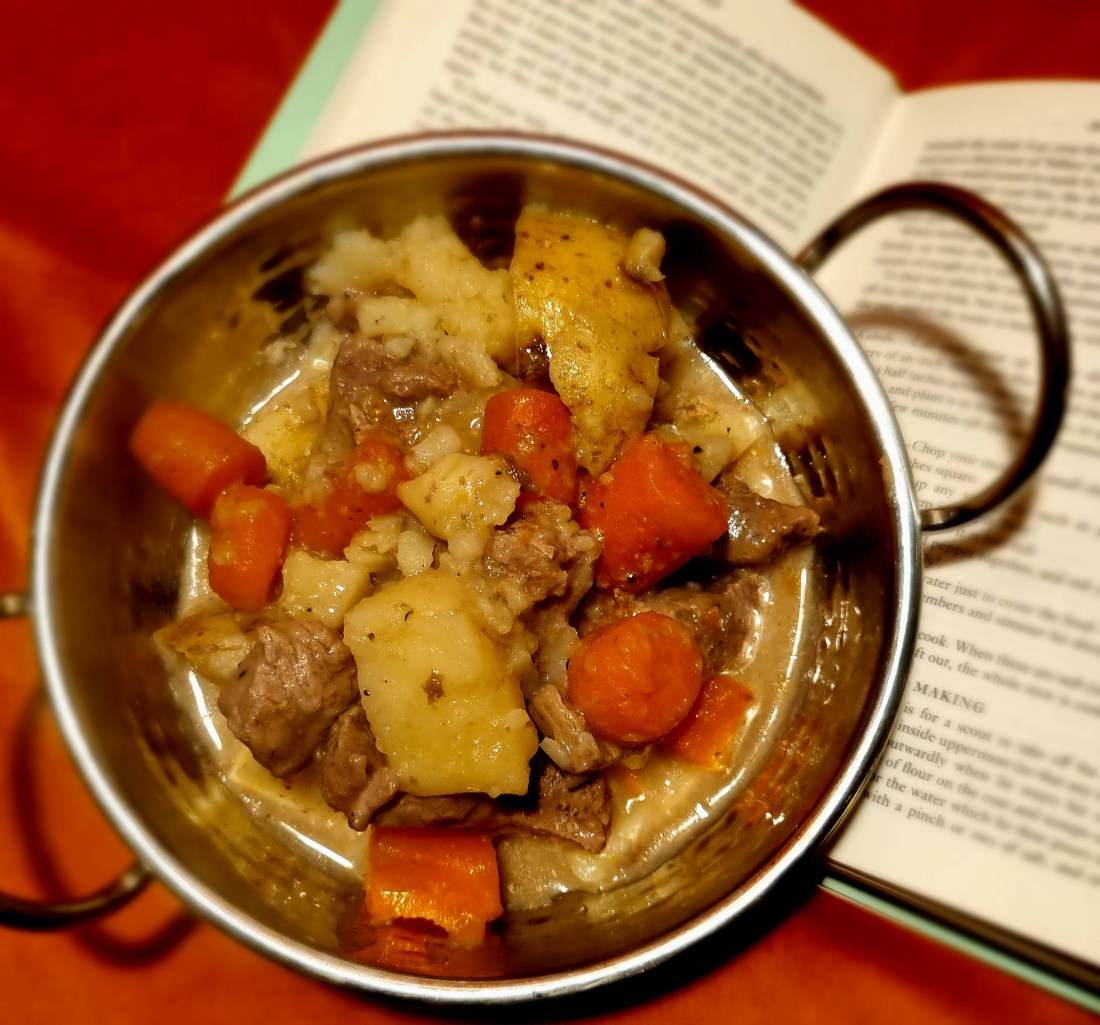
Hunter’s Stew – chop your meat into small chunks about an inch or one and half square inches. Scrape and chop up any vegetables, such as potatoes, carrots, onions etc, and put them into your ‘billy’.
Add clean water or soup till it is half full.
Mix some flour, salt and pepper together, and rub your meat well in it, and put this in the ‘billy’. There should be enough water just to cover the food – no more.
Let the ‘billy’ stand in the embers and simmer for about one hour and a quarter. The potatoes take the longest to cook. When these are soft (which you try with a fork) enough not to lift out, the whole stew is cooked.
Robert Baden-Powell, Scouting for Boys
Imperialist he may have been but my God, the man knew stew
I used extra lean stewing beef for this which mean I had to adjust Baden-Powell’s cooking time by approximately seven years until it was tender enough to eat, but once it was cooked – wow. Such a simple recipe yet it really packed a punch, even in the comfort of my own home. I can imagine that were I out in my tent on a cold night this would be like ambrosia. The gravy was salty and rich, just how I like my men, and had percolated through the fluffy insides of the potatoes so that everything tasted of beef and salt – delicious.
In the end I got so distracted eating my stew that I forgot to leave any for my prey. Which was bad for my love life but good for ending this over used man-eater trope, thank god.
I’m a bit of a New Years Grinch. The idea that at the start of the year that we must nurture artistic skills within ourselves, or start jogging, or learn to speak French just well enough to ask a Parisian if they, too, enjoy playing football at the weekend with their brother just seems like too much effort and pressure too soon after the effort and pressure of Christmas. I just want to relax and I don’t see the point in forcing myself to do something I have minimal interest in when I know I will give it up before midnight on 2nd January. I did once set myself the goal of being the type of woman who can do her bra up behind her back rather than employing what I like to call the ‘coward’s method’ (or frontus swivellus, to give it its Latin name.) It was a silly but achievable goal which I nevertheless failed to achieve because my elbows don’t work that way.
If, however, you find the fresh slate of a new year the boost you need to nurture your inner Caravaggio or if you can only dust off those running shoes by the wan light of a new year sun, crack on. And if you do hope to one day play football at the weekend with your brother in France before having a ham and cheese sandwich and asking a stranger where the toilets are despite the fact that the ‘WC’ symbol for public toilets is the same as it is in Britain as it is in France,then you go ahead and download that Duolingo, girl.
Merry Christmas?
There is one New Years tradition I could possibly embrace, however: gift giving. “But Ellie you greedy cow”, I hear you cry in frankly an overly hostile way, “you’ve just had your annual visit from Father Christmas!”
Hear me out, though. Traditionally within Christian culture the new year was a bigger deal than Christmas, and was therefore when all the biggest feasts and merriment happened. Christmas was just the day when some guy* was born; 1st January was the day when that guy was given the holy name of Jesus (and was also circumcised as per Jewish tradition.) This was obviously a Very Big Deal and became known as the Feast of the Circumcision of Christ.
*I mean, he was still the son of God.
Apparently Jesus hated this painting, but Mary kept it above the mantlepiece nevertheless.
Jesus’ circumcision was so important that it affected dating methods throughout Christian Europe. New Year in England was actually celebrated on March 25th until 1087 when the Normans began to use the not at all creepily entitled circumcision dating which placed New Year on 1st January. In 1155 the people of England, presumably concerned by the gross breech of GDPR associated with organising an international calendar around one individual’s intimate surgical procedures, went back to celebrating New Year on 25th March. This was known as annunciation dating, when the Archangel revealed Mary’s pregnancy to her, and it stayed that way until 1752 when we forgot our shame and went back to circumcision dating. Not that people took much notice between 1155 and 1752; although the change of date affected certain legal aspects of society, it appears most people still thought of the new year as beginning on 1st January.
And just to cement January’s status over Christmas – it was actually 6th January, which was when the magi arrived to meet Jesus, which was the big celebration. In the Tudor era, for example, Christmas was a time for feasting after four weeks of fasting, but it came with a sense of restrained awareness of the significance of the holy birth. By the 6th January however, any semblance of restraint had been carelessly tossed aside as if it were a Messiah’s foreskin, and decadence reigned. In 1532, Henry VIII hosted a Twelfth Night banquet which contained over 200 dishes and had to be housed in a temporary banqueting hall which was erected in the grounds of Greenwich palace specially for the occasion. I’ve written more about Twelfth Night here.
Get to the gifts
Okay, so: gift giving was front and centre of all these New Year’s revelries. People would exchange gifts small and large with loved ones to celebrate the day. During the Christmas of 1616, the playwright Ben Jonson wrote a masque for King James I to celebrate the festivities (and take the piss out of Puritans who would have had such entertainment banned if they had their way…)
In this play one of the characters is called New Years Gift and is presented thusly:
NEW-YEAR’S-GIFT, in a blue coat, serving-man like, with an orange, and a sprig of rosemary gilt on his head, his hat full of brooches, with a collar of ginger-bread, his torch-bearer carrying a march-pane with a bottle of wine on either arm.
Masque of Christmas, Ben Jonson
Later on in the masque another character makes reference once again to New Year carrying gingerbread gifts. So what better inspiration for this year’s first experiment?
Design by Inigo Jones for a masque costume representing a star. Credit
Sugar Gingerbread
Because I am not completely immune to the New Year’s nonsense of achieving unreasonable goals, I decided to try and find a gingerbread recipe written in a year ending with 24, in honour of 2024.
I could find only one. Well, three, technically, although they all came from the same source: The Virginia Housewife, by Mary Randolph published in 1824. The first one, Ginger Bread, seemed a little too austere given the celebratory occasion. Ms Randolph’s second recipe seemed even more frugal judging by the title Plebeian Ginger Bread. But, like Goldilocks, the third option was perfect: Sugar Ginger Bread.
Take two pounds of the nicest brown sugar, dry and pound it, put it into three quarts of flour, add a large cup full of powdered ginger, and sift the mixture; wash the salt out of a pound of butter, and cream it; have twelve eggs well beaten; work into the butter first, the mixture, then the froth from the eggs, until all are in, and it is quite light; add a glass of brandy butter shallow moulds, pour it in, and bake in a quick oven.
The Virginia Housewife, Mary Randolph
The instructions and measurements were a mess. Pounds thrown in with cups? Quarts of non liquid products? Twelve eggs?! Flicking through the rest of the book I was inclined to think Ms Randolph perhaps didn’t try all of her recipes herself, as the recipe ‘To Make The Stuffing for Forty Melons’ proves, being a rather long recipe which finally concludes with a mango getting stuffed (?!) rather than even just one of the forty (?!?!) nominated melons:
Wash a pound of white race ginger very clean; pour boiling water on it, and let it stand twenty-four hours; slice it thin, and dry it; one pound of horse-radish scraped and dried, one pound of mustard seed washed and dried, one pound of chopped onion, one ounce of mace, one of nutmeg pounded fine, two ounces of turmeric, and a handful of whole black pepper; make these ingredients into a paste, with a quarter of a pound of mustard, and a large cup full of sweet oil; put a clove of garlic into each mango.
To Make the Stuffing for Forty Melons, Mary Randolph
The verdict
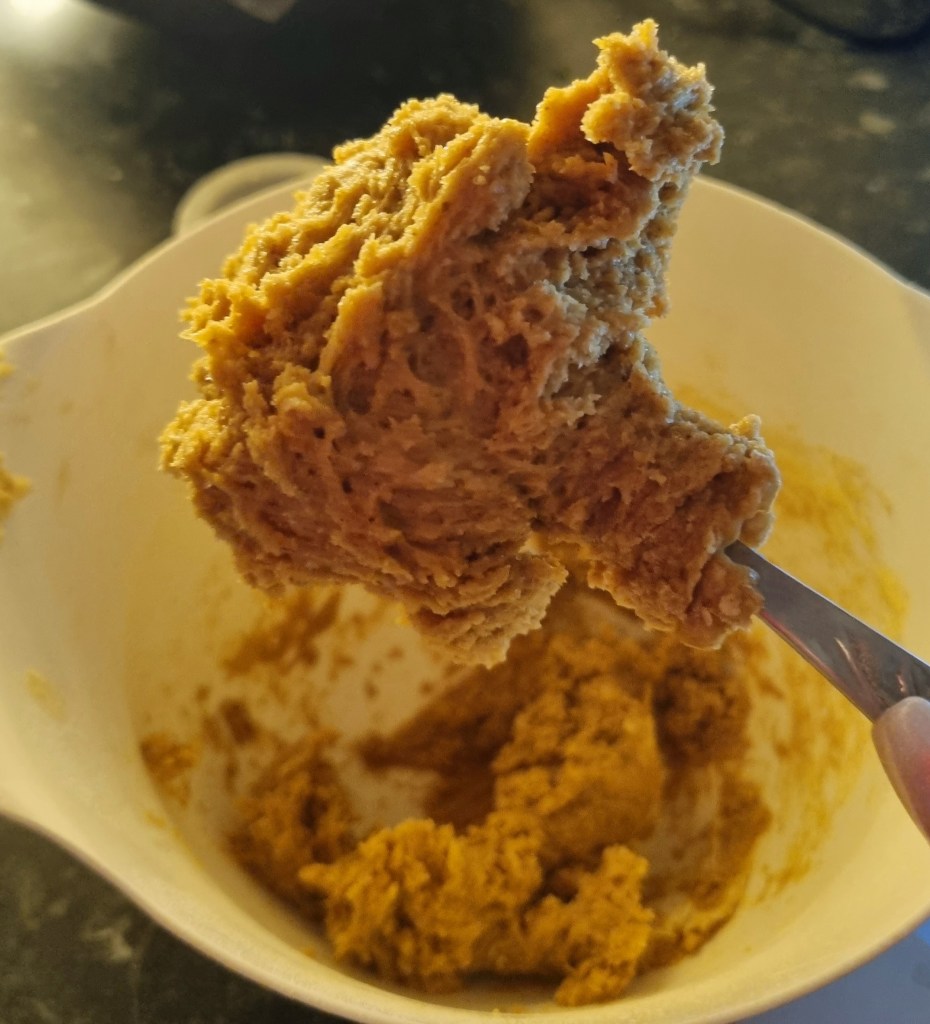
I muddled along as best I could with this hodgepodge of a recipe (the gingerbread one, not the fever dream melon one), and noticed that even though the recipe was called sugar gingerbread, the sugar was vastly outweighed by the ginger. In fact, dry ingredients in general outweighed wet ones so that the mixture was exceptionally thick and claggy, leading me to think I’d converted something incorrectly given that I was supposed to “pour” the mix into the baking tin at the end. Nevertheless, I persisted.
Less ‘pour’ more ‘apply with a cement trowel’.
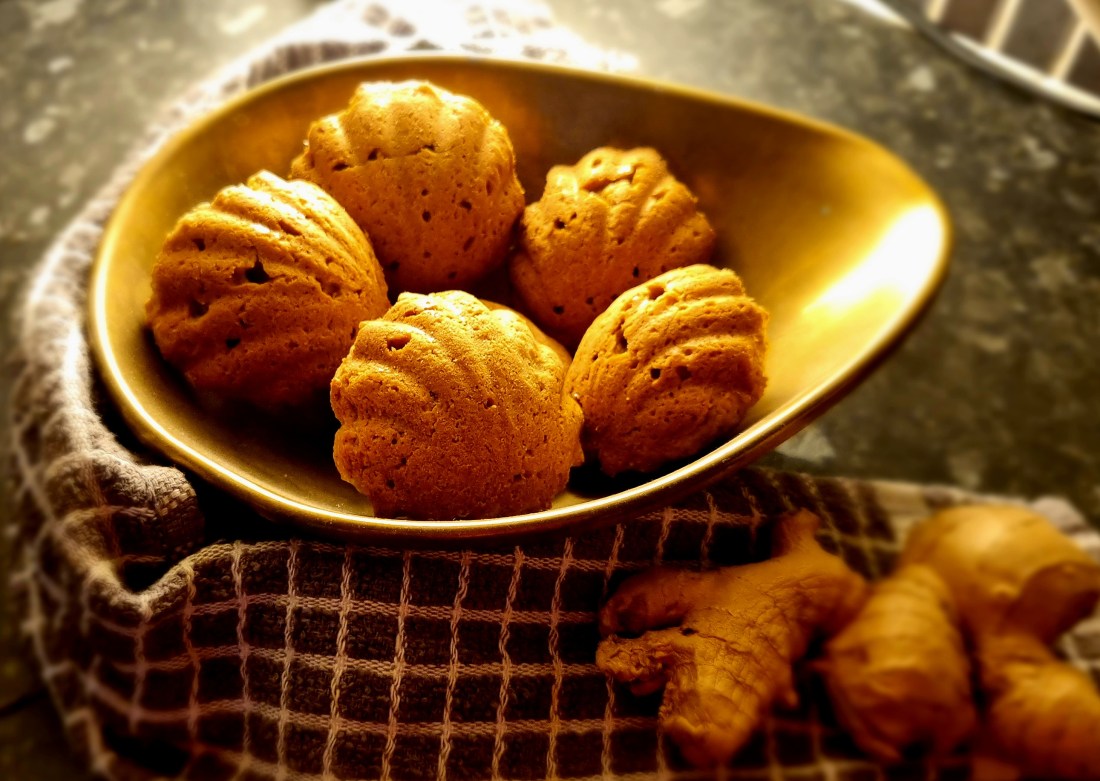
They baked for approximately 25 minutes or so, filling the room with a very festive scent indeed. Once cut open and tried the verdict was that they 1) were not overly sweet, 2) would go well with a sharp cheddar, and 3) packed so much of a spicy gingery punch that they could scare away a threatening New Years cold.
I made enough for a batch of six and honestly, I could have done with more – particularly to adequately fulfil point 2 with the amount of Christmas cheese we had left over.
The wise men came bearing gifts of gold so have some gingerbread in a gold bowl
Whatever your feelings about New Year traditions, I hope this year brings you happiness and health and plenty of New Year gifts this coming week.
What a bad week it’s been for Boris. Who would have thought that a man who built an entire career out of appearing to be nothing more than a benign buffoon would be so cruelly brought down by some party hats and the arse-end of a Colin the caterpillar cake.
The poor man claimed he didn’t know he was attending a work party during the lockdown. That plate of cake in his hands? He was just holding it for a mate. The assembled crowd of friends and colleagues with the rictus grins on their faces listening to his speech? Never met any of them before in his life.
Then: fine, so maybe it was a party, alright? But he only stayed for 0.3 seconds and he thought he was following the rules the whole time he was there. The rules that said you couldn’t congregate with other people indoors? Yeah, those ones. Look, he’s a smart man, he went to a £46,000 a year school and he’s got a degree from Oxford in professional clownery, okay? For God’s sake, he was the bloody PM during all this time, he was on the telly every night with those apocalyptic rhymes telling us all to keep our distance. Fuck, he was in a Whatsapp group with all the boffins who were texting him all the time saying “you mustn’t meet indoors with other people, Boris, please” so I think he, of all people, would know what the rules were, thank you very much.
And now this innocent man is the victim of a witch-hunt. Afforded no true opportunity to defend himself except for a 1000-word tantrum letter published across every major news organisation in the country and the inevitable parade of key-note speeches at political dinners and addresses. And thank God for these engagements, I say, because at least they’ll be financially lucrative for the poor man after he was forced to speak out about his paltry £160,000 a year salary as PM during the pandemic while the rest of us got to stay at home, isolated, away from our loved ones, unable to visit each other for months on end – no, not even for a fucking Colin the caterpillar cake whether it was at a work do or our gran’s funeral – because we were following the actual rules, properly.
It’s been a bad week for Boris, that’s true. Sadly satire waits for no man, be he benign buffoon or malignant moron. So without further ado I present this week’s experiment: fat rascals.
“Time to celebrate” indeed. I hope he’s proud of himself. Credit: Marks and Spencer.
‘Rascal’
These are round scone like cakes with dried fruit baked into them. A Yorkshire delicacy, the Foods of England website states that the origins for the recipe are obscure, but the earliest recorded version appears in 1855.
The ‘fat’ part of the name is obvious: these treats are made with lard, butter and cream. What seemed less obvious to me was the ‘rascal’ part.
Nowadays, a rascal might refer to someone who is a bit cheeky but ultimately still likeable. This meaning is relatively modern, however, and it used to be that to call someone a rascal was to render them utterly base and worthless. The earliest mentions of the word in English survive from the 14th century and seem to originate from the Old French term rascaile
Today, fat rascals are most commonly known as being a popular treat at Betty’s Tea Room. Apparently they make millions from the almost 400,000 of them they sell every year and Betty’s owns the trademark name. I think we’re okay to make them ourselves, though…
The method
I began by mixing flour, butter and lard together until it was like sand. Unfortunately, while satire waits for no man, it also waits for no experimental food historian either (a lesser known version of the already misquoted phrase…) and in order for my introductory paragraphs to stay relevant, I had to make these rascals today. In 30 degree heat. By the time I was done mixing my fats and flour I already had a pretty cohesive paste rather than the dry sandy texture I think I was after. Oh well.
To the fatty paste I added dried fruit, sugar and baking powder. And then, just to really amplify the richness, a good glug of double cream. The dough was rolled out into a very sticky sheet about 3/4 inch thick and cut into circles. Each one was decorated with a glace cherry and some almonds and then baked at a high temperature, rendering the kitchen hotter than all of Dante’s circles of hell combined.
A party of fat rascals
These weren’t too bad. They were actually quite light and flaky, probably because of the addition of lard to the dough. I’m not a huge dried fruit fan, but if you like fruit scones and want something a little bit more indulgent, these could be a great alternative.
And Boris, if you’re reading: chin(s) up, love. It might be you that’s the butt of the joke now, but by next week I’ll have got bored of politics and will probably go back to focussing on Great British food classics instead, like Eton mess and spotted dick.
That’s not a super funny opening line, sorry. I typed a few puns out – some basic stuff about nuptials turning into nopetials or whatever – but it all sounded a bit like telling someone I was doing fine, no really, really fine, just fine!!! And as this is not an online documentation of a breakdown, I thought it best to start with minimal British awkwardness and get straight to the point (anyway – you can tell it’s all okay by the use of only three exclamation marks rather than four. Four’s the tipping point, isn’t it? Four’s when people start to worry, but three is okay.)
Genuinely: it’s fine. J continues to be the perfect father to both our daughter and our Le Creuset set, and we speak regularly (mostly to tell the other to get off Netflix so the other can have a turn – AND IF YOU DOB US IN TO NETFLIX FOR THIS I WILL HUNT YOU DOWN).
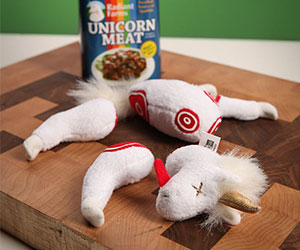
Fine or not, though, Christmas promises to be a bit shit this year. Worse than the year my parents misjudged my love of unicorns (and misjudged my sense of humour), and bought me a tin of ‘unicorn meat’ thus ruining Christmas morning for everyone. Worse than the year dad didn’t buy mum any gifts because she said she didn’t want anything and he believed her, which was somehow my sister and my’s fault. Even worse than the year we ran out of bread sauce because mum only made double the recipe…
Wasn’t funny at fifteen twelve; isn’t funny now, mum. Credi
I managed to deny the inevitability of Christmas 2022 until about Halloween, but as soon as 31 October rolled over into November, reality descended and, like a tsunami of excrement breaking through sewer floodgates, the festive jollities of a nation flooded my every sense.
Every trip to Sainsburys came with pre-battle talks as I mentally prepped myself to march past the walls of Quality Street without giving in to the urge to kick them over, I reveled in imagining I could fix my heating bills by setting fire to all the Christmas trees that suddenly sprouted from shopfronts two weeks ago, and I’ve dithered in writing my list to Santa for so long now that, what with the Royal Mail Strikes, it’s unlikely to reach him in time.
(Keep it light, Ellie)
Yeah, yeah.
Because we are a society obsessed with Christmas, I cannot ignore that Doomsday is just around the corner, nor can I pretend I’m excited. I could start new traditions, but honestly, screw that shit – it might work for 20-something wellness gurus with sunlight in their veins, but I’m a 30 year old woman with a wardrobe of impractical clothes she bought in a fit of post-breakup mania, and mostly good old vitriol and wine coursing through in my veins. The point is I don’t want to build new memories or “embrace the differences” this year; I want to Fuck Up Christmas.
Specifically, Christmas Dinner.
If ever there was a year to flip through retro recipe books for genuine festive inspiration, rather than gagging in disgust at the horrifying delicacies, this is it. To hell with your family-sized roast turkeys, and screw your flambéd Christmas puddings; my showstopper will be the state of the bathroom after my guests’ digestive systems buckle under the unrelenting diet of Unspecified Things in aspic.
This seems like a healthy way to deal with things…
The first experiment in Operation Fuck Up Christmas (OFUC) comes courtesy of the 19th century, from a work called ‘A New System of Domestic Cookery’ by the anonymous A. Lady. Technically she wasn’t anonymous; we know that ‘A Lady’ was actually Maria Rundell, a writer of recipes and general household maintenance of little fame, who first published Domestic Cookery in 1806.
My copy is from 1842, I think.I do not look after it as I should.
The recipe is called ‘Egg Mince Pies’ and it was a great start to get me into the Grinch spirit. While I was familiar with traditional mince pies, which had meat in them, meatless, egg-heavy pies were new to me.
Boil six eggs hard, shred them small; shred double the quantity of suet; then put in currants washed and picked one pound, or more, if the eggs were very large; the peel of one lemon shred very fine, and the juice, six spoonfuls of sweet wine, mace, nutmeg, sugar, a very little salt; orange, lemon and citron, candied. Make a light paste for them.
Domestic Cookery, A Lady
The thing is, most of the recipe seemed pretty mundane and as I was mixing everything together part of me wanted to give up, livid that I’d been tricked into making what was essentially a normal mince pie when what I’d wanted was a Frankenstein’s monster of a yuletide pastry to make kids cry. The kitchen smelled like Christmas, the radio kept threatening to play All I want for Christmas is You before I managed to hurl my Sonos across the room, the mixture looked exactly like mixtures I’d grown up with when the world wasn’t so spiky.
And then. And then. The eggs, boiled so hard they could break through mortar, were duly added and a kind of gently threatening festive mayhem descended, shattering the saccharine scene I’d built up.
The dubious combo went into some pastry cases of equally dubious quality (but still made with increasingly diminishing amounts of energy love), and baked for – I don’t know, 30 minutes? Somewhere between 30 and 47 minutes.
I looked round the kitchen, furious that I was expected to clean up my own mess, and went for a nap instead, drifting off to suspiciously pleasant smells.
The verdict
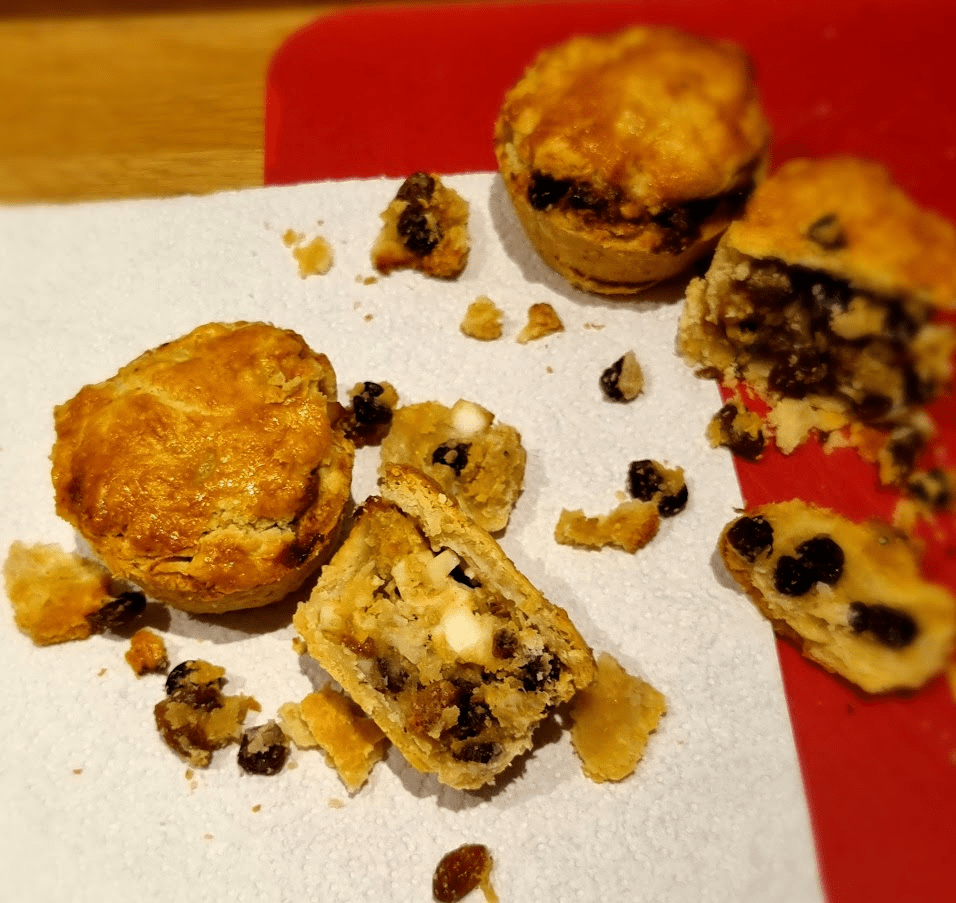
Pastry looks good though…
These were actually not that bad. By which I mean they were quite good, which for the purposes of OFUC makes them bad??? One pie on its own was pretty filling, in part thanks to the combination of suet and butter in the recipe, but also because I don’t own any mince pie tins so I had to use American cupcake pans instead, meaning that one pie was big enough to feed a small city, maybe Ely, for about a week.
However, there was no getting away from the fact that it was very eggy, albeit in a deliberate yet inconsistent way. Because the eggs were diced and mixed in as if they were currants, each mouthful was hit and miss as to whether it would be egg free or egg heavy. It felt nicely passive aggressive: munching down on what seemed to be a normal, boring mince pie only to be confronted with a slightly sulphuric, chalky egg lump half way through.
Will these Fuck Up Christmas? Not on their own, no. They’re too aesthetically pleasing and err just a touch on the side of ‘normal’ to be powerhouses of my Christmas dinner this year. However, as a first foray into alternative provisions for this festive season they worked pretty damn well.
Finally, I do want to express my thanks to people who have reached out over the past months, mostly to ask if I’m still alive or if I succumbed to the ever-present threat of food poisoning. Thanks. And to those who have been reading this and think this post has been the blog equivalent of updating my location on social media as ‘At Hospital’ in the expectation that people will comment “DM me babe”, “OMG hun, are you OK?” and just loads of crying emojis, you’re absolutely right – fucking DM me, babe.
Look at any medieval recipe and you might be struck by a couple of things – the lack of clear instructions or bafflingly obscure titles for starters (‘Compost‘, anyone?) You may be surprised by the range of spices available to medieval Europeans, or the fact that numerous texts seemed to have a bizarre fondness for recipes involving scalded eel.
One thing that might initially pass you by while you’re wading through indefinite numbers of eel carcasses, though, is the sheer number of times almonds are mentioned. Specifically, almond milk.
Now, you might be partial to an oat milk latte. You might have strong feelings on whether sweetened or unsweetened soya milk is better over Cheerios, but believe me when I say this: your careful deliberations in the queue at Starbucks over which non-dairy alternative to add to your inevitably disappointing drink would be mocked by any Ye Olde Medieval Person standing in the queue behind you.
For medieval folk, only almond milk was the One True Milk Alternative. But why? After all, this was an age before veganism and concerns about arterial health. Until the 16th century, almonds didn’t even grow in England, yet in the 14th century English book Forme of Cury, almost 25% of the recipes use almond milk in some capacity. In the 15th century English work Liber Cure Cocorum, around 17% of the 130 or so recipes contain an almond milk base.
“We like to drink (almond milk) with Gerald, cos Gerald is our mate…”
And it’s not like almond milk is being used for one specific reason. Oh no. The ways medieval cooks used this ingredient were varied. Sometimes it’s used as a possible main ingredient, such as in a recipe forDaryols where it is specified as an alternative to cow milk:
Daryols
Take creme of cowe mylke oþ of alma(u)nd(es) do þ(es) to ayro(u)n wyth sug(ur). safro(u)n (and) salt medle hyt yfer(e) do hyt in a coffyn of two ynche depe. bake h(i)t wel (and) [serve it].
Take cream of cow milk or of almonds and add this to eggs with sugar, saffron and salt. Mix it well and put it in a pastry case two inches deep. Bake it well and [serve it].
Sometimes almond milk is used instead of water and mixed with starches to make a thick pottage, such as in the not at all distressingly titled ‘Rice of Flesh’. Equally, it is also used as a thickener itself, especially when mixed with breadcrumbs ( see the recipe ‘Mortrews of Fysshe’, which appears to be spiced fish pate spread over a paste of almond milk and bread.)
Occasionally it’s added almost as an afterthought or economy ingredient, as in the case of ‘Frumenty of Porpoise’, where the cook is instructed to boil wheat in ‘the secunde mylk of Almaundes’ – suggesting that the ground almonds used to make almond milk were recycled at least once to make a second (presumably weaker) almond solution.
So why does this modern sounding ingredient crop up so regularly, and in so many different ways? Religion.
Thou Shalt Not Eat Anything Good for 40 Days…
Lent required 40 days of fasting. That didn’t necessarily mean eating less but rather restricted what and when you could eat: no meat, dairy or eggs. Slightly madly, fish didn’t count as meat and neither did certain water-adjacent birds like barnacle geese. In fact, medieval cooks seem to have expanded the definition of ‘fish’ to mean anything that spent time most of its time in water, which is why beavers were also considered A-OK. For this reason Lenten fare is often titled ‘…on fish day’, even if the recipe didn’t include fish.
Fishy looking beaver (ha), pursued by hunters. British Library.
Almond milk – almonds steeped in water and strained – was a perfect milk substitute for these days where cooks could, to a limited extent, capture the creamy essence of a meal without compromising their immortal souls (although almond milk was also popular in non-fast recipes too.)
“40 days?”, I hear you say. “That’s not very much of the year. Certainly not enough to warrant a whole 25% of a cookbook, surely?”
And you’d be dead right. If fast days only occurred during Lent.
Not content with 40 days of scaled eel and nutty water, the medieval Church dictated that in addition to Lent, there were to be Ember days – four additional fast days of the year – and Rogation days which followed Easter Sunday and called for an extra four days of fasting in the lead up to the feast of Ascension day, followed by another fast before Pentecost and further fasts during Advent. Oh, and in addition to this there were fasts on Wednesday, Friday and Saturday. Every Wednesday, Friday and Saturday.
In total, Allen Frantzen estimates that by the 12th century the average lay person would have spent a minimum of 150 days of the year fasting – or 41% of the year. The figure rises to a whopping 200 days for monks – or 54% of the year. When seen like this, you start to wonder whether a cookbook which dedicates 25% for dairy-alternative recipes is really doing enough…
Of course the big question is how far did ordinary people actually stick to this? Most extant documents are proclamations and church documents which lay out what they thought the ideal should be. Whether or not farmer Jim was religiously sticking to dishes of boiled beaver tail for almost half the year, or whether he actually spent most of Lent secretly sticking his face into cheese and bacon flans is anyone’s guess.
Actually, the fact that people did struggle to adhere to all the fast days is documented. A late 13th/early 14th century manuscript known as the the Harley Lyrics details the reasons people were expected to fast on Friday in particular. In the introduction the manuscript tellingly reveals that people should fast “more willingly on a Friday than any other day of the week…” which suggests that the Church was aware that some people begrudged fast days and possibly did not adhere to them as strictly as they ought. A fifteenth century schoolbook also shows that students, perennially preoccupied with their stomachs, did not enjoy fasting in the slightest (and reveals that some fish were considered more palatable than others, showing that even when fasting people still adjusted their food to maximise taste):
Thou wyll not beleve how wery I am off fysshe, and how moch I desir that flesch were cum in ageyn…
Wolde to gode I were on of the dwellers by the see syde, for ther see fysh be plentuse and I love them better then I do this fresh water fysh, but not I must ete freshe water fyshe whether I wyll or noo.
Interestingly (and it is interesting, thank you very much), certain people were exempt from fasting. The sick, young and old were not expected to fast and Christopher Dyer has suggested that records for the early 14th century show that harvest workers and labourers working on fast days were allowed to supplement their fish with cheese, which was otherwise banned during fast.
As I was reading through recipes in the FoC on a particularly fun and normal Saturday night, I was struck by references to almonds in three specific recipes: Creme of Almaundes, Grewel of Almaundes and Caudel of Almaunde Mylk*.
Photo from the Rylands Medieval Collection, University of Manchester
Creme of Almaundes
Take alma(u)nd(es) bla(u)nched. Grynd he(m) (and) drawe he(m) up thyke. Set he(m) ou(er) þe fyr(e) (and) boyle he(m). Set he(m) ado(u)n (and) spryng hem wiþ vyneg(er). Cast he(m) abrode uppo(n) a cloth (and) cast uppon he(m) sug(ur). When hit is colde gader hit togader (and) leshe hit i(n) disch(es) (and) sue it forth.
Take almau(n)d(es) bla(u)nched and drawe he(m) up wiþ wyne. Do þ(er)to poudo(ur) (of ginger) (and) sug(ur) (and) colo(ur) hit w(it)h safro(u)n. Boyle hyt (and) sue hit forth.
The three recipes are strikingly similar. They appear one after another and follow broadly similar methods: blanching almonds, grinding them and mixing them with liquid before boiling. Grewel of almaundes contains oatmeal whereas the other two have no other thickening agent.
So, why three versions of what is essentially the same thing?
One possibility is intended audience. While FoC was intended to be a working document for the royal kitchen, the introduction at the start of the John Rylands version makes clear that the recipes contained within it were intended to reflect “alle maner of States bothe hye and lowe”.
With this in mind we can start to rank the recipes in order of class, high to low. I’d argue that Caudel of Almaunde Mylk is the most expensive of the three as it contains both wine and saffron (the most expensive of all medieval spices.) By the same logic, second in the list would be Grewel of Almaundes followed by the lowly Creme of Almaundes, which contains no saffron, just sugar (and vinegar).
But is it as simple as this? I’ve always thought of gruel as bland slop served to Victorian orphans who knew better than to ask for more, but in this reading gruel is of a higher quality that creme, something that I would associate with luxury and wealth. Additionally, while oatmeal might have been relatively cheap, almonds were not, so the argument that Creme of Almaundes was written for ‘lowe’ persons doesn’t quite hold water…
It’s possible that Grewel of Almaunds and Creme of Almaundes were on a similar level; the instructions for Creme of Almaundes show that though some of the ingredients may have been cheaper, the necessary preparation was considerably more involved and skillful.
Another possibility, though it isn’t stated explicitly, is that these three recipes are a form of invalid cookery. Almonds were considered to have strong healing properties and were considered particularly good for brain development. The contemporaneous French text Le Viandier de Taillevent has a section called ‘Dishes for the sick’, in which a recipe very similar to Grewel of Almoundes appears.
FoC took a lot of inspiration from French texts like Viandier, however Viander only has one recipe for almond milk mush (for want of a better description): a recipe for ‘Lenten Slices’, which at first glance appears similar to Creme of Almaundes, but requires the addition of fruit.
Conclusion
What can we learn from all this? That the recipes were intended to be eaten during Lent is obvious. However, I think there’s an argument to be made that the three recipes represent an author showing off his skills and distinguishing himself from other cooks, specifically continental ones. I couldn’t find the same number of almond-milk-based recipes in other culinary texts as appear in FoC – the contemporaneous French text Viandier specifies the use of almond milk or almond broth in only approximately 13 out of 182 recipes (excluding nota style recipes). Likewise, the c.1430 German text Registrum Coquine uses almond milk in only 10 of its 75 recipes. In the c. 1400 text An Anonymous Tuscan Cookery Book, approx. 17 out of 184 recipes refer to almond milk.
What’s also interesting (and it is this time, I promise), is that An Anonymous Tuscan Cookbook has an entire section dedicated to the making of almond milk ‘for invalids’, a little like Viander, whereas FoC, as already mentioned, makes no mention of almond milk’s health-giving benefits.
Another possibility is that the use of almond milk, even in superficially very simple and economical dishes, was intended to highlight wealth. Almonds had to be imported to England – at great cost – from Arabic countries who supplied whole almonds to most of Europe via a network of trading routes. Could it be that countries in mainland Europe – that much closer to said trade networks and often interconnected to one another – had to pay less to import almonds than England did? And if so, did this mean that continental France or Italy saw almonds in a more utilitarian and less luxurious light?
There’s more to be said here about the politics of almond milk, I think, but even I would die of boredom at this point. Blog post 2 – where I make and compare each other three recipes above – may touch on it (or it may not – let’s keep you in anticipation, I know waiting to find out will be the highlight of your week…). In the meantime think of those 14th century cooks, grinding and soaking their almonds when you have your next non-dairy coffee, and thank God we have Alpro now…
Until next time!
E x
*A recipe for Jowtes in Almond Milk appears between Grewel of Almaundes and Caudel of Almaunde Mylk, but I disregarded it from this examination because in that recipe the almond milk simply acts as a base whereas the jowtes (herbs) are the main star. I’ve made Jowtes in Almond Milk before and the result was a vivid green soup as opposed to a thick paste like meal, which the three recipes listed above clearly are.
If the past two years have taught you to view new beginnings with suspicion rather than excitement, I hear you. If you’re entering 2022 with the battle-weary persona of a ye-olde-medieval video game character about to embark on his final quest, I hear you. And if you’d rather just pretend 2020/2021 didn’t happen and have muted all alerts for ‘variant’, ‘lockdown’ and ‘Joe Wicks’, I hear you (especially about Joe Wicks; nothing against the man but I just can’t trust anyone who looks like they enjoy HIIT that much.)
If, however, you’re feeling a bit more optimistic about this year then I might have something for you. (For those in the first category I can only recommend gin?)
My #positivevibesonly NY recipe is inspired by the Scottish Hogmanay tradition of first-footing.
The origins of first-footing – the belief that the first person who enters your home on New Year’s Day will bring good luck for the coming year – are vague. A 19th century article on the topic seemed to suggest it was a relatively modern practice, invented in the 17th or 18th centuries by young women of a, um, lustful nature who encouraged their sweethearts to visit them just after midnight on New Year’s Day. Following this first-footing visit, a marriage was usually made between the suitors on the subsequent New Year’s Day.
By the 19th century the tradition had become a bit of community fun. Generally a dark haired handsome man would knock on the door after midnight on the 1st January with a variety of specific gifts and bestow good fortune on the household. He would then be rewarded with food and drink and the general NY festivities would continue.
One gift often mentioned in the sources is shortbread, which has become absolutely synonymous with Scotland. The earliest recipes that we’d today call shortbread date back to the 16th century under the name ‘short cakes’, with the earliest one I could find appearing in Thomas Dawson’s 1594 The good Huswifes handmaide for the Kitchin.
But, and this is meant with no disrespect to the noble Scottish delicacy, shortbread can be a bit… basic. I couldn’t help think that the combination of the fundamental components of shortbread – wheat flour, sugar and fat – had to have been discovered before the 16th century.
I also couldn’t help thinking that we were due some frankly fantastic fortune after the past two years, and I wondered if that fortune would be more forthcoming if ushered in with extra special shortbread.
And so, having established the most tenuous of tenuous links between current events and today’s experiment, I present one of the earliest ‘shortbread’ recipes I could reasonably claim: Khushkananj.
To make Kushkanaj
It is that you take excellent samid flour and put three ounces of sesame oil on every [pound], and knead it hard, well. Leave it until it ferments, then make it into long cakes, and into the middle of each put its quantity of pounded almonds and sugar kneaded with spiced rose water. Then gather them as usual and bake in the brick oven and take them up.
This is shortbread in only the most technical of terms in that it is short (ie crumbly). I’m not here trying to attribute historic Scottish cuisine to the Middle East (although that’s actually not as far fetched as it might sound…), or slap European labels on non-European foods like an appropriation arsehole, Ok? Ok.
The recipe can be found in the 13th century Baghdadi work كتاب الطبيخKitāb al-Ṭabīkh (The Book of Dishes), compiled by Muhammad bin Hasan al-Baghdādī. Originally it contained 160 recipes, with additional recipes being added over the centuries to account for changing tastes and techniques. Charles Perry – the editor/translator of the English version – has stated that the Kitāb al-Ṭabīkh was so influential that for centuries it was the Arabic cook-book of choice for Turkish sultans.
At some point after 1226 a further 260 recipes were added to book and the collection was renamed Kitāb Waṣf al-Aṭᶜima al-Muᶜtāda (which is a great title for exploring the rarely used symbols section in my Word). In the late 15th century the Turkish physician Mahmut Şirvâni added 82 extra recipes of his own and translated the rest into Turkish, thus compiling the first ‘original’ cookery book of the Ottoman Empire.
Today’s experiment appeared in a section basically titled ‘On making things mixed with flour’, which was a pretty underwhelming start for my new year of good fortune, but I continued.
The first thing that stood out to me was that the recipe contained quantities – actual recognisable quantities! What was more, they were helpful quantities that could be scaled down easily. Anyone who’s followed this blog for a bit now will know the biggest issue I have trying to recreate medieval (European) recipes is the lack of clear instructions. Yet here, on the first day of this auspicious year was a sign from the god of imperial units that good fortune was coming my way indeed. Sure, they were Perry’s interpretation of whatever the original unit was, but that wasn’t the point: the point was that they were there at all.
The next thing to contend with was the term samid flour. This has been translated by Perry and Laura Kelley, author of The Silk Road Gourmet, to be semolina.
The third thing I realised was that the semolina, once mixed with (untoasted) sesame oil, was supposed to be left to ferment – a definite move away from traditional shortbread. In all honesty, I gave it 24 hours with a bit of warm water to do its thing before I realised I was in serious danger of missing the New Year’s Day cut off for good luck, so I don’t know how fermented it really was in the end.
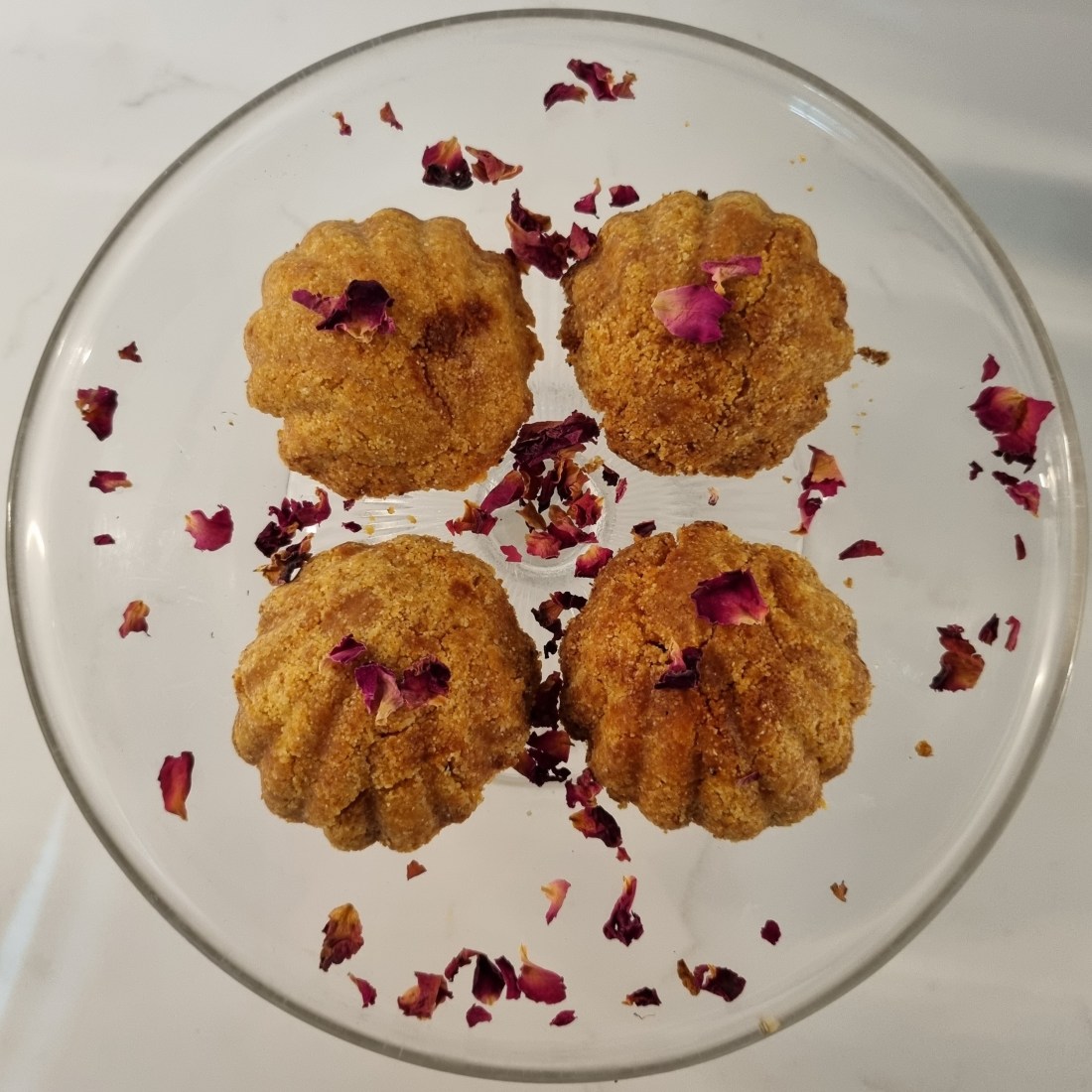
The rest of the instructions were reasonably straightforward. The dough felt and looked reasonably similar to shortbread dough in that it kept bloody crumbling up every time I tried to move it, and the rose water/almond additions filled the kitchen with a very appetising scent as it cooked.
Verdict
Time to come clean: these were not very similar to shortbread at all. They were dry and crumbly, for sure, but they weren’t as sweet and they lacked that melt in the mouth feel because the semolina was much coarser than wheat flour and the sesame oil couldn’t match the butteriness of, well, butter.
Those aren’t all bad things; if anything the mild sweetness tempered with the perfumy rose notes was actually more nuanced than the high-pitched sugariness shortbread can sometimes have. I felt I had to work through each mouthful, in the same way one might work through a dry Weetabix, which made them weirdly satisfying.
In the end I had to be my own dark haired biscuit-bringer, but I hoped these very distant shortbread cousins shared some of the minimum required properties of New Year’s Day shortbread – enough to win me a year of good luck, at least.
Here’s to 2022!
E x
To make 8 Kushkanaj
450g semolina 85g untoasted sesame oil 40g sugar 20g almonds Rose water Spices: I used ginger, cardamom, saffron
Knead the semolina with the oil and add enough warm water to form a relatively sticky dough that holds its form when you squeeze it.
Leave overnight somewhere warm or until it begins to ferment (you can skip this step if you want).
Roll the dough into 8 portions.
Grind the almonds, and add to the sugar.
Add the rose water and spices to the sugar and almond mixture.
Create an indent in each dough portion and spoon a little of the almond and sugar mixture into this. Close and seal.
Now it’s up to you: you can bake these in moulds as per the original instructions, or you can leave them as discs.
Bake at 200 degrees C for about 30 minutes or until turning golden brown.
It’s been a while, I know. I’ve been busy trying to raise my child to not be, at the very least, an empathy-devoid serial killer in the making WHILST ALSO attending classes full time (ha) WHILST ALSO running a house and being an attentive wife WHILST ALSO – oh, fuck it.
In all honesty, the seemingly never ending plague did such a number on my motivation to do any writing that it got easier and easier not to, and harder and harder to pull myself out of it. Truthfully, I can try not to raise a child that might grow up to dabble in casual murder, I can attend classes full time, I can let the house fall to ruin run a house and be an attentive wife — I just can’t do it all in a plague and keep up with writing.
However, I realised that if I didn’t write SOMETHING I was in real danger of not writing again, plague or no plague. Which is my way of telling you to go ahead and disregard this post; it’s really just me working through some stuff. You don’t need to see it. Go on: piss off.
Because it’s Christmas I thought I’d ease myself back in with something simple and tasty. And, preferably, alcoholic.
My inspiration for today’s experiment came by the way of Glyn Hughes’ The Lost Feast of Christmas. Specifically, it came from Robert May’s 1660 work The Accomplisht Cook, and it was for Buttered Beer.
May was 72 when he wrote his work, a collection of largely unrestrained recipes for the Restoration nobility, gathered from his experiences as a professionally trained chef. Rather sweetly, he addresses fellow cooks in his preliminary remarks on cooking, calling them ‘most worthy artists’ and hopes that they will find his writings helpful and insightful when beginning or continuing on their own career.
You just don’t get titles like this anymore
Buttered Beer or Ale Otherways
Boil beer or ale and scum it, then have six eggs, whites and all, and beat them in a flaggon or quart pot with the shells, some butter, sugar, and nutmeg, put them together, and being well brewed, drink it when you go to bed.
Robert May, The Accomplisht Cook
This seemed like the thing I was looking for: comforting, sweet and a good excuse to go to bed early. Interestingly, the recipe appeared under the chapter ‘Pottages for Fish Days’, suggesting (but not necessarily meaning) that it was considered relatively restrained; fish day referred to a time of relative abstinence when meat and dairy were cut down or avoided.
If you want to know more about 17th century beer check out this blog . Suffice to say, it was a little different from the mass produced ales of today. Unfortunately, the mass produced ales of today were all I had, and the guy in Sainsbury’s stared at me with a look akin to that of a turkey witnessing the approaching knife when I asked him to show me to his selection of historically accurate beverages.
I listened politely as he read out the blurb on the back of the bottle – the same one I’d just read myself – and decided to go for a traditional amber ale with an alcohol volume of 4.7%.
The next thing I remembered, with utter joy, was how fond people in the past were of not including accurate measurements. How much beer? Scrap that – how much butter? It was a titular ingredient and given the call for six eggs I feared we might be dealing in kilos rather than grams.
I muddled by on what I thought were appropriately scaled down quantities of butter and eggs. The recipe called for the egg shells to be included in the egg/sugar/butter mixture, but didn’t explain why. My only thought was that egg shells were used in other 17th century wine making recipes to clear the liquid.
This seemed unlikely to be the reason here, though, as the addition of butter ensured the finished product was always going to be cloudy. Apparently cowboys in the American West added egg shells to their coffee as they brewed it over campfires in order to mellow the taste by absorbing acidic tannins. Could it be that egg shells were added to beer to reduce the tannins in beer, thereby reducing astringency? I didn’t know, but the end result was pretty smooth and mellow, so maybe!
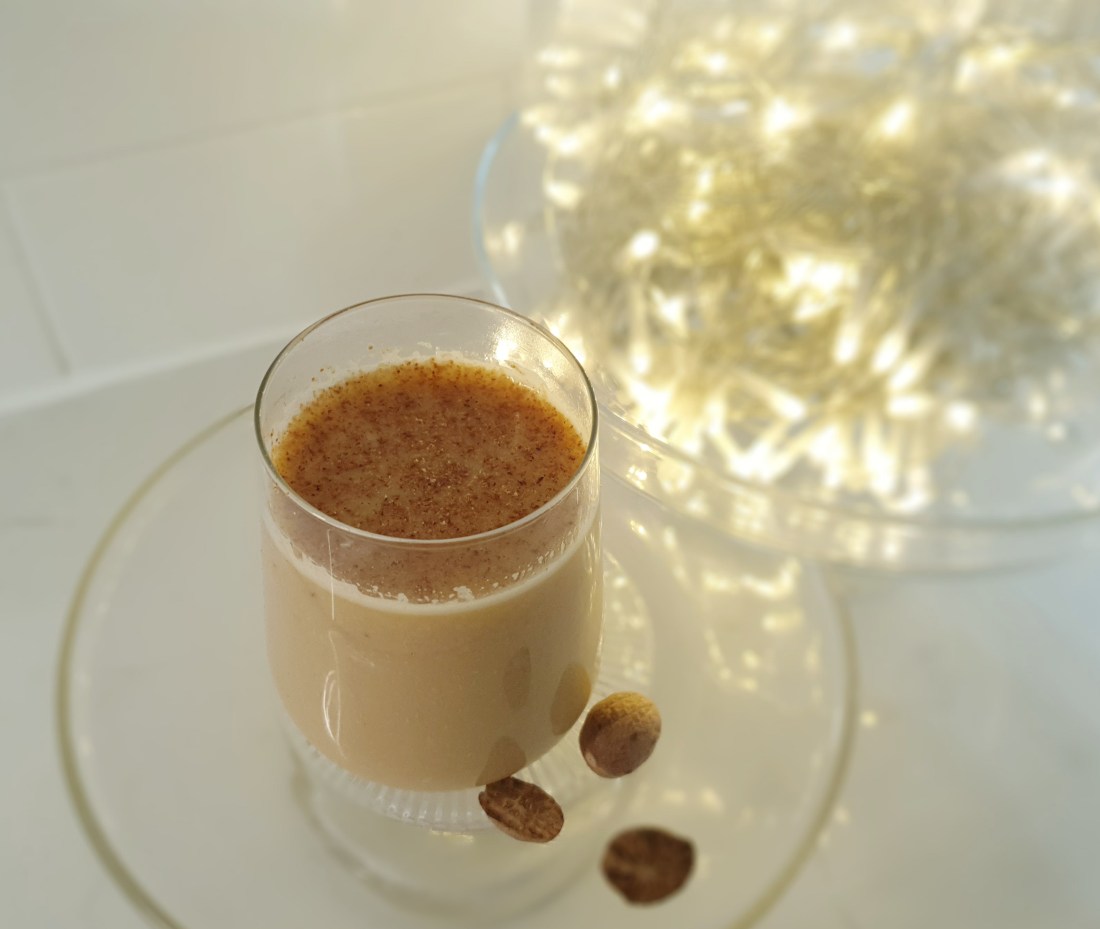
Once the beer was boiled and cooled a little, the egg mixture was added and whisked continuously for a few minutes before the whole thing was strained and poured out. Finally, it was bedtime time to drink.
I’d forgotten how to do soft wanky arty focus. Soon remembered though!
All in all, this was not too bad. Not too bad at all. It was very rich and thick, almost dessert like and there was a hint of brandy and Christmas pudding to it (though that might have been psychosomatic given the context.) I don’t actually like beer but found I could drink half of this easily. If you like snowballs or eggnog, I’d seriously think about adding this to your repertoire too.
I woke suddenly, already knowing the creature was in the room before I saw her. I kept my eyes closed, heart thumping, as the door squeaked open quietly and yet somehow with the impact of an orchestra of foghorns. The orange lamplight glow on my eyelids flickered as the beast crossed the window towards my bedside…
The stench about her was reminiscent of a city on a hot day. She stopped. I heard her paw the ground and imagined twisted claws as sharp as knives tearing through the carpet. The mattress bowed as she heaved her stinking form beside me which was when I finally mustered the courage to open one eye: Matted hair, eyes and skin and teeth glowing in the moonlight. She lunged towards me, mouth in a gaping open howl of an O and an ink-black throat that swallowed my own scream and mingled it with her wail:
“I need a pooooo!”
Okay, so it’s not going to win gothic of the year. But a terrifying midnight waking from a squitty child (mine, I should specify), a few nights ago did at least provide me with a decent opening into today’s creepy post, which comes courtesy of the creators of A Gothic Cookbook – a fully illustrated collection of recipes from some of the finest gothic stories in literature.
I was given the opportunity to try out a recipe and jumped at the chance with more excitement than Dracula at an open window. But before I reveal which recipe and book, here are a few words from Ella Buchan, one of the creatives of A Gothic Cookbook.
What is A Gothic Cookbook all about?
A Gothic Cookbook is, first and foremost, a celebration of food in Gothic literature. It’s about highlighting how authors in the genre, from the Romantic era to contemporary novelists, write evocatively about food. They use it, to varying degrees, to heighten tension, spotlight inequalities, highlight oppression, create a queasy unease, portend doom, reignite memories (warm or terrifying), or to warn of a greedy, gluttonous, dangerous nature.
So what can we expect to see?
Each of 13 chapters focuses on a Gothic tale, from Dracula and Frankenstein to Beloved and The Haunting of Hill House, and discusses how food manifests itself in that story before presenting the reader with recipes inspired by the text. From Rosemary’s Baby, for example, the mousse with the “chalky undertaste” becomes individual Chalk & Chocolate Mousses, with the dark dessert topped with peaks of white chocolate mousse and a walnut. We’ve recreated the Paprika Hendl that Jonathan Harker loved so much he jotted a note to “get recipe for Mina”, and our Rebecca chapter has chicken in aspic (from the ball) and the entire, lavish afternoon tea spread served each day (at half past four) in Manderley.
How do you decide what to include?
Each recipe is either based on a dish mentioned or described in the book, inspired by ingredients and themes that dominate in the story, or has a tale to tell about the author (such as a vermicelli dish galvanised with a lively herb sauce, in homage to Mary Shelley’s tale of being inspired by an experiment that saw a piece of pasta begin to move…)
The book will also include drinks and cocktails, from a breakfast-worthy hot chocolate (Angela Carter’s The Bloody Chamber) to a tangerine sour based on the “bitter” segments that tried so hard to warn the second Mrs de Winter not to become the second Mrs de Winter.
We’ve also created a beautiful cocktail booklet exclusively available via the crowdfunding campaign, with libations such as this “Cup of Stars” cocktail – a nod to the famous passage in Shirley Jackson’s The Haunting of Hill House. We chose a clarified rum punch because it has an interesting history, dating back to at least the 18th century, because it’s milk-based (like the drink the little girl loved to sip from her cup of stars), and because it’s just really delicious.
Don’t do it, Eleanor told the little girl; insist on your cup of stars; once they have trapped you into being like everyone else you will never see your cup of stars again; don’t do it…
So there you go: today’s experiment is Clarified Milk Punch, or “Cup of Stars”, inspired by The Haunting of Hill House. This recipe comes from the cocktail booklet which accompanies A Gothic Cookbook. Thank you Ella for letting me loose on your creation!
Clarified Milk Punch or Cup of Stars
Ingredients:
4-5 green or white tea bags 200g sugar Cinnamon stick and star anise (optional) 600ml just-boiled water 3 lemons, zest and juice 600ml rum 500ml whole milk
Method:
1. Add tea bags, sugar and spices (if using) to a medium mixing bowl or saucepan, pour over boiled water, stir, and steep for around 5-10 minutes. Fish out the tea bags and spices and add lemon zest and juice.
2. Add the rum and stir well.
3. Pour the milk into a separate, large bowl and pour the punch mixture into it, stirring well. It will curdle, as it should.
4. Leave for half an hour to 45 minutes and strain through a sieve lined with muslin cloth. This can take a while, so leave to one side and let it work its magic.
5. Strain again (through the same sieve) and repeat until beautifully clear. You can reserve the curd-like remnants for baking, mixing into cheesecake recipes, or spreading on crackers.
6. Pour into sterilised glass jars or bottles and seal tightly. The punch will keep well, unopened, in the fridge for around 2 months.
7. Serve over ice and garnished with a lemon twist, ideally in cups with stars at the bottom.
In the absence of a cup with stars on the bottom, I strew sugar stars around the plate. Bit of a mistake; the combination of milk bottle, straw and cake decorations made my 3-year old daughter think this was all for her.
Conclusion
This recipe makes enough for about ten servings and suggests that it should keep refrigerated, in unopened sterilised bottles, for about two months. In all honesty my husband and I made it four days into the suggested two month shelf life before we’d finished it all, such was our greed.
I used dark rum which meant my Cup of Stars was slightly more golden than it would have been if I’d used white rum, though I think either type would work well. I’ll also admit that I was too impatient to continue straining the drink until it was “beautifully clear” – I made three cycles through a muslin cloth before my impatience got the better of me, forcing me to settle on “coquettishly murky” rather than gorgeous and translucent. No matter; it still looked and tasted fantastic and after a day in the fridge the remaining cocktail had cleared to a perfectly clear straw coloured liquid.
I’m not normally a liquor fan, but this cocktail might just convert me. It was light and sweet with a refreshing lemony twist, but the rum still caught the back of my throat with its spicy, molasses-tinged heat. Beware: this might look like an innocent drink (especially if you opt to serve it in a cup with stars at the bottom!) but it packs a punch (insert your own pun about ‘seeing stars’ here.)
For more gloriously gothic recipes you need to check out A Gothic Cookbook. At the moment the book is in production, but you can bag yourself a copy – with optional extra goodies – by supporting the crowdfunder on Unbound here. And if that wasn’t good enough you can use the code GOTHSTAILS10 for 10% off pledges up to £100. The code will run until midnight on 19th August.
Oh – and you can also follow the team at A Gothic Cookbook on Twitter here to get your fix of Frankensteinian food and Drac-tastic (not a word) drinks!
It’s the start of the summer holidays, and what a year it’s been for teachers and students!
By 6pm on the last day of term I’m usually arse-deep into a profusion of cocktails of unhealthy quantities of alcohol and sugar (sorry for that image). But this year felt a bit different.
For one, it felt like a less triumphant end to term than previous years. After weeks of sanitising upon entering the classroom (“one squirt’s enough, Ryan!”), mask wearing (“for the last time, it goes over your nose, Ryan”) and learning ‘zones’, (“I don’t care if the year 7 toilet area is nicer than year 10’s, Ryan, you still can’t use it!”) the final day felt more like a hobble over the finish line rather than a victory parade. Maintaining COVID protocol and encouraging 1000 kids to as well had been truly exhausting, but somehow* our school managed to avoid the tsunami of cases that overwhelmed many other local schools by the end.
The second reason the end of term felt a little flat was because it was my last one (as a teacher at least). From September I’m off to become a student again and get my Masters. Will I return to teaching? Possibly (probably?) – it’s a career I’m passionate about and I really believe there are very few other jobs that will fulfil me like teaching did. But for now I’m going to try something else – wish me luck!
So I spent Friday evening reading my goodbye cards (“my favourite lesson was when we drew castles” – a supply lesson, as I was away that day…) and generally moping. Until my husband pointed out that with the longest summer holiday ahead of me, I had more time than ever before to focus on historical cooking.
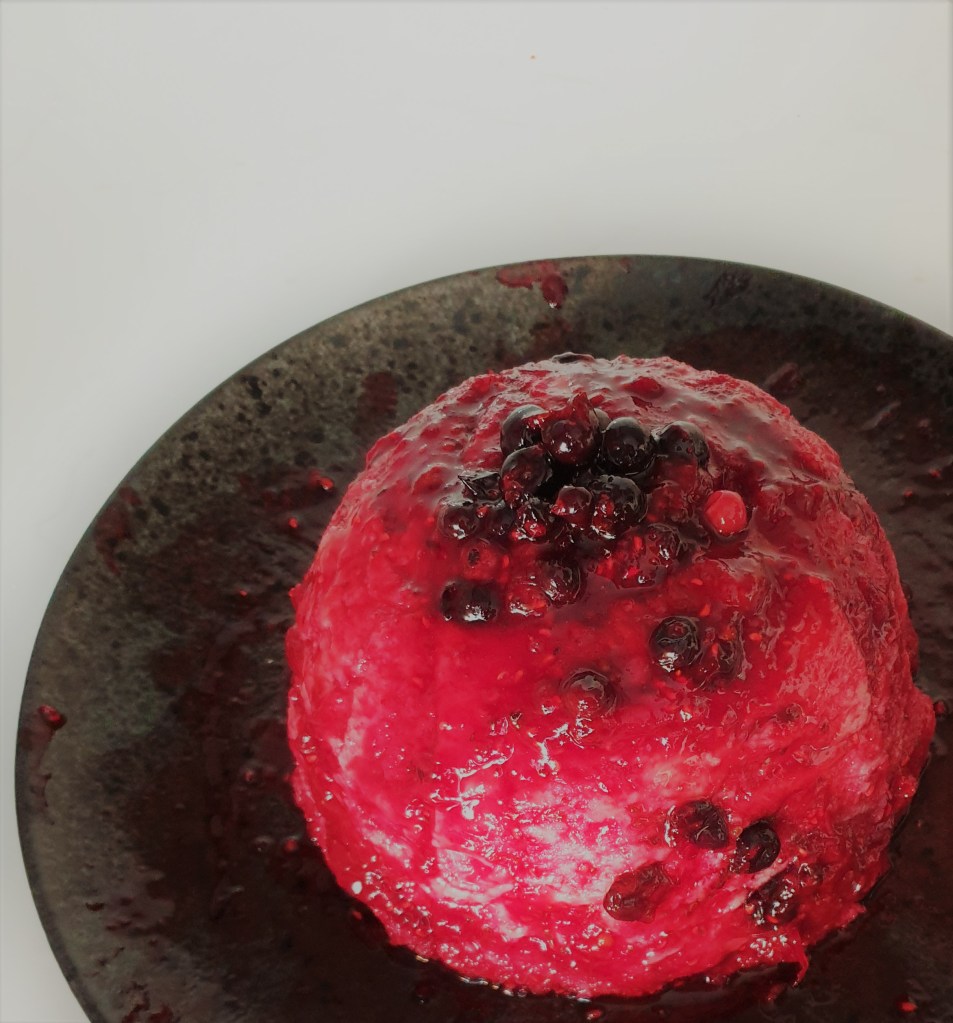
Summer pudding…
He was right, and summer was making its presence felt with a week-long heatwave, so I decided my first foray into summer-hols-historical-cooking should be distinctly sunshiney. Summer pudding, anyone?
Summer pudding is something I remember eating once or twice as a child. I recall being in a gloriously sunny garden aged six or seven, sitting on a stripy deckchair and being handed a bowl of purple and pink bread with vanilla ice cream and thinking it was the oddest jam sandwich I’d ever seen. For the uninitiated: summer pudding is essentially stewed fruit which has been left to soak into a mould of stale bread. It should resemble a bright red/pink/purple dome which when cut into spills forth oozing summer fruits. It’s been decades since I last ate summer pudding and I’d come to associate it with other old fashioned desserts that are slowly dying out.
Of course it’s not true that summer pudding is completely dying out; Nigella Lawson, pinnacle of modern British baking, includes an updated recipe in her most recent cookbook. Search ‘summer pudding’ in the BBC Good Food website and you’ll get a fair handful of decently reviewed recipes. But for some reason when I think of summertime desserts I think of lemon tart, choc ices and eton mess before I think of summer pudding.
Perhaps it’s the name. It’s too eager, isn’t it? Too full of hope, and if there’s one thing a Brit knows not to trust, it’s the promise of summer of any kind. So come July, we eschew summer pudding for something that can be enjoyed with less irony as the gazebo and BBQ collapse in gale force winds, and hypothermia sets upon Uncle Alan.
But as poor as it may be now, summer pudding’s branding problem is nothing compared to what it was.
…or hydropathic pudding?
Let’s be clear: summer pudding’s reputation and history is murky at best. How do you sell a dome of stale bread drenched in stewed fruit, which has spent 24 hours being squashed down by a plate laden with the heaviest kitchen objects you could find – a cafetiere of stale coffee and a bottle of ketchup balanced precariously atop a kilogram bag of sugar?
To find the first truly identifiable summer pudding reference I had to move my research to the 19th century, when summer pudding went by many different names, including the infinitely less marketable name ‘hydropathic pudding.’ Today’s experiment is from the earliest reference I could find to anything resembling summer pudding and comes from Lizzie Heritage’s 1894 work Cassell’s new universal cookery book.
Hydropathic Pudding
This has many names. It is very nice when properly prepared, and the pudding served very cold. Required: fruit, sugar, and bread. Cost, variable; generally moderate.
The nicest fruits for this are raspberries or currants, or a mixture, or strawberries, with or without a few red or black currants; plums are sometimes used. Take a plain mould, and cut a piece of bread to fit the bottom; then put fingers of bread round; the sides should be bevelled a little so that they overlap and prevent the escape of the fruit. The latter is stewed with enough sugar, and poured in, and a cover of bread put on. A plate with weights on is put on the top, and the pudding put in a cold place to set.
Another way is to line the mould, and then fill up with layers of bread and fruit; and if the bread is cut very thinly, this will be generally liked better than the first mode, as there is less fruit, and it suits the majority better. For a plainer dish a basin may be used, and slices of bread put to line it entirely; then either of the modes can be followed. These should be turned out with care, and may be served plain, or with a simply made custard. They are useful for those who cannot take pastry or rich puddings, and for children.”
As you can see, the recipe above is almost identical to summer puddings today, further cementing my feelings that it was a very old fashioned dessert. But I wondered: if nothing had changed, ingredients wise, then why the name swap?
References to “those who cannot take pastry” and the suggestions to serve it plain suggest that the pudding was offered as a healthy alternative to heavier steamed puddings that were popular at the same time.
Even more compelling to the ‘healthy’ origins of summer pudding is the original name: hydropathic pudding.
Hydropathy is/was a belief that water alone can cure ailments – be it through drinking particularly pure water or through the use of water therapies like bathing. Now, no one’s disputing that getting plenty of H20 in your system is a good thing, but believing that Radox and a rubber duck will cure you of your gluten intolerance is nonsense. While immersing yourself in water will certainly alleviate certain symptoms (e.g. joint pain or muscle inflammation), it’s unlikely to actually cure you of the actual illness.
The rise and rise of hydropathy
Hydropathy experienced a boom during the 19th century thanks to Austrian farmer Vincent Preissnitz who apparently cured his own broken ribs by wrapping his chest in damp bandages and drinking a lot of water. Inspired by the seemingly miraculous healing properties that clean water, stripped down diets and regular exercise had on patients abroad, English Captain Richard Tappin Claridge popularised hydropathy in Britain.
In 1842 he published Hydropathy; or The Cold Water Cure, as practiced by Vincent Priessnitz, which was an instant hit and ran to multiple editions within a few months. Hydropathy dealt mainly with the various forms of bath invalids could take**, but one chapter explained the diet that hydropathic spas should offer to their customers.
Ah, bottom left corner – my favourite: stand on a balcony wearing a sheet, looking into a bath.
Unsurprisingly, Claridge recommended a diet of water and cold foods. He explicitly stated that hot food or food that had “stimulating properties” such as spices or rich sauces should not be served. Furthermore, he states that the ideal breakfast consist of bread, cold milk (or water), and fruit. Fruit should be eaten cold and regularly, but only the types of fruit that grow naturally in Britain; according to Claridge, exotic fruits were often particularly juicy “to refresh the blood [of those who are] parched up by a burning sun” which is hardly an issue in Britain, so fruits such as mango or pineapple were thought to overstimulate the temperament of the average Brit, undoing the good work of previous hydropathy treatment.
Summer pudding – or rather, hydropathic pudding – fit the bill perfectly: cold, wet, bready and British summer-fruity, it must have had a prominent place on the dining tables of hydropathic spas.
But while holidays to spas were all well and good for the social elite of Europe, when it came to home dining frugal health food wasn’t something you necessarily wanted to serve to guests. Hydropathic pudding might sound enticing to someone who had survived four days on tepid mineral water and raw carrots, but in real life – where the cakes and buns exist – it just sounded… naff.
Hence the name change; by the early 20th century, hydropathic pudding had fallen out of recipe books and had been replaced with identical instructions for summer pudding instead, which was infinitely more appetizing and far less reminiscent of urine-filled pools and eggy smelling water.
Today’s experiment
Whatever you want to call it, the 1894 recipe I followed was delicious. Yes, I had to pour over extra syrup when I turned it out because not all the bread had soaked the juice up. And yes, I did get a tiny bit of ketchup on the bottom of my pudding because someone hadn’t screwed the cap on properly before I used it as a weight. But despite this, my summer pudding was divine: tart and sweet, spongy and, above all, summery.
I stuck mostly to blackcurrants and raspberries as per Heritage’s instructions and added a couple of extra layers of bread inside the pudding itself as she suggested, which went down very well. Rather than plain, as I suspect Claridge would have liked, we ate ours with clotted cream – healthiness be damned.
Would I make it again? Absolutely, and to be honest I don’t know why I don’t make it every summer. Perhaps it’s because it takes a little bit longer than other desserts because it has to be left for quite a while to soak. Perhaps it’s because it seems like a bit more of a faff than ripping open a Vienetta and going to sit in the paddling pool. But I suspect, really, it’s because of the reason I mentioned before: its name is too gloaty, too self-confident; the day after I made this the heatwave ended and the heavens opened. Summer pudding indeed.
Extra juice may or may not have been poured on top…
E x
*It wasn’t really “somehow”; it was down to exhaustive, careful planning by SLT – who worked really hard to keep everyone safe – and sheer luck. Also the fact that Ryan went on holiday the last week of term helped stop the spread within year 10.
**I couldn’t not tell you about one of Claridge’s specific types of bath: the douche bath. Here, he says people can find relief for afflicted parts of the body by stripping off and exposing themselves to the “powerful action” of running water. Now, I’m sure that some people genuinely used these douche baths for purely medicinal purposes, but Claridge’s slightly disapproving instruction to stop using them “when it produces feverish excitement” and that, for some reason, the average duration of a douche bath “is from three to fifteen minutes” and that “most of the patients…are very much pleased with this part of the treatment” suggests many hydropathy spa patients weren’t finding complete relaxation from drinking twenty glasses of water a day alone…






















 The Past is a Foreign Pantry
You must be logged in to post a comment.