Trench Cake: 1914

I’m teaching trench warfare to year 9 at the moment. I really like my year 9’s; they’re funny and inquisitive and (fortunately) have never had to live through anything more distressing than the wi-fi going down. So it’s really hard for them to grasp just how grim conditions in the trenches would have been. We’ve gasped at images of trench foot (seriously, only click on that if you’re done eating), analysed maps and images showing the position of trenches and groaned at the futility of going over the top, just to be cut to shreds by machine gun fire. And yet, they still don’t quite get it. How can they? I can pinpoint the exact moment they lost their ability to relate to the situation on the Western Front and that moment is called the Somme:

“I just wouldn’t go over the top, miss, I’d just refuse and tell the C.O. to do one.”

“Yeah, what would they do if the whole trench didn’t go over?”

“I’d run away back to England. D’you think I’d get to keep the gun, though?”

I did my best Mary Poppins-esque smile of charitable patience, even though we’d covered these exact scenarios every single bloody lesson so far.

“You think you could swim the English Channel in full military uniform, do you Finn?” I queried in what I hoped were calming non judgmental tones to hide my inner eye roll. “You must have just been pretending you didn’t have the stamina to do the 800 metre race at sports day, hmm? And Robbie – realistically what do you think might happen if you told a 6 foot something man with a gun who’s also out of his mind with fear to ‘do one’?”

We agreed (yet again!) that none of us knew what we’d really do if faced with similar circumstances to the men who fought in the trenches of World War One. It was an incomprehensible time – in everything I’ve taught, nothing comes close to matching the futility and horror of trench warfare and the impossibility of how people coped with it. Take Herbert Burden, a soldier who fled the battlefield after seeing the carnage and massacre at Bellwarde Ridge (1915), where over 1000 men were slaughtered in a 1/2 mile square battlefield in 12 hours. Aged just 16, he was still 2 years too young to have officially and legally signed up to the war but he had lied about his age – like many others, he had been swept along in the propaganda campaigns promising excitement and adventure. Still didn’t stop him getting executed by firing squad for desertion, though.

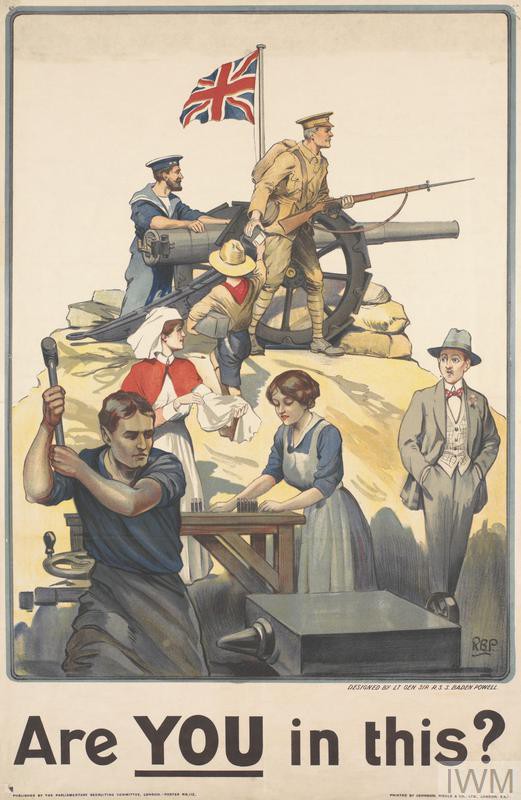
My students’ repeated inability to accept what happened in the trenches is a clear indication of how awful the reality must have been for a lot of men when the fighting was happening. Even when there was no fighting and boredom was the predominant emotion, it was still boredom mixed with mud, rats and the risk of an unexpected bullet hole in the head if you happened to stand in the wrong place at the wrong time. That year 9 can’t accept the realities of trench warfare, but instead come up with incredulous scenarios they’d try in order to escape the trenches every lesson, shows how out of the ordinary the situation was.

Imagine, if you can, you are a young man fighting in World War One. You’ve just got back from a gruelling week on the front line. You haven’t taken your boots off for days, you’ve only slept curled up in a dug out and it’s been pissing it down constantly because the climate of Northern France doesn’t give a damn about making this war easier for you. And that’s one of the ‘better’ front line experiences. You get back to the rest camp for 4 days’ break before returning to the front line again and after a mandatory wash and shave (this is the British army after all – got to keep those personal standards up, even if the water’s grey and the towel smells like feet) you are handed a package. Something from your family, to keep your spirits up: a cake.

Now, people back home during World War One weren’t totally ignorant of the realities of the war. They would have seen men returning bandaged and broken, unable to speak of their experiences and worked out that maybe this war wasn’t the jolly 20th century Butlin’s holiday it had been billed as. Soldiers also wrote home to their families to tell them of their experiences. The only problem with this was that at the start of the war, every letter sent from the battlefields was opened and read by a junior officer and then read again at Home Depot in Regent’s Park (the Post Office sorting office, not the home improvement shop) to make sure it contained no classified information that might fall into enemy hands. If it did, or if it contained information that wasn’t classified but was deemed too graphic or likely to lower morale, that section could be deleted or crossed out.

So I can only think that people back home were aware of the guns and general ‘ugh’-ness of the war and trenches, but must not have realised the true extent of the reality; the mud, lice, blood, despair and boredom, when they named the cake in honour of them. Also, as a side note, if you know that your husband’s having a bit of a hard time fighting in less than ideal conditions, why would you send him a gift named after the very thing he’s struggling with? “Made you this cake, darling, know how much you’re hating it out there so I’ve called it trench cake to remind you that you can never escape. Toodle-oo!”

It’s astounding that in the depths of war, the Post Office still managed to deliver 12 million parcels and letters every week to men at the Western Front. Among the lipstick marked envelopes and perfume scented photos, some of those packages contained Trench Cake baked by the wives, sisters and mothers of men fighting to keep their spirits up and serve as a welcome break to the unrelenting front line diet of bully beef and bread.

Although rationing wasn’t introduced until the end of the war in 1918, some traditional cake ingredients were still hard to come by as import shortages occurred and prices rose. In order to get to France in one piece and be enjoyed properly, Trench Cake had to be the cake equivalent of Lord Kitchener himself: robust, a patriotic reminder of England and able to keep without being wrapped in brown paper or stored in an airtight container (I’m assuming – but what Lord Kitchener got up to in his own time is his private business.)

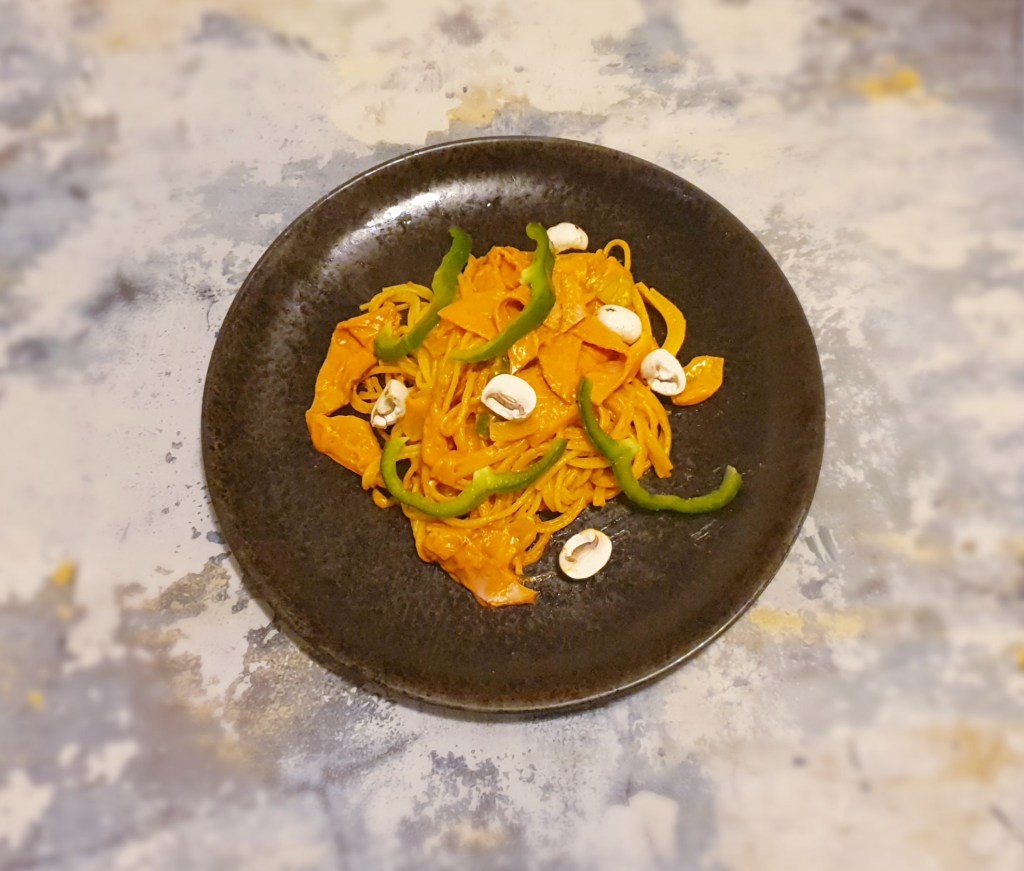
Following the re-released recipe, I mixed margarine, brown sugar, flour, currants, spices, lemon rind and cocoa together. It smelt lovely and reminded me of a light version of a Christmas cake. Surely any man would be delighted to get this? The recipe then said I should add milk, mixed with a teaspoon of vinegar with 1/2 a teaspoon of baking soda dissolved in it. Hmm… I guess the vinegar and soda were supposed to react to make bubbles and cause the cake to rise, but in my case it just led to a jug of funky smelling liquid after I mixed it with the milk. I added all the ingredients together and baked it at 180 degrees for 1 and a half hours. The recipe called for it to bake for 2 hours, but after 1 and a half the edges had started to burn and it was most definitely cooked through.

Shiny, shiny vinegar cake

First impressions were that if it didn’t taste great it could at least serve as a back up weapon, maybe a bludgeon or missile, in a tight spot. It was very, very dense and very, very dry. If I was sending this cake today it would have cost me over £5 to get it to France and I would also have to label it in capital letters “PERISHABLE”, which might have been one ironic morale booster too far for front line troops.

Turns out, it probably wouldn’t have ever made it to France for the simple reason that it was actually pretty decent. Sorry, imaginary front line soldier, but you’re going to have to get through another tin of corned beef without dessert this time.

Because there wasn’t any white sugar in the recipe it wasn’t very sweet – I had to go back and check I’d actually added any sugar at all. As the sweetner used had been light brown sugar (and not an abundant quantity at that), the flavour was more treacle-y, made slightly sweeter by the currants, but definitely not like modern cakes at all. The ginger and nutmeg spices weren’t obvious, except in that sort of subtle warming way TV chefs mention and that up to this point I’ve had no idea how to recreate properly. You’d miss them if they weren’t in the cake, but you didn’t notice their individual presence. I gave my sister – who has developed an uncanny ability to always appear at times of culinary triumphs and disappears at times of despair – a slice. She said she could taste the cocoa very well and could she take half of the cake home, please?

Looks like a cake, tastes like a cake, sits in your stomach like a cannon ball

In all seriousness, this was a success. I can absolutely see how men would be delighted to receive this and how their loved ones at home would have enjoyed the process of carefully measuring and weighing ingredients out, knowing their act of love would bring happiness to their man abroad and perhaps a welcome distraction from their imminent return to the front line.

Next week, year 9 will be watching Peter Jackson’s They Shall Not Grow Old (hey, it’s the end of term and one of the perks of being a History teacher is the prerogative to watch historical films in the name of education.) As we watch and comment on what the students can see and hear, and how the genuine front line footage supports what they know about trench warfare, I think we might all be eating a slice of trench cake too. That, or hiding under the tables if Robbie and Finn decide to tell me, their commanding officer, to ‘do one’ and use it as a missile instead.

E x

Trench Cake

225g plain flour
115g margarine
1 teaspoon vinegar
1/4 pint of milk
85g brown sugar
85g currants
2 teaspoons cocoa powder
1/2 teaspoon baking soda
nutmeg
ground ginger
grated lemon rind

  1. Grease a round cake tin and pre-heat the oven to 180 degrees.
  2. Rub margarine into the flour.
  3. Add dry ingredients to the flour and margarine. Mix well.
  4. Dissolve the soda in the vinegar and mix. Add the milk.
  5. Add milk, vinegar and soda mix to the dry ingredients and stir well.
  6. Turn into the cake tin and bake for between 1 1/2 hours and 2 hours.
‘Lasagne’: 1390

It was a bitterly cold and windy day when I decided to make the ultimate comfort food: lasagne. It had been a disappointing morning – every time the Met Office issues storm warnings I get my hopes up that Hurricane Santa might bring me a trampoline or part of someone else’s fence, but alas, yet again I hadn’t been good enough this year.

So, the lasagne was to cheer me up – proper comfort food, which I’ve been trying to avoid in an effort to be healthier. Something hot, cheesy and far too calorific to be good for me. I planned to eat it standing tear-stained at the window, brandishing a fork trailing strings of cheese and shouting “see what you’ve made me do, Santa?!’ angrily at the wind. As is his way, my husband gently suggested that the sight of a fully grown woman shouting cheesy nonsense at an invisible Santa two months after Christmas might give the neighbours cause for concern. He promised to look into whether adult trampolines were a thing, if I’d redirect my anger to something less overly dramatic.

Which is how I came across medieval lasagne, or Losyns, as Forme of Cury would have you spell it (click here for a bit more info on Forme of Cury when I made Caudle Ferry.) Cheese? Check. Pasta? Yes (after a fashion). Meat? Er…

Maggie Black, who translated and adapted this recipe in The Medieval Cookbook tells us that lasagne was thought by some to be considered an ideal dish to serve at a last course at a banquet. The heaviness of it would ‘seal in’ the copious amounts of alcohol imbibed during the dinner, at least for long enough until the guests got back to their own homes (although possibly not; most medieval hosts rich enough to throw banquets would also house their guests for several nights too.) There’s also some suggestion that lasagne would have been served to resting armies, being quick and easy to make and incredibly filling, as well as being a bit of a crowd pleaser.

The first thing I noticed about this dish was the pasta. There was a study done recently* that ranked homemade pasta as one of the best comfort foods there is – along with mashed potatoes and roast chicken. Having said that, I’m always a bit wary of people who have their own pasta machines because it does take a bit of effort and the sorts of people who make it regularly enough to need a machine always seem like the sorts of people who jog up mountains for fun, or think watching foreign art films without subtitles is a good date night. You know, people who just generally do well at all aspects of life in an effortless and supremely annoying way. My life always seems to be full of effort of one kind or another, so I have no time for that sort of smugness, and no time to make pasta regularly, so we don’t own a machine.

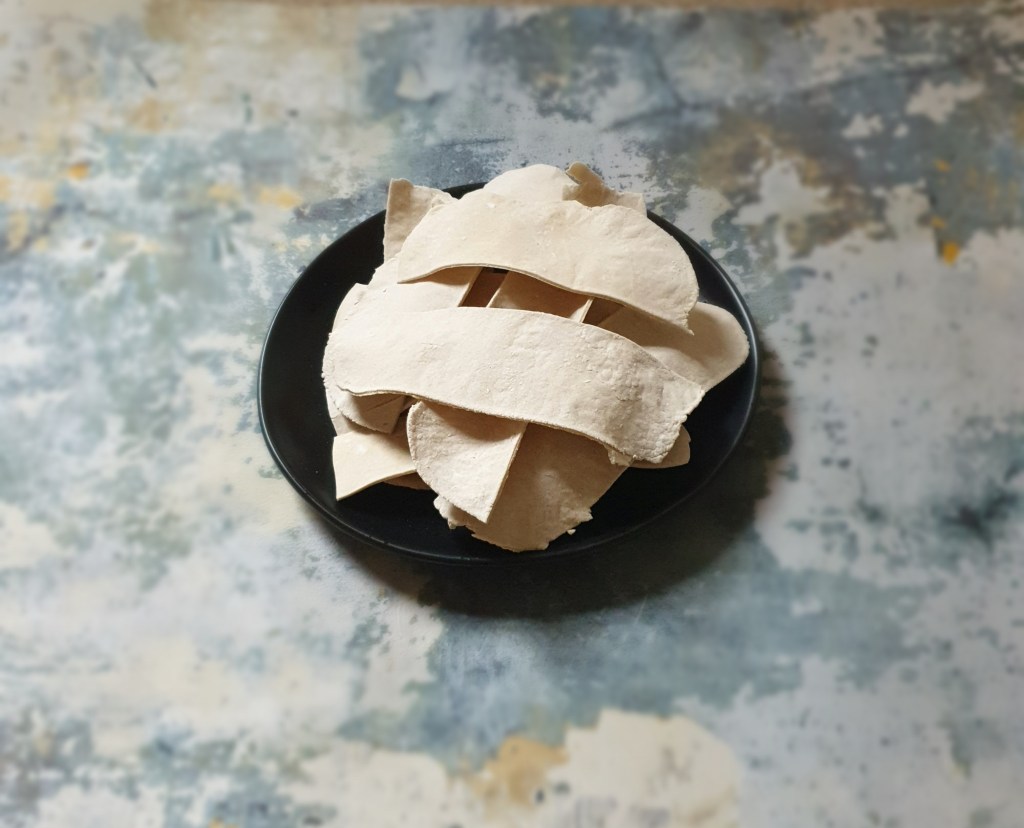
Medieval people must not have thought of pasta as the richly comforting food I do. The recipe I used said that the lasagne sheets should be made out of fine white flour, “paynedemayn” which had been mixed with water into a dough. No eggs, no seasoning, no nothing. With the dough made, I rolled it out into as “thynne foyles” as I could just using rolling pin and cut it into strips.

The worksurfaces were now covered in flour and sticky grey mush. Every time I make dough I think of the people we bought our house from: who excitedly told us that they’d updated the kitchen and put new worksurfaces in – their pride and joy. I had promised I’d take care of them. As I surveyed the mess of ground in dough, sticky stained wood and crevices turned ashy with flour no duster could reach, I hoped they had no idea this blog existed.

The recipe told me to dry the pasta, and back in the 14th century it would probably have been air dried over a number of days. Because I have to work in order to pay for the kitchen I promised I wouldn’t ruin, I didn’t have a couple of days to just do nothing waiting for this to air dry, so I laid the lasagne sheets out on a baking tray and dried them in a very low oven for 2 hours at 80 degrees until they were hard and brittle.

Bland and anaemic, just how comfort food should be

The lasagne sheets baking, I turned to the filling and was straight away struck by the next medieval twist. No meat. No filling, really, of any kind unless you just count cheese, which I did, so I cracked on with it.

Cheese was a very popular and common foodstuff of the middle ages, with many different varieties eaten throughout Britain. Since meat was expensive, pretty much every peasant household would make their own cheese as a vital source of protein and richer houses might buy more expensive or imported varieties from the continent. According to P. W. Hammond there were 4 main genres of cheese during the middle ages: hard cheese (like cheddar), soft cheese (like cream cheese), green cheese (a very young soft cheese) and the appealing ‘spermyse’ (cream cheese with herbs.)

The original recipe calls for grated “ruayn”, which is a cheese that no longer exists in its original form. Some people think it could refer to cheese made with rowan grass from the second harvest of crop season and so was only made at certain times of the year, whilst others suggest it may have been a variant of ruen cheese, which just meant cheese made with rennet. Either way, if I didn’t have time to air dry pasta I definitely didn’t have time to wait until the end of harvesting season to make some obscure long lost cheese. In 1170 Henry II bought 10,240 lbs of cheddar and so since it was definitely available by 1390, I couldn’t see too much harm in substituting ruayn for a mild Cathedral City, especially not one that was 50% off.

Once the lasagne sheets had dried, I boiled them in chicken stock until they were soft again (why?!) and then laid a layer of them in a rectangular dish. I sprinkled on a handful of grated cheddar and then a pinch of “powdour douce” – a curious medieval seasoning that appears in lots of recipes and for which no definitive recipe seems to exist (surprise, surprise). I knew from previous research (which quickly taught me to spell ‘douce’ correctly) that powder douce was meant to be a combination of sweet spices, such as cinnamon possibly with some sugar mixed in, and was the lighter alternative to the other popular medieval seasoning “powdour forte” which was seen as a stronger collection of spices containing black pepper. In the end I used Dr. Christopher Monk’s recipe, which also gave a very full account of the history and preparation of this enigmatic spice cocktail.

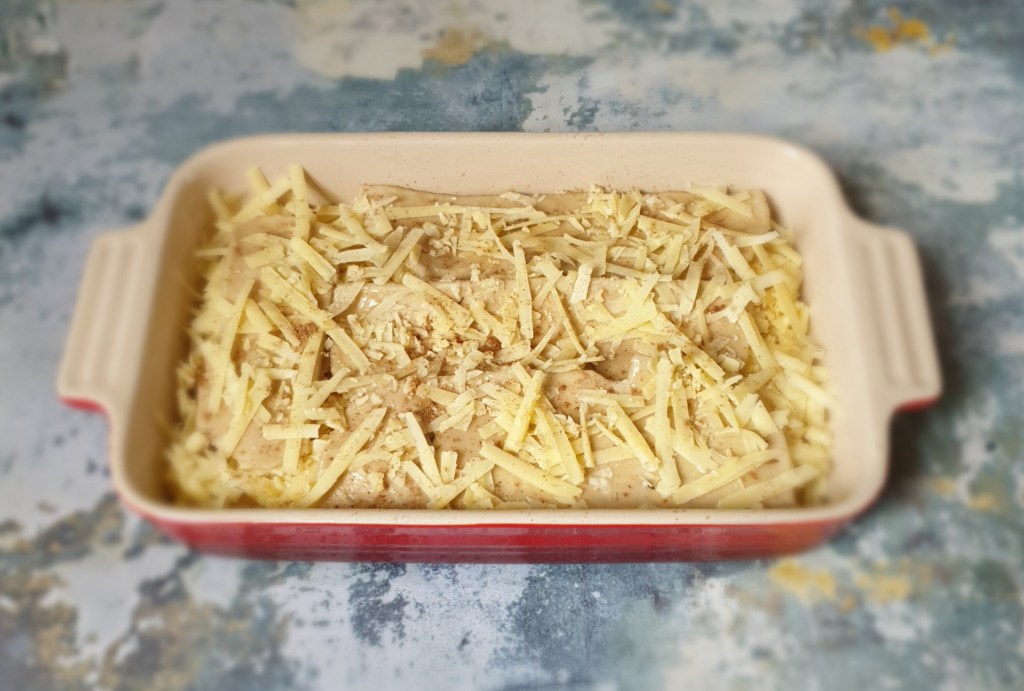
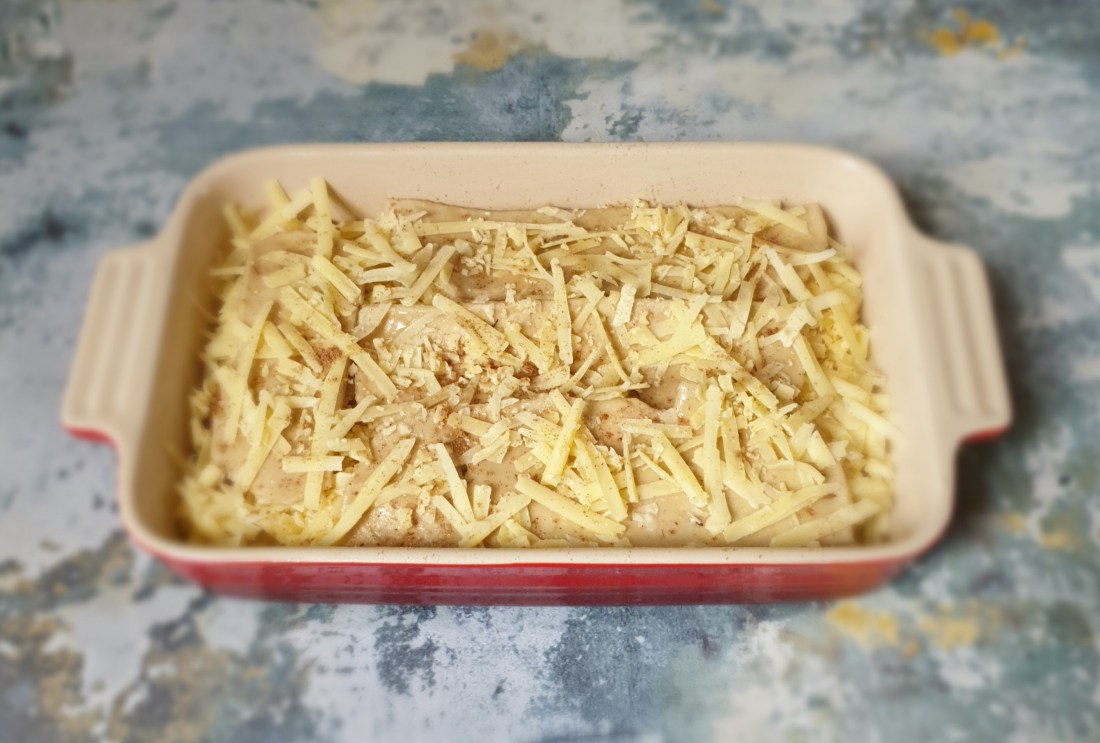
And so I built the cheesiest lasagne man has ever known: a layer of cheese, a dusting of powder douce, a layer of lasagne sheets, and so on until I had used up all the pasta. Into the oven it went for 20 minutes or so until the cheese was bubbling and the air smelt and felt odd – hot and spicy, but also greasy. My idea of comfort food heaven.

It contained no white sauce, no meat, no tomato and pseudo-pasta but it did at least look like a lasagne

I’ll admit that when it was done even I was a little bit alarmed at the amount of melted cheese. I mean, it was literally just a dish of cheese with a few brittle bits of dough languishing in the middle. Luckily I pulled myself together and cut a slice to make your eyes water.

Initial thoughts were that the cloves in the powder douce ruined it slightly. Not liking cloves in any form, I imagine my initial dislike was down to personal taste, but as they were one of the most widely used spices in medieval England and a key component of the seasoning, I had to add them. The general flavouring was a peculiar mixture of cheese and cloves and one that I wasn’t used to, but wasn’t 100% unpleasant. This is something I’ve found is true for lots of the things I’ve cooked so far – often the combination of flavours is a bit jarring to modern palates, but aren’t necessarily horrible.

The lasagne sheets were quite flavourless but the texture was robust and very similar to pasta cooked al dente (MasterChef here I come…) It was clear their role was to add bulk and fill diners up, which it did well, rather than to be a complementary flavour to the cheese and spices.

So. Much. Cheese

Would I make it again? Yes, with tweaks: I’d cut out the spices for a start and include more salt. I’d use eggs in the pasta and I think the whole meal would work well with the addition of some sort of minced meat, possibly in a tomato sauce, added in with the cheese. Actually, as that sounds bloody delicious, I’m off to patent it.

E x

*A study done by me. It was delicious.

Lasagne

9 or 10 lasagne sheets
3 pints chicken stock
Powder Douce
175g cheddar cheese (more if you’d prefer your coronary to come earlier)

  1. Cook the lasagne sheets in a pan of boiling chicken stock until soft and malleable.
  2. While the pasta is cooking, lay a base of grated cheese in a rectangular lasagne dish. Sprinkle over a pinch of powder douce.
  3. Cover the grated cheese with 3 sheets of cooked lasagne.
  4. Repeat the pattern two more times: cheese, powder douce, lasagne until you have used up all the lasagne
  5. Sprinkle cheese over the top and bake in an oven at 160 degrees until cheese is melted and pasta is cooked through.

Review: Fitzwilliam Museum’s ‘Feast and Fast’ Exhibition

A librarian, a linguist and an historian walk into a bar…

…which immediately empties as people try to escape the inevitable smug but still dull punchline.

In this case, though, the bar is actually a museum which was so totally the opposite of smug and dull that no one was trying to leave. Unfortunately the librarian, linguist and historian were real enough, but they mostly kept to themselves and only diminished the quality of the exhibition a little bit.

As a history lover (can I stop calling myself a historian now? There surely aren’t enough letters after my name to qualify), I have quite a particular set of criteria that I think need to be met in order for a museum or exhibition to be graded ‘awesome’. For those that are wondering – the grading scale goes ‘awesome’, ‘good for a rainy day’, ‘would pass through it to get to the loos’ and ‘would rather be on Friday after school detention duty’.

A museum should be three things to the visitors that go there: academic but also accessible, engaging, and a bit of an indulgence. I want to leave feeling like I’ve learnt something that even if not immediately pub quiz useful to know, still feels good to have learnt it.

The Fitzwilliam Museum’s Feast and Fast: the art of food in Europe 1500-1800 manages to fulfill all those criteria and more. Open over the feast and fast periods of Christmas and Lent (nice touch) its aim is to “present[s] novel approaches to understanding the history and culture of food and eating” which it achieves through a visual smorgasbord of recreated food from history, artefacts, original documents and the obligatory paintings of naked women lounging around bowls of semi peeled fruit.

If you’d like a more comprehensive and slightly less irreverent review of the exhibition then check out this review. If you just want to know what a swan tattoo is and ruminate on whether Adam really needed a fig leaf that reached down to his knees, read on.

The first thing you notice is the 4 foot pineapple installation outside the exhibition by Bompas & Parr, who describe themselves as experts in “multi-sensory experience design.” They sound super cool but I don’t really know what “multi-sensory experience design” means, though that’s probably OK because I doubt I’m the sort of target audience they’re going for. The three of us enjoyed the jarring nature of a giant modern pineapple squatting in the manicured grounds of the museum and did some very uncool selfies in-front of it, shattering all the pineapple’s street cred with each chin-heavy/grimacing shot we took.

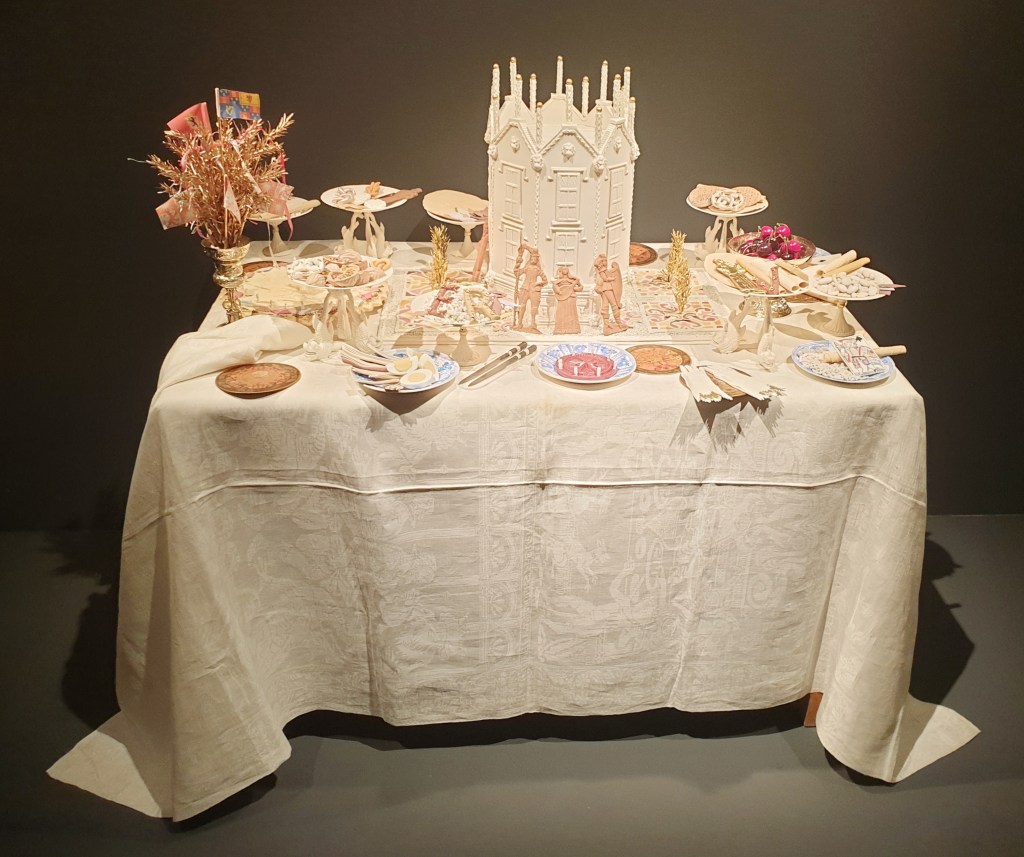
The first wow factor hit as soon as we stepped into the main exhibition. A recreation of an early 1600s banquet greeted audiences square on and my first thought as I gazed at it was ‘well, thank God we didn’t bring my daughter’. I didn’t know this, but in 17th century England ‘banquet’ meant a formal dinner but could also mean a sweet course afterwards. The food historian Ivan Day made everything on the table out of sugar paste after the Renaissance custom whereby very, very, very rich (like, so unbelievably rich I could just keep writing the word very over and over again) would get their chefs to deceive guests by disguising food as something else. So on this table the food-stands, plates, walnuts, bacon and eggs and gloves were made out of sugar. This would have confused and delighted guests – the entertainment element of 17th century Come Dine With Me. We did wonder whether, when they were setting all this up, any of them were tempted to just lick a bit of it or eat one of the sugar almonds, and what the penalty might have been if they were caught. Had my daughter been with us no doubt we’d have found out.

Already confused and delighted, we moved on to the swan tattoos. Proper Historians would call them ‘swan registers’, but since there wasn’t a Proper Historian to be found, we continued making fun of a centuries old custom. In the later middle ages swans were bred as status symbols and by 1482 a law was passed that said all unmarked white swans found in common waters were automatically property of the king. Cue swan owners throughout England branding their birds in an effort to stop this very peculiar form of taxation. The bills of the swans were etched according to the symbol of their owners and registers of each symbol were kept track of. In 1570 the Order of Swannes decreed that anyone caught tampering with any of the tattoos, or adding their symbol onto an unmarked swan without permission would be thrown into prison for a year.

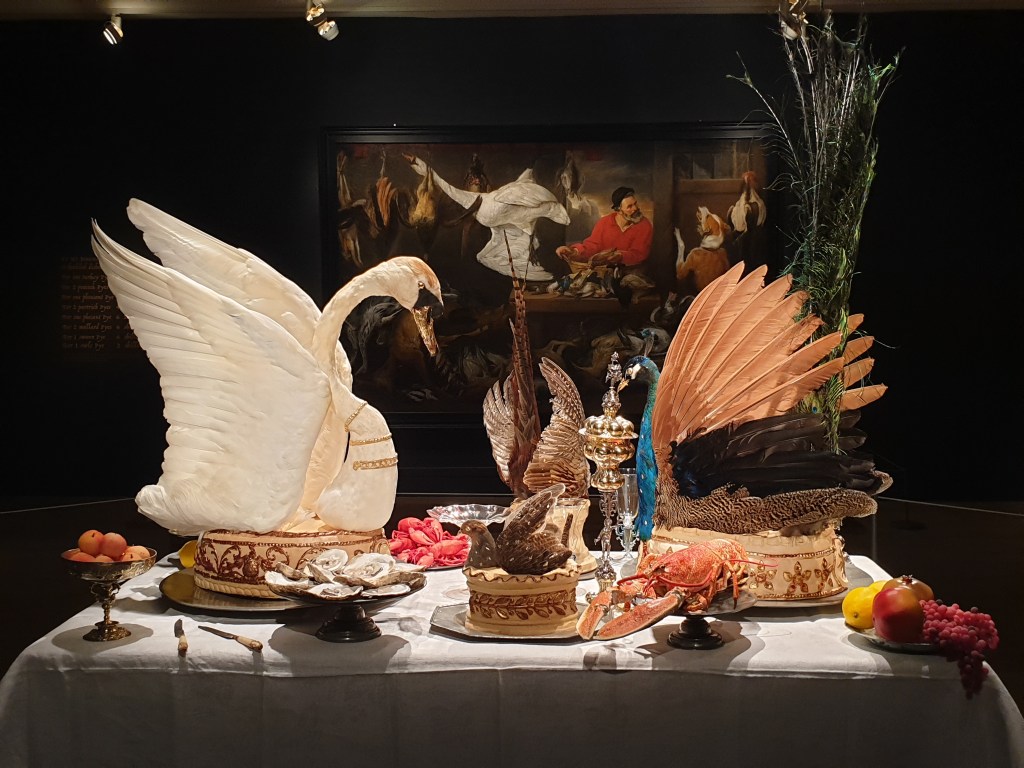
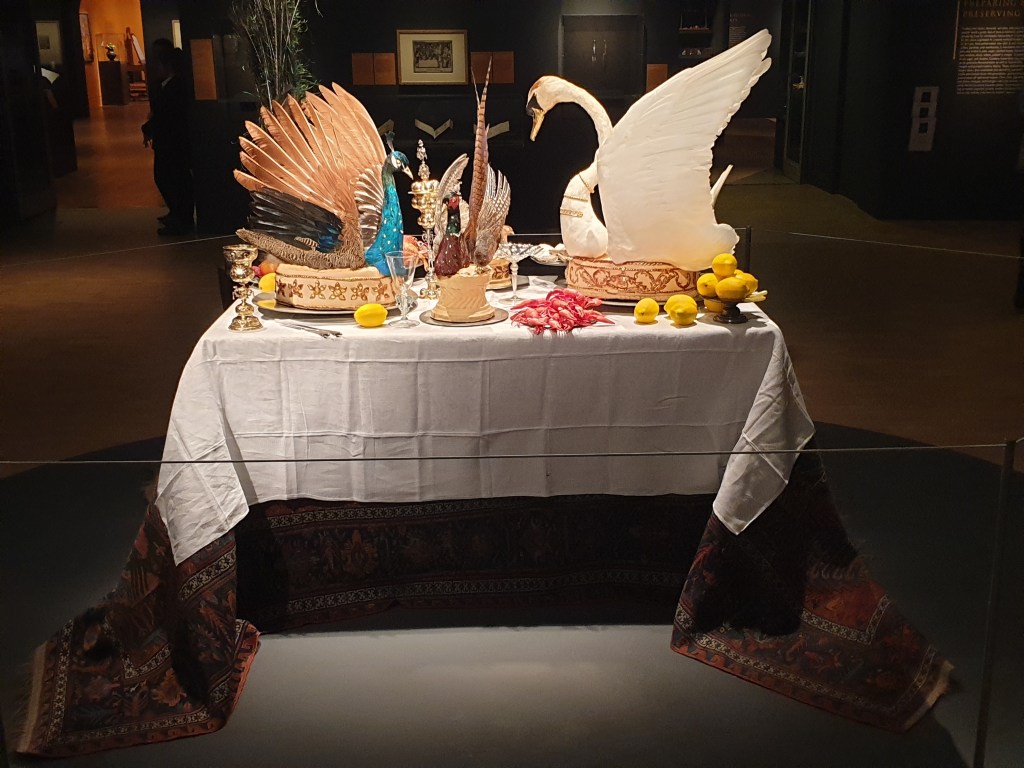
Speaking of swans, the second wow factor came in the form of a Baroque Feasting Table where I counted a swan, a pheasant, a peacock and a partridge (stuffed and with gilded eyes and beaks) decorating a table groaning under silverware, fruits and seafood. I can’t really think of anything funny to say about this bit – it was just a truly extraordinary display of decadence and gluttony. If it’s true that throughout history humans have had a very anxious relationship with food – with the poor always questioning ‘where’s the next meal coming from?’ and the wealthy thinking ‘this tastes revolting but shows I’m rich so should I serve it?’ (the answer was always yes) – then whoever prepared this banquet was clearly in the bathroom when humans were getting their food anxiety handed out. Even the tableware – the knives, glasses and tablecloths – screamed wealth. Break a mug at this dinner party and you’ll be repaying the hosts with your annual salary. The curators had lit the whole thing beautifully and it looked exactly like a painting, I found that my eyes couldn’t stay still and kept skipping from one shiny object to the next, which maybe says more about my ability to appreciate art than anything else.

By now it was time for some pictures. Now, I am not a huge fan of art. I firmly fall into the camp of if-I-can-do-it-it’s-not-art. Luckily, most arty things are beyond me, so fans of blobs of primary colour on canvases can rest easy that I won’t be picking a fight with you. At least, not until I’ve done the photo shoot for my own unmade bed. To make the pictures go a bit quicker we played a game of bingo, which if you’re ever stuck in a gallery with people who know about art (and want you to know that they know about art), is a great way to stop yourself from turning yourself inside out from boredom. On our bingo list was: man leering at buxom cook while she dithers, dead pheasant, fruit used as a modesty item, small child with plate of food balanced precariously on their head while adults cavort inappropriately behind them and people gazing at an apple. We also had a bonus round – in honour of the icon that is Mary Beard – called ‘Is it Art or Is It F***ing?’ which I won when I found a Cezanne.

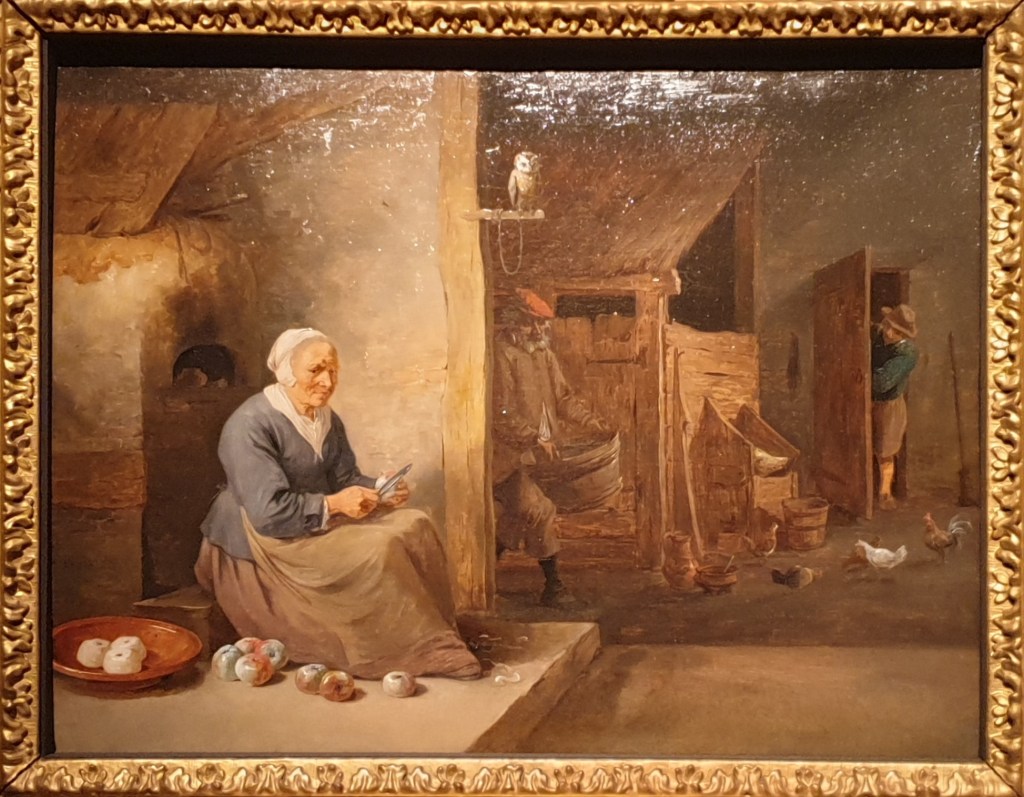
Amazingly, we didn’t find much on the bingo list (apart from the previously mentioned massive fig leaves which indicated Adam needed a doctor, so Eve probably did him a favour getting them out of that garden.) What I did find, however, was a couple of images that fell within the cliched ‘women and food’ category but that really made me laugh. The first depicted an older woman who looked decidedly pissed off, fannying about with some fruit. When I looked closer I found that maybe the reason she looked so cross was that the artist, David Teniers (1610-1690) had entitled it ‘An Old Woman Peeling An Apple’. The second image, by Godfried Schalcken (1643-1706), was of a young woman holding out a waffle and was imaginatively called ‘A lady holding a plate with a waffle’. It was apparently meant to be sensuous and seductive, but that was lost on me and it just made me feel hungry instead. I shared a fun moment with one of the exhibition attendants when I reached out to point at the weirdly modern looking waffle and he lunged forward to stop me, thinking I was going to smear my greasy not-a-proper-historian fingers all over it. I mean, it was fun for me, probably less so for him.

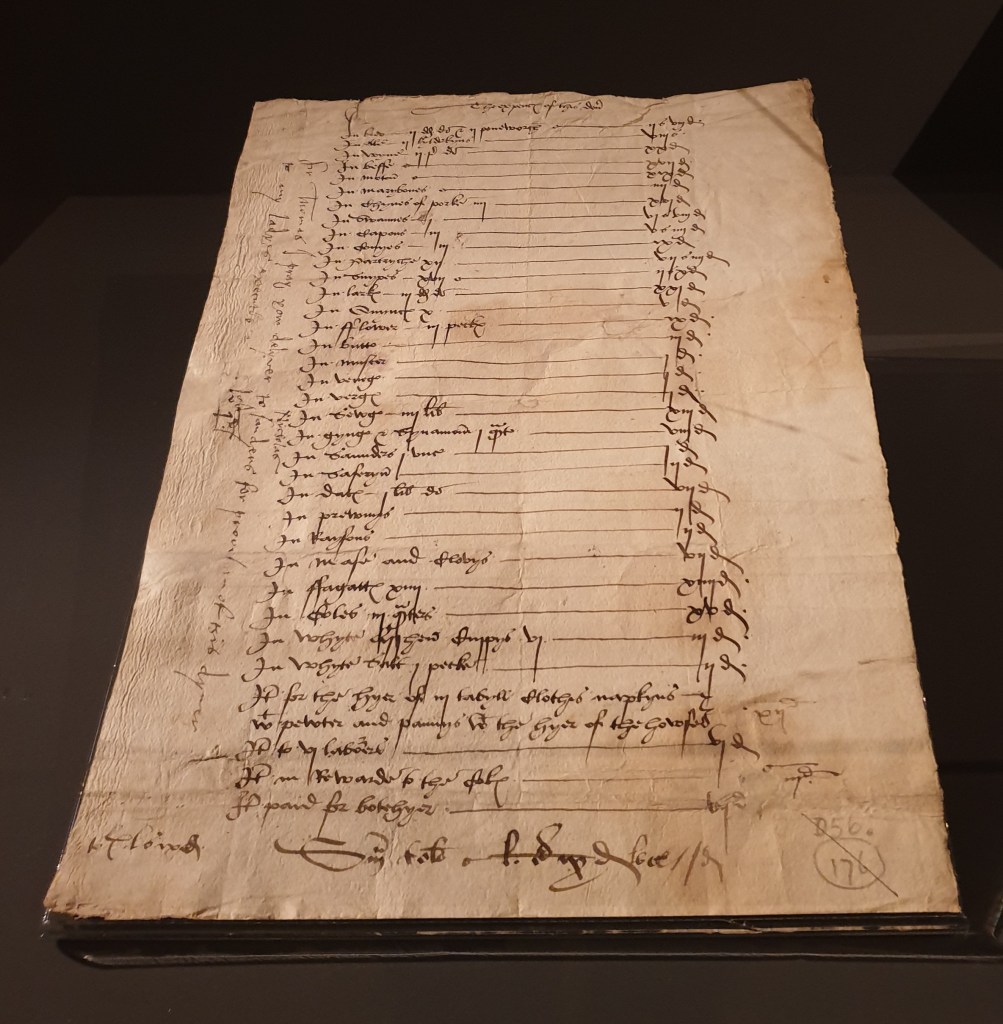
Another item of note included the 1510-11 inventory of Margaret Beaufort’s expenses for a feast for the winding up of her estate where over £1000 in today’s money was spent on meat – including our trusty friend the swan. I set a new life goal: get so famous that one day people would pore over my weekly Sainsbury’s receipt, encased in glass and softly lit from above while a little plaque solemnly informed people that in this week alone my household had consumed two boxes of Coco Pops and a crate of sausage rolls (you have to know who to ask…)

So, what did I gain from this visit? Well, firstly I got some brilliant ideas for future cooking experiments – if you need me over the weekend I’ll be waist deep in the river dressed as a swan going ‘quack quack’ in en effort to lure them into my net. As well as this I also got to try the sugariest coffee cake known to man in the museum cafe, it’s been two days and I’m still shaking as I write.

I also got a properly in depth understanding of where a lot of the foods we enjoy fit into history and our culture as well as an appreciation of why some foods have certain elevated statuses while others are seen as being lowly and modest. For example, once you understand that the medieval Catholic Church decreed that no meat was to be consumed on holy days, which accounted for about 40% of the year, you kind of get why banquets where hogs were paraded round with apples in their mouths were such entertainment and reserved for the rich, who wanted to celebrate the occasions where meat was permitted in a way that separated them from the poor.

This exhibition was not only academic and accessible, it was also incredibly entertaining and I definitely felt like I’d had a proper treat by the end of it. Even the librarian, who admitted museums weren’t really her thing, couldn’t stop herself from getting excited over Isaac Newton’s notebook showing a record of all the snacks he had bought while studying as a student at Cambridge. Every little detail was well thought out, from the moody lighting which made you feel quite alone and allowed you to focus despite being surrounded by people, to the exhibition-inspired kid’s paintings at the end (hey, it guaranteed those parents will visit at least!) There really was something for everyone, as long as ‘everyone’ doesn’t include toddlers. Maybe don’t bring them, unless you’re really good at repairing sugar paste castles.
Feast and Fast: The Art of Food in Europe, 1500-1800

26th November 2019 – 26th April 2020

Admission: Free

The Fitzwilliam Museum
Trumpington Street
Cambridge
CB2 1RB

Spinach Tart: 1699

We’d had quite a long day having yet again been up early, each of us lying silently and pretending not to hear our toddler’s 6:00am shouts, hoping that the other would break first and get up with her. I won, but my husband got his revenge by allowing her to play with a toy drum kit very loudly and enthusiastically in the room directly under our bedroom. After what seemed like a never ending day, 13 hours later she was back in bed drifting off to sleep and we crashed onto the sofa, exhausted.
I’m giving you this background so you’ll understand that I was tired and slightly delirious when I decided to unwind by making this dish. Because what could be more relaxing than making puff pastry from scratch for the first time ever using vague historical methods, whilst hoping that any noise or swearing you make doesn’t drift up to the bedroom above you? As soon as I started I realised I’d basically become a hostage to butter and dough, unable to stop what I’d started but also unable to call for help.

This recipe is taken from a 1699 Stuart book called Elizabeth Birkett’s Commonplace Book, which the National Trust has helpfully transcribed here and which you can also find in Sara Paston’s Book of Historical Recipes.

The Stuart era was one of the most turbulent and violent periods of English history, seeing the attempted assassination of its first monarch, an increasing obsession with witchcraft, a full on civil war, the Interregnum, the restoration of a monarchy that seeemed hell bent on bankrupting itself and the eventual increased curtailing of royal prerogative. Phew. How fitting, then, that a dish from this time period should mimic the unpredictable and confusing nature of the era.

First, I had to take a “good quantity” of spinach and boil it. Taking into account that even a tonne of spinach has an uncanny ability to wither away into just enough to feed an ant, I settled on a 900g bag of frozen spinach to start with, with emergency back up spinach in the fridge if the frozen stuff dwindled too much into nothing. If this experiment didn’t work it did at least indicate that I should change banks because the anti-fraud squad at NatWest still has yet to contact me; after all, if spending £10 on healthy green veg and nothing else doesn’t constitute unusual activity on my credit card I don’t know what does.

After I’d boiled an ungodly amount of spinach I had to strain it completely, shred it and then mix in the yolks of 4 eggs and an ambiguous amount of sugar, stated only as “a good flow” in the recipe. At this point I really began to question myself: What was this dish for? Was it a pudding? Was it a main? Some quick research told me that sweet spinach tarts were a popular “second course” dish in the 17th century. Out of how many dishes, though, I couldn’t find. Was it meant to be served alongside roast beef or with custard? The bewildering nature of this recipe was shining through loud and proud.

I read on and was perplexed to see that I also needed to add a “pretty amount of butter.” I paused.

“Darling,” I whispered sweetly through to my husband, aware that the bat-eared child was dozing directly upstairs. “How would you describe this butter?”

“For God’s sake, if it’s mouldy just don’t use it,” he hissed back, not even looking at it. “No one will care if you have to use marge instead.”

I thrust the half used pat of butter under his nose. “Would you say it looks pretty?”

I genuinely think he thought I’d lost it.

“Would you describe this butter as the most beautiful thing you’ve ever seen? More radiant than your wife, more delightful than your child?”

His eyes twitched. “Er -“

“Look at its shiny greasy gleam. Look at the little toast freckles poking out at you, even though I’ve asked you a thousand times to use a different knife, look at it’s pretty gold wrapping. This is one hot piece of butter, right?”

“Yes?”

“Thank you!”

Back to the kitchen I skipped, while my husband quietly researched psychotherapists in our area.

I melted the ever so pretty half pat of butter and mixed it into the spinach, sugar and egg mix. The recipe then just casually mentioned that I’d need some puff pastry to lie the mixture on. I don’t know why I didn’t read ahead fully, but by now it was 9pm and my will was waning. Learning that I’d have to make puff pastry from scratch for the first time in my life, and using instructions that were clearly already written by a madwoman was almost too much.

(Luckily?) Elizabeth Birkett didn’t provide a recipe for 17th century puff pastry, so I began to toy with the idea of using shop bought ready rolled. I mean, no one would know, right? I could just say I’d made it myself… My eyes read down the recipe to where, underneath the ingredients for the tart filling, I saw another 17th century recipe, from an unknown document: ‘To Make Pufe Past’. Damn.

Puff pastry is one of those things that I always thought sounded really daunting and belonged firmly in the realm of Serious Cooking. It’s the sort of thing I imagined Nigella Lawson might silkily say was ‘divinely simple’ to make from scratch before whipping out twenty different ingredients and revealing you need a chemical engineering degree for. The instructions for making 17th century puff pastry were, however, fairly straightforward, but I still Googled how to make it just in case.

Of all the things I’ve accomplished, including my family, this is the best

The difference between 17th century pastry and modern day pastry was obvious: eggs. Modern day puff pastry is basically a bucket load of butter mixed with dough made of flour and water. 17th century was a bucket load of butter mixed with a dough made of flour and a bucket load of eggs. This 1686 recipe was one of the most decadent display of a culture going ‘sod it’ in the face of political, religious and financial uncertainty I had seen. I guess if you thought you might lose everything tomorrow (and for King James II this was true just 2 years in 1688 later during what became known as the Glorious Revolution) then you might as well eat all the eggs and butter you have all at once, a la Ron Swanson.

First I added 3 eggs and 1 egg yolk to 275g of plain white flour. The dough was very wet and I doubted that I’d be able to roll it out like it was required, so I added more flour until it was firmer. I then stuck it in the fridge, which wasn’t wholly historically accurate, but did give me an advantage later on when I had to add lumps of butter and roll it without it melting.

After it had chilled for 15 minutes or so, I rolled it out and stuck lumps of butter over it. Thanks to my Googling, I knew I had to fold the dough into thirds, give it a quarter turn and then roll it out. Then, I added more lumps of butter and had to repeat the process 10 times. In all, I used up an entire block of butter and I definitely lost count of how many turns I did. It still looked bloody awesome, though.

Once the pastry was made I placed it onto a baking tray and slopped my weird sweet spinach mix onto it. I spread it around, covered it with another layer of dough and brushed it with a rose water and sugar glaze. It then baked for 25 minutes while I did my best Bake Off impression, peering in through the oven door every 30 seconds and whispering “rise, rise, rise” to myself. In the other room, my husband dialled the number for the psychotherapist.

The kitchen filled with a pleasant buttery aroma. Because the oven had to be so hot when it went in to give the pastry a chance to rise properly the rooms downstairs also got very hot. We switched the central heating off, basking in the glow of the oven, and tried not to think about another Stuart event, the Great Fire of 1666, which started in a bakery perhaps making spinach tarts like this one.

Finally, the tart was golden and was even doing a very good impression of successfully risen puff pastry. I narrowly avoided 3rd degree burns when I opened the oven door and removed the dish, genuinely excited to try this enigmatic experiment.

A delicious vegetarian wellington/quiche/custard tart, my favourite

By now it was after 10pm. We were both exhausted. The kitchen looked it had been the site of a fight between an army of millers and dairy farmers. There was butter in every crack and crevice of the work surface and my husband visibly recoiled in horror when I emerged like a crone with hair and face covered in a thick dusting of flour. I cut us a slice, not sure what to expect.

The pastry had worked! It wasn’t perfectly flaky layers like Paul Hollywood would have liked, but it was definitely closer to puff than any other type. The mixture wasn’t as watery as I had expected either, perhaps because I’d spent so long pressing the spinach into the sieve to drain it. Because it had called itself a tart, I cut it into two generous slices, but after a few mouthfuls both of us agreed that standard portions were far too big. It was just far too rich to be able to eat a whole slice of; baklava sizes would have been much better.

Taste wise it was subtle and sweet but the spinach was still the main flavour. Luckily, spinach isn’t too strong of a flavour anyway, so it wasn’t overpowering. The rose water and sugar glaze was a bit perfume-y for my tastes, but because there was only a little bit of it, it was easily hidden with another bite of filling.

I’m waiting for that handshake, Paul

It definitely wasn’t unpleasant and actually when I came home I had a bite of it cold as an after work snack, but I still don’t know where it would fit in a modern day dinner. It wasn’t pudding-y enough to be a dessert, and I think the subtle flavours would be lost if you tried to serve it with custard or cream. It was too sweet to be a main. It might fit in well at a brunch alongside other pastries but you’d have to think of another name for it because if someone gave me the choice of an almond croissant or something called a spinach tart, I know what I’d pick.

One of the more minor reasons I started this blog was to eat more greens. Though it’s taken some time to achieve this, and most other adults manage it without needing to resort to making an egotistical song and dance about it, I felt that in this recipe I might have finally managed it. Unfortunately any healthy kudos I might have achieved were definitely neutralised by the amount of butter that also went into this. It was one of the most unhealthy things I’ve eaten. As it cooked, I watched the butter pour off it and as soon as it hit my tongue, melting and rich as it was, I heard my long suffering junk food clogged arteries sigh ‘not again.’ Still, in small quantities, definitely one to try!

E x

Spinach Tart

For the pastry:
275g plain flour
3 eggs plus an extra yolk
250g unsalted butter
water

For the filling:
900g frozen spinach

4 egg yolks
50g of sugar
125g melted butter
a tablespoon of rose water and sugar for glaze

  1. Preheat oven to 200 degrees.
  2. Mix flour and eggs together to form a dough. Place in the fridge for 15 minutes.
  3. Roll dough out into a rectangle the size of a baking tray.
  4. Place 50g of butter, in lumps, onto the dough.
  5. Mark the dough into thirds and fold it over itself. Turn it a quarter clockwise and roll it out into a rectangle again. Repeat this until all the butter is used up.
  6. Divide the pastry into half.
  7. In a pan, cook the spinach. When it’s cooked, drain it and dry it completely.
  8. Mix in the yolks of 4 eggs and 50g of sugar.
  9. Add the melted butter and when all combined, spread over half of the pastry which has been rolled to cover a baking tray (it will be very thin).
  10. Cover with the other half of the pastry and glaze with a mixture of rose water and sugar.
  11. Bake at 200 degrees for 25 minutes or until golden and risen.

Honey-Cakes: 2nd century AD

Sounds like a disgusting cutesy nickname to me. Luckily, it’s not (at least not in my household where our nicknames tend to fit more comfortably within a broad ‘ballbag’ theme.)

Loathe as I am to go from ballbags to my mother in law without a sentence in between, I have to admit that as it’s her birthday this weekend, I’ve been thinking a lot about birthday celebrations and the various traditions that surround them. When did we first begin marking the anniversary of the moment a family said goodbye to sleep forever? Why do we look back on a person’s life instead of looking forward at what’s to come (I mean, ultimately death, right? Think I answered my own question…) and why, oh God why, do we give gifts to the little buggers who don’t even remember the bloody day instead of to the woman who can remember every slow and agonising minute in glorious never-ending technicolour?

Obviously what I’m most interested in is the history of the birthday cake. I remember the cakes my mum made for me when I was little were always the second best part of the day (after the presents, obviously). She worked so hard to get them perfect: a 3D witch hat cake for a spooky themed birthday party and a hot dog shaped cake for a BBQ party stand out most. The BBQ one was made out of ginger cake with marzipan buns which not only tasted delicious but also hid the questionable sausage shape from a congregation of 9 year olds.

It was when I got older that my mum hit the cake jackpot, though. Gone were the novelty shapes and questionable amounts of food dyes – now it was all about pure sophistication; if you haven’t made Nigella Lawson’s chocolate sour cream cake, do. It’s in her book How To Be A Domestic Goddess, which was my bible as I got older but isn’t available online. I found this instead, which is an approximation and also by the goddess herself so go and make it!

Despite my love of birthday cake, I was guessing the cakes of bygone ages probably contained ever so slightly fewer E numbers and jelly diamonds than the ones I grew up with. Still, I remained hopeful for my mother in law’s sake and began to search for the first ever birthday cake.

I thought the parameters of my research topic (“history of birthday cake”) were clear, but the internet thought otherwise: ‘Do you mean the first time someone put candles on a cake?’ Google asked me mockingly as it flung several thousand results my way. ‘Or do you mean the first recorded use of the words ‘birthday’ and ‘cake’ together in a recipe? What about the development of the idea of birthday cake as part of a celebrated cultural tradition, is that what you meant? Here, have some pictures of cats.’

£1000 if you can catch all these in your mouth
Photo by Sharon McCutcheon on Pexels.com

After I’d watched 8 or 9 cat videos I narrowed my research down a little bit and found that there were two predominantly accepted ‘first’ birthday cakes. The first involved giving cake to a child on their birthday with candles on it to mark their age with an additional candle to “symbolize the light of life” and dates back to an 18th century German celebration called Kinderfeste.

As part of Kinderfeste, parents would tenderly bake their precious child a fruit or simple sponge cake and might decorate it with nuts and dried fruit; you know, the sort of wholesome but boring treats favoured by people who don’t know what hundreds and thousands are. Then they would lovingly present the cake to the delighted birthday girl or boy whose eyes would shine in the flames of the candles that illuminated it. They might wait for their special poppet to take a deep excited breath with the growing anticipation of whether they’d get their wish in one blow or not, and then suddenly they would very tenderly and lovingly snatch the cake from the little sucker and make them wait all day, unrelentingly replacing each suffering candle as it flickered and died until evening came and finally, finally, the child would be permitted to eat the (presumably) wax covered stale treat. Happy birthday! Obviously the kids knew that tradition stated they weren’t supposed to eat the cake until the day was done, but I like to imagine that every year they got their hopes up that maybe this would be the year mum and dad relented early and that every year their hopes were dashed.

I couldn’t see my mother in law being overly delighted if I pulled that stunt, so I turned to the other ‘first’ birthday cake: the Ancient Greek honey-cake.

Ancient Greek stories, be they epic, play or poem, are littered with references to honey-cakes. In the Odyssey the father of the teenage princess Nausicaa serves them to Odysseus after he returns her to him as a thank you (unlike modern day parents, who probably wouldn’t welcome a naked older man in for lunch if he turned up on the doorstep with their underage child, the Greeks had a very specific brand of hospitality called xenia which forced them to put all reasonable parental responsibility aside in the name of being good hosts. Naturally.)

Honey-cakes were also made for the gods, and one of the earliest uses of them acting as a celebration of an anniversary involved them being offered to the Greek goddess Artemis. Followers of Artemis, goddess of hunting, the wilderness, chastity and the moon, would bake ‘moon shaped’ honey-cakes at various points in the year to celebrate different aspects of her divinity. In an amazing display of irony, every 9th month followers of Artemis also celebrated her status as a champion deer hunter by offering her simple honey-cakes shaped like stags. Next month, however, when she was meant to be honoured as a gentle mother nature figure, they hunted and sacrificed a full on goat.

Like Anglo-Saxon bread, the Ancient Greeks don’t seem to have considered the average honey-cake worthy of recording a recipe for. Maybe, given their prevalence throughout Greek writing, they were so culturally ingrained that people just knew how to make them without needing to learn. So I’ve had to do some proper research for this; the kind of internet searches that sound so academic Google would now think twice about flinging cat pictures my way in the results pages. One of the things I’ve found is that if you’re specifically interested in the cultural use of cake as an offering to gods in ancient civilisations, you should definitely check out this blog.

Apicius, the 1st century Roman cookery text, has an entry on Greek honey-cakes which is helpfully just one sentence long: “To make honey cakes that will keep take what the Greeks call yeast and mix it with the flour and honey at the time when making the dough.” There are no instructions on cooking times or on the function of the cake, which I’ve just come to expect by now, to be honest.

Digging deeper still, the Greek rhetorician Athenaeus, who was writing during the end of the 2nd/beginning of the 3rd century records in his Deipnosophistae numerous references to honey-cakes, even providing some sparse ingredients and an idea of how they should look: “a little loaf…made of oil and honey.”

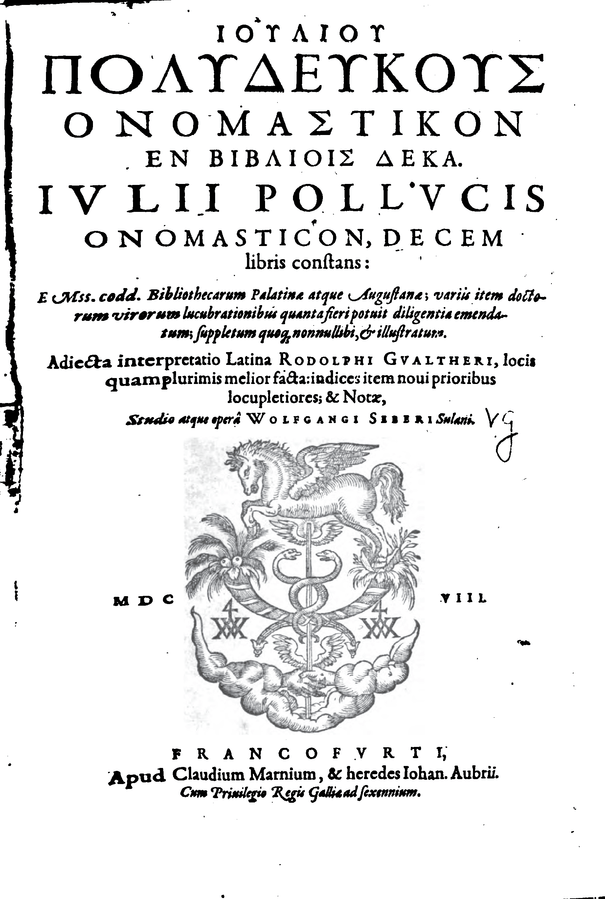
I felt I was getting closer to what would surely be the most underwhelming birthday cake ever made. My final burst of research took bloody ages because I spent half a day trying to find an English translation of the 2nd century Greek grammarian Julius Pollux’s Onomasticon; one of the earliest dictionaries of ancient Greek phrases and words which sounds just about as exciting as a wet Monday afternoon. In Onomasticon there’s a chapter entitled ‘On meals [and] the names of crimes’, because those two topics are so obviously linked, which mentions honey-cakes. I was therefore hopeful that Julius Pollux could provide the final piece of information I was looking for (or at the very least the dictionary definition of ‘honey-cake’) but it turns out no one’s bothered to translate Onomasticon into anything other than Greek or Latin. I can’t think why. I did spend a woeful hour hopefully searching for the Latin word ‘mel’ (honey) and ‘libum’ (cake) in a pdf of a Latin translation, but it was utterly pointless and nearly cost me my laptop when in a fit of frustration I tried to throw it across the room after a passage I had been really hopeful about was Google translated as “the pig the cake does dancing outside”.

The most exciting thing about this book is that there’s a winged horse jumping over a carrot with a moustache on the front cover

Yet again I was saved by someone doing history far, far better than me who had provided a version of a recipe from Onomasticon which confirmed that oil, water, honey and flour were the only ingredients I’d need. To make it as authentic as possible, I decided to use spelt flour, which had been cultivated in the ancient Middle East and, along with wheat and barley, was an important crop to the Greeks. Encyclopedia of the Ancient Greek World also says the ancient Greeks believed the goddess Demeter gifted them spelt and so it was often associated with religion and ritual, making it perfect to use for these birthday cakes. (I’ll be honest – at this point I was so deep into a black hole of websites and tabs and books that I’d forgotten that my mother in law’s birthday was meant to be the priority.)

Anyway, enough history; more cooking. Making the honey-cakes was easy peasy. I mixed oil, water, honey and water in a bowl until it formed a dough and then rolled it out. Like an idiot, though, I hadn’t realised that the honey would make the dough as damn sticky as it was and I spent ages scraping it off the rolling pin and re-flouring the surface while my toddler impatiently shouted ‘cake! cake!’ in what felt like the most stressful and judgmental way possible.

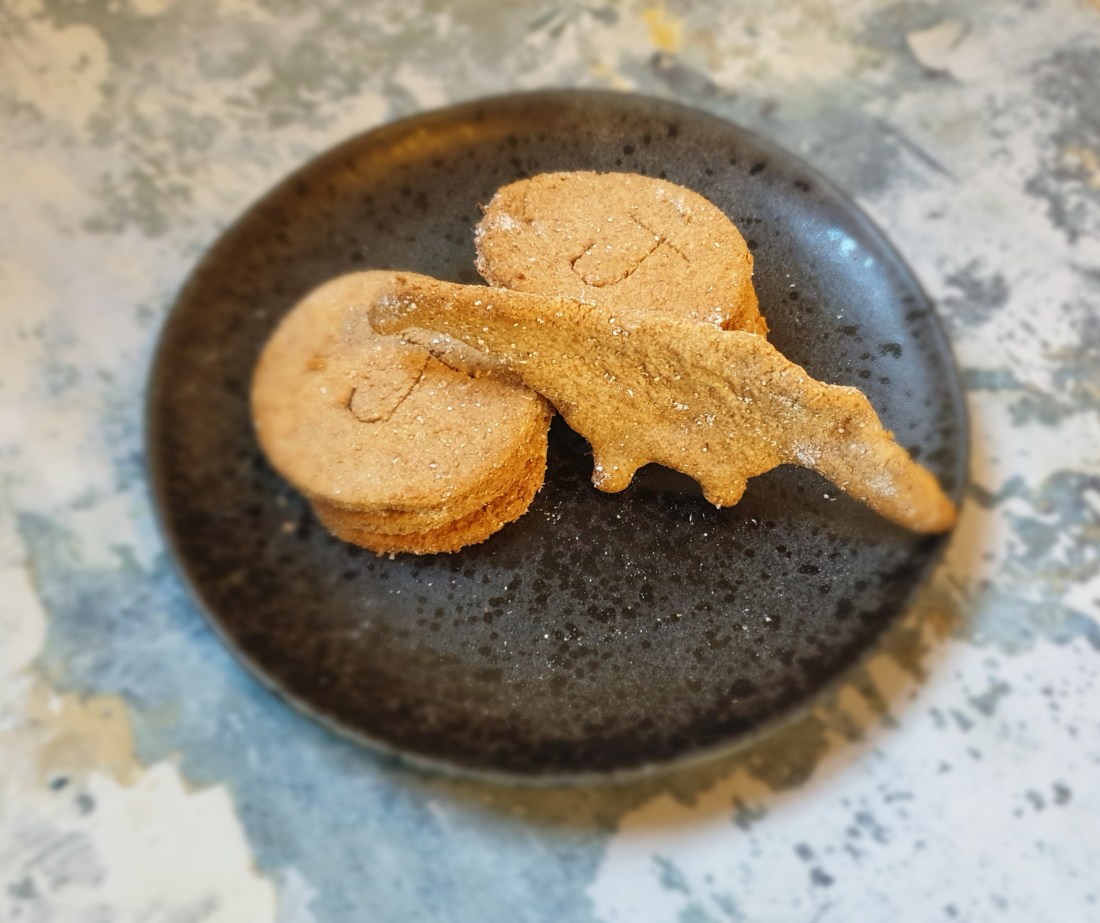
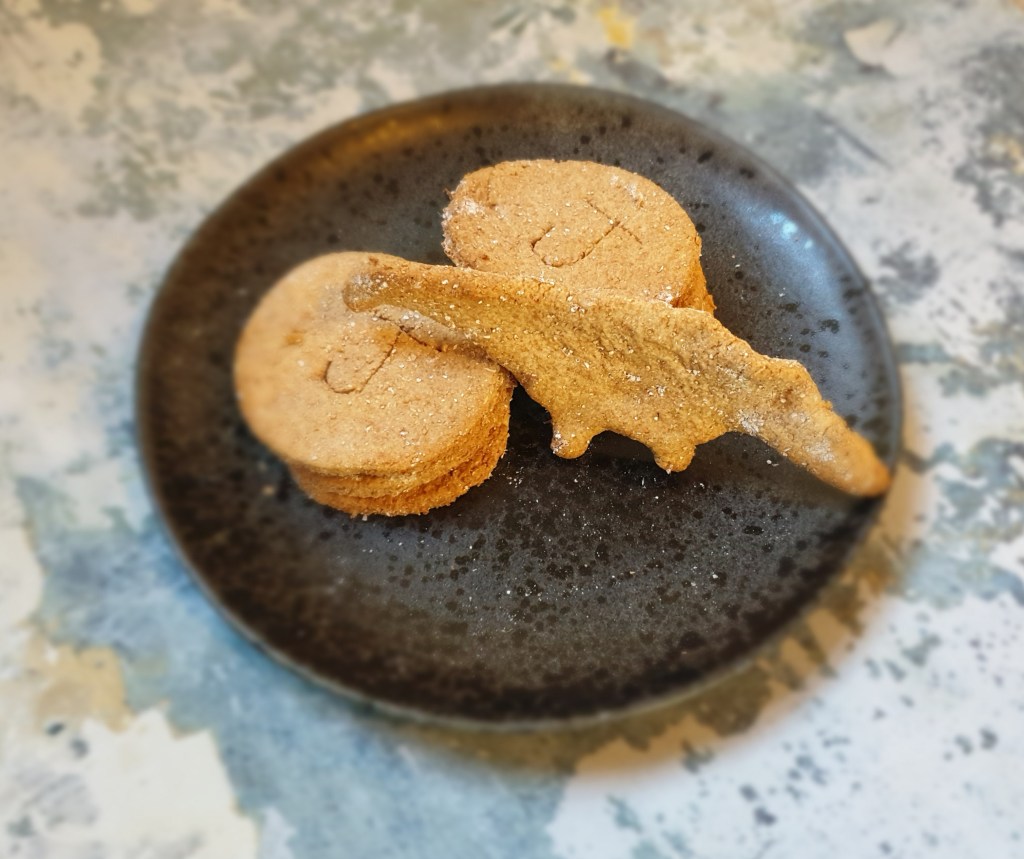
Once the dough was finally rolled out, I tried to cut it into stags in honour of Artemis. Now, the ancient Greeks may have had a booming market for stag-shaped cookie cutters, or they may have just been very handy with freehand shaping, but I couldn’t get the antlers right and my stags looked less like the magnificent beasts they were supposed to and more like unidentifiable roadkill. I didn’t think my mother in law would appreciate some bulldozed animal biscuits, so I improvised and used a dinosaur shaped cookie cutter instead after the ancient Greek deity T-Rexima, goddess of tiny arms and shouting loudly, who incidentally is also my daughter’s god of choice.

I also made some ‘moon shaped’ biscuits (plain old round to non Greeks) and because it was my mother in law and not Artemis I was honouring, I stamped them with a ‘J’ instead of the symbol for Artemis (a bow and arrow) and baked them in the oven, crossing all my fingers and toes that these would work.

Yes, dinosaur nerds, I know that’s not a T-Rex and I don’t care

First things first: these are not cakes. What we have here is a biscuit, which is Definitely Not A Cake. It’s obvious now why there aren’t any English translations of Julius Pollux’s dictionary and that’s because it’s obviously a steaming pile of trash. Maybe he realised he’d accidentally left the word ‘biscuit’ out of the ‘B’ words and couldn’t face melting his wax tablet down to make space to correct it so just lumped these in with ‘C’ for cake, knowing full well that no one would ever read that far? Well I’m on to you, Pollux. Maybe you could add another rhyming ‘B’ word to the Onomasticon too for a description for your dictionary?

Imaginary arguments aside, these were very pleasant. Because of the spelt flour the texture was grainy and fairly rough – I’m glad I didn’t try with plain white because it would have changed the feel of these totally and I think they would have been further away from the originals. They were also very hard initially, but once you chewed them a bit reminded me of an oatcake. The honey obviously ensured they were sweet, but it was a very subtle sweetness. My husband (who took one bite and apparently turned into some sort of gourmand) said they’d make perfect cheese biscuits, particularly as a complement to goats’ cheese.

Everyone was quietly surprised by how good these were – my daughter ate most of the dinosaur ones by herself (which to be honest isn’t really a useful indication of whether they tasted nice or not as she’ll eat anything). My mother in law, who isn’t one for very sweet and sickly things, also seemed to enjoy them and even said she could see these being sold successfully if they were marketed as sort of semi-sweet biscuits. The fact she enjoyed them was a huge relief because I hadn’t made any sort of back up cake if they had been disgusting. Fortunately my father in law had thought ahead so we ended up having honey-cakes and proper birthday cake too.

Overall the link between ancient Greek honey-cakes and modern day birthday cakes might be a tenuous one, but this afternoon it was one we were all glad to pretend was much stronger.

E x

Honey-cakes

150g spelt flour
75g honey
1 tablespoon olive oil
Water

  1. Mix flour, honey and oil together. Add water to form a stiff dough.
  2. Roll out to about 1cm thickness and cut into shapes or circles.
  3. Bake for 12 minutes at 160 degrees.

Stewed Rabbit: 1861

Last week I began to question if I was still young.

Now, I’m not one of these people who fears getting old at all. Nothing makes me switch channels faster than when adverts come on showing beautiful women slathering greasy creams onto their faces while some voice over purrs that the cream contains acid and will make them look so young midwives will be wiping their wrinkle free bums and bundling them up in blankets before they can blink. Incidentally, why was acid a substance my chemistry teacher wouldn’t let us handle without twenty pairs of goggles and a hazmat suit, but as soon as you turn 50 is OK to smear on your eyelids?

First of all, I found a grey hair. No big deal; I work with kids and they’ll keep me young, I thought, and went to work.

Year 7 were working on developing their extended answers to essay questions. Who knew: sometimes history can be boring! As practice, I’d asked them to write a paragraph about their favorite subject at school or, if they didn’t have one (as so many of them loudly shouted), their favorite family member. It was all going really well until one of the little delights put their hand up to ask a question.

“Miss, is this alright: History is my favorite subject at school -“

“Certainly the best possible start, Sophie.”

“There are lots of reasons for this, mainly it’s because the topics we’re looking at are interesting, such as Battle of Hastings.”

Things were looking good. I willed my head of department to walk through the door.

“However, there are other reasons I enjoy it too, such as my teacher…”

As my ego drowned out the sound of the class collectively rolling their eyes, I imagined the headteacher joining my head of department in the doorway and giving me a thumbs up. Sophie was saying something else now, so I re-tuned in.

“…so therefore the reason I like her is she’s a bit like my nan, who I would say is also my favorite family member.”

“Er, what was that last bit?”

Even after we’d established that Sophie was just comparing my personality rather than my appearance to that of a 70 year old, I found it hard to shake the idea that maybe my youth (in a sort of true sense of the word) was coming to an end. Later, whilst I researched care homes and browsed Boots for hair dye, I thought about what I’d achieved in my 27 years and wondered: was it it enough?

All this background is just an incredibly long winded way to introduce Isabella Beeton, a woman who crammed so much into 28 years of life that she’s often mis-imagined as an elderly spinster, rather than a young woman under 30 (spot the difference now, Sophie?)

Born in 1836, Isabella Beeton is still an absolute stronghold of English kitchens throughout the land. Most people have heard of her Book of Household Management which was published in 1861, but what they might not be aware of is that the collection of recipes and household advice was actually published serially in a magazine owned by her husband before it was turned into a book. Not specifically a cookbook, but an instructional guide for the flourishing middle classes to help housewives with the everyday problems they might encounter as they ran their households. Her writing style was brisk and clipped which made her seem like a repressed middle aged woman, but did lend an air of authority and gained her many fans. Unfortunately, Mrs Beeton died at the age of just 28 from complications surrounding the birth of her fourth child. Her husband later sold the magazine they had worked on together and to keep a good income rolling in, the men who bought it continued to publish recipes under her name and in her writing style to give the impression she was still alive, such was her popularity and success.

Originally, Mrs Beeton didn’t focus on recipes but on translating work, having been educated in England and Germany. In fact, she had been given quite an extensive education and training and by 19 was proficient in multiple languages, piano, dressmaking and had even trained in pastry making at a German finishing school. All this worldly experience would later be used in her book; in between the recipes that made Mrs Beeton famous there are chapters on fashion, how to hire servants and how to raise children to be polite and respectful.

As well as being a celebrated cook, Mrs Beeton appears to have been a massive occultist too

Whilst flicking through the book I was delighted to learn that the correct term of address for me was Mistress of the Household and that “as with the commander of an army, or the the leader of any enterprise, so it is with the mistress of a house.” I read on, bristling with importance. “She [is] who makes her husband and her children happy, who reclaims the one from vice and trains up the other to virtue…” Finally, some recognition!

To help me command my household without going bankrupt, Mrs Beeton also included a breakdown of how much to pay each type of servant, from the lowliest maid and “occasional girl” (£150 – £200 a year) to an entourage of a cook, a couple of housemaids, a nursemaid and a manservant (about £1000 a year). My husband enquired hopefully whether we could get an “occasional girl” of our own. I told him that since it was my job to save him from vice we could not, but that I’d look into getting us a manservant.

Stewed Rabbit is a recipe that sits in chapter 18 of Household Management in-between a chapter about the natural habitat and behaviour of birds and some “General Observations on Game”. Having never cooked rabbit before I was a bit alarmed when the butcher whacked a carcass down on the counter rather than some pre-cut packaged meat, but I think I hid it well and only squeaked a little bit. Victorian cooks were used to seeing meat in its original state and I counted myself lucky that at least I hadn’t had to behead, skin and gut it.

Although the stewed rabbit part of the recipe was straightforward, there were many sneaky additions that weren’t immediately clear would need lots of prep. For example, when going through the ingredient list I saw that I’d need to add ‘a few forcemeat balls’ and something called ‘mushroom ketchup’. Knowing that cooks throughout history hated waste of any kind, I was suddenly very wary of what the forcemeat balls might be.

Turns out they’re sort of like stuffing, but smaller and smoother in texture. Mrs Beetons says that there should be no one flavour that overpowers them and they should melt in the mouth and not be dry, nor heavy. This made me rather question the bloody point of them, but I obliged and made 15. Mrs Beeton also suggested using the liver of the rabbit but said I could pick ham if the liver was not available. Though a queasy glance at the pile of bones, skin and meat told me the liver was very much available, guess which one I picked.

I’ve helpfully distorted the size of these by putting them into a novelty skillet, which makes them look massive. In reality they’re about the size of walnuts

The mushroom ketchup was something I had to adapt, as Mrs Beeton’s recipe takes about a week to make properly and I only had an afternoon. It involved salting a lot of mushrooms and leaving them for 3 days to draw the water out (or 15 minutes over a low heat with a lot of mashing if you have no time), and then boiling them for hours until all the neighbours had evacuated their houses to escape the stench. With the street empty, the mushroom/water potion was strained through a sieve and bottled.

My sneaky additions prepared, I set about making the stew. First I cut off the liver and kidneys from the rabbit, spraying blood everywhere as my knife wasn’t sharp and in my blunt carvings I accidentally tipped the blood drenched dish the rabbit had been sitting in upside down. Then I placed the joints into a large pan to which I added 2 chopped onions, cloves and lemon peel. I covered with water and let it cook for half an hour while I scrubbed myself and the kitchen clean a la serial killer style.

The recipe very unhelpfully told me that the rabbit stew would take ‘rather more than 1/2 an hour’ to cook. Nothing else, cheers Mrs B. I went back after half an hour and saw that the meat appeared cooked, but since 1/2 an hour didn’t feel like very long at all I left it a further 1/2 hour, hoping to emulate some of the slow cooking style of modern rabbit stew recipes. I had also by now had a chance to look at some modern day recipes and was dismayed to see the addition of wine, butter, olive oil, garlic and all other sorts of things that would make this dish a lot more appetising. The thriftiness World War One enforced on the British public was still decades away from this recipe, but boy was Mrs Beeton practicing hard for it. It was now that I discovered decadence and frivolity were not traits that Isabella Beeton was known for; she espoused frugality and moderation (sometimes bordering on what we might call minimalism today) in everything she did, even when writing meals for people who could afford servants.

After some further boiling from the rabbit, and some silent seething resentment from me, I drained some of the water off and added the forcemeat balls. To make a gravy, Mrs Beeton advised added flour and butter and then a ladle of the mushroom ketchup. I boiled it all together and then it was done.

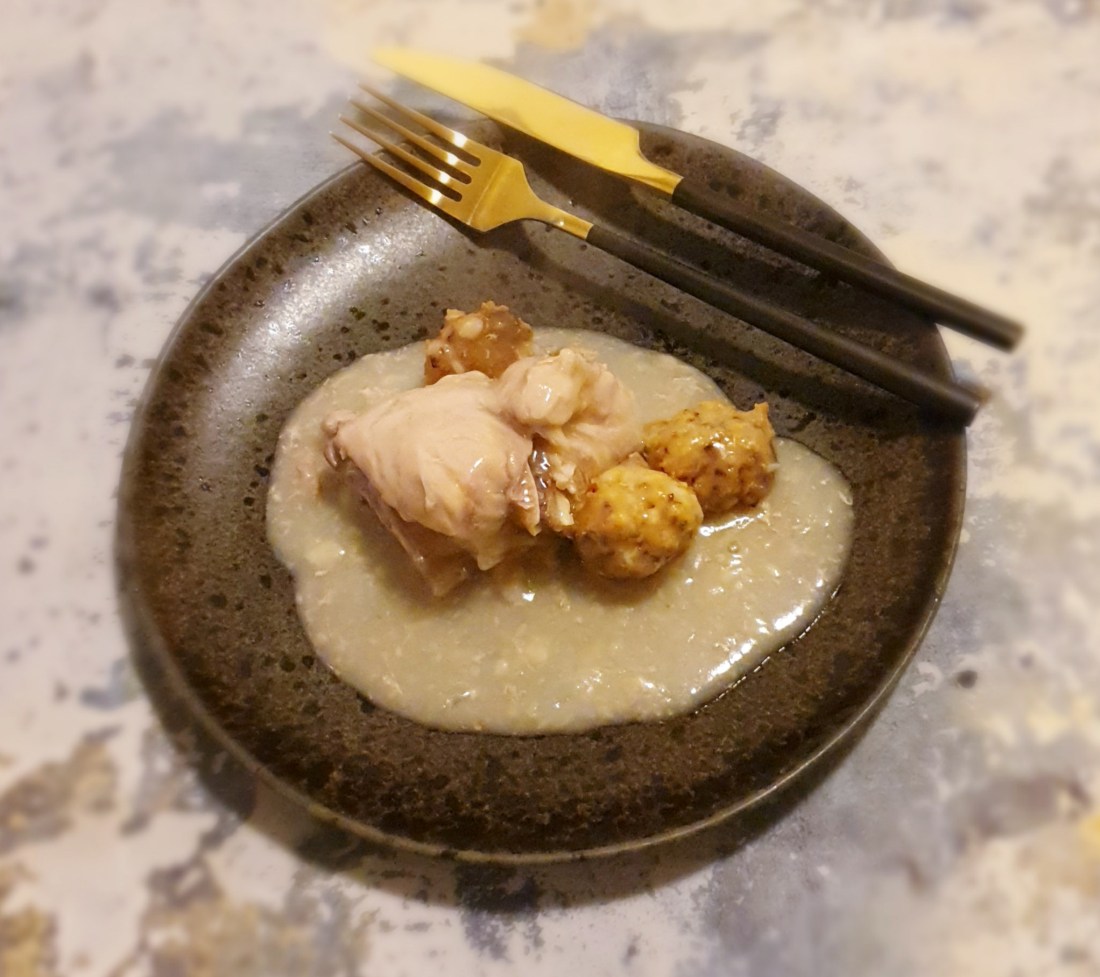
Honestly, I did nearly give up on this. There was a moment while I was stirring that I looked at the grey slush before me and then caught sight of the BBC recipe which was open on my phone brazenly looking so much better and just thought ‘sod it’. But I rallied, in true Beeton style, and admonished myself for setting such a negative example to my impressionable child and imaginary servants. I plated up, ignored the fact that even though I’m pretty imaginative I couldn’t think of a way it could look more unappetising, and ate.

Charles Darwin, the great evolutionary scientist of the Victorians themselves has shown that evolution takes a long time, longer than 150 or so years anyway, to make significant change to a species. Therefore, the Victorians must have had tastebuds. I can only imagine, then, that they must also have had a deep seated self loathing. The rabbit was bland and chewy, thanks to the fact the recipe didn’t do anything to it other than boil it in water for only half an hour. The sauce might have been thick, but like the rabbit, lacked any sort of meaningful flavour apart from a hint of cloves which was just a bit unpleasant with nothing to offset it. There was an earthiness from the mushroom ketchup (which incidentally was actually quite useful in other dishes that needed something salty) but it was a subtle flavour against the already bland backdrop, and didn’t really enhance anything. It was immediately obvious, therefore, why the forcemeat balls were there: taste. Unfortunately, the taste was not unlike lemon scented sink cleaner with an added bitter kick to the back of the throat. Of my tiny portion, I ate two forkfuls; it was worse than Lord Woolton’s Pie.

Even with a side plate size serving I managed to scratch my throat on a tiny fragment of bone

I felt slightly betrayed by Mrs B. I mean, it may have been down to my cooking ability but as you’ll see, the instructions are not exactly hard to follow so if I went wrong I’m not sure where it was. People who still want to try rabbit stew and don’t hate themselves would be far better off making the one from the BBC recipe instead of this. I’m not done with Household Management yet, but we’re definitely taking some time away from each other for a bit following this dish. On the plus side though it has taught me that I if I do ever commit a murder, no forensic lab will ever be able to prove it happened in my kitchen.

At the start of this Mrs Beeton may have compared me to a commander of an army, but it was an army that had suffered a heavy defeat and was now limply retreating to the direction of the nearest kebab shop. My husband, guinea pig that he has become, had been very excited to try stewed rabbit. When he texted to tell me he was heading home I texted him back: “getting a takeaway, what do you want?”

E x

Stewed Rabbit

1 rabbit
2 large onions
6 cloves
Lemon peel of 1 lemon
Forcemeat balls
Table spoon of butter
2 or 3 tablespoons of plain flour
Mushroom ketchup

  1. Put the rabbit, cut into joints, into a large pan with the chopped onions, cloves and lemon peel.
  2. Cover with water and boil for 1 hour or so.
  3. After the meat is cooked, thicken the sauce with flour and butter – take out two ladles of water from the pan and put in a bowl. To this, add the flour and butter and whisk together until thick. Then tip this back into the main pan and stir until fully mixed in.
  4. Add a ladle of mushroom ketchup, or more or less depending on taste, and stir.
  5. Add the forcemeat balls and bring to a boil.

Forcemeat Balls

3 slices of ham
180g of breadcrumbs
1 large egg
10g of beef suet
rind of 1/2 a lemon
1 teaspoon of finely chopped basil, sage, mint and thyme
1/2 teaspoon of ground mace

  1. Chop the ham into as small pieces as you can. Add the grated rind of 1/2 a lemon.
  2. Add the breadcrumbs, beef suet, herbs and mace. Stir until well combined.
  3. Beat an egg and once it’s well beaten add it to the mix to combine. It should now be the consistency of sausage meat. If too dry, add water. If too wet, add more breadcrumbs.
  4. Roll out balls the size of a small walnut and place on a baking tray.
  5. Bake for 25 minutes at 160 degrees.

Mushroom Ketchup

1 pack of portobello mushroom
120g salt
brandy

  1. Place the mushrooms in a pan and cover with salt. Mash the mushrooms and salt together over a gentle heat.
  2. Once mashed, cover the mushrooms in 1.5 litres of water and bring to the boil. Let them cook for 3 hours, by which time the water should have reduced by half.
  3. Strain the mixture through a sieve into a jug so that only the liquid remains.
  4. Add a teaspoon of brandy and store in the fridge, covered, for 3 days.

Spaghetti a la Campbell: 1916

When my daughter was born a very good friend gave me the best ‘new mother’ advice I’ve ever received: lower your standards. If things are still too hard to manage, lower them again.

As I lunged towards my daughter who was smearing peanut butter into our velvet sofa (the purchase of which remains one of the stupidest things I’ve ever done) I thought of these words. As I slammed my foot down on top of one of her lego blocks and fell to the floor screeching a stream of incoherent swear words, I heard my friend’s voice repeat them. And as I gazed from my vantage point to under the stupid sofa at the litter of tissues, toys and gently festering bits of forgotten food while my daughter prepared to jump onto my head, I heard my friend shout, “too low! TOO LOW!”

Clearly, our household management was lacking. So today while my husband was still working and I had put the wild child to bed I decided to learn how to look after our home better, beginning in the kitchen.

Once in the kitchen, I had no idea where to actually start but fortunately in 1916 the American soup company Campbell’s released a promotional recipe book called Helps for the Hostess. This was aimed at families (well, let’s be honest – women) to help them raise their standards and create harmony throughout the home, mostly through the medium of soup. With hindsight, it’s pretty obvious that for Campbell’s the soup came first and the family harmony was more of a bonus.

Now, I didn’t really think soup was going to fill the crack in our kitchen wall, or solve the damp problem under the stairs, but the Campbell’s book was so overflowing with that very American brand of brisk optimism that I began to hope it could.

“A refined, well appointed home gives a recognized social standing which money alone will not achieve, among people who are worth while”, it declared right from the start. My God, I wanted to be worth while already. The book went on to assure me that with a few soupy additions to my cooking, I, a sweet and simple young wife, could now “charmingly welcome” my husband home after a hard day’s work with a “little dinner…the very fact that [I would have] prepared the meal and served it to him [would] add to the intimacy” of our 21st century relationship.

After I’d changed out of my work trousers into my best gingham frock, I set about researching the background to this gem. In 1916 the Americans had yet to join World War One, and so their cooking instructions lacked some of the frugality found in some British cookbooks of the same time period. The trouble for Campbell’s soup, however, was that they were struggling to fit into what the average American needed in their day to day life. Plain canned tomato soup, as convenient and relatively inexpensive as it was, just wasn’t speaking to the public on any sort of consumer level.

To shift more tins, Campbell’s changed their advertising to create the iconic red and white striped background and overlaid images of enticing food on top of this. Still, nothing. Frustrated, they began to target housewives who cooked soup from scratch, arguing that buying their soup would save them time and work. But, the equally frustrated housewives argued back, peeling and boiling vegetables for soup was a welcome break in the afternoon from surreptitiously swigging whiskey and sobbing into a pillow.

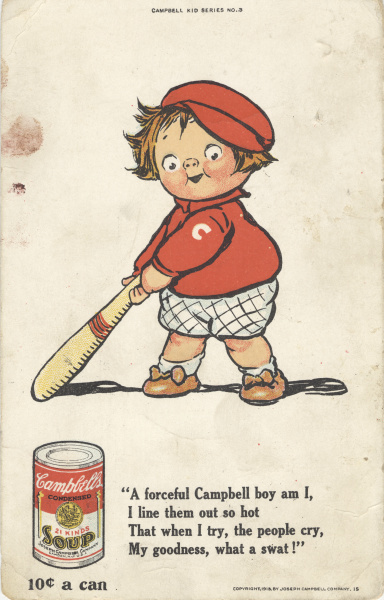
Then, Campbell’s had its breakthrough: what could any sane woman like more than impossibly large pig faced babies extolling the virtues of the soup with peppy slogans? Slogans that tapped into women’s insecurities about how well they were looking after their families. Slogans that implied the only way to be a good mother and wife was to fuel their families with soup. Slogans that gently suggested that wives would bring shame and humiliation on their husbands if they brought dinner guests home without much warning and there wasn’t enough store cupboard food to feed said guest.

The combination of disturbing pig kids spouting annoying rhymes about how the soup would make them strong and clever began to work on the women and business began to grow. As sales boomed, executives worried that there might be a limit to how much soup one household might reasonably need, so created a series of recipes that would encourage housewives to use more cans of the stuff in ingenious ways whilst simultaneously destroying what might otherwise be a decent meal.

You’ve eaten enough soup, boy

Spaghetti a la Campbell is actually one of the more appealing suggestions in Helps for the Hostess. Wanting this meal to actually bring me closer to my husband rather than be the grounds on which he successfully filed for divorce, I had decided to skip over offerings such as ‘Tomato Aspic with Cucumber Filling’ and ‘Stuffed Eggs in Aspic’ and, something called ‘Rum Tum Ditty’ which as far as I could tell was just tomato soup with a whole block of cheese sinking miserably in the centre of it.

In what appeared to be a genuine attempt to make life easier for housewives, the recipe itself was really straightforward. As I was cooking it I could feel myself getting more charming and competent around the house. I did a tinkly laugh as I thought of how my husband might like it if I warmed his non-existent slippers by the fire for later, and how I would regale him with delightful tales of our delicate and naive daughter who had spent the day tenderly playing with her dolls and not at all jumping in puddles and throwing sand at pigeons in the park.

If you wanted you could also use Campbell’s tomato soup as an emergency self tan

“I’ve made pasta”, I told him when he got home. “It’s got tomato soup in it.”

“Oh. Don’t we have anything else?” was the response. Hardly the warm and grateful attitude I had been expecting.

“No we don’t. You could have had aspic. You still can.”

Despite the rocky start, it wasn’t a bad weekday meal. Sure, the tomato soup made it a bit sickly sweet for modern day standards, and the cold raw pepper garnish was a bit odd, but the smoked ham added a nice subtle flavour to what was essentially a basic tomato sauce. In fact, it was so inoffensive that I forgot I was eating something experimental and my husband had seconds. Housewives of America must have thought it was alright too, because the company continued to go from strength to strength throughout the first half of the 20th century eventually buying out other American brands and incorporating them into the Campbell’s family. 1916 was still too early to be considered the era of convenience food, but with their tinned soup and quick family friendly recipes, Campbell’s was definitely paving the way by creating new and innovative shortcuts.

After eating we were too tired to clean the kitchen up. The silent mess under the sofa was still quietly rotting away and the lego bricks were still strewn with dangerous abandon across the carpet. We lowered our standards once more.

E x

Spaghetti a la Campbell

1 can of condensed Campbell’s tomato soup
2 onions
2 peppers
20 button mushrooms
280g of spaghetti
5 slices of smoked ham
1/2 teaspoon thyme
2 cloves of garlic
parmesan

  1. Boil the spaghetti in a pan of salted water with 2 cloves of garlic.
  2. Chop the onions and fry them in olive oil. Add sliced up pepper and mushrooms, leaving some of both raw to the side to garnish later, and cook until soft.
  3. Slice the ham into strips and add to the onions and peppers. Fry for 3-4 minutes.
  4. Add a can of Campbell’s tomato soup to the ham and veg mix and stir together.
  5. When the spaghetti is cooked, drain and add to the pan of ham and veg and add a 1/2 teaspoon of thyme. Stir thoroughly.
  6. Lay on a plate and add the left over raw sliced pepper and mushrooms and serve with Parmesan.

Anglo-Saxon Bread: 1047

When I was 6 or 7 we did an experiment at school mixing water and flour together and using the glue created to stick bits of lovingly beglittered tat to other bits of beglittered tat to take home as a ‘gift’ for our parents. My mum kept all our artwork stuck to the kitchen door but now that I think of it I’m not sure I remember my handmade glue creation making the cut, which seems really unfair when you consider that a Father Christmas made by my sister out of a toilet roll tube and some glued on cotton wool enjoyed pride of place on our tree every bloody year. It wasn’t even homemade glue she used either.

Probably not the most promising anecdote to start with but one that I couldn’t stop thinking about throughout this week’s experiment, for reasons that I imagine are already apparent.

Inspired by Netflix’s The Last Kingdom, I decided to try something Anglo-Saxon. On the show there’s a lot of talk of meat from the Vikings, and lack of meat and unfortunate abundance of gruel from Alfred the Great, but not as much talk of bread as you might expect, given that it’s a universal foodstuff. I’ve worked out this could be for a few reasons:

  1. The producers were fully aware that there was an original plot they were trying to remain faithful to whilst also creating TV drama that would grip an audience. Lengthy discussions on the merits and nuances of bread probably weren’t considered as sexy or compelling as having yet another scene where Uhtred had to show off his muscles and improbably conditioned hair like a macho Barbie.
  2. The script writer was a coeliac with a grudge.
  3. There wasn’t really a universally accepted Anglo-Saxon term for ‘bread’ – at least not in any way that we’d use it today.

To really understand why there was no clear word for bread in Anglo-Saxon England you have to understand the special kind of jiggery pokery that is the evolution of the English language. I don’t. Luckily, Dr Irina Yanushkevich seems to so I’ve taken a lot of my info and processes this week from her paper ‘The Domain of Bread in Anglo-Saxon Culture’.

To cut a long story short(ish) (and hide the fact that I don’t really understand it all), the Anglo-Saxons had many words relating to different types of bread, or bread like substances, or specific ingredients used to make bread, or the tools needed to prepare bread, or the physical action of making the bread, or the times of year which you could start making bread, or the types of people who might make bread, or the sacrificial role of the bread in religious ceremonies, or how much someone wants to eat the bread or how they will pay for the bread.

Truly, if I were an Anglo-Saxon baker I’d be getting restraining orders against most of the village, so obsessed people appeared to be with bread. If I learned anything from this experiment it’s that when compared to the Anglo-Saxons, even the nation’s own self aggrandising bread whisperer Paul Hollywood pales into insignificance in terms of preoccupation with the stuff.

But where does the word bread come from?

I’m so glad you asked.

Anglo-Saxons had different breads for different people, with fine white wheat being used for the most expensive types and pea or bean flour used for the poorest. This lowly bread was also known as horsebread, and was considered fit only for animals or in times of famine. On the other hand, wheat was a labour intensive crop to grow, and riskier for farmers as it was comparatively more susceptible to damage compared to its hardier counterparts rye and barley, (both very common bread varieties for the Anglo-Saxons), so breads made out of it cost much more, hence why in the later middle ages wheat became known as a cash crop.

According to Dr. Yanushkevich, the word bread may derive from the Gothic word broe, which was related to brewing or fermenting, as baking and brewing went hand in hand at this time. The Anglo-Saxons possibly used broe to describe bread leavened with barm from fermenting beer and the word hlāf to describe bread that was unleavened. So far, so simple. The trouble is that hlāf could also be used to mean ‘food’ in general and, later, breads that were only used in religious contexts.

Still with me? Ok. Whatever you called it, bread was a pretty big deal to the Anglo-Saxons. It could be spread with butter for a quick snack after a hard day’s work of fleeing from the Vikings bravely defending England, or used to mop up sauces at a feast or even serve as plates, known as trenchers, once it had gone too hard and stale to eat (though this use was more prevalent during the middle ages.) Therefore, the leaders of England did what all good capitalist overlords do: regulated the production and sale of it (yeah, yeah, I know it’s not good history to apply modern systems to different eras but whatever.)

In 1047 King Edward the Confessor passed the Bread Purity Law after his delicate royal palate had been offended by something masquerading as bread but that was Definitely Not Proper Bread as he and his entourage travelled to London. In the Bread Purity Law he made it a crime to call anything that contained anything other than just “fine flour, water, barm and salt” bread. Bad news for artisan food markets everywhere.

Unfortunately the Hovis baker’s boy had to be executed after yet again breaching the terms of the Bread Law
Image credit: Dmitry Makeev

Technically, then, I should be fined 30 shillings (it being my first bread related offence) under Edward’s law as my bread didn’t contain any barm, which was the froth on top of fermenting beer and which the Anglo-Saxons skimmed off and added as a rising agent. What I made was something that would have been an everyday quick fix to go with a main meal, rather than to be shown off to your rich guests as the world’s most underwhelming showstopper. This was the bread shown fleetingly in scenes of The Last Kingdom; bread that would quickly and easily feed an army, fill a belly that hadn’t eaten meat in days and placate an upset child with a dab of honey on it.

In the same way we wouldn’t write a recipe on how to boil a pan of water, it appears the Anglo-Saxons considered this type of bread to be so simple and ingrained into people’s lives that they didn’t write any recipes for it either. All we have are references to the laws and customs of the time to work out how to make it.

First, I mixed 160g of as unadulterated white wheat flour as I could find with a pinch of salt before adding 5 or 6 tablespoons of water and stirring until it was the consistency of a standard bread dough. Now, it’s unlikely that the Anglo-Saxons making this basic type of bread would have used wheat flour; more likely they’d have used a barley or rye mixture but not only did Sainsbury’s flour aisle not stretch to those good honest grains (too much shelf space taken up failing to flog the tomato and pesto bread mix, apparently) but I also felt that in a recipe as sparse as this one, I might as well treat myself to a better quality of flour.

Unleavened Anglo-Saxon bread was baked on flat stones or griddles placed on embers, with pans placed over them to encourage steam to help them rise just a little bit. Resisting the urge to use the dough to fix our faulty cupboard door handle back on, I scraped two ladle’s worth of it onto my griddle and put a very authentic Anglo-Saxon wok over the top to create some moisture.

After only a couple of minutes I was overjoyed to smell burning, which I was sure would only add to the complexity of flavours in this recipe, so I quickly whipped my wok off (not rude) and flipped the breads over for another couple of minutes. Then they were done.

Not a cartoon filter, just a combination of plate patina, odd lighting and blinding photographic talent

These were genuinely decent. I would actually rather make these again than buy pitta bread, they were that easy and cheap to make. I’m not going to talk about the flavour because it was a plain white piece of bread and everyone already knows what that tastes like (and if you don’t then you need to re-examine how you’re living your life.) Accompaniment wise, though, I could see this working with anything; my husband had managed to whack a great slab of cheddar on top of his with alarming speed while I opted for a far more dignified scraping of chocolate spread. Both worked well. What I would say is that this bread was much, much better eaten hot than it was after an hour or so. After it had cooled it was really quite chewy and hard work. To a battle-weary Anglo-Saxon that might not have mattered so much, but modern day standards have thankfully improved.

I might not be a great Anglo-Saxon warrior or a Viking warlord, and yes, I’ve written the word bread so many times that it doesn’t actually look right or mean anything to me anymore, but spending an hour making this has made me feel a little bit closer to the history which inspired The Last Kingdom, and to Uhtred’s impossible hair, which is a huge benefit however you look at it.

E x

Anglo-Saxon Bread

160g plain flour, water

1. Combine flour and water and mix into a dough.

2. Heat a griddle pan or frying pan and place a little oil or butter to melt on it.

3. Spoon a couple of tablespoons of dough onto pan (or however much you want depending on how big you want your bread.) Make sure it doesn’t come up too much by flattening and spreading it with the back of a spoon.

4. Cook for 5 minutes before flipping and cooking on the other side for another 5 minutes. If dough is still pale and soft then return to pan and cook for longer.

Anglo-Saxon Bread: 1047

When I was 6 or 7 we did an experiment at school mixing water and flour together and using the glue created to stick bits of lovingly beglittered tat to other bits of beglittered tat to take home as a ‘gift’ for our parents. My mum kept all our artwork stuck to the kitchen door but now that I think of it I’m not sure I remember my handmade glue creation making the cut, which seems really unfair when you consider that a Father Christmas made by my sister out of a toilet roll tube and some glued on cotton wool enjoyed pride of place on our tree every bloody year. It wasn’t even homemade glue she used either.

Probably not the most promising anecdote to start with, but when you read on you’ll see why I was reminded of my sticky, doughy gluey childhood experiment…

Inspired by Netflix’s The Last Kingdom, I had decided to try something Anglo-Saxon. The show relies heavily on what I’m calling the 3 F’s: fighting, feeding, and, (*checks thesaurus*) fornicating.

Within the ‘feeding’ sections of the show there’s a lot of talk of meat from the Vikings, and a lot of talk about the lack of meat but unfortunate abundance of gruel from Alfred the Great, but not that much talk about bread. I’ve worked out this could be for a few reasons:

  1. The producers were trying to create a great TV drama that would grip an audience. Lengthy discussions on the nuances of bread probably weren’t considered sexy, and perhaps didn’t lead as naturally into the fornicating scenes as having yet another shirtless shot of Uhtred showing off his muscles and beautifully conditioned hair like a macho Barbie.
  2. The script writer was a coeliac with a grudge.
  3. There wasn’t really a universally accepted Anglo-Saxon term for ‘bread’ – at least not in any way that we’d use it today.
Hnnnngh.
Credit: Radio Times

The importance of research.

I did a lot of research trying to work out which of the three reasons it was – hours and hours, in fact, of rewatching selected scenes with meticulous focus and attention to detail.

Eventually I decided the reason bread doesn’t get much of a mention in the show is probably because of reason 1, but the historian in me still wanted to delve into reason 3 a little more.

To really understand why there was no clear word for bread in Anglo-Saxon England you have to understand the special kind of jiggery pokery that is the evolution of the English language, which I don’t. Luckily, Dr Irina Yanushkevich does, so I’ve taken a lot of my info and processes this week from her paper ‘The Domain of Bread in Anglo-Saxon Culture’.

To cut a long story short(ish) (and hide the fact that I don’t really understand it all), the Anglo-Saxons had many words relating to different types of bread, or bread like substances, or specific ingredients used to make bread, or the tools needed to prepare bread, or the physical action of making the bread, or the times of year which you could start making bread, or the types of people who might make bread, or the sacrificial role of the bread in religious ceremonies, or how much someone wants to eat the bread or how they will pay for the bread.

Truly, if I were an Anglo-Saxon baker I’d be getting restraining orders against most of the village, so obsessed people appeared to be with bread. If I learned anything from this experiment it’s that when compared to the Anglo-Saxons, even the nation’s own self aggrandising bread whisperer Paul Hollywood pales into insignificance in terms of preoccupation with the stuff.

But where does the word bread come from?

I’m so glad you asked.

Anglo-Saxons had different breads for different people. Fine white wheat was used for the most expensive types and pea or bean flour used for the poorest. This lowly bread was also known as horsebread, and was considered fit only for animals or in times of famine. On the other hand, wheat was a labour intensive crop to grow, and riskier for farmers as it was comparatively more susceptible to damage compared to its hardier counterparts rye and barley. Breads made out of wheat therefore cost much more, eventually becoming known as a ‘cash crop’.

According to Dr. Yanushkevich, the word bread may derive from the Gothic word broe, which was related to brewing or fermenting, as baking and brewing went hand in hand at this time. The Anglo-Saxons possibly used broe to describe bread leavened with barm from fermenting beer and the word hlāf to describe bread that was unleavened. So far, so simple. The trouble is that hlāf could also be used to mean ‘food’ in general and, later, breads that were only used in religious contexts.

Still with me? Ok. Whatever you called it, bread was a pretty big deal to the Anglo-Saxons. It could be spread with butter for a quick snack after a hard day’s work of fleeing from the Vikings bravely defending England, or used to mop up sauces at a feast. Bread could even serve as plates – known as trenchers – once it had gone too hard and stale to eat (though this use was more prevalent during the later middle ages.) Therefore, the leaders of England did what all good capitalist overlords do: regulated the production and sale of it to keep the wealthy wealthy and the poor, well, poor.

Despite its obvious importance, it appears the Anglo-Saxons considered bread to be so ingrained into people’s lives that they didn’t write any recipes for it. All we have are references to the laws and customs of the time to work out how to make it.

In 1047 King Edward the Confessor enacted the Bread Purity Law. This was after his delicate royal palate had been offended by something masquerading as bread but that according to his royal highness was Definitely Not Proper Bread. The Bread Purity Law made it a crime to call anything that contained anything other than just fine flour, water, barm and salt, bread.

Unfortunately the Hovis baker’s boy had to be executed after breaching the terms of the Bread Law
Image credit: Dmitry Makeev

But you’re not using barm…

Technically, then, I should be fined 30 shillings (it being my first bread related offence) under Edward’s law as my bread didn’t contain any barm: the froth on top of fermenting beer which the Anglo-Saxons skimmed off and added as a rising agent.

The bread I made today was something that would have been an everyday quick fix to go with a main meal. This was the bread shown fleetingly in scenes of The Last Kingdom; bread that would quickly and easily feed an army, fill a belly that hadn’t eaten meat in days, and temporarily quieten an upset child.

The method.

First, I mixed 160g of white wheat flour with a pinch of salt before adding 5 or 6 tablespoons of water and stirring until it was a fairly wet dough. Now, it’s unlikely that the Anglo-Saxons making this basic type of bread would have used wheat flour; more likely they’d have used a barley or rye mixture. However, not only did Sainsbury’s flour aisle not stretch to those good honest grains (too much shelf space taken up flogging tomato and pesto bread mix, apparently) but in a recipe as sparse as this one, I felt I might as well treat myself to a better quality of flour.

Unleavened Anglo-Saxon bread was baked on flat stones or griddles placed on embers, sometimes with pans or lids placed over them to encourage steam to help them rise just a little bit. I scraped two spoons worth of it onto my griddle and put a very authentic Anglo-Saxon wok over the top to create some moisture.

After only a few minutes I was overjoyed to smell burning so I quickly whipped my wok off (not rude) and flipped the breads over for another few minutes. Then they were done.

Anglo-Saxons preferred brie with their bread, but would eat Red Leicester if they had to.

The verdict.

These were genuinely decent. More than decent, in fact – these were pretty damn good.

They tasted ever so slightly charred and a bit salty but other than that, just like bread. Pitta bread, in fact. The insides were quite fluffy despite the density of the mixture and the overall size of the bread – about the size of my palm – was just right for a snack.

I ate mine with a hunk of cheese, but I could see this working with anything really – the salt content could be altered depending on whether the breads are served with savoury or sweet accompaniments.

One thing worth mentioning is that this bread was much, much better eaten hot than it was after an hour or so. After it had cooled it was quite chewy and hard work, although to a battle-weary Anglo-Saxon that might not have mattered so much.

All in all, this experiment was a great success ending in a quick, cheap and adaptable bread recipe and a couple of day’s worth of watching The Last Kingdom on repeat for Very Important Research Reasons. Roll on series 5!

E x

Update: it has come to my attention that the Bread Purity Law may have been an internet joke, and not a true law after all. We all love a good joke, don’t we…?

Anyway, joke or not, later medieval Assizes of Bread did pretty much the same thing: attempted to regulate the sale of bread and ensure ingredients were up to scratch.

Anglo-Saxon Bread

160g plain flour
Water
Salt
Olive oil or butter (optional)

1. Combine flour and water and mix into a fairly we dough. It should be easier to spoon than knead.

2. Heat a griddle pan or frying pan and place a little oil or butter to melt on it.

3. Spoon a couple of tablespoons of dough onto pan (or however much you want depending on how big you want your bread.) Make sure it doesn’t come up too much by flattening and spreading it with the back of a spoon.

4. Cook for 5 minutes before flipping and cooking on the other side for another 5 minutes. If dough is still pale and soft then return to pan and cook for longer.

Cabinet Pudding: 1895

If you’ve bumped into any good history teachers today they may have bored you with the information that Queen Victoria died on this day 1901. As any BBC docudrama will tell you: she reigned from 1837, becoming queen at the age of just 18, until her death 64 years later which at the time made her the longest reigning monarch in British history. At the time of her death it was said that Britain had an empire “on which the sun never set”. Which all sounds very impressive if you imagine David Starkey animatedly frothing about it with something by Elgar playing in the background, but doesn’t really mean anything on its own; are we supposed to praise her for being fortunate enough to afford decent medical care and comfort to aid her long reign when at the same time approximately 25% of the population in lived in poverty? Or is it that if you’re the sort of person who believes the positives of the empire outweigh the negatives, we should laud her for personally hitching up her skirts and striding across India to plant the flag and introduce the ever so grateful natives to civilisation because apparently those 1000 year old languages and temples don’t count?

That’s not to say she doesn’t deserve her status as Golden Girl of the Royal Family. She patronised many new inventions and supported rapid industrialisation which made Britain wealthy beyond measure. Likewise, her decision to open Buckingham Palace up for public events whilst still being used as a family home in an attempt to connect with her people (as long as they weren’t too smelly and dirty), was nothing short of revolutionary and her modifications are still used today to help bring the nation together. She may have been known for being a bit dour and hard to amuse in public, but her wit and warm nature (spoken of by those who knew her well) helped form strong international links with countries in Europe, even through times of great political uncertainty. It’s telling that she appears to have had some kind of influence in creating an uneasy peace between her two grandsons Wilhelm II of Germany and George V, as Wilhelm lamented after the outbreak of WW1 that if she’d still been alive she would never have allowed George and Tsar Nicholas II of Russia (also one of her relations through marriage) to form an alliance which would help lead to war. He did keep quiet about what she might have thought about Germany’s own alliance system and its contribution to the war, though.

It’s therefore a bit frustrating when you Google Queen Vic and, other than a dodgy pub in London, the first things that come up are clinical facts dressed up as personal hard-won achievements. With this in mind, then, I present to you Cabinet Pudding – a dish I can find no account of Queen Victoria particularly enjoying, nor one that takes its name from her. But it happened to be created in her era and so by Google standards that’s close enough.

Also known as Chancellor’s Pudding, Cabinet Pudding is something that some people might have heard of but aren’t quite sure what it is. This recipe is from Mary Beale’s Wholesome Cookery which was published in 1895 and which I found in this book. Apparently it was on the menu along with another Victorian fave, Charlotte Russe, at a dinner at Erddig in December 1914. By all accounts the whole evening was a delight, “notwithstanding poor Philip’s gout”, as one guest wrote, but I heard he was putting it on for attention.

It quickly became apparent that it was lucky I had the day off. Now I understood why cooks in period dramas always seemed so angry and fraught – I swear at one point I was meant to be simultaneously straining custard whilst stirring something else, chopping fruit, juggling rolling pins and fending off the advances of the footman*.

My first job was to butter an oven proof bowl and “ornament the bottom and sides with pieces of preserved fruit”. That was it. Let me tell you: I’m still angry at how such a monumentally difficult task was disguised as being so simple in one short sentence. I don’t know what kind of butter they must have been using 100 years ago but I’m certain Pritt Stick would be interested in the recipe.

I picked glace cherries, sultanas, tinned apricots and tinned peaches as my fruits because thanks to the invention of canning in 1810, they were all used in the Victorian era and I thought would work well together.

Since starting this blog it’s become a theme that my expectations don’t match reality: I had imagined the inside of the bowl becoming a stained glass window of jewels glistening with ruby and amber hues. In actuality, every piece of the damn fruit peeled itself from the side and slumped to the bottom in a heap of brown.

This was about the time I began to question whether superglue would really cause that much internal damage

Once I’d built the fruit back up to about 1/3 of the way of the bowl and decided to quit while I was ahead, I found I had to add some stale slices of cake and alternate with crushed ratafia biscuits. If the fruit shenanigans hadn’t immediately proven it for me, it was now apparent that Mary Beale was a woman who had lost her grip on reality if she thought ordinary people were letting their cakes sit around long enough for them to get stale. I made a basic sponge cake in 15 minutes (humble brag, don’t care) and left it in the oven for a bit longer to dry out so it would mimic the dryness of these imaginary uneaten treats Mary wrote about. Having no idea how to throw together a ratafia biscuit I consulted the Victorian powerhouse that was Mrs Beeton.

In her Book of Household Management, Mrs Beeton talks about these being small, round almond biscuits but what’s more important is that she also says cooks should just as well buy these from a good shop as make them themselves. Guilt free, I bought a packet of the first Amaretti biscuits I could find.

I made layers in the bowl of alternating cake and ratafia biscuits, separated with spoons of apricot jam, (the original recipe also says cooks could use “lumps of guava jelly” – thanks, empire!) and then turned to the custard.

No idea why the idea of making a custard from scratch scared me because it was quite simple, (apart from the twenty hands needed bit at the end), but I had visions of scrambled egg, so was put off. I heated 450ml of whole milk with the rind of 1 lemon very slowly until it was almost but not quite boiling. In the meantime, I whisked 4 eggs together with 1 tablespoon of caster sugar. When the milk was hot enough, I strained it over the eggs, whisking continuously. It sounds easier than it was, so don’t look like that. The recipe also calls for a wine glass of brandy to be added to this at this point, which I forgot to do, but which would have been a good addition.

Once it was all mixed it had to be very carefully poured over the bowl of cake and fruit. The quantities were perfect and even once my fake-stale cake had absorbed it there was still liquid on top. Then it was wrapped in buttered greaseproof paper and foil and steamed in a pan for 1 hour.

“Why have you made a fruity brain?” my husband cowered as I held it triumphantly above my head

Ok. Let’s just cut to the chase: it looks like it wouldn’t be out of place in a neurosurgeon’s lecture room as an example of rare and unusual brain diseases. But! It didn’t taste like that. (I think. Who knows – maybe brain is delicious?!)

Because of the mish mash of ingredients in this, every bite was different. One moment I was mostly getting almond and then the next cherry. The whole thing was very soft and melt in the mouth, even the dry cake and drier ratafia biscuits just dissolved. Because of the tiny amount of sugar in it, the custard wasn’t particularly sweet but just sort of mild and creamy – more of an eggy background to the nuttiness of the cakes and syrupiness of the fruit. The recipe advised to serve with custard that had been topped up with yet another glass of brandy, but I found it rich enough on its own.

E x

*Not really. But I can dream.