Boiled Chicken After The French Fashion: 1594

We had a dinner party last week.

I mean, sure, instead of a perfectly clean and tidy house my husband was still madly hoovering up the lounge when people arrived. And yes, it’s true that we saved on toastmaster fees by getting our toddler to do it instead by running round in only a nappy, gleefully screaming at guests and trying to push them over. As for ballgowns and bowties? Unfortunately as all mine were at the dry cleaners or something I had to make do with a 2 day old top of dubious odour and jeans that were so snug I spent half the evening with the button undone – before eating. But damnit, I’m still calling it a dinner party.

Luckily our friends aren’t nobs, and fully expected this to be the case. They mucked in with the cleaning and manfully refrained from shoving the toddler back and not one of them turned up wearing a ballgown. It was all very harmonious and then I said, “tonight’s meal is going on the blog.”

Lots of silence. I think one of them went, “oh?” in a sort of quiet fear.

“No, no, it’s all okay!” I panicked, “I picked one that wasn’t too out there, in terms of ingredients, and I can’t see why it wouldn’t taste nice.”

“So what is it?”

“Boiled chicken -“

“Oh for fu-“

After the French Fashion”, I interrupted triumphantly. “It has to be good if it’s French, right?”

“It’s okay, we can get a takeaway later,” someone muttered to their partner.

Boiled Chicken after the French Fashion was a Tudor dish from Thomas Dawson’s The good Huswifes Handmaide for the Kitchin which I’d found in Terry Breverton’s book The Tudor Cookbook. I really wasn’t kidding when I said I’d tried to pick something that would appeal to modern day tastes but was still dinner party worthy and despite it’s anaemic sounding name, it fit the criteria perfectly. In fact it was delicious.

Okay, was it truly representative of a Tudor feast? No. But I had limited time and resources to work with so although I’d had every intention of making the 1516 dish Live Blackbird, Rabbit, Frog, Dog or Dwarf Pie, where live animals, and I guess people (!), were sealed into a pre-baked pie crust before jumping out to the delight of the king and his courtiers, I found getting hold of enough dogs to fill it adequately was difficult. Also, the meal I had prepared was just one dish, but by royal Tudor standards that was basically peasant fare. For example, over the course of just 3 days Lacey Baldwin Smith tells us that Elizabeth I’s court ate: 67 sheep, 34 pigs, 4 stags, 16 bucks, 1,200 chickens, 363 capons, 33 geese, 6 turkeys, over 1000 pigeons, almost 3000 eggs, 430 lbs of butter and a cartload of oysters. In earlier years, Henry VIII, (well known for his restraint when it came to meals) was said to have frequently spent £1520 a year on food for the royal household. In today’s money that’s approximately £860,000. In comparison, as my husband pointed out, I was offering guests unseasoned chicken with a 60p bag of curly kale and a couple of boxes of Matchmakers for dessert. Do you think Henry VIII would have found that a behead-able offence?

Still, I was determined that this would be a success. Dawson’s recipe asks cooks to quarter an unknown quantity of whole chickens and add them to a pan of white wine at a rate of 1 pint of wine per 2 chickens. Maths wasn’t my strongest subject at school and my determination wavered as I had flashbacks of trying to work out the fairest payment plan if Paul, Danny and Sue bought a pack of sweets for £3.47 but split them according to a 20:33:47 ratio. (In my mind it always ended with Sue absolutely losing it, grabbing the bag and sprinting off, culminating in a ratio more representative of playground life at 0:0:100.)

Because there were 6 of us, we were hungry and I was hoping to have leftovers, I settled on 12 chicken breasts cut into thirds. Post-Roman and early medieval chickens in England were smaller than their modern day counterparts and though I expect they had grown by the time of the Tudors, I can’t find any evidence to show whether they were of a comparable size to chickens today. I estimated that 12 breasts was roughly equivalent to 3 or 4 Tudor chickens so added 2 pints of white wine to the pot. Somewhere in the back of my mind, my maths teacher cheered me on.

I added thyme, parsley and half a thumb’s worth of ginger, chopped up into as tiny pieces as I could manage, and then sliced 5 dates. This was one of the more unusual ingredients, but actually the technique of mixing exotic sweet fruits with savoury dishes was typical for the Tudor time period, especially for the rich where it was yet another opportunity to show off their wealth. It’s something that we perhaps don’t do as much now, or if we do it’s only done with specific meals, (pork and apple sauce, for example), but during the reigns of Henry VIII and his murderous offspring, it was common for cooks to use a mixture of ingredients that we might now consider almost experimental.

The dates weren’t easy to chop and ended up being more of a paste, but I added them anyway. I had one left over, which I gave to my toddler who excitedly shouted, “chocolate! chocolate!” as she ate it, so there’s a mum win for me.

The final ingredient was 6 hardboiled egg yolks. I had no idea what they were for, or whether they should be sliced, crumbled or added whole. I assumed they were to act as a thickener for the wine to turn it into more of a sauce, but couldn’t see how 6 yolks would do that on their own. Still, I dutifully chopped and added them to the pot.

Definitely the most vibrant and healthy looking meal so far. Luckily, this would all change

I left it to simmer for about 1 and a half hours on a low heat. After a while I checked to see if the yolks had done their thing and was unsurprised to find they hadn’t. In fact, before they’d been added, this meal looked quite appetising. After their addition, however, it had turned a sort of creamy grey colour, still the thickness of water only now with lumps of rubbery yolk bobbing on the surface like deformed bath ducks. In order to salvage the appearance of the meal, and not to be blacklisted from any dinner parties ever again, I mixed in a tablespoon of flour to make up for the lacklustre thickening efforts of the egg yolks. Other than this addition, everything else was as the recipe intended.

Once the liquid resembled a silky looking white sauce and less like Satan’s bathwater, I added some salt and cinnamon and “served it forth” along with some distinctly un-Tudor mustard mash and greens. It’s a myth that the Tudors added spices to rotting meat to disguise the disgusting taste; spices like cinnamon, which became popular during the reign of Elizabeth I, were so expensive that their presence in recipes indicates that the chef could definitely have afforded good quality meat. It would have been more than it was worth to a royal chef to use up rotting meat for the king or queen, and so as with the dates the cinnamon would have been an exciting way to show off relatively unusual ingredients and wealth.

It. Was. Amazing.

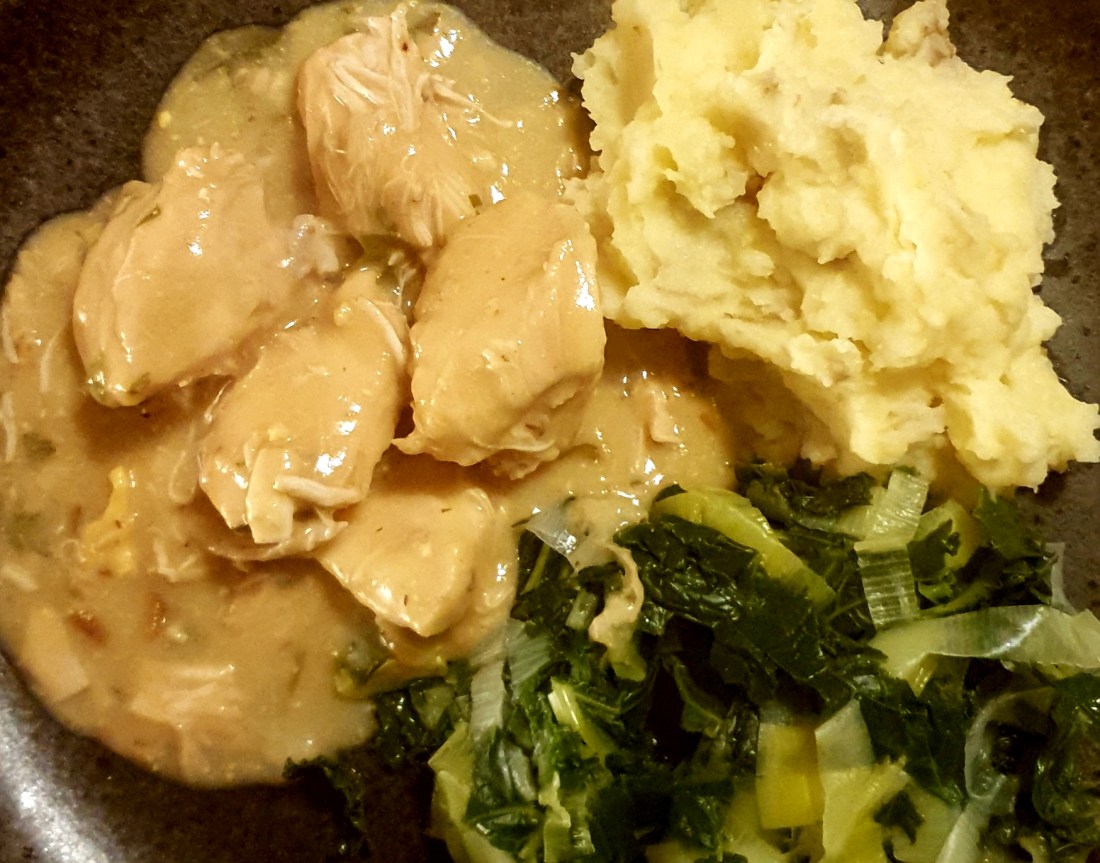
Before anyone was allowed to tuck in, I had to get the perfect picture. Cue 10 minutes of my guests hiding unsightly wine glasses, adjusting the positions of the knives and forks and just generally getting out of the way. All for me to end up picking a super close up shot

The chicken was tender and had just started flaking and the alcohol had cooked away to leave a rich fruity flavour behind. It was sweeter than any other savoury sauce I’d had before thanks to the dates, but the salt and herbs stopped it from tipping too far. Despite what I thought was quite a lot of ginger at the time, it wasn’t spicy at all. I thought I could detect the hint of cinnamon in a warming way, but whether or not that was because I knew it was in there was unclear; some people could taste it and others, (inferior guests, in my opinion), couldn’t. The addition of flour helped the overall attractiveness of it, but I can see that even without it it would still taste good, just maybe more broth like.

My fear had been that people would try it and go quiet, suddenly remembering that they’d actually eaten recently already, or that they were trying to lose weight for January. But in reality, every plate was cleared! In fact, there was only a small portion left by the end, enough for lunch later in the week.

This dinner party might not have been quite as sophisticated as Mary Berry’s, or as showy as the Tudor’s but in the end it was very us – and not a frog, dog or dwarf was harmed in the making of it.

E x
Caudle Ferry: 1390

Right. I have a confession to make and it’s not one of the cool ones like ‘I was once on a game show in the ’90’s’ or ‘my whole life as you know it is a lie because I’m actually hiding from the mafia and my name is really Julianna’. This confession is probably quite boring to lots of people and also not really much of a confession to anyone who knows me: I am obsessed with the middle ages.

Anything at all will do it for me – crumbly ruins on the side of a motorway? Excuse me while I leave my child unattended on the hard shoulder to go exploring for an hour. Recently discovered plague pit? Sounds like a fantastic family holiday destination. Year 7 National Curriculum guidelines on the Norman Conquest? Make it a Key Stage 3, 4 and 5 mandatory subject. (Actually, I could write an entire post about how medieval history has been infantalised in our education system and is often seen as an ‘easier’ time period to study, helping transition 11 year olds from primary school to secondary. As far as I’m concerned, if my year 7’s aren’t leaving class weeping quietly but with a full comprehension of the many and varied differences between villeins and freemen then I haven’t done my job properly.)

This recipe was therefore something I was really looking forward to: medieval, sweet and seemed pretty straightforward. The collection of recipes this dish is from, the 14th century Forme of Cury, have also been extensively researched, so plenty of reading for me to get stuck into.

Forme of Cury is the oldest cookery book written in English and the original seems to have been written by the master cooks of Richard II, who reigned from 1377 – 1399. During the course of the middle ages, the recipes were updated, edited and copied meaning that there are actually numerous versions. The book contains about 196 recipes designed to instruct the cooks of great households on how to emulate the dishes enjoyed by King Richard for their own masters. Interestingly, despite being written by the king’s cooks, not every recipe in the text is a frenzied opportunity to show off wealth or skill; some of them are for everyday foods such as “common pottages”. It appears that what the authors were really concerned with was making an instructional manual to ensure that cooks knew how to prepare their meals, whatever they were, properly and with care.

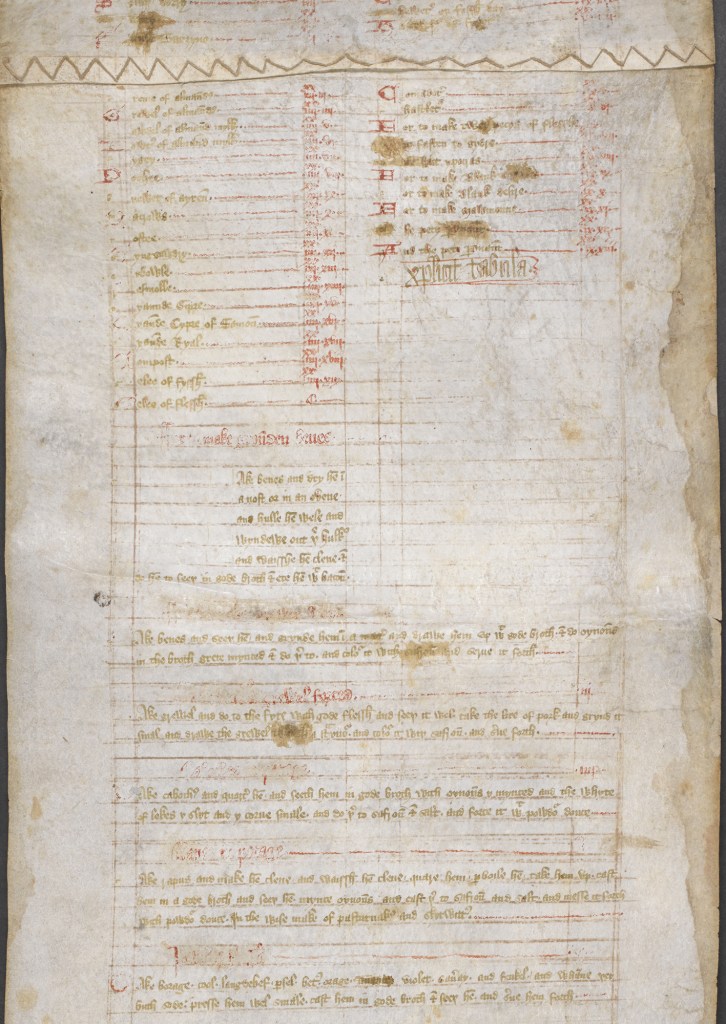
1420’s version of the Forme of Cury. From the British Library, Add MS 5016
I’m no expert, but I reckon those spatters could be BBQ sauce

The version I’m using is an 18th century copy of an original 14th century text. It would appear that during the 1700’s, the English naturalist, (not naturist, as I realised I’d written on my 3rd read though), Gustavus Brander, asked his friend Samuel Pegge, an antiquarian and all round nerd, to transcribe an original copy of The Forme of Cury he just had casually lying around into a book. Proving that people have been half-arsing their homework for centuries, Pegge returned it and the book to Brander with a note apologising that he had not been able to complete a full transcript of the text because of his lack of ability, but that he hoped what he had completed would be good enough. History is silent on whether Brander accepted this excuse or if he made Pegge redo it in lunchtime detention.

Caudle Ferry was an odd one to recreate because I wasn’t sure what the modern day equivalent was and, frankly, the medieval version didn’t seem to know what it was meant to be either. Some people suggested that it should be like a thick drink and others stated it should be more like a dough which could be sliced. From what I can gather it started out as a warming drink and over time developed to become more of a food through the addition of breadcrumbs to the recipe. The only thing that was clear to me was that it was definitely meant to be sweet.

With literally no idea what this should look like and, in true medieval style, with no sodding measurements or times stated in the recipe, I called my sister for help. I lured her in with the promise of cake and that I would mention her in this post, despite the fact I’m fairly sure only she and my husband read this blog.

First of all I mixed 2 dessert spoons of white flour with 185ml of white wine. I chose Sauvignon Blanc because of its intoxicating and heady notes of frugality which were created by being 50% off in Sainsbury’s. To this, I added “a grete quantite” of clarified honey and a few strands of saffron. Thanks to my last foray into medieval cooking, I knew that I didn’t need to waste time clarifying my honey, so I took the step of declaring that “a grete quantite” converted into 3 dessert spoons and stirred it all round. The honey sank to the bottom of the mix and, as my sister said, certainly sat there looking like it was a great quantity, so I left it at that.

I then cooked it on a low heat for 6 or 7 minutes, stirring it continuously because I didn’t want the flour to go lumpy. When it had thickened, I added two egg yolks and a pinch of salt and continued to stir over a low heat. Still with no idea of what this was meant to be like, I could only describe the texture and appearance as being like the love child of custard and wallpaper paste. My sister, whose kitchen specialty is eclairs, told me I’d basically made choux pastry, which is a much more appetising way of describing it.

After I was confident the yolks had been fully incorporated and cooked, I scraped it all into a bowl and sprinkled on 1/4 teaspoon of ground ginger and 1/2 teaspoon of sugar. Ever the gracious hostess, I dared let my sister try it first.

“I have created a new dish for your majesty, inspired by the work of the palace decorators currently re-papering your room”

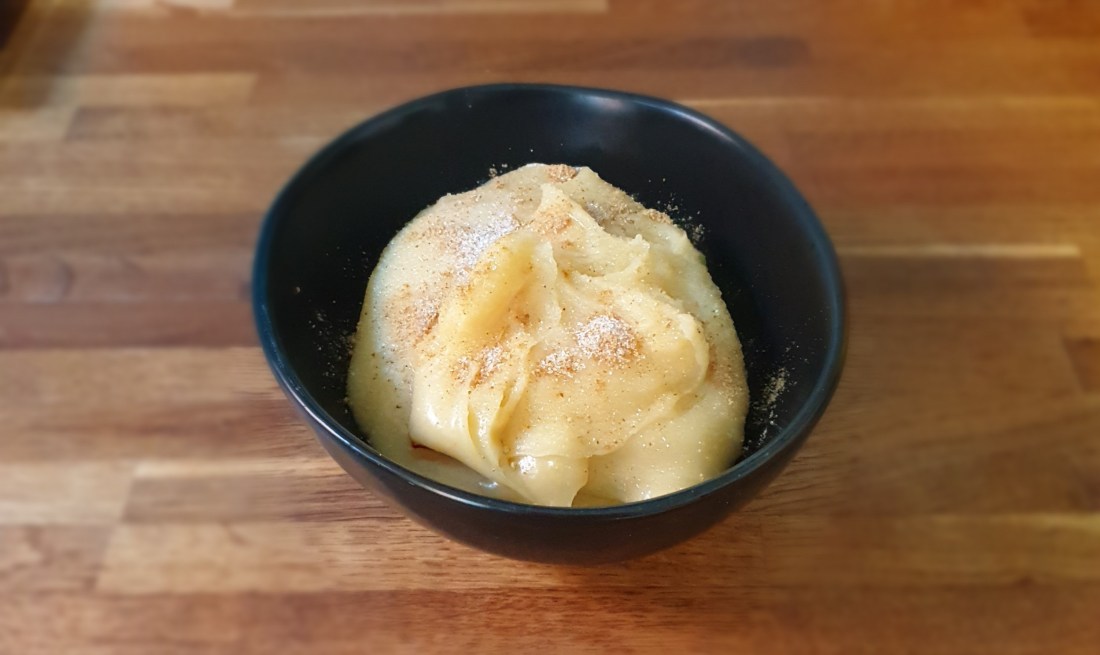
Thanks to my diligent stirring the texture was very smooth. It was also very, very thick and sticky and not as creamy as it looks. The wine was a prominent flavour, but was nicely balanced by the great quantity of honey, which I’d absolutely nailed. Overall it was like a mildly sweet, slightly alcoholic goo. Both of us agreed that a few spoons was plenty and we weren’t able to finish it all. During the middle ages this dish may have been served along with many others, with guests taking a spoonful or so of each, so to eat an entire bowl may have been overly ambitious. Regardless, the first spoon we tried became one of those situations where you’re waiting for the other one to give their opinion first so you know whether you can admit to actually quite liking something, or whether you’re just a total weirdo.

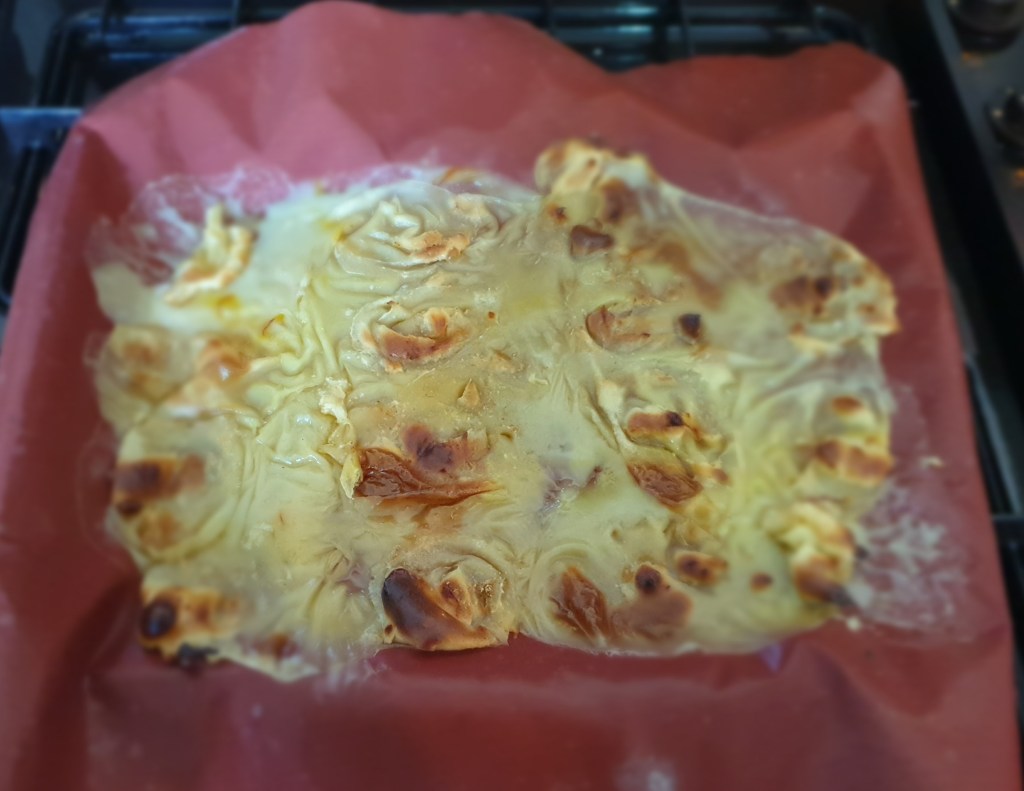
It seemed a shame to waste what was left so, inspired by my sister’s comment about choux pastry, I scraped the remaining mixture out into little profiteroles onto a baking sheet and baked at 180 degrees for 15 minutes. Unfortunately it would appear that my sister has sold her soul to the devil of baking because after following her instructions and fantasising about the boozy filling I could make to go with them, my profiteroles looked like this:

No, I didn’t try to eat it

Even though I still don’t really know what Caudle Ferry is, I guess sometimes the old adage ‘if it ain’t totally inedible, don’t piss around trying to be clever’ really is true.

E x

Lord Woolton’s Pie: 1940’s

It’s been a long first week back to work for both of us. Those 6:00am alarms had not been missed and their return was not welcome. Having crawled through Monday to Friday, I decided that what we could all do with was a delicious treat at the weekend to pick us up. Surely a dish named after a lauded member of the aristocracy would fit my needs?

Having wrestled my toddler into bed for a much needed nap, (though whether it was her or I who needed her to have one isn’t clear), and waited until her protestations – all of them eloquently well argued and not at all like wordless sirens – died down, I turned to the pages of history to find inspiration.

Lord Woolton was the Minister of Food from 1940 to 1943 and his job was essentially to prevent the nation starving during World War Two when food was scarce and could not be easily imported. At this point, I’ll admit, alarm bells were ringing because I had a sneaking suspicion that my decadent pie was possibly not going to be as indulgent as I had hoped, but I’d picked it now so tough luck to me. “Lunch might be a little bit simpler than I’d planned”, I told my husband. Poor, innocent man; I felt I had to break it to him gently.

In January of 1940, the British government introduced rationing in an effort to ensure food was shared out fairly between all. In order to maintain group poverty at a level where everyone was suffering equally, Lord Woolton’s department distributed ration books, which were small booklets filled with coupons and given to every man, woman and child in Britain. Housewives had to register their family’s ration books at certain retailers in an effort to stop duplication. Certain foods could only be purchased with the coupons and once they were gone, they were gone. Woolton himself described it in 1940 when he told the Evening Express: “I suppose I am going to run the biggest shop in the world.”

From January of 1940, butter, bacon and sugar were rationed. In March, more meat was added to this list. For a nation that was the home of the Sunday Roast and the Full English, (yes, I’ve capitalised these national treasures), suddenly finding that meat was not as available as it had been was staggering. Combine this with the fact that in July of 1940 tea became a victim of rationing too and it’s a wonder Britain had the morale to go through with the war at all.

Subsequent years saw the rationing of foods such as jam, cheese, eggs, tinned tomatoes, sweets and chocolate. Other items were also rationed on a points system. Dried fruit, cereal and baked goods like biscuits and cakes were given out according to consumer demand and how available these items were. People would queue for hours in long lines at the shop only to be told that certain items had run out when they eventually got to the front. Milk was also given out on a priority basis to those deemed most in need of it: children and expectant mothers.

Some foods weren’t rationed. I’m sure that children in the 40’s who could only half remember what chocolate tasted like would have been comforted by the knowledge that seasonal local fruit and vegetables were usually readily available, although any fruit that was imported would have faced dwindling supplies.

It was with this national backdrop that the government came up with the ‘Dig for Victory’ scheme – an initiative designed to get people converting their gardens into allotments in order to become as self sufficient as possible. Many public spaces, such as parks, were also converted. Propaganda posters began to be created encouraging, and at times cajoling, those who were slow to start the process.

Truly patriotic mothers sent their unaccompanied babies into the wild with metal tools twice the size of them

Reproduced from the IWM

Historically, the people of Britain have viewed vegetables with the same level of mistrust and wariness that one might have if a rabid cheetah somehow broke through the back fence and was waiting in the borders of their garden. Oh, we grew them and even cultivated them, but in the past vegetables tended to be cooked until all the green had seeped away and those nasty dangerous vitamins had been boiled out.

To help people adapt to their slimmed down pantries and to encourage them to actually eat all the veg that was now being grown, Lord Woolton and his department devised a collection of recipes to inspire housewives to make the most of the ingredients available to them. Lord Woolton’s Pie, as it became known, is perhaps the most famous of these Ministry dishes.

By now, any lingering hope of a luxurious Saturday lunch was gone and had been replaced with despair when I read that journalist William Sitwell, who had recreated this recipe as part of his article into Lord Woolton and rationing, had described the meal as “grim and dull”. I went back to my husband and told him that as well as being simpler than he was expecting, lunch was also going to be a historical twist on the types of spiritual and energising meat free meals served in 5 star yoga retreats and was therefore, if he thought about it, Very Exciting Indeed.

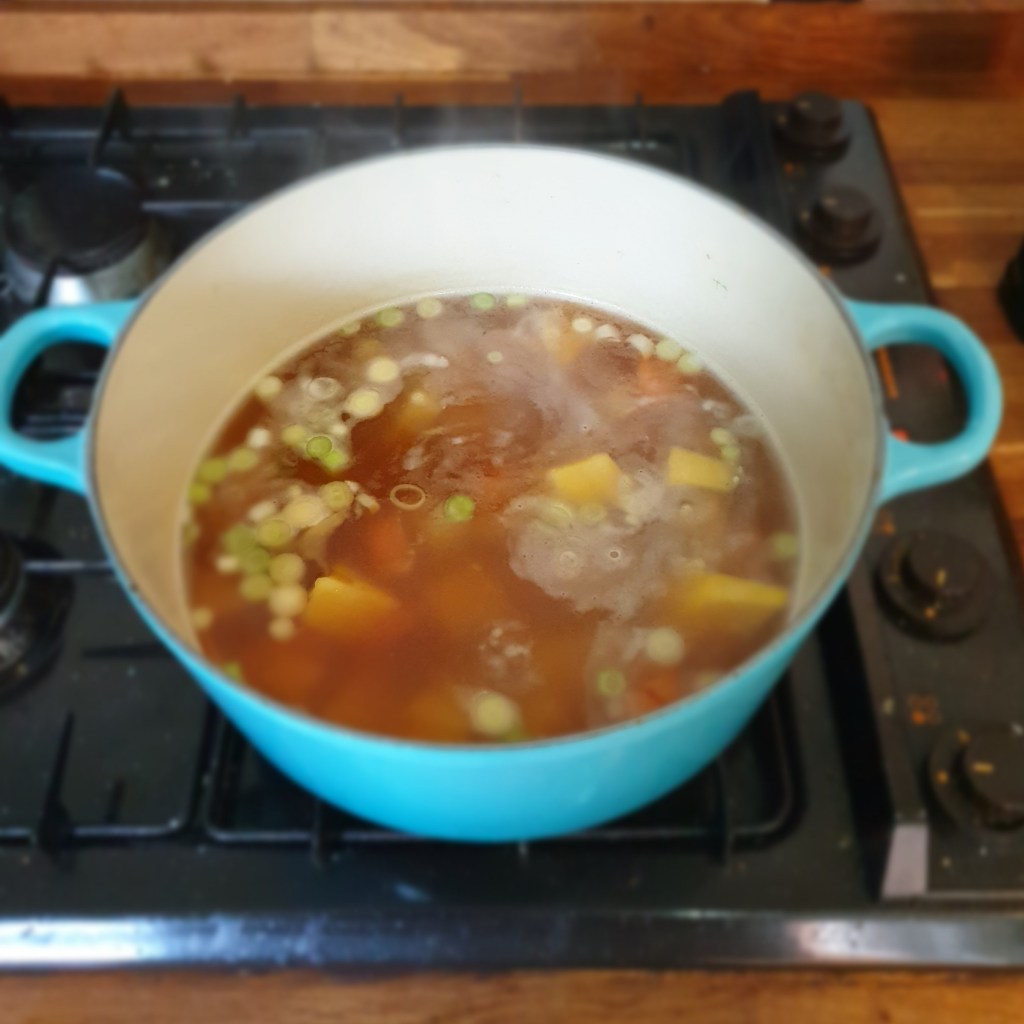
For the pie filling I chopped and diced just over 1lb of potato, swede and carrot and mixed it with 4 diced spring onions. I tipped the vegetables into a saucepan of water, into which I added 1 teaspoon of Marmite. Food historians might argue this addition was part of the recipe because it was a quick way of ensuring additional nutrients were added to people’s sparse diet during the war; as a member of Team Hate It, I think it was just another way of making the public miserable.

The steam kept fogging up the camera, which was probably not a bad thing for this meal

While all this was simmering I began on the pie crust. Now, I am a big believer that if you’re going to advertise something as a ‘pie’, it needs to have a crust on the top, sides and bottom. Anything else is just a stew with a bit of pastry on top: disappointing, deceitful and downright insulting. Lord Woolton must have thought this would be perfect for this meal, then.

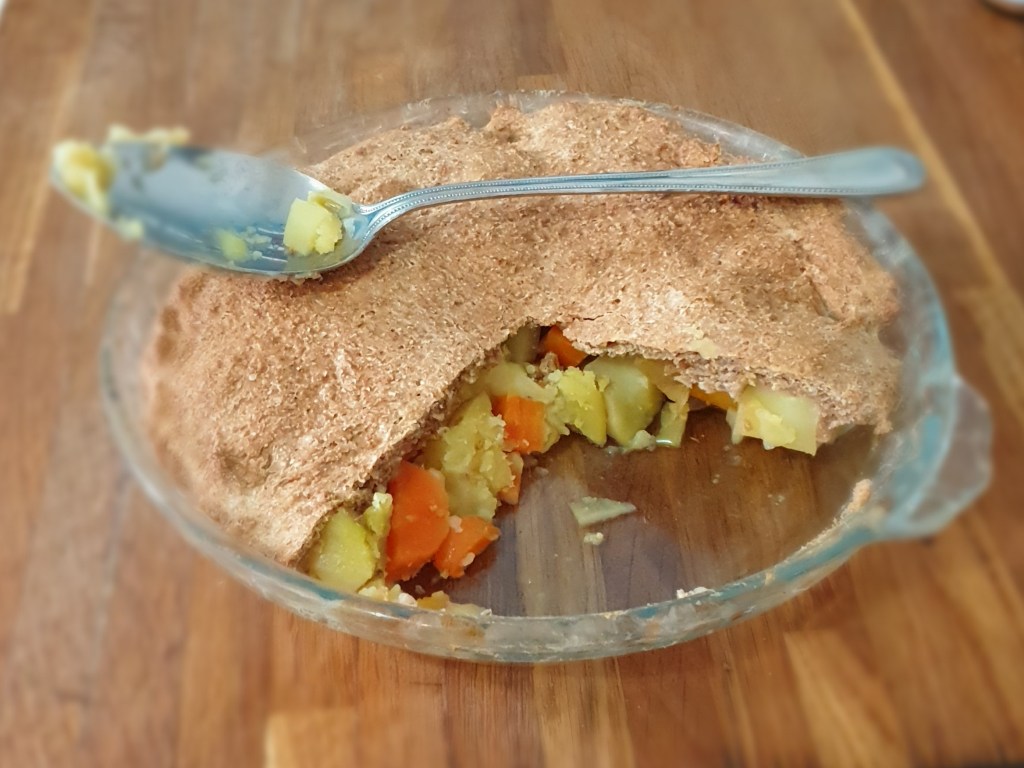
The crust consisted of 8oz wheatmeal flour, 1 teaspoon of baking powder, a pinch of salt and 1/4 pint of cold milk (or water, depending on your sadist percentage). I mixed all the ingredients together into a sticky dough and rolled it out into a disk just big enough to disguise a stew as a pie before tipping the vegetables into a dish and covering with the pastry. It cooked at 180 degrees until the crust had turned golden brown.

It’s hard to put into words the range of emotions that flickered on my husband’s face when I presented lunch to him. To his everlasting credit he attempted a compliment when he described it as “simple waste not want not food”, which is exactly what the point of the meal was. It’s easy for me to mock now, but at the time this dish became popular because of how surprisingly filling it was as well as how quick, easy and cheap. If you were a woman trying to feed your children properly under strict rationing whilst also working, being self sufficient and/or running a household alone whilst your husband was at war, I don’t think you could get much better than this.

Not as “grim and dull” as I was expecting it to look

Additionally, this recipe also allowed me to fulfil a personal goal of eating more vegetables, even if they had been tainted with the poison that is Marmite. In terms of taste, it was unsurprisingly very bland. Because of the lack of any fat it had a thin and quite watery quality to it. The pastry was also underwhelming in flavour, but would have been filling if we’d not given up and reached for the biscuits after a few mouthfuls. Luckily for those living through rationing, this era was also responsible for some of the best puddings ever known to man: custard trifle to use up stale cake, lemon meringue pie to use eggs that were about to turn, and jam sponge made with grated carrot as part substitute for sugar were all welcome additions to the table.

My daughter woke up just as we sat down to eat so I thought I’d see what her verdict was. This is a child who will eat anything that’s not nailed down. I have seen her devour crayons with relish. This Christmas, in her eagerness to get to the chocolate inside, she consumed part of the foil on the outside of a chocolate coin. This time, however, she took one bite of the pie, chewed it round for a bit, spat it out and handed it back to me. Despite its good intentions and the history of its necessity, I couldn’t think of a better summation for this dish.

E x

This post is part of Twinkl’s VE Day Campaign, and is featured in their Best Wartime Recipes to Celebrate VE Day from Home post”

Lord Woolton’s Pie: 1940’s

It’s been a long first week back to work for both of us. Those 6:00am alarms had not been missed and their return was not welcome. Having crawled through Monday to Friday, I decided that what we could all do with was a delicious treat at the weekend to pick us up. Surely a dish named after a lauded member of the aristocracy would fit my needs?

Having wrestled my toddler into bed for a much needed nap, (though whether it was her or I who needed her to have one isn’t clear), and waited until her protestations – all of them eloquently well argued and not at all like wordless sirens – died down, I turned to the pages of history to find inspiration.

Lord Woolton was the Minister of Food from 1940 to 1943 and his job was essentially to prevent the nation starving during World War Two when food was scarce and could not be easily imported. At this point, I’ll admit, alarm bells were ringing because I had a sneaking suspicion that my decadent pie was possibly not going to be as indulgent as I had hoped, but I’d picked it now so tough luck to me. “Lunch might be a little bit simpler than I’d planned”, I told my husband. Poor, innocent man; I felt I had to break it to him gently.

In January of 1940, the British government introduced rationing in an effort to ensure food was shared out fairly between all. In order to maintain group poverty at a level where everyone was suffering equally, Lord Woolton’s department distributed ration books, which were small booklets filled with coupons and given to every man, woman and child in Britain. Housewives had to register their family’s ration books at certain retailers in an effort to stop duplication. Certain foods could only be purchased with the coupons and once they were gone, they were gone. Woolton himself described it in 1940 when he told the Evening Express: “I suppose I am going to run the biggest shop in the world.”

From January of 1940, butter, bacon and sugar were rationed. In March, more meat was added to this list. For a nation that was the home of the Sunday Roast and the Full English, (yes, I’ve capitalised these national treasures), suddenly finding that meat was not as available as it had been was staggering. Combine this with the fact that in July of 1940 tea became a victim of rationing too and it’s a wonder Britain had the morale to go through with the war at all.

Subsequent years saw the rationing of foods such as jam, cheese, eggs, tinned tomatoes, sweets and chocolate. Other items were also rationed on a points system. Dried fruit, cereal and baked goods like biscuits and cakes were given out according to consumer demand and how available these items were. People would queue for hours in long lines at the shop only to be told that certain items had run out when they eventually got to the front. Milk was also given out on a priority basis to those deemed most in need of it: children and expectant mothers.

Some foods weren’t rationed. I’m sure that children in the 40’s who could only half remember what chocolate tasted like would have been comforted by the knowledge that seasonal local fruit and vegetables were usually readily available, although any fruit that was imported would have faced dwindling supplies.

It was with this national backdrop that the government came up with the ‘Dig for Victory’ scheme – an initiative designed to get people converting their gardens into allotments in order to become as self sufficient as possible. Many public spaces, such as parks, were also converted. Propaganda posters began to be created encouraging, and at times cajoling, those who were slow to start the process.

Truly patriotic mothers sent their unaccompanied babies into the wild with metal tools twice the size of them

Reproduced from the IWM

Historically, the people of Britain have viewed vegetables with the same level of mistrust and wariness that one might have if a rabid cheetah somehow broke through the back fence and was waiting in the borders of their garden. Oh, we grew them and even cultivated them, but in the past vegetables tended to be cooked until all the green had seeped away and those nasty dangerous vitamins had been boiled out.

To help people adapt to their slimmed down pantries and to encourage them to actually eat all the veg that was now being grown, Lord Woolton and his department devised a collection of recipes to inspire housewives to make the most of the ingredients available to them. Lord Woolton’s Pie, as it became known, is perhaps the most famous of these Ministry dishes.

By now, any lingering hope of a luxurious Saturday lunch was gone and had been replaced with despair when I read that journalist William Sitwell, who had recreated this recipe as part of his article into Lord Woolton and rationing, had described the meal as “grim and dull”. I went back to my husband and told him that as well as being simpler than he was expecting, lunch was also going to be a historical twist on the types of spiritual and energising meat free meals served in 5 star yoga retreats and was therefore, if he thought about it, Very Exciting Indeed.

For the pie filling I chopped and diced just over 1lb of potato, swede and carrot and mixed it with 4 diced spring onions. I tipped the vegetables into a saucepan of water, into which I added 1 teaspoon of Marmite. Food historians might argue this addition was part of the recipe because it was a quick way of ensuring additional nutrients were added to people’s sparse diet during the war; as a member of Team Hate It, I think it was just another way of making the public miserable.

The steam kept fogging up the camera, which was probably not a bad thing for this meal

While all this was simmering I began on the pie crust. Now, I am a big believer that if you’re going to advertise something as a ‘pie’, it needs to have a crust on the top, sides and bottom. Anything else is just a stew with a bit of pastry on top: disappointing, deceitful and downright insulting. Lord Woolton must have thought this would be perfect for this meal, then.

The crust consisted of 8oz wheatmeal flour, 1 teaspoon of baking powder, a pinch of salt and 1/4 pint of cold milk (or water, depending on your sadist percentage). I mixed all the ingredients together into a sticky dough and rolled it out into a disk just big enough to disguise a stew as a pie before tipping the vegetables into a dish and covering with the pastry. It cooked at 180 degrees until the crust had turned golden brown.

It’s hard to put into words the range of emotions that flickered on my husband’s face when I presented lunch to him. To his everlasting credit he attempted a compliment when he described it as “simple waste not want not food”, which is exactly what the point of the meal was. It’s easy for me to mock now, but at the time this dish became popular because of how surprisingly filling it was as well as how quick, easy and cheap. If you were a woman trying to feed your children properly under strict rationing whilst also working, being self sufficient and/or running a household alone whilst your husband was at war, I don’t think you could get much better than this.

Not as “grim and dull” as I was expecting it to look

Additionally, this recipe also allowed me to fulfil a personal goal of eating more vegetables, even if they had been tainted with the poison that is Marmite. In terms of taste, it was unsurprisingly very bland. Because of the lack of any fat it had a thin and quite watery quality to it. The pastry was also underwhelming in flavour, but would have been filling if we’d not given up and reached for the biscuits after a few mouthfuls. Luckily for those living through rationing, this era was also responsible for some of the best puddings ever known to man: custard trifle to use up stale cake, lemon meringue pie to use eggs that were about to turn, and jam sponge made with grated carrot as part substitute for sugar were all welcome additions to the table.

My daughter woke up just as we sat down to eat so I thought I’d see what her verdict was. This is a child who will eat anything that’s not nailed down. I have seen her devour crayons with relish. This Christmas, in her eagerness to get to the chocolate inside, she consumed part of the foil on the outside of a chocolate coin. This time, however, she took one bite of the pie, chewed it round for a bit, spat it out and handed it back to me. Despite its good intentions and the history of its necessity, I couldn’t think of a better summation for this dish.

E x

Jumbles: 1596

In 2016 The Great British Bake Off set its contestants a Tudor technical challenge: to bake a batch of Jumbles. These sweet little doughy knots were popular in the 16th century because they used basic kitchen ingredients and were lauded as being so easy that even the most cackhanded of cooks would struggle to mess them up. This was, obviously, too tempting a challenge to ignore.

Despite having a ready made recipe in the Bake Off’s version, I wanted to do a bit of hunting to see how accurate it was. Nothing against Bake Off, but history wasn’t made by bowing to the interpretations of national institutions with armies of qualified food historians and access to every library in Britain behind them. Good historians question everything put in front of them, hoping for the moment when they can triumphantly push their glasses further up their nose, wag their finger and whine, “er, actually, I think you’ll find…”

Anyway, we can all rest easy because thanks to my dedication I can confirm that Bake Off‘s version is fairly true to the original. This means that my breakthrough history discovery is yet to come, which I’m not annoyed about at all.

The 16th century was the first time that cookery books began to be published and collected in any sort of significant numbers. They were overwhelmingly owned by the aristocracy, however, because much of the population still couldn’t read and because many of the recipes used ingredients that would have been too expensive for ordinary people. Lots of the recipes in them were still about impressing guests with exotic flavours and showing off wealth, rather than filling hungry stomachs. It was not until 100 years later in 1664 that the poor could hope to compete with the rich by showing off meals made with a relatively new addition to England – the potato – with a treatise of their own by John Forster, concisely entitled *deep breath*: England’s Happiness Increased, or a sure and Easy Remedy Against all Succeeding Dear Years by a Plantation of the Roots called Potatoes: Whereby (with the Addition of Wheat flower) Excellent Good and Wholesome Bread may be Made Every 8 or 9 Months Together, for Half the Charge as Formerly; Also by the Planting of These Roots Ten Thousand Men in England and Wales Who Know Not How to Live, or What to Do to Get a Maintenance for their Families, may on one Acre of Ground make 30 Pounds per Annum. Invented and Published for the Good of the Poorer Sort. We can only imagine he was paid by the word.

The recipe I used for my Jumbles was taken from a popular 1596 work by Thomas Dawson called The Good Huswifes Jewell and would have been one of the books that became popular during this culinary boom. Dawson’s recipe used 20 eggs to make 100 Jumbles, and though I suspect my toddler would have happily worked her way through 100 of them, I wasn’t prepared to become a mother to a child that had become 50% dough.

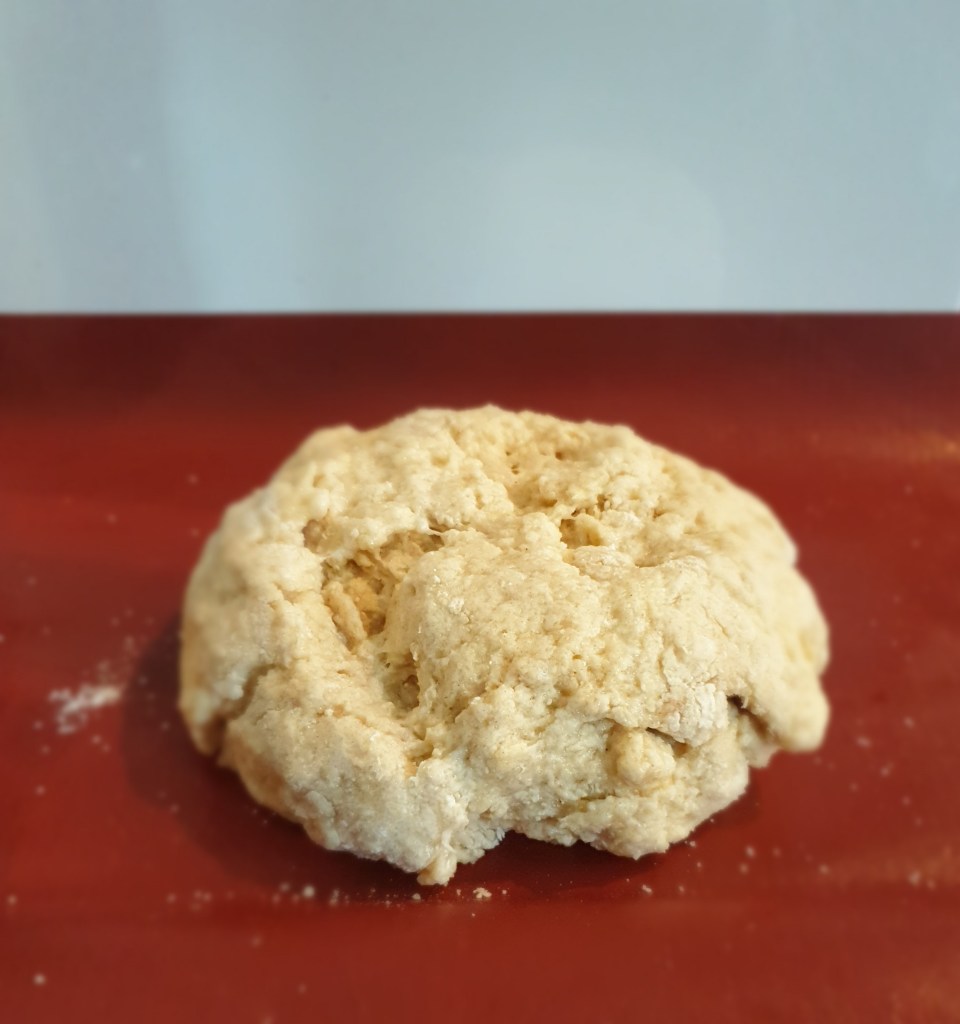
First I mixed 400g of plain flour with 150g of caster sugar in a bowl and added 2 beaten eggs and 1 teaspoon of caraway seeds and kneaded it together. The dough was very dry, so I added 50ml of water, which helped bind it. I tipped it out onto a non stick sheet, which after this attempt I’m renaming ‘a total liar sheet’, and divided it into 12 sticky blobs.

The real story here is that I’ve discovered the artistic blur setting (aka food mode) on my camera

While I waited for a saucepan of water to boil, I rolled the dough balls into sausages and tied them into knots, or jumbles. My first jumble attempt was actually pretty impressive! Maybe as promised, the recipe was genuinely inclusive of kitchen klutzes after all? A quick and confident twist of the next sausage told me: no.

I created 2 bespoke designs – the elegant ‘twist and loop’ and the ‘squashed turd’. In fairness, ‘squashed turd’ hadn’t started out that way, but after 5 attempts at threading the dough through a loop of itself I had to admit that that’s what it had become.

After the dough had been shaped I dropped each one, one at a time, into the saucepan of boiling water for about 5-10 seconds until they bobbed to the top. I then fished the molten, distorted shapes out with a spatula, because my slotted spoon was on holiday somewhere, and put them on a greased tray in the oven at 180 degrees, brushing each one with rose-water and a sprinkling of sugar before they went in.

Part way through dipping these in water, I texted my husband to tell him I had just boiled 2 turds. He didn’t reply

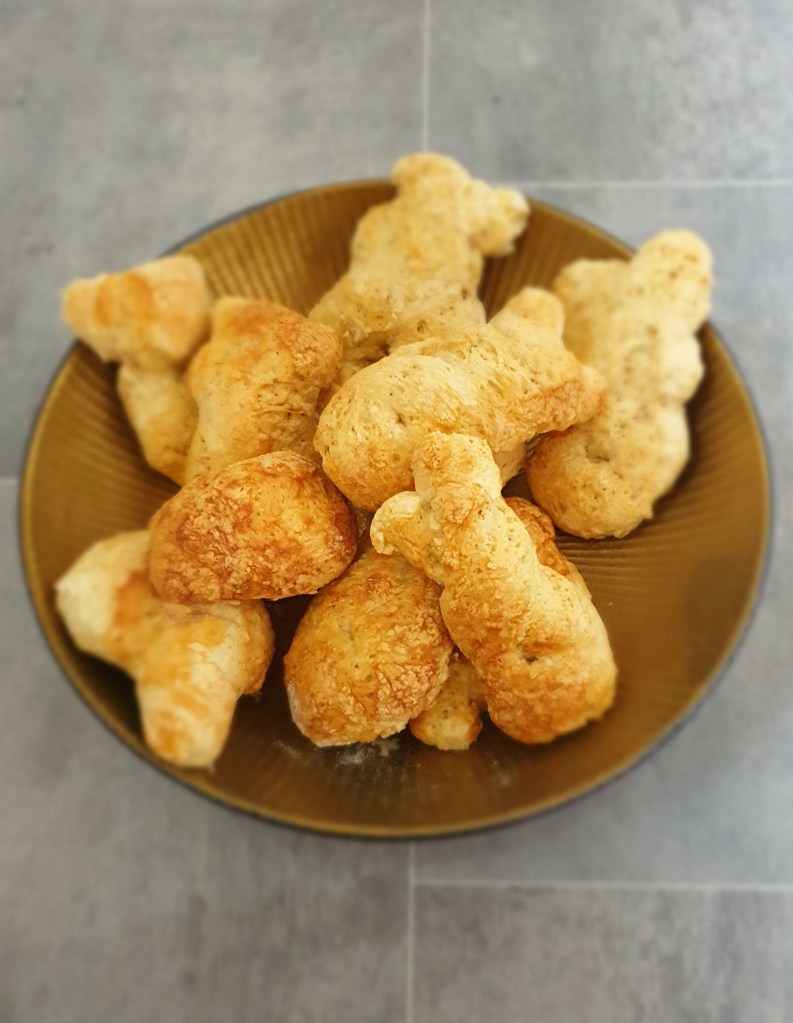
After 20-25 minutes they were golden and smelled lovely with a fragrant spicy aroma. Unfortunately but not unexpectedly, they had lost some of their shape in between being boiled and then baked. Some of the elegant twist and loops had lost their loops and some of the squashed turds just looked like little round buns, but they were still quite appetising! I tasted one of the blobbier looking ones and found that it was chewy like a bagel with just a hint of sweetness. The caraway seeds mixed with the rose water glaze to be quite fragrant without being overpowering. There was a definite non-modern feeling to these, despite them using modern ingredients. The Jumbles were quite heavy (one was filling enough), and though I had mine plain, I think they’d work well with some honey or salted butter hot from the oven. Definitely worth a go!

It’s hard to do a cover up when you only have one pretty jumble to pile over a bowlful of ugly jumbles, but I tried

E x

Patina Lucretiana (Roman pork with onions): 900 AD

I seriously considered pretending I understood Latin for this one. Actually, I started learning it back in summer but then stopped when I went back to work having only just grasped the basic fundamentals of the nominative, accusative, dative and despair.

Still, I had enough to know that Patina Lucretiana does not mean ‘Roman pork with onions’. It’s actually named after a Roman contemporary of Cicero, Lucretius Epicuraeus, and loosely translates to The Lucretian dish. (I think. Despite having an amazing teacher I was better at the despair parts of my Latin lessons.)

This recipe is taken from a Roman cookbook called Apicius which is a collection of recipes organised really helpfully (genuinely!) into 10 books for each type of food: game, veg, poultry, fish etc. The first book is called ‘The Careful Experienced Housekeeper’ and is basically a 21 chapter long text on how to make sure your household doesn’t run out of the basics, and how to stop food from rotting. Before you get to that, though, the author thought that what a truly careful and experienced housekeeper needed to know was how to get properly pissed, and so the first 5 chapters are dedicated solely to making and keeping alcohol – including salvaging wine that probably should be thrown out, as in chapter 5 ‘To clarify a muddy wine.’

Patina Lucretiana is essentially braised pork belly cooked in onions and something called ‘liquamen’. This obscure term was totally lost on me and after a bit of research I found that no one truly knows what it is, but it’s likely to have been some kind of fish sauce, a bit like garum. Coupled with the fact that the recipe also mentions a broth I assumed it was meant to be more of a stock.

The recipe is also very specific in calling for salted pork belly. This is probably because, and I don’t think is common knowledge, the Romans didn’t have fridges. In order to preserve meat they might salt it, smoke it or air dry it, to draw the moisture out and make it last longer. Though I probably could have used the pork chops we had in already, (thanks to the freezer, which, in an annoying twist for the author, was invented just after the fall of the Roman Empire) I wanted to see what it would taste like with the proper cuts prepared as closely as possible to the original recipe.

So, armed with just over 500g of pork belly and a bag of sea salt, I carefully yet cluelessly began preserving the meat. It took ages because I employed the timeless chuck-it-and-hope-it-sticks method when applying the salt, which didn’t work as well as I’d hoped because the pork skin was quite dry and covered a lot of the area. In the end I had to salt some clingfilm, lay the pork on it and try and wrap it up as I poured more salt down the sides. Stuck it in the fridge and waited 2 days, an arbitrary number plucked out of the air and which I’ve since learnt would have given just enough time for the salt to do sod all as apparently it takes about 5 days to cure 1 inch of meat. So much for authenticity.

Delicious pointlessly salted meat

After 2 days I began on the rest of the meal. The recipe stated that onions needed to be added to a pan with some of the liquamen, but first they should be cleaned and the “young green tops of them rejected”. This was tough on me and the onions and I for one was in tears by the end. Afterwards I realised that the reference to young green tops probably meant I should have used spring onions, so if I did this again I’d use them, not ordinary onions.

I let 2 chopped onions cook for 10 minutes in olive oil while I made 150ml of liquamen by dissolving a fish stock pot in water with a couple more teaspoons of oil. I added this to the cooked onions and then added the very salty pork belly (I did scrape some off).

This bit I was quite nervous for, actually. I don’t really cook pork and the recipe didn’t make it clear whether to cook it on the hob or in an oven, or for how long. Since most Roman cooking was done over a hearth, with pans supported by tripods or grid irons, and the recipe had made no mention of roasting or ovens, I decided to cook it on the hob but in a dish with a lid so that it cooked in the steam of the stock and onions.

I was never more aware of how unpleasant food poisoning might be than at this point

To help me work out how long to cook this for I looked up some modern day recipes for braised pork belly. I found that it works best when left for a long time (lots of recipes suggested 2.5 hours for 1kg of pork.) With that in mind, I left my 500g (checking that the liquamen levels didn’t get too low) for about 1.5 hours. After about an hour I added a spoon of honey, about 150ml of water and a few dashes of vinegar and then left it to cook more before serving.

Potato should always form 50% of the plate

Honestly? It wasn’t as good as I’d hoped; perhaps the author wasn’t such a fan of Lucretius after all! Now, I hold my hands up and say that could well be down to my inferior cooking abilities, but I found it a bit tough and difficult to cut through. Unsurprisingly, salt was the predominant taste and only stopped short of becoming overpowering because the honey and water sweetened it slightly. Still, by everyday modern standards it was way too much.

The ancient Romans didn’t have mashed potatoes but we did, which was a bit of a saving grace for this meal, along with the onions which were delicious. The whole thing combined reminded me of an overdone gammon although the potatoes with a bit of the sauce on top worked well.

Despite the fact that I should have been in my element as this meal contained no green whatsoever, I wouldn’t rush to make it again. This is one that can stay in the past.

E x

Medieval gingerbread? (hold the ginger…): 1430’s

I’m back to work on Monday having enjoyed an entire 2 weeks of Christmas holiday (perks of being a teacher!) and, well, I’m not sure I’ll be going back. No real reason, it’s just I’ve become so used to only wearing pyjamas and eating chocolate for every meal that I don’t think I can remember how to be a functioning adult, let alone a functioning adult in charge of the future generations of this country. I’ve also had a cold all Christmas and I am pretty sure that if part of your holiday is spent lying on the sofa being poorly instead of lying on the sofa drunk on mulled wine, then you’re allowed to redo the whole thing. I mean, I need to double check it, but I’m fairly certain the law is on my side with this one.

Anyway, in an effort to prolong the festivities I decided to make some gingerbread. This is actually something I’ve wanted to do for ages and every year I tell myself that I’ll make one of those gingerbread houses and decorate it with smarties and jelly tots just like a Hansel and Gretel fever dream. And yet every year I never get round to it. Eggnog always seems to happen instead. So I thought my first dip into the pantry of history could be one that fulfils my wish for a biscuit house and gets post number 1 done in one go!

Except… it turns out that 15th century medieval cooks didn’t quite go in for candy cane picket fences and soft snap biscuit walls. In fact, their whole concept of gingerbread was totally different to ours. For a start: no ginger was needed. In gingerbread. Gingerbread. I actually did some research into this recipe and from what I can gather it was either left out because the other ingredients were believed to fulfil the job of the ginger (more on that in a second) or because the author just forgot to add it in. He had one job! Either way, we aren’t sure why a recipe daring to call itself ‘Gyngerbrede’ would so boldly flout the trade descriptions act, but there we go.

The actual ingredients are honey, powdered pepper, saffron, cinnamon and bread. Always helpful, the author of this recipe didn’t really specify any quantities other than a ‘quart of hony’ which is roughly equivalent to a modern day litre. This is absolutely outrageous decadence for a recipe written at a time of famine, war and plague, so this recipe must have been aspirational and only for the rich (as if the presence of spices hadn’t given that away). I substituted a quart for 250ml instead.

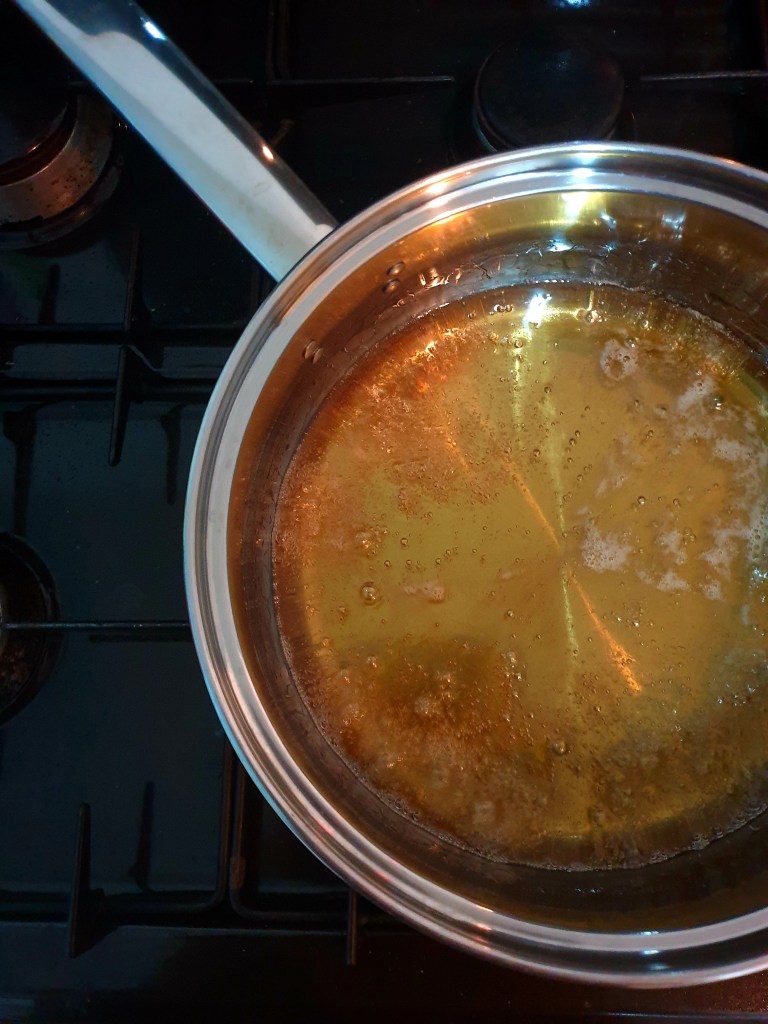
First, I had to take my honey and boil until a scum formed, then skim this scum off. This was pretty easy and smelled quite good. There was minimal scum to get rid of because I guess modern day honey manufacturing methods have taken out a lot of the impurities for us, but I sort of swirled a spoon around the pan for the spirit of the thing.

Then I added powdered pepper, (which I hand ground in a pestle and mortar that I found in the cupboard that neither myself or my husband bought but which I’ve learnt is one of those things that all kitchens must generate themselves, like cinnamon sticks and batteries) and stirred it. This was a bit trickier because there were no quantities given in the recipe so I just put in a teaspoon of ground peppercorns and hoped for the best. Then I added a few strands of saffron (did you know that saffron was so highly prized that in 15th century Germany, merchants who cheated their customers by adulterating their stock could be arrested and executed?) and gave it all a quick stir.

So far, so good. I think Dulux would call this colour ‘Moderate Dehydration’

Next I risked my marriage by grating a quarter of a loaf of white bread all over the kitchen counter less than 15 minutes after my husband had lovingly tidied and wiped down all the surfaces and swept the floor. I suppose if I was doing this properly I would have made my own medieval loaf, but as it was I couldn’t be arsed and my toddler was now very curious about the pan of bubbling honey, so I just used a plain wheat loaf instead. Ordinary medieval peasants would only have access to rougher grains for their breads, for example rye, as wheat was a ‘cash crop’ and usually only for the wealthy. However, given that I’d already established this recipe was written by a lunatic who presumably had enough cash to sink a litre of honey and saffron in one go, I assumed using a simple shop bought cottage white loaf would be close enough to the fine wheat bread of the wealthy medieval classes. I grated the bread into as fine breadcrumbs as I could using a cheese grater because the curious and slightly insomniatic (is this a word?) toddler was now in bed in the room above the kitchen so using the food processor to make breadcrumbs was out of the question, and tipped the mass into the honey mix.

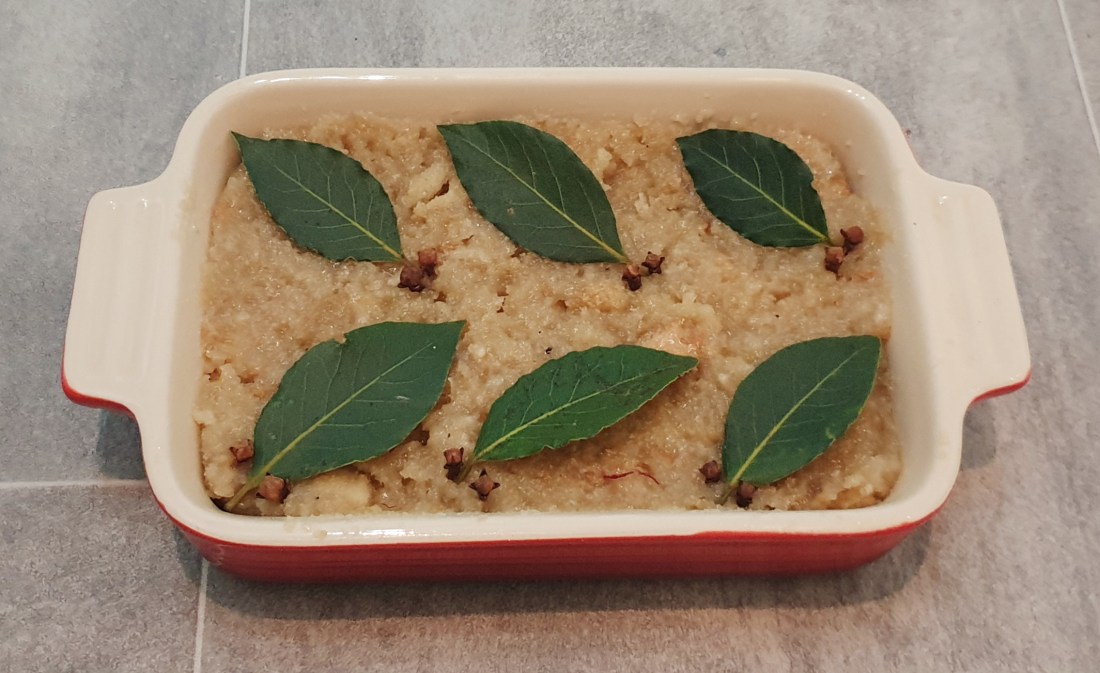
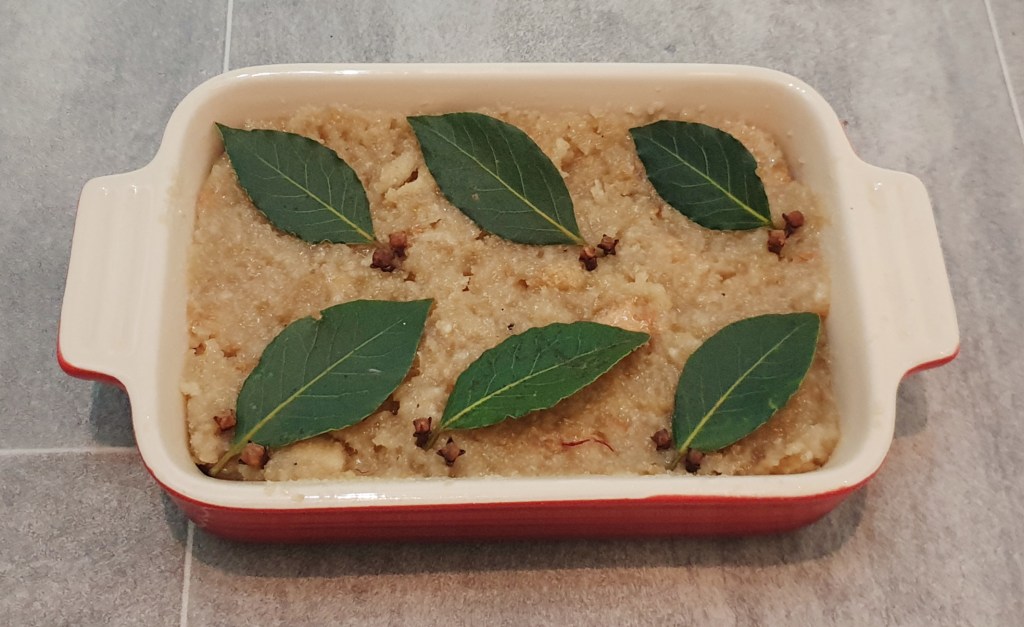
It all began to smell very medieval. Sort of ferment-y and sweet and musty. I stirred it all together until it was basically a thick paste and tipped it into a dish to squidge down. It had a grainy texture, like homemade fudge. At this point the recipe suggested adding sandalwood for a red colour, and I can see why; once I had patted it into all the edges and smoothed it down it resembled less cookie-cutter house of dreams and more regurgitated cat food. The author must have thought the same because he practically begged me to add evergreen leaves and cloves for disguise decoration.

I mean, who wouldn’t want to eat this?

Realised at this point that I’d forgotten to add the cinnamon, which by medieval standards would have been a big no-no. Remember I mentioned earlier that one possible reason for the lack of ginger in this recipe was because it was believed the other ingredients would have done ginger’s job for it? Medieval people believed in the theory of the 4 humours – that the human body was made up of 4 essential liquids: blood, black bile, yellow bile and phlegm. Illness was caused when the humours became corrupted or misaligned and because each humour shared attributes with the 4 elements (hot, cold, wet, dry) a sick person could have their humours realigned by taking a medicine with elements in it which would generate more of the humour they were lacking, or cause them to purge some of the humour they had too much of. Ginger, with its spicy kick, was associated with the element of heat and therefore would have been seen as a medicinal ingredient for those whose illness was caused by a lack of bile and who needed to create more by warming up their insides. Other ingredients with similarly spicy qualities, such as cinnamon, did the same, which is why a medieval person using this recipe as more of a medieval version of a chakra cleanse rather than a sweet treat might have been distraught by my forgetfulness. Although the teaspoon of pepper, another spicy addition to the recipe, may have made up for it. Either way, whoever the author was they must have really been lacking in yellow bile…

After a couple of hours in the fridge I cut it into slices and sprinkled on some of the forgotten cinnamon. It didn’t taste as bad as I thought it would! It’s not as painfully sweet as I expected but is very sticky and kind of nougat like. I had chilled mine in the fridge before cutting it because I’m a sucker for an anachronism, and I think that made it more palatable. A teaspoon of pepper is maybe too much as it definitely had a kick to it, although that may also have been overeager cinnamonning at the end. All in all I definitely wouldn’t call this gingerbread, but I can see why someone who had the misfortune to live before chocolate and gummy bears were invented might think it was a decent treat.

E x

Welcome!

The past is a foreign country; they do things differently there.

L.P. Hartley, The Go-Between

I’ve never actually read The Go-Between but I assume that it exists, like all great novels, to provide a useful quote to showcase my fragile intellect and act as a punny title for my amateurish blog attempts.

This blog is very much a work in progress, born of a desire to do more of the things I’m passionate about (history and eating) whilst not really wanting to commit to any real or meaningful New Year’s resolutions that might actually benefit me. You know, like reading more history books or learning to cook a meal that could be accurately described as something more than just ‘brown’.

Amazingly, my daughter’s father did not consider these cakes a healthy alternative to fruit or “a good example to set for our daughter at breakfast time.”

So with that in mind welcome to The Past is a Foreign Pantry – a blog where I’ll be making meals, cakes, breads, snacks and other culinary curiosities from history. I’ll try to stick to as authentic ingredients as far as budget and reality will allow (looking at you, 1665 medicinal recipe for ‘Plague Water’ containing powdered unicorn horn), but won’t be worrying too much about authentic methods, because who has actually got time to hand mill grain when there’s season 2 of You to watch?

Other than that no time period or foodstuff is off limits and I’ll also try all the food myself, just to add in a bit of moderate peril to make it more exciting. Obviously I’ll share the recipes as well so that anyone who wants to can try them out for themselves.

So if you’re a history buff and foodie whose idea of a good time is boring impressing your friends with fancy-pants meals that may or may not give them food poisoning then you’re in the right place. Enjoy!

E x