Winner winner chicken dinner: Tudor carving habits

I’ve always loved roast dinners. Not to cook – I find that end bit where everything’s bubbling over, the potatoes are turning from ‘golden brown’ to ‘lightly cremated’ and the sink’s full of every pan you ever owned piled high in a dangerously greasy game of Jenga quite stressful. But to eat? Oh yes.

In fact, I would go as far as classifying a good roast dinner an essential health food. Let me explain…

When I was younger I had to spend a few weeks in hospital. Before being admitted I’d been reading one of the Harry Potter books but because of an astounding lack of forward planning on my part I got sick during a weekend trip to my grandpa, who lived over 100 miles away and ended up in a hospital that was too far for my parents to nip back home for one lousy book. I don’t remember much about the first week apart from one event in particular: languishing in bed, I turned to my dad and asked if he could tell me the end of the Harry Potter I’d been reading, you know, “in case I don’t make it.” (Yep – even from a young age I’ve always had a flair for hammy melodrama.)

I remember thinking that my dad was taking a long time to recall the story and almost gave up waiting for him before he suddenly answered. At this point it’s worth saying I was genuinely life threateningly ill, I was a young child and we were a long way from home. All he had to do was come up with something comforting and simple. He cleared his throat…

“Voldemort broke Harry’s wand so Harry couldn’t fight back. He killed Harry and then set fire to Hogwarts. Dumbledore managed to escape but Voldemort cast a spell and he lost all his powers…” his eyes gleamed brightly as he found his rhythm.

“Ron and Hermione were captured by Voldemort’s henchmen and forced to work for Voldemort. They weren’t allowed to talk because Voldemort cast a silencing spell on them so they couldn’t speak ever again. Eventually Voldemort controlled everything and no one could stop him. Dumbledore came back and tried to fight him but he couldn’t cast any spells and he was eaten by Hagrid’s big spider. Or it might have been that big snake that lived in the walls instead. The end.”

I remember asking him if he was sure that was the ending and him glancing at my mum, who had turned very pale and was clenching her fists very hard.

“Er…I might have forgotten some things,” he admitted. “Hang on…oh yes. It turns out that Hagrid was a secret agent for Voldemort all along – him and McGonagall -“

“Could I have a quick word, darling?” I watched as my mum frogmarched my dad out of the ward. She must have cast her own silencing spell on him because when they came back he wasn’t allowed to talk to me for the rest of the visit and just sat grumpily at the end of the bed eating my grapes.

I was pretty upset. I was also convinced he’d got it wrong, but this was in the days where most people had phones without internet so there was no way of checking apart from getting better and getting home to read it for myself. And what was it that lifted my spirits after my father had so callously crushed them, and spurred me on to good health? A roast dinner.

Oh, I know some of you will pipe up with other factors for my survival like the compassion and skill of the doctors and nurses, modern testing, medication, expert surgery and round the clock care. But to those people I say – could you cover any of that in gravy?

Yes, I know it takes a great deal of skill to become a medical professional. I know it’s a vocation that takes years to master and great levels of intellect that an apricot stuffed pork loin can never hope to possess. But what I also know is I’ve never, ever tasted a roast dinner as good as the one I had when I was finally able to eat a proper meal again. It was bliss. It was heaven. Things that I’d previously shunned, like boiled cabbage, I wolfed down like nectar from the gods. Was the meat chicken or pork? Lamb or beef? I couldn’t tell because it had taken on that worrying grey colour and had no discernible flavour from sitting in warm water for so long. Did it matter? Did it hell! The potatoes were soggy round the edges, there were no Yorkshire puddings and the gravy had clots of fat floating on the surface. It was, to this day, the best roast dinner I’ve ever eaten.

Each day after that I got a bit better, until I was allowed to go home. So yes, a roast dinner is a health food. It’s up there with acacia berries, flax seeds, coconut oil and quinoa and I truly believe it will only be a matter of time before Holland and Barrett start selling vacuum packed roast dinners alongside their perplexing array of supplements and protein powders.
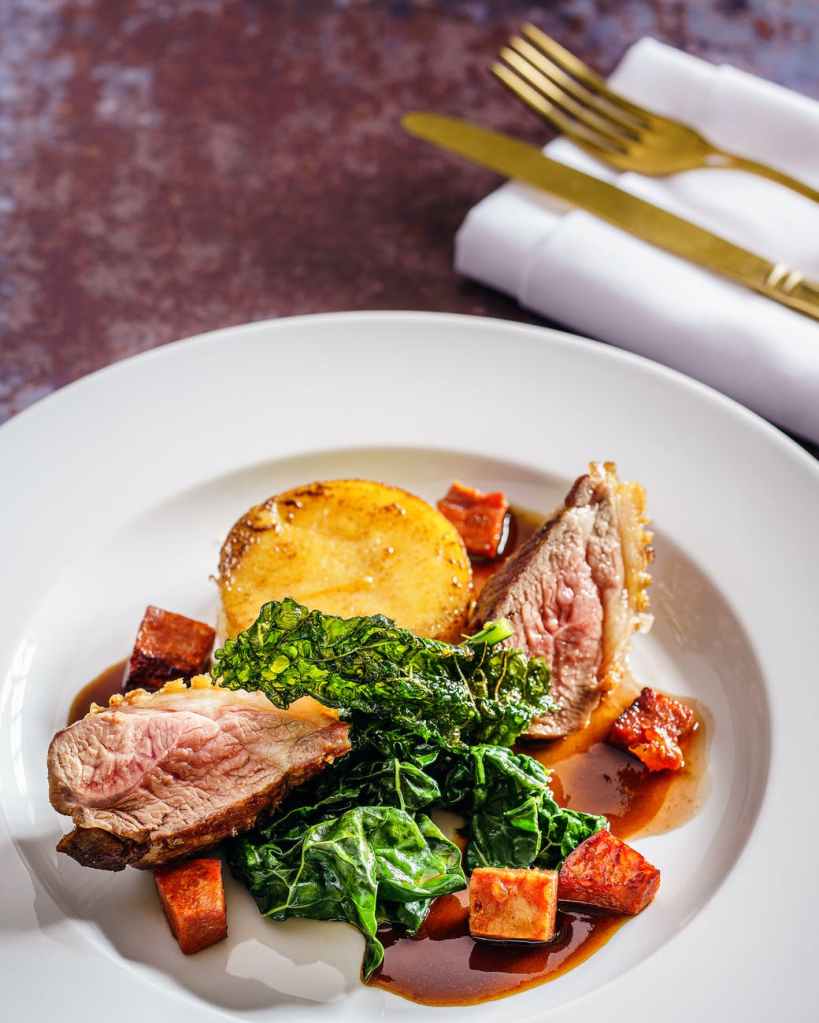
You can tell this roast thinks it’s too good for you now.
Photo by Sebastian Coman Photography on Pexels.com

For many, myself obviously included, a roast dinner would have been the obvious Easter meal last weekend with lamb being a popular and traditional choice. Some, however, may have chosen to shun tradition this year by skimping on certain side dishes now that Aunty Barbara wasn’t coming round to sit on the sofa for three hours lamenting the absence of mashed potato, and certain heathens might have even done away with a roast entirely. Not so in our household. I spent most of Easter morning locked in the kitchen doing Very Important (veg) Prep which involved the veg setting calmly in water and the lamb taking care of itself in the oven. I also spent a lot of time on Twitter. Every so often my husband poked his head in and asked how things were and if I might join him in looking after our toddler, who was rampaging round the living room high on sugar screaming “Egg! Egg! Chocolate Egg!” over and over.

“Sorry, love, I can’t. Need to check on the spuds.” I wiggled a pan of very placid potatoes that had yet to be cooked and shrugged. “I would help if I could, but it’s about to get mad in here.”

And, 45 minutes later, it did.

Have you finished with your anecdotes yet? When does the history start?

Soon.

The point is, when I brought that roast dinner to the table I was really looking forward to it. We assumed the traditional roles – you know, the one where the woman does all the work but the husband steps in at the last second to take the glory of carving it – and I watched through my fingers as he absolutely butchered my beautiful lamb joint.

When he placed a slice of meat on my plate that looked as if it had been carved with all the delicacy and deftness of a wooden spoon I knew it was about time he received a history lesson in the lost art form of meat carving:

The terms of a Carver be as here followeth:
Break that dear –
Slice that brawn –
Rear that goose –
Lift that swan –
Sauce that capon…

Wynkyn de Worde, The Boke of Keruynge 1508

Carving was a big thing at aristocratic Tudor tables. In fact it was such an important aspect of dining that several books were published to instruct squires and other young men aspiring to noble ranks in the correct methods for carving each animal they might come across at the dinner table. It was clear that my husband had read approximately none of them.

Putting aside what books such as the fabulously named Wynkyn de Worde’s Boke of Keruynge can tell us about Tudor tastes (porpoise, anyone?), the first thing to notice is that Tudor carvers were nothing short of wordsmiths. Where my husband had two main carving techniques (the classic ‘back’n’forth’ and ‘pull the legs off’), Boke of Keruynge contains no fewer than 39 inventively named techniques for different animals, each distinct from the last. Some of them are familiar, if a little graphic for modern day tables – “Dismember that heron”, “Unjoint that bittern” – while others are elegant in their ambiguity – “Frusche that chicken”, “Trassene that eel” – and yet more were clearly just made up when Wynkyn was running out of ideas – “Untache that curlew”, “Splat that pike”.

Only the very rich could afford whole animals, so the purpose of having so many methods of carving wasn’t necessarily down to making the most of the meat (after all, how much difference could there be between carving a swan and carving a goose – other than the legal implications of one of them?) It was about showing off.

In bringing a whole animal to the table the lord was inviting people to gaze upon his wealth. Having a highly trained carver was therefore a necessity – what you didn’t want was someone who would mangle the meat into unrecognisable chunks, but would instead arrange the choicest cuts and present them in as pleasing a way as possible. The role of the carver also wasn’t to cut the meat into tiny bite sized portions, but to slice certain cuts off and possibly de-bone sections which could then be speared onto a diner’s plate and cut up with their own knife (forks weren’t introduced to England until the 17th century.) A carver should therefore be someone who cared, ideally because one day they would be dining on beautifully carved meat themselves and they had to learn how to recognise what it looked like. For this reason carvers of non-royal aristocratic households tended to be young men who were living and serving in the households of lords, perhaps as squires, as part of their training for the ranks of the nobility.

There was also another element to carving: power. As well as following the correct procedure, the carver had to carve the meat according to a rigid hierarchy. The man who owned the land where the animals had been killed had to be given the best cuts so one of the key jobs of the carver was to ensure that once the meat had been carved appropriately, he chose the gristle-free, richest and tastiest morsels for his lord. Once that had been done the platter of carved meat would be passed round the table – on a hierarchical basis, naturally – and diners would spear the cuts they wanted with their own knives. The carver could now breathe a sigh of relief that he had served his lord well and wouldn’t receive his own dismembering or unjointing later.

The role of the carver was so important that it had long been elevated in society. When what you served and how you served it said so much about your status and rank, the wealthy couldn’t afford to take risks with sloppy knifemanship from bog standard kitchen servants. During the 15th century the role of the carver therefore became highly coveted and developed into a special courtly office called the ‘carvership’ which only selected officials could hold. These roles paid well, as Elizabeth of York’s carver William Denton’s wage of £26 13s. and 4d. in 1503 attests.
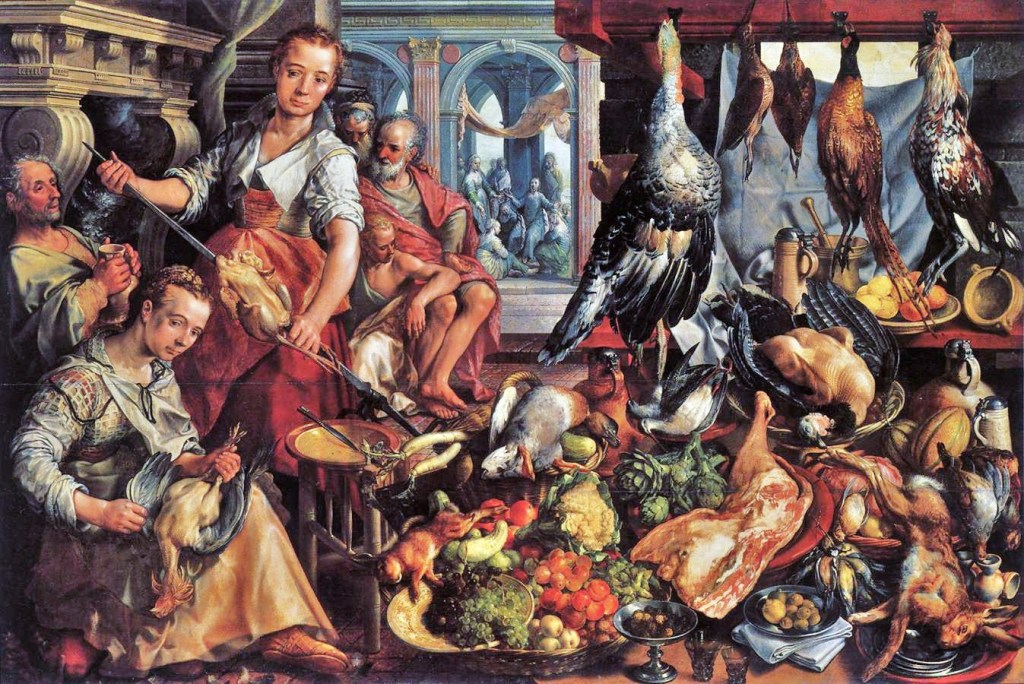
The people in the background are just as horrified as I am with her lack of safe knife skills.

Knives in Tudor England

Knives were an essential part of life in Tudor England, and not just for preparing food. They were used for everything: cutting rope, whittling wood, stabbing clowns in the arse – you name it. Every man and boy over the age of five carried a knife with them at all times – I mean, I have child locks on all the kitchen drawers to stop my daughter getting at sharp objects, but sure – hand knives out to five year olds; they can definitely be trusted at that age.

But the carving knife was different.

Throughout the Tudor era and subsequent centuries the status of those who crafted carving knives – cutlers – increased. Cutlers who created the tools necessary to carve meat enjoyed a similar status to other master craftsmen such as jewellers and armourers. During the middle ages a cutler’s prestige could be increased according to the intricacies of the designs he created: a handle of polished brass was good, one that was inlaid with gold or silver was better, one set with amethysts and amber was best. And sparkliest.

As the Tudor era took hold, banquets became more elaborate and, what with the falling price of meat, feasts would contain numerous displays of meat carving and exotic animals for guests to sample, all with expensive spices and sauces to show off the king’s wealth and generosity. Such was the abundance of meat at Henry VIII’s court that his courtiers could easily be offered menus containing 5000 calories a day. To complement the richly overflowing tables a carver would be expected to put on a bit of a show and the knives he used were the main star. The accounts of Henry Fitzroy, Duke of Richmond (also Henry VIII’s only acknowledged illegitimate child) show that he possessed a pair of carving knives weighing just over 500g (an average modern day one weighs approximately 160g) that were also gilded.

It’s obvious that by now carving knives were more than just shiny tools. Yes, they showed wealth but they also represented a lord’s masculinity (you know, because the Tudor era was in dire need of yet more ways men could peacock around slapping their masculinity onto things.) The carving knife and what it represented became a symbol of how much of a man the lord was. A blunt knife could indicate a weak man who struggled to make an impression on the world. A plain knife could reveal a man’s miserly, simple ways that weren’t worthy of respect. Knives were so tied up in the concept of manliness and good honour that men who swore oaths would sometimes hand over their knives as testimony of good faith. As betrothal gifts young men would send their bride to be (or her family) gifts of knives which probably seemed sexier and a lot less threatening than it would today.

And in all of Tudor England, who should have the biggest, longest, hardest knife of all? Obviously Henry VIII. The inventory of his utensils described his knife case alone as “garnished with sundry emeralds and pearls and rubies about the neck and divers amethysts, jacynths and balases upon the foot thereof furnished with knives having diamonds at the ends.” I’m sure he wasn’t overcompensating for anything.

First the knives, now the codpiece? Henry love, simmer down.

My husband didn’t seem too interested in my history lesson. By now he was done hacking at the lamb and the walls were flecked with bloody juices. Scraps of meat lay strewn across the table and floor as he triumphantly proffered me the first glob.

Wynkyn de Worde hadn’t mentioned lamb in the pages I had come across, but if he had I expect he wouldn’t have called for it to be “Sawn Apart like Something Out of Jaws“. For all intents and purposes it appeared that my husband had adopted de Worde’s advice on how to carve a peacock instead and had thoroughly “disfigured” it.

Still, it tasted nice with or without bejewelled handles and ruby encrusted knife boxes.

E x
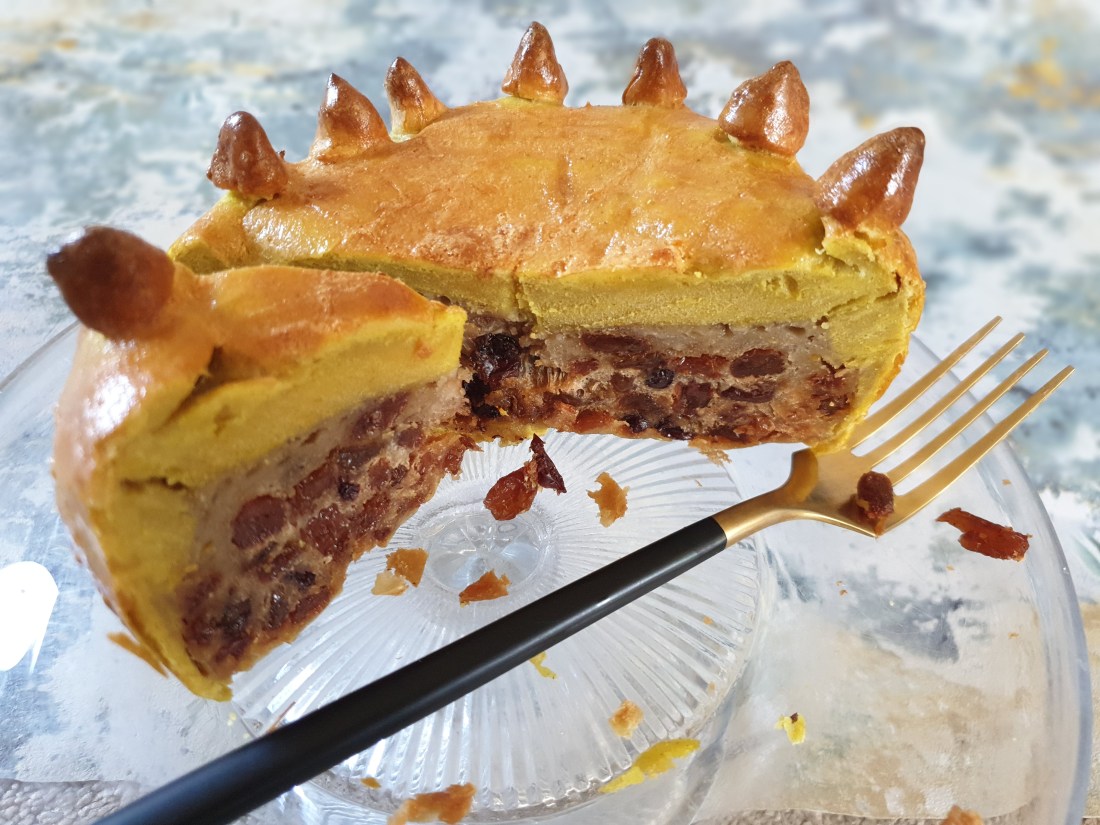
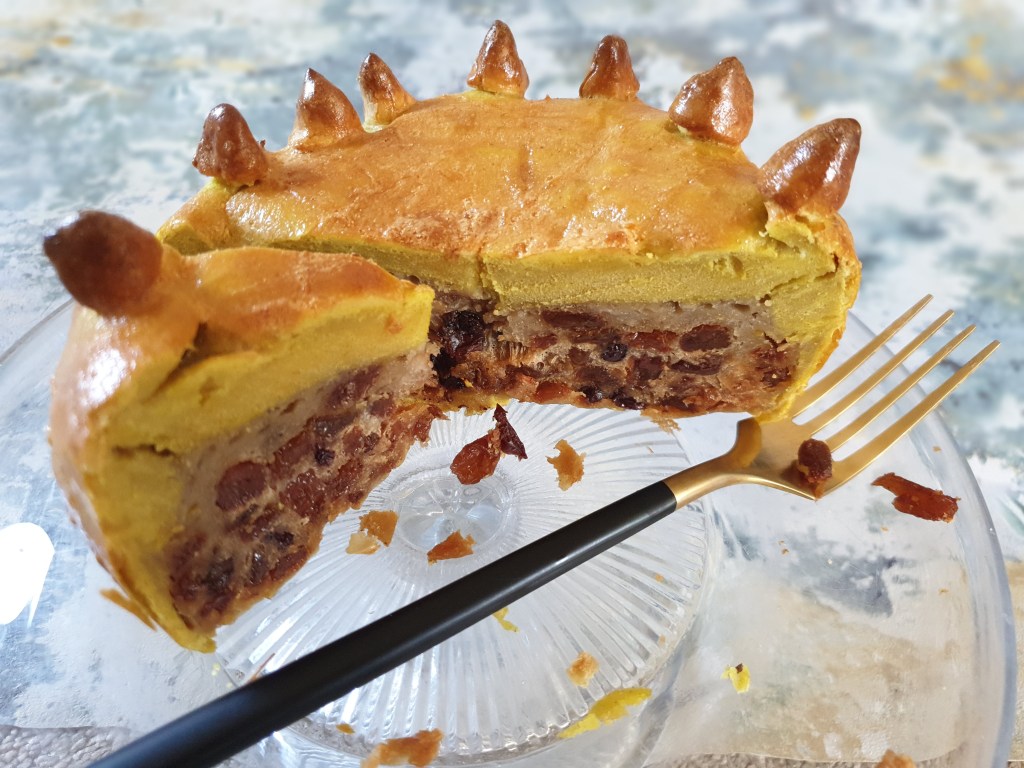
Shrewsbury Simnel Cake: 1879

Happy Easter!

In honour of Jesus’ disciples (NOT YOU, JUDAS) and as a virtual homage to modern simnel, there are eleven hidden* Easter eggs of the nerdy variety in this post – find them all, win a prize.** In the Easter spirit of goodwill and peace I feel I must tell you that there are also a good few egg-related puns thrown in to keep hardcore egg fans (you know who you are) sunny side up. I make no apologies for these, although I’m aware we’ll all be feeling eggstremely awkward by the end. Feel free to log off now (I would.)

Hopefully by the time the day’s done you’ll have argued with loved ones over how large your Easter hunt haul is, vomited up an unholy (ha) amount of chocolate and had at least one Zoom call that went: “We can see you! We can see you! Can you see us? Oh wait…it’s frozen. Darling, do you know how to get it to unfreeze? It’s just showing me a picture of their dog’s crotch at the moment. Hang on… yes! HAPPY EASTER! How are you? Oh no it’s frozen again. Gosh, she’s got quite the nose on her hasn’t she? I’ve never really noticed it before – oh! You can still hear us? Ah.”

Easter will be a weird one for lots of us this year, what with the Easter bunny not being allowed out apart for non-eggsential travel, but that’s no reason to negglect history. I know, I know. You thought you could use these unprecedented times as an excuse; that I’d take pity on you and give you a break. But really – do you think that Jesus arose on the third day to make an Easter bonnet out of pipecleaners and mini chick toys so that you could “have a break” from my ego?

Get over yourselves.

Gone are the days of meaningless night-before trips to the supermarket to load up on Cadbury’s 3 for 2 to dole out to our nearest and dearest. This year I’ve been surprised at how touched I’ve been by the gifts left by family members on our doorstep for my daughter – a bunch of flowers, a chocolate rabbit, an Easter card. They feel extra poignant and though it’s true I ate that bunny within 30 seconds of it being inside the house and before she knew it existed, it’s nice to think that despite our troubles this year still can still feel special.

It’s family that’s the focus for today’s cake, actually. There’s a million and one posts about the history of Easter, why we celebrate Easter bunnies and the hot cross bun and they’re all much better than anything I could write, but there’s only a million about the history of simnel cake so plenty of space for me to crack on and throw my take on it into the ring.

I don’t know the reason, but this guy’s Easter has taken quite the turn.

Why’s it called Simnel?

Eggsellent question (I know you were waiting for that one.)

Modern day Simnel is a light fruit cake with a marzipan top and 11 marzipan balls circling the edge to represent Jesus’ disciples. Yes it’s true there were 12 disciples, but in order to show how cross they were with Judas for betraying Jesus, bakers denied him his own little marzipan ball. It’s the baking equivalent of cropping someone out of a picture – which is what da Vinci should have done. It’s a cake that lots of people feel they should make at Easter, but don’t really want to on account of the abundance of much more convenient and “treaty” food after 40 days of Lent (I mean, who would pick fruit cake over chocolate? Lunatics, that’s who.)

Having said that, Simnel Cake wasn’t originally a cake for Easter. In fact it wasn’t even a cake, and the marzipan balls that are so synonymous with simnel are actually a relatively modern concept. True simnel contained no marzipan whatsoever.

An almost certainly untrue story told in Chamber’s Book of Days of 1879 says that a couple a long time ago called Simon and Nelly found some spare dough one Easter and had a fight over what to do with it. Simon, the bloody weirdo, wanted to boil it but Nelly, who was clearly carrying over 50% of the brains of the couple, said they should bake it instead. In the end they came to a pointless compromise and boiled it for a bit before baking it afterwards so that “this new and remarkable production in the art of confectionery became known as the cake of Simon and Nelly…Sim-Nel, or Simnel!” An earlier 1838 poem in the Wiltshire Independent switches the madness round and has Nelly insisting on boiling the dough and Simon as the voice of reason, but the general absurdity of the tale is still the same. In reality simnel has been around for a lot longer than either Simon or Nelly.

Simnel is referred to as early as the 13th century, though it probably pre-dates this, but there are no surviving recipes for it. This is partly because the word simnel wasn’t necessarily describing a specific recipe; possibly a scrambled form of the Latin ‘simila conspera’, meaning ‘fine flour’, medieval simnel refers to a type of leavened bread that was prepared for spring. This bread was high quality indeed: the Chronicle of Battle Abbey tells us that William the Conqueror granted the monks there 36 oz. of “bread fit for the table of a king, which is commonly called simenel.”

As the 13th century progressed, however, simnel began to take on another meaning, much more similar to our concept of a cake. In 1225, John of Garland wrote in his Dictionarius that simineus was a French word for the Latin for cake, placenta, possibly highlighting that simnel was moving away from a description of flour into something more like a cake we would recognise.

Skipping past the story of the 15th century pretender Lambert Simnel (who’s nothing more than an eggregious red-herring in the history of the simnel), by the 17th century the simnel cake had eggceeded simnel bread in popularity. It seems to have been particularly popular in Shrewsbury, Bury and Devizes with all three locations claiming slightly different variations of the simnel cakes as their own.

At the same time, the symbolism of the simnel was forming. Since the Middle Ages people had followed the tradition of returning to their ‘mother’ church and bringing presents to their mothers on the fourth Sunday of Lent: Mothering Sunday. As the centuries progressed Mothering Sunday became more of a bank holiday with domestic servants, girls in particular, given the day off to return home to visit family and the church of their baptism. Naturally, as good daughters, they brought their mothers homemade gifts and it’s in this context that the simnel cake came into its own.

A servant might have to poach some ingredients from her mistress to make the cake or, if she was well thought of, the mistress would donate the ingredients to her. The better quality the ingredients, the higher regard the mistress had for the servant – meaning that a girl had to adopt a souffle souffle approach with her mistress in the weeks preceding Mothering Sunday to ensure she was given the best ingredients. The mother would be given the simnel by her daughter but wouldn’t usually eat it until Easter Sunday, when she would cut into it and, in an act of motherly love, intensely scrutinize the efforts of the daughter to see whether the cake was still moist or whether she’d raised a disappointment.

The best simnels are gluten-free, dairy-free and Judas-free.
Image credit here.

Shrewsbury simnel

Since I’d missed Mothers’ Day by a good three weeks I wasn’t off to the best start. In addition to this, the Take That Greatest Hits albumen I’d bought for my mum hadn’t gone down well, least of all because my mum can’t stand Take That so there was a lot resting on this cake.

Traditional Shrewsbury simnel cake was nothing like I was expecting. Slightly disconcertingly, I had to start by making a dough out of flour, water and saffron until it was a very stiff, which I had to shape into a pastry case that would hold its shape, without baking it.

Luckily for me my temperamental kitchen gets very hot at the slightest hint of sun and I had chosen to make this on the first day of the mini heat wave. I wailed as my pastry case wilted under my clumsy hands. When I’d had en-oeuf of failing, I cheated and shaped the dough in a saucepan lid and stuck it in the fridge to firm up while I got on with the actual cake.

The recipe for simnel in Book of Days is succinct and unhelpful: “a very rich plum cake with plenty of candied lemon and other good things.” I can’t stand fruit cake myself, so wasn’t sure how to just whip one up. I consulted Chambers’ English contemporary, Mrs Beeton’s Book of Household Management for what constituted “rich plum cake” and “good things”.

Mrs Beeton had three distinct recipes for plum cake, of varying quality. The best one, which she enticingly called “an unrivalled plum pudding” used a cholesterol-boosting 16 eggs. Since my hypothetical mistress had granted me 2 because that was all we had in before the next shop, I worked my way onto the second best recipe, which called itself “an excellent plum pudding made without eggs”. This one looked good eggcept it contained mashed carrot and mashed potatoes. These ingredients might seem bizarre today, but they would have helped keep the cake moist for the weeks leading up to its consumption. Unfortunately we didn’t have carrots or potatoes in either. With a heavy heart, already seeing the disappointment in my mother’s eyes, I turned to her most basic of recipes which she had tartly entitled “a baked plum pudding.” No eulogising here – just a straightforward cake with currants, sultanas, suet (we actually did have some of that in, don’t ask me why), flour, eggs and lemon peel. No sugar, I noticed. Also, Mrs B wanted to me to add milk to this, (or water for a “very plain pudding”, which really highlighted how far I’d strayed from my quest for Chambers’ rich plum pudding), but I added brandy instead, which she’d used in her unrivalled plum pudding.

The mixture was very wet because it used a higher ratio of egg to flour than I was used to working with. I realised later that I’d messed up my calculations when converting Mrs B’s lbs to grams so I ended up adding a bit more flour and suet to firm it up a bit. I then spooned it into the chilled pastry case it went, which promptly began sagging at the sides, all my careful chilling undone.

The next stage involved boiling the pastry encased pudding for several hours. I had added a pastry lid and by this point the whole thing resembled a sort of deflated pastry ball. In my mind I saw my mother’s eyes fill with angry tears. Panicked, I tied it in a muslin cloth and forced it back into the saucepan lid for structure and as I crossed my fingers I poured boiling water over it. After half an hour I pulled it out of the saucepan lid, confident that 30 minutes boiling would have helped set the pastry, and replaced it, lidless, back into the water.

I did feel eggceptionally Victorian during this bit, it has to be said.

After two and half hours I lost patience. I was already pretty sure this wasn’t going to redeem me from the Take That CD and wanted to get it over and done with. Tentatively, I pulled the dense mass from the seething pot, peeled off the muslin and looked upon my deformed doughy creation. My husband chose that moment to wander in.

“What’s that?” he asked fearfully.

“It’s a simnel cake.”

He paused. “Oh, for Easter?” Then, completely oblivious to the irony: “It looks like a cake for Satan.”

Once I’d chased him out of the kitchen I dotted some pastry blobs on, because I’d seen them on a drawing of a simnel in Book of Days (though Chambers made no reference to them being the disciples), glazed the Satan cake with egg wash and baked it for an hour. It was then that I read that truly authentic simnels should be so hard that they felt “like wood” and that Chambers could recall a lady who had never seen one before mistaking a large one “for a foot stall.” Because nothing says Happy Belated Mother’s Day/Easter like a cake that could double up as furniture.

After an hour it was ready. I took a photo of it and texted it to my mum.

“Happy Easter! It’s a simnel cake!”

I saw she’d seen it. Three little dots appeared as she formed a response. Then they went away. They came back for a minute and then disappeared again. She was either really, really delighted or cutting me from her will. Finally:

“Is it though?”

Oof.

Despite her lukewarm response, it was instantly obvious why this would have been a good cake to take back home to keep for the weeks before Easter – with its thick impenetrable pastry case there was no way this cake could go off. Even before I cut into I knew that if I left it for 1000 years it would survive.

Taste-wise, this was not as good as a modern day simnel. It was incredibly eggy, because I had messed up the ratios, although it wasn’t completely inedible because the amount of currants and sultanas provided a little natural sweetness. I could definitely taste the brandy, and was glad I’d not just used milk because it made the whole thing slightly richer. Without it it would have been quite bland, which is why I see why Chambers called for a “very good” plum pudding because what I’d made was essentially a weak fruity flan.

The pastry was weirdly pleasant, though. It tasted of saffron, because there were no other flavourings in it and eating it felt like a bagel. The outside crust was very hard and I reckon if I’d wanted to I absolutely could have used it for a little foot stall. Once I got through it, though, it was softer and chewy. I know it looks a bit underdone in the picture, but it wasn’t – again, it had the dense chewiness of a pretzel.

All in all though, it was probably a good thing I wasn’t able to give this to my mum. Even though I hope I’ve shown the modern day simnel isn’t technically traditional, she counts herself as a simnel purist and the lack of marzipan balls and over abundance of pastry in this version wouldn’t have impressed her one bit.

Hopefully you’ve had a great, if weird, Easter with at least one chocolatey treat in it somewhere. I also hope you managed to catch up with family or friends without Skype freezing on a picture of the dog’s marzipan balls, that you were able to enjoy the sunshine and that wherever you are you remain healthy and safe. This will end, one day, and when it does? Well, let’s just say there’s a boiled simnel cake encased in pretzel pastry waiting for you. Aren’t you eggstatic?

Happy Easter.

E x

*Loosest use of the word hidden
**Prize does not eggist.

Shrewsbury Simnel Cake

160g plain flour
80g currants
80g sultanas
80g suet
2 eggs
1/4 pint of brandy
Candied peel or lemon rind

(For the pastry)
250g plain flour
Saffron
Water to mix

  1. Mix the ingredients for the pastry together and knead until it forms a very stiff dough.
  2. Shape the dough around a pan so that it forms a pastry case. Keep some dough back for a lid. Place in the fridge to chill and set.
  3. Begin on the cake. Mix flour, suet, currants, sultanas and lemon peel in a bowl.
  4. Add the eggs and brandy and mix well.
  5. Spoon the cake batter into the pastry case. Add the pastry lid onto the case and pinch the edges tightly to stop cake batter escaping during cooking.
  6. Wrap the pastry case with cake in it up in a muslin cloth and place in a pan of boiling water. Boil for at least 2 hours.
  7. Remove pastry case with cake in it and unwrap. Glaze with egg wash.
  8. Place it on a baking tray and bake in an oven at 190 degrees for 1 hour.

The spread of Manichaeism: an ancient conspiracy theory?

Hello fellow lizard overlords – sorry, I meant people. Perfectly ordinary hot blooded, delicious, bipedal people, which is a normal human greeting and Not Suspicious At All.

It’s that time of the week (or is it month, or year? Time has become meaningless) where I substitute some mediocre cooking for some mediocre history and the topic for today is: conspiracy theories.

I know, right? I’m excited too.

I love a good conspiracy theory. Not to believe in, I urgently must add. I’m not sat here thinking there’s any merit to the idea that Australia doesn’t exist or that early noughties pop star Avril Lavigne died and was replaced by a clone called Melissa (for one – loving the fact they’ve called her clone something as ordinary as Melissa and two – surely the bigger news here would be that human cloning exists?)

Without wanting to get too emotional about it all, I love what conspiracy theories tell us about human nature. Last year I ran an on-off history club and one of the topics we looked at was the 1969 moon landings. We analysed the evidence to suggest the landing were real and then looked at the evidence that some people had put forward to suggest the landings were faked. At the end we had a debate and took a vote. Most of the club ended up deciding the moon landings were fake and we had to disband for a couple of weeks while they went away to do more accurate research (and I could have a lie down in a dark room with a lot of calming gin as I ignored emails from parents wanting to know just what the hell I was teaching their kids.) Why did the conspiracy theories about something as well documented and culturally significant as the moon landings trump the reality? What was it about these theories that seemed more appealing or truthful than the weight of all the evidence to the contrary?

To speak in vague terms akin to a conspiracy theorist: The answer lies in the question. It was to do with the appeal of the theories. When they knew they’d be given a platform to argue their findings on, the students instinctively wanted a wow! factor to their arguments. They wanted controversy and something unique or original that would make their voice stand out from the crowd. Arguing against the accepted (logical!) history was a chance for them to argue against the establishment – science and scientists (and, I guess me as their history teacher) – and they wanted to take that opportunity.

Sure, there were some sweethearts who watched as I rocked under my desk after hearing conspiracy theory after conspiracy theory and took pity on me by presenting wholly logical and scientifically sound arguments that the moon landings did happen, but even I have to admit their presentations weren’t the ones I remembered later that evening.

The boy who stood on his desk and chucked paper balls at the rest of us to show the effects of gravity, therefore ‘proving’ (tenuously) that NASA must have slowed down footage of the astronauts jumping around in space to make it look like there was no gravity? Yeah, I remembered him. If not for his terrible argument, at least for his showmanship. Afterwards he admitted he didn’t believe the conspiracy theory, but that it was more fun to argue that side of the debate.

What I’m trying to say is this: the truth is boring and conspiracy theories are exciting and get you noticed. That’s part of their appeal – that some purely hypothetical small time football player in the 70’s who sadly had to give up his dream of making the big league and become a sports presenter for a short amount of time before being fired could still make a name for himself as a ‘professional’ conspiracy theorist which would keep him in the public eye. Hypothetically.

But what makes Sharon on Facebook share clickbait articles like ‘THE SECRETS BEHIND CHEMTRAILS – YOU WON’T BELIEVE NUMBER 6!!!’? She’s not going to get famous from someone else’s theory, is she? All she’s doing is signposting that it’s absolutely fine for the rest of us to go ahead and never take anything she says seriously again.

Jan-Willem van Prooijen and Karen M Douglas give a good explanation of why people are so drawn to conspiracy theories. They argue that in times of crisis, usually on a large communal scale (and as we’ve seen recently on a global scale), people feel a inherent loss of control. The feelings that this loss of control stimulate, such as fear and confusion, propel people to try and make sense of the crisis so that they can regain some of the control they feel they lost. They begin to look for patterns or explanations in places and things that in ordinary circumstances they wouldn’t and – crucially – listen to people who claim to have the answers and are able to provide cast iron solutions to the problem. In addition to this, because the best theories serve a function, once they gain enough traction they can enter a group’s culture and become embedded in people’s philosophies and beliefs, eventually being passed down generations with little analysis on the part of those who believe it. That’s partly why the Flat Earth Society, founded in 1956, is still going strong today.

For today’s conspiracy theorists, torching 5G towers seems like a solution to coronavirus. During the Black Death of 1348 hounding Jewish communities who were accused of poisoning wells seemed like it would fix the problem (and, to be honest, was just another instance of Antisemitism in an achingly long tradition of using Jewish people as scapegoats for society’s ills.)

There are countless theories from history and as much as I personally love the sound of my own voice I don’t imagine everyone else does, so to narrow it down I’m leaving out the flat earth, JFK assassination and moon landings stuff – you’ve heard it before and nothing I could say (no matter how brilliantly) could offer a viewpoint that’s any more interesting or informative than what’s already been written. What I’m going to focus on is about as close to a conspiracy theory as I could find from ancient Rome – the story of how the emperor Diocletian dealt with the spread of Manichaeism.

Mani-what-chaeism?

On Sundays Manicheans went to their local swimming pools for some holy breaststroke practice.

You mean you don’t know? Ha. What an amateur.

Manichaeism was a Persian religion that focused on an early form of dualism during the 3rd century. To put it in terms so simple as to render it almost totally null (and to maybe hide that I don’t understand all the religious terminology) essentially followers of Manichaeism believed that flawed human nature was a consequence of a power struggle between the forces of good and evil, more often referred to as light and darkness. In a nifty sidestep to Mackie’s inconsistent triad, Manichaens believed that though God – the ‘Father of Greatness’ – was powerful, he wasn’t omnipotent and was therefore locked in a battle with the devil – the ‘King of Darkness. All the world’s suffering, evil and even just things that made people go “ugh”, like a rainy day, were byproducts of this struggle. One more of these byproducts was the potential for humans to do wicked things, since the battle was fought not just in the world, but inside each and every one of us – with good actions acting as triumphs for God and negative actions acting as triumphs for the devil. The whole world was one big battleground. A beautiful blossoming flower might be construed as a victory for God, but it could be neutralised by a victory for the devil when some nob came along to pick it and stick it in a vase, thus killing it instantly. In this way, nothing was inherently good or evil, but rather each thing had the capacity for both good and evil (light and dark) within it and the goal was to do more good things so that when the eventual day of judgement came and light and dark was separated for ever, there would be more light than dark and God would ultimately triumph.

Got it? Good.

By the 290s, Manichaeism had spread far and wide, finding a particularly strong foothold in Egypt, and had arrived in Rome by the 300s. Accounts of Manichaeism in Rome are largely written by anti-Manichaens so it’s hard to get a fully accurate picture but it seems that for a short time Manichaeism rivalled Christianity in its popularity. Saint Augustine of Hippo – part theologian, part Nile creature – had even been a follower of Manichaeism before his conversion to Catholicism in 386.

In 284 Rome got a new emperor: Diocletian. He’s not as famous as Nero (who was also the focus of an ancient Roman conspiracy theory when Rome was burned down in 59AD), or as totally bonkers as Caligula, but was known for being the architect of a fun 10 – 15 year period where Rome attempted a total annihilation of its Christian (and Manichean) population.

Emperor Diocletian. Look how disapproving he is of your Bible.

Losing interest…what has this got to do with conspiracy theories?

I get it: ancient conspiracy theories aren’t as exciting as modern ones. Fewer lizards, no robots and largely centered around mysterious and secretive organisations (actually, that’s one conspiracy theory that hasn’t gone away.)

Hear me out, though.

Diocletian took power following a pretty turbulent period in Roman history. Not the most turbulent by any means, but still a politically stressful time. The emperor before him, Carinus, is alleged to have gone power mad, spent most of Rome’s money on things he didn’t need and lived a generally debauched lifestyle – reportedly marrying and divorcing nine different women in a three year period. The emperor before him had been, er, killed in a mutiny just before Rome was due to fight the Persians – its very longstanding and much hated enemy.

So it was that Diocletian came to power. Rome was a bloated, rapidly waning super power with growing social divisions, increasing political and military corruption and witnessing an influx of religions and cultures which caused some to feel that the true essence of what made Rome great was disappearing. Surely there was a cause to this slow slide into the dung heap of oblivion?

Well, yes, actually. The Manichaens.

The conspiracy theories began: the Manichaens were sent by Persia to destroy Rome. They operated covertly to hide their evil doings. There was no religious element to them at all, rather their motives were purely political. At some point, much later on, Augustine piped up with more information – that Manichaens enjoyed eating sperm and menstrual blood during their quasi-cannibalistic religious ceremonies. Bit of a two faced backstabber, was Augustine; his old Manichaen mates must have felt more than a little betrayed, if only because their rituals were meant to be secret, damn it!

It was the perfect conspiracy theory; one reason for Rome’s decline from its glorious golden age centuries ago could now be attributed to this weird little religious sect. Even better that this so called religion was started in the Persian empire, Rome’s enemy – if anything that just proved it couldn’t be legit. It was all a Persian conspiracy to destroy Rome.

In 302 Diocletian issued his edict on Manichaeism, laying out what a conspiracy it was and paving the way for religious persecution:

As for these people who set up new and unheard of sects contrary to the ancient rites [of Rome], in order that in support of their perverse belief they might drive out those doctrines which had been granted to us in earlier times by divine influence…we have heard that they, namely the Manichaens, have arisen and advanced into this world very recently from among the Persians – our enemies – just like new and unexpected diseases, where they are committing many crimes against our communities…

We should be afraid that they might attempt, as is their wont, to corrupt men of more innocent natures, the modest and tranquil Roman race, and the whole of our empire with the deplorable customs and sinister laws of the Persians as with the poison of a snake…

Mosaicarum et romanarum legum collatio

I mean, he doesn’t hold back. Poison? Perverse? Corrupt? Diocletian meant business when he set out this conspiracy theory. Woe betide you if you were a Manichaen in Rome after 31 March 302 – you’d probably end up in prison!

We command that the heads of Manichaeism be subjected to the harshest punishment; that is to be consumed by the burning flames along with their condemnable writings.

Mosaicarum et romanarum legum collatio

Ah. So…not prison then?

While Manichaen leaders were being burnt alive, low status Manichaens were being beheaded and high status Manichaens were being enslaved in quarries and mines to do literally back breaking labour until they died. All Manichaen property was seized and destroyed and all wealth was deposited straight into the imperial treasury.

There were no internet chat rooms and tin foil hats here; it was, as responses to conspiracy theories go, pretty hardcore. And yet, like most conspiracy theories, it was also pretty baseless. Whether or not Diocletian truly thought Manichaeism was a Persian conspiracy or whether he spotted an easy scapegoat is unclear, especially given the anti-Manichaen nature of the surviving sources about Manichaeism in Rome. What is clear, however, is that he certainly wanted the people of Rome to buy into the conspiracy theory.

Sure, there may have been some Persians and Manichaens who hoped for the downfall of Rome. And what religion doesn’t want to ultimately take over other cultures and civilisations? But in the end Rome’s alarm that Manichaeism was a massive Persian conspiracy to overthrow the status quo was unfounded. In subsequent years, Diocletian would go on to persecute other religions, most famously Christians, for many of the same reasons as he gave in the edict of 302. Ultimately, these persecutions were unsuccessful and within 25 years of the start of the Christian persecutions, the emperor Constantine would make Christianity the empire’s religion of choice. Too late for the Manichaens in Rome, though.

So what can we learn from this? Well for a start, the next time you comment on Sharon’s Facebook post asking her why she has to be like this, you can take heart knowing that to an extent humans have always “been like this”. Conspiracy theories are nothing new and in times of turmoil we’ve always sought to make sense of what’s happening, often by pinning blame on those we’re already angry with, or those who we think will be easy targets. Human nature is, in that regard, unfortunately timeless.

But if there’s one thing you should definitely take away it’s this: you can fight them all you want, but what the Illuminati wants, the Illuminati gets.

E x

Parsnip Pie: 1954

I languished at home, the very picture of a glamorous but troubled 1950’s movie star, (think Grace Kelly or Elizabeth Taylor, thanks) cradling my wailing child and weeping to my husband that we hadn’t tasted anything that wasn’t tinned and steeped in sugary tomato sauce for 84 years now.

“Well – just go to the bloody shops. You’re still allowed, you know”, was his unsympathetic response.

“I can’t just go out”, I snapped back, “I’m social distancing. No, this is it for us – a diet of spaghetti hoops, Marmite, and that jar of chutney my mum gave us back in 2012. Oh, cruel world, why must things be this way…” My husband had already walked off.

‘How rude’, I thought, and went and got a bag of crisps.

Later, he told me he’d booked delivery of a veg box from a local farm shop that was due to arrive in two days. You just got what they had in, so I awaited its arrival with mounting excitement.

Finally the day came and the veg box arrived – overflowing with carrots, onions, potatoes, swede, courgettes, apples and oranges. I’d post a picture, but you all know what a carrot looks like. Also, there were rather a lot of parsnips. In fact, without wanting to sound ungrateful, there was an almost obscene number of parsnips. You know that nursery rhyme about the magic porridge pot that won’t stop cooking porridge until it overflows and engulfs an entire village? It was like that, but with parsnips. I checked with my husband that he’d not asked for so many of them, or inadvertently ordered the delivery under the name ‘Parsnip King’, but he hadn’t. It seemed that whoever packed our box just really wanted to spread the parsnip love.

No matter, though, I was sure there was a historical recipe to be found somewhere. And there was. Lots of them, in fact. It would seem that the humble parsnip has quite a longstanding history of its own. I hope you’re ready.

The story of the parsnip

Stop being so childish. Credit: wikimedia.

It’s not really a sexy vegetable, is it? (Okay, bad example. Although, I am a bit worried if humorous root veg does it for you.) Lumpy, wonky and with enough crevices for dirt to get really stuck in, the parsnip isn’t a veg celeb like its sleeker, more colourful cousin the carrot. In fact, it’s almost like the parsnip doesn’t want us to like it; the leaves of the parsnip can exude a sap that is toxic to humans and the flowering part of wild parsnip looks incredibly similar to the violently poisonous water hemlock – which can be lethal to humans. The parsnip’s anti-social personality hasn’t gone unnoticed in the world of showbiz, either; in 2018 Aldi’s successful Christmas mascot, Kevin the carrot, battled an ‘evil’ parsnip called Pascal.

And yet throughout history the parsnip has been lauded as a king of vegetables (or at least a courtier of vegetables.) The Roman emperor Tiberius had wild parsnips specially imported from the banks of the Rhine as part of the tribute owed to Rome by Germany and in 1288, the writer Bonvesin da la Riva spoke about the parsnip as being one of the delightful foods enjoyed by the people of Milan in his work Marvels of Milan. The golden age of the parsnip took off in the Middle Ages, before Europeans became aware of the potato and that flashy bastard, the carrot, thanks to its unbeatable sweet flavour and versatility. As well as providing bulk and nutrients to stews and soups, mashed parsnip was added to sauces as a thickener and to puddings for sweetness when sugar or honey wasn’t readily available.

Parsnips were introduced to North America during the 16th century, predominately as a root vegetable, but the Americans knew they had a good thing in their own homegrown spuds and the humble foreign parsnip failed to take off on a huge scale. Unfortunately for Pascal and his parsnippy pals, things were about to get worse as demand for parsnips dwindled thanks to falling sugar prices during the 17th and 18th century and potatoes (which, let’s face it, are so much better) became available on a global scale. Today, parsnips are mainly eaten in northern Europe in soups, as accompaniments to roast dinners and as the disappointing bits of vegetable crisps.

That’s enough parsnip history, thanks

Okay.

So what was I to do with my unexpected glut of parsnips? For inspiration I turned to Dorothy Hartley’s Food in England. Hugely acclaimed from the moment of its publication, Food in England is both a cook book and a history of English food from the middle ages to the 20th century. As testament to its popularity, it has remained in print since the first edition and has been called a classic by both food critics and chefs alike.

Reading through the book it was clear to see that Hartley loved what she did. The recipes were littered with her own opinions and comments and at a whopping 676 pages long it was far longer than a cookbook need be, suggesting that the author was enjoying researching and writing about as many foods as possible. Many of the recipes that Hartley states as being ‘historical’ aren’t cited, which is a bit frustrating for someone trying to uncover the history of a dish, but rather are recorded by Hartley in the tradition of oral history; she travelled along England collecting old family recipes from far flung communities that had been passed down through generations. Sometimes she could pinpoint the origins of a recipe, such as a 1615 recipe for ‘Eggs and Bacon’, but mostly it was just a record of ordinary people’s meals, carefully collected and curated under appropriate titles with vague time periods such as ‘To Pickle Mackerel (a very good, old recipe)’.

Good old Dotty. She knew that nothing would improve the reputation of English cuisine than a cookbook with a pig’s head on the front of it.

Parsnip pie is one such vague recipe, which is why I’ve stuck with the publication date of Hartley’s book. There are literary references to it from 1810, but no definitive recipes for it that I’ve found.

I began my pie by peeling and boiling three of the largest parsnips I had. This still left plenty of parsnips over for a roast dinner and more than enough for anyone who cared to glance into the veg drawer of my fridge to exclaim in honesty, ‘gosh, that’s a lot of parsnips!’ Parsnips naked, I chopped them and boiled them until they became very soft – the goal was to be able to push them through a sieve.

While the parsnips were boiling, I enlisted my husband to make a shortcrust pastry for the pie case. I am fortunate that my husband is a man blessed with above average intelligence, so I was astounded when he replied that he didn’t know how to.

“What do you mean? Use a recipe – it’s just flour and butter?”

He tentatively began mixing. Then he paused. “It says to add some water.”

I waited, but it appeared he had finished speaking.

“So? Add some!”

“How much? What water?”

I gestured towards the thing called the tap. “Enough to make it stick together.”

He brought the bowl over and stood looking at it for a long time. I have never seen someone more petrified by a sink.

“You do it – I’ll add too much.”

I know it’s learned helplessness, but I was so bemused by the sight of a grown man so utterly unable to mix flour and water into a dough that I did it for him. He began to mix it together as if in a trance and I turned back to the parsnips, with a lot to think about.

Once they had boiled into a semi mush, I attempted to sieve them. This was a bloody pain in the arse and I wondered if Dorothy had included this but as part of her witty approach to recipe writing – was she laughing at me from cookery heaven, like I’d laughed at my husband? I really couldn’t see much difference between the small mound of parsnip I’d managed to push through the sieve and the great mass still in the sieve that I’d mashed up with the back of the spoon so, checking that my husband wasn’t watching my momentary lapse of culinary superiority, I tipped it all in the bowl.

Hartley suggested adding one tablespoon of honey to each pint of parsnip which by my estimates was about two tablespoons, and a good deal of ground ginger and allspice. To this I added an egg yolk and the zest and juice of two lemons and then rolled out the finally finished pastry to cover a pie dish. Long time readers of this blog (hi, mum!) will know that when it comes to pastry, I don’t believe a pie to be a pie unless it has a pastry base, sides and top. I’ve said it so much that it’ll probably become an epithet on my tomb when I die, but: A pie without a pastry case is just a stew with a lid.

I was so close. Dorothy Hartley was so close. We had a full pastry case with a filling neatly contained inside it – no faffing about. And then she suggested a lattice work crust. The barest, most meagre pastry top a pie could have. A pastry top that only covers approximately 50% of the pie, leaving 50% open to the elements and thus creating an unholy pie/flan combination.

I couldn’t work out what I was more disgusted by: a stew masquerading as a pie under a puff pastry crust, only to reveal its true self in all its charlatan misery once broken into, or an almost-pie with no sense of mystery that spilled its delicious secrets before even being cut into, thus ruining the anticipation. In my distress both options seemed equally devastating. All I knew was that my admiration for Ms Hartley had evaporated, much like the moisture and intrigue in a pie with a lattice work crust.

Stoically I continued, cutting strips of pastry slightly thicker than was necessary to compensate for the abominable holes in the crust and laying them in a lattice. It will come as no surprise to you to learn that the skill of lattice work was an evil magic I had no prior experience of and I actually found it quite tricky to start with. In fact, I had to restart it a couple of times to get the overlapping and underlapping just right.

Lattice work completed and brushed with egg yolk, the ‘pie’ went into the oven at 180 degrees for 30 minutes while I started on the meringue.

Oh yes. Parsnips and meringue – don’t say I don’t treat you.

Hartley’s meringue wasn’t cooked in an oven. She described it as being beaten sweet egg whites with lemon rind which was piped onto the edges of the completed pie and then returned “to the cool oven to set.” The absence of an oven, or mention of cooking the egg whites in any way led me to believe the recipe meant an Italian meringue, since this version of meringue held its form best and did not require any cooking other than boiling sugar syrup.

Once the pie was out of the oven and sufficiently cooled, I piped my meringue in very fetching 1950’s rosettes along the sides. I was so pleased with my piping skills I got a bit carried away and added unnecessary dots of meringue around the rosettes, which sort of ruined the look to be honest. I let it sit for an arbitrary amount of time, since the meringue was good to go anyway, before cutting a slice for me and my husband.

Yeah, I was pretty proud of the lattice work in the end, thanks for asking!

Straight away, my husband dived in for a bit of the pastry, ignoring the filling.

“This pastry is delicious!” He cried. “It’s the best pastry I’ve ever tasted. It’s so buttery and rich. Well done you. Except, I suppose well done me, really. Who knew I’d be a natural?”

I resisted the urge to hurl my plate at him and bit into a forkful of my own pie. It was…disappointing.

Because it looked very similar to pumpkin pie I had hoped for buttery sweetness. What I got was a weird mix of sweet and sour, because of the amount of lemon juice in the mixture. The sweet wasn’t all that sweet, either. Either my measurements were off with the honey, or Dorothy didn’t try all her own recipes, because I had to search very hard for the honey at all. The flavour of the parsnip wasn’t wholly unpleasant, but it was somewhat lost with the acidity of the lemon and the two flavours together seemed to fight rather than complement one another.

I didn’t get much of a ginger hit, either. The spices were too subtle against the two warring flavours of parsnip and lemon, so other than a residual heat from the ginger, there wasn’t much to indicate any seasoning at all.

The meringue was great, though. It provided much needed sweetness to balance out the filling. The only trouble were the ratios – there was far too little meringue to filling so after one pleasant forkful it was back to parsnip and lemon gruel.

I will, grudgingly, admit that the pastry was also good. That’s because it was a BBC good food recipe for basic shortcrust pastry I’d found by googling a ‘really easy shortcrust pastry recipe – like, really really easy’ for my husband to follow after his kitchen meltdown. There was no way it could have gone wrong. Still, there he was sitting gleefully on the sofa still sampling the delights of the foolproof pastry without having tried any of the weird sour filling. I had an idea.

“You’re right, the pastry is great,” I told my husband, sneakily scraping my serving into the bin. “I’m actually going to try and cut down on my carb intake while we’re indoors so the rest can be for you. Thank you so much for helping me make it. This one’s basically like a joint effort!”

“Yeah, and it couldn’t have turned out better.” He bit down on more pastry. “I’d be happy to help you next time too, if you want?”

“Yeah. That’d be great. Enjoy the rest of it.”

Four hours later and he’d eaten every bit of the pie. Every bit, that was, except the filling which had been carefully scraped out, dumped into a bowl and pushed to the back of the fridge along with my mum’s homemade 2012 chutney to be rediscovered next lockdown.

I went back to the veg box. I could still see at least four parsnips nuzzled in amongst the broccoli. Dorothy Hartley also had another recipe for Parsnip Cakes. I considered it for all of one second before cutting them into chunks for a side dish to our roast dinner – king of the veg they may have been and no matter how much Hugh Fearnley-Whittingstall would love me to embrace the ‘snip, for me they’re best as a side dish to a roast dinner. With carrots. Thank god for carrots.

E x

Parsnip Pie

3 large parsnips
2 tablespoons of honey
Zest and juice of 2 lemons
Ground ginger
Allspice
2 large eggs
225g plain flour
100g cold butter, diced
100g caster sugar
25ml water

  1. Peel, chop and boil the parsnips.
  2. While parsnips are boiling, rub flour and butter together until it resembles sand. Add in a little water to form a dough and roll out to cover a pie dish.
  3. When parsnips are soft, push them through a sieve, or mash until very fine.
  4. Add the yolk of an egg, honey, lemon zest and juice and spices to the parsnips and combine thoroughly.
  5. Smooth parsnip mixture over pastry case evenly.
  6. Cut remaining pastry into strips and cover parsnip mixture in a lattice work pattern. Brush with egg yolk.
  7. Cook at 180 degrees for 30 minutes or until pastry is golden.
  8. While pie is cooking, begin on the meringue. Weigh out 50g of egg whites into a bowl.
  9. Into a saucepan, weigh 100g of sugar and 25ml of water. Heat until boiling and sugar is melted.
  10. Whip the egg whites with a handheld mixer until foamy and then pour boiling sugar syrup into the mix. Pour down the side of the bowl to avoid splashing yourself with hot sugar.
  11. Whip the egg whites and sugar syrup until peaks form.
  12. Once pie is out of the oven and cooled, pipe meringue around the edges.

Apple Pandowdy: 1869

It’s very hard to sum up America in the 19th century. Every day I lament to myself: why, oh why, can’t America in the 19th century be summed up more easily? But that’s just the way it is.

Where were its skyscrapers, malls and subways? Its millions of tourists flocking to see shows on Broadway and the sights of the Grand Canyon? Where were its property tycoons rigging up chains of luxury hotels before inexplicably becoming president? And, for the love of God, just what was going on with the flag?! (There were over 20 incarnations of it during the 19th century alone as more and more states were admitted to the Union.)

From the 1810 census we are told there were just over 7 million people living in America, with most of them listed as living in the Northern and Southern Eastern states such as New York and South Carolina. However, it’s best not to take everything the 1810 census says at face value; until 1830 there was no standardised method of acquiring and presenting information, some states’ census returns got lost or altered over the years and, pretty crucially, it didn’t take into account the hundreds of thousands of Native Americans who lived in the Great Plains to the West. It’s also pretty inaccurate in that it categorises the free white settlers into groups (males under the age of ten, females aged 26-44 etc), but then allowed slave owners to record a single lump sum for the number of slaves they owned, so detailed records of the demographics of an entire 1.5 million people are absent.

Flawed as it was, the 1810 census did provide some context to how much America changed in the 100 years of the 19th century to become more like the America we know today. As the 1890 census attests, the population (including Native Americans this time) had increased to just under 63 million and because slavery had been abolished in 1865, no slaves are listed either. That didn’t mean the problems of slavery had vanished; the reconstruction of the south following the American Civil War (1861-1865) had been messy and many ex-slaves found their lives had changed not a jot and in some cases worsened as they were left to fend for themselves in communities that made it clear they were still slaves in all but name, despite the then President Ulysses S. Grant’s attempts at promoting civil rights.

Ulysses S Grant, American president 1869 – 1877. Also half alien, apparently.

Who were the Americans?

As well as political changes, the people of America were changing their perceptions of what it meant to be American. Was it that you had to have been born in the country, or was ‘American’ a state of mind? This was the century to find out.

In the first half of the 19th century there were some very dull land exchanges which men with big beards sitting in wood panelled rooms tend to get very excited about, but your average 15 year old always switches off for when it comes round to that part of the GCSE course. Essentially, in 1803, the Americans experienced their first major foray into capitalism when they bought 827,000 square miles of land west of the Mississippi River off the French for $15 million. The Louisiana Purchase practically doubled the size of America but the problem was the Americans didn’t quite know what to do with all this land. In 1819, one particularly excited beardy man called Major Stephen Long was sent on a mission to explore the lands west of the Mississippi River and came back to tell the government that, in a spectacular example of ‘Buyer Beware’, the lands the government had paid so much for were:

“…wholly unfit for cultivation and farmers cannot hope to live on this land. Occasionally there are large areas of fertile land but the shortage of wood and water will mean settling in the country is impossible.”

Major Long, 1819

Yikes. So inhospitable and barren did the American people believe the West to be that they called the Great Plains the ‘Great American Desert’ (thereby proving that the American talent for self promotion has grown over time, or at the very least that PR and advertising has changed dramatically.)

The government tried to promote the idea of moving westwards for expansion as much as it could until in 1845 John L O’Sullivan, founder of the United States Magazine and Democratic Review coined the term ‘Manifest Destiny’. He argued that since God had given Americans all this land, they had a duty – nay, a destiny – to take it, cultivate it and control it. Never mind that there were already people living on the Great Plains, the government said. Were they white? No? Christian? No? They didn’t count. This slant was very popular, (and helped by the discovery of gold in 1849), and from the 1840’s onwards America’s population boomed as migrants from the East and immigrants from other countries flocked West to take their share of the land and its resources.

Conflict and tension between settlers and the Native Americans of the Great Plains increased sharply in the 1860’s as more and more Native Americans fought against the settlers for the land they had lived on for generations. Stories of brutality were common on both sides, although it’s worth remembering that one of those sides was made up of people with non mechanical weapons and the other side was made up of organised armies backed up with guns and profoundly racist passions: “…It is right and honorable to use any means under God’s heaven to kill Indians. … Kill and scalp all, big and little; nits make lice.” John Chivington, a pastor-turned-colonel (yes, really), said in 1864 before the Sand Creek Massacre.

Ironically, there was now a sense that the land, which had seemed too enormous and unending only a few decades ago, was suddenly at risk of overcrowding and of natural resources drying up. As settlers fought to take over the land and Native Americans fought to stop them, it might seem to some that this was a fight about more than just space; this was a fight about national identity and ideals. By the 1890’s it seemed that being a true American meant having a fighting spirit, a devotion to God and a belief that the right thing to do was to make use of all the resources available in order to better oneself, whatever the cost. That doesn’t mean that all people of the 1890’s were heartless, not at all. Just that they mostly operated, as with everyone else, within the parameters of their time and society.

Are you going to talk about food soon?

That’s a pretty long and surprisingly impassioned preamble to what is essentially a recipe for dry apple crumble, sorry. I’m struggling not having a class in front of me so you, poor reader, have become a bit of a stand in – I hope you were taking notes, there will be a test.

The reason for that not very relevant history is that for 19th century America, a recipe wasn’t just a chance to show off wealth or skill. It was often a mark of who you were – what your brand was. At a time when people were making the most of the new opportunities available to them and fighting for a sense of identity and belonging, no one published anything, not even cookbooks, without wanting to say something bigger about themselves than just ‘I make a good pound cake.’

The recipe for Apple Pandowdy comes from Mrs. Winslow’s Domestic Recipt Book for 1869 and although the origin of the word ‘pandowdy’ isn’t clear, some historians believe it came about because of the dish’s appearance as being a bit boring, or ‘dowdy’, and having been baked in a pan.

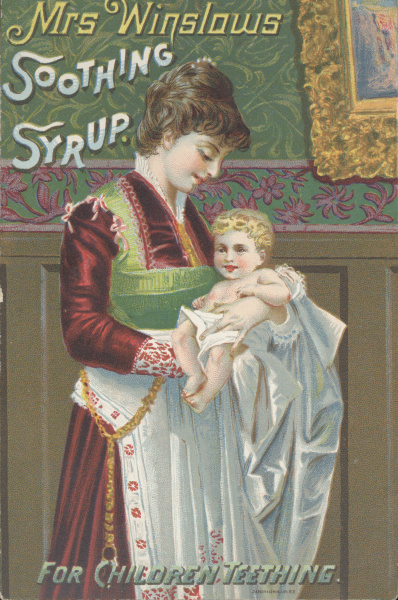
For Charlotte Winslow, the 1800’s were the perfect opportunity to make her fame and fortune. A paedriatric nurse, she rose to prominence in the 1840’s as the face of Mrs. Winslow’s Soothing Syrup – a cure all for ‘fussy babies’ that was manufactured by her son in law and his partner for sale in America and Britain. Mrs. Winslow’s Soothing Syrup was sold as a remedy for babies who were teething or had dysentery, because obviously those two things are very similar. It was hugely popular and in 1868, more than 1.5 million bottles were sold. The secret? Morphine.

“Would baby like his syrup inhaled or injected?”

One teaspoon had enough morphine in it to kill the average child. Just to make sure that non-average, already morphine-addicted children didn’t miss out, it also contained alcohol. Unsurprisingly, parents began to notice the adverse affects (to put it mildly) of giving the syrup to their children and the medicine quickly gained the nickname ‘Baby Killer.’ Despite this sales continued to do well and it wasn’t until 1906 that morphine was removed from the ingredient list (although the alcohol remained) and 1930 when it was finally removed from the market completely.

Domestic Recipt Book for 1869 proudly advertised itself as a book, or pamphlet, which could help women cook meals for their families as well as cure them with home made treatments. If the remedies inside the pages couldn’t help, then the adverts on the front of the book for Mrs. Winslow’s ready-made cough and cold remedies could be purchased at nearby pharmacies (or maybe street corners, given the contents of such treatments.)

What better recipe book to cook a meal for my family – including a young child – than from the manufacturer of the ‘Baby Killer’ herself?

It was a surprisingly easy recipe to follow and only used five basic ingredients. (Un?)Fortunately none of them was morphine.

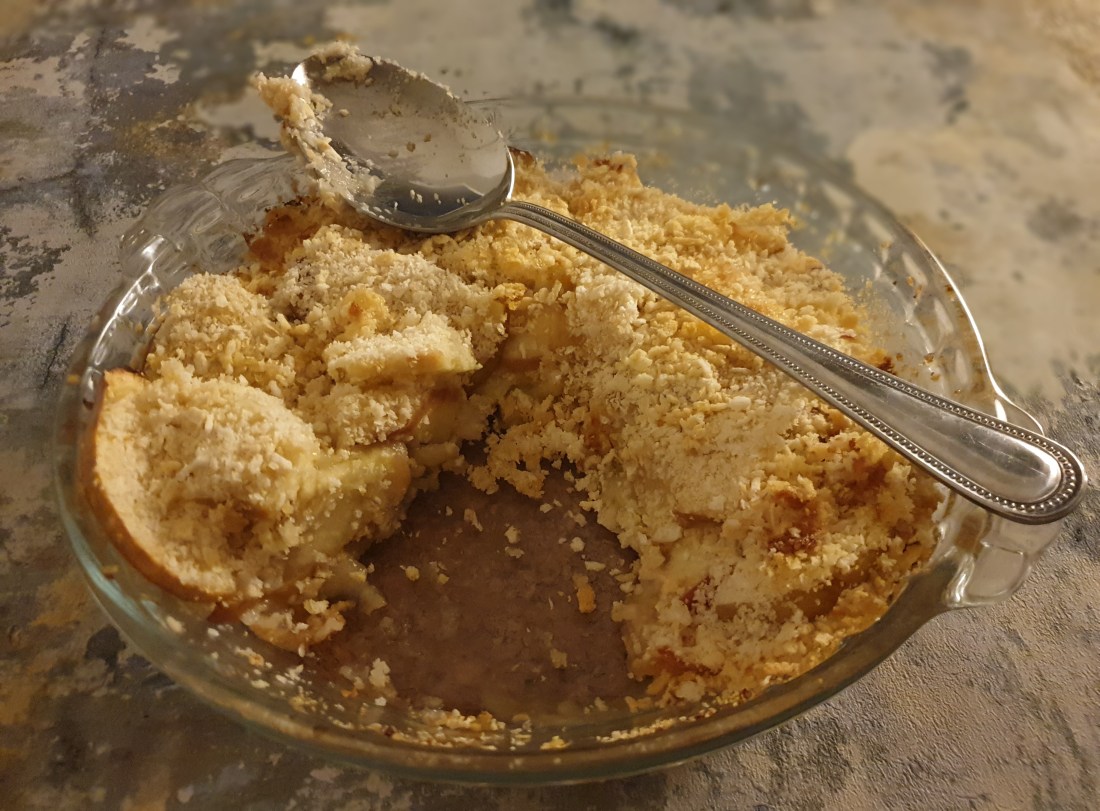
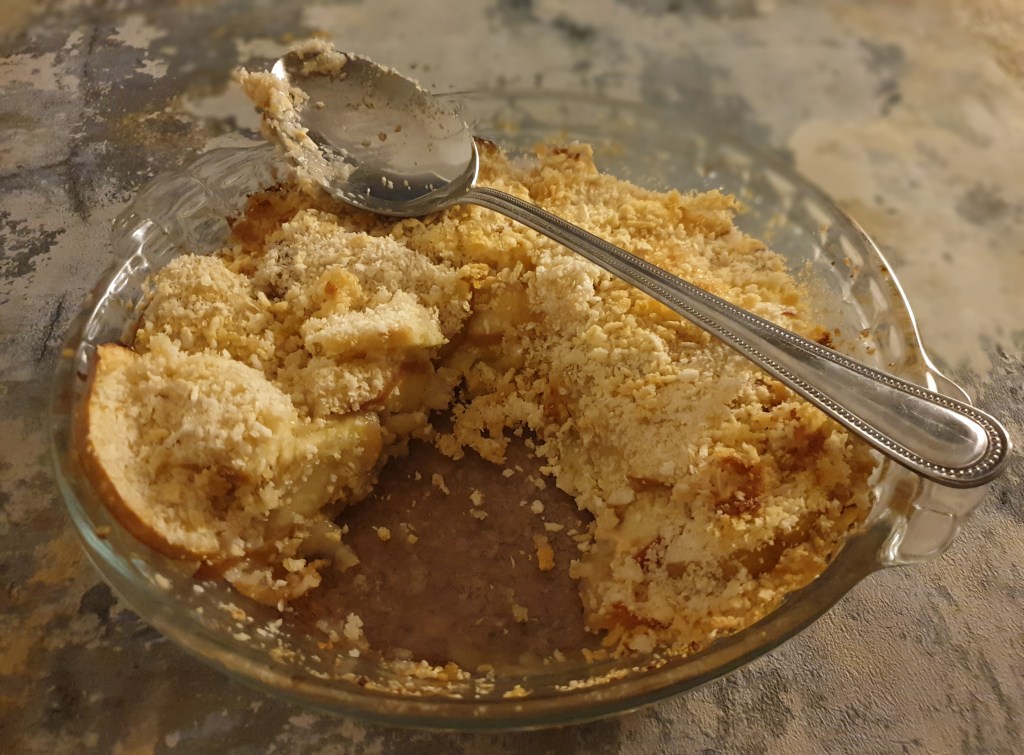
First, I sliced three apples and laid a layer of them in a buttered dish. On top of this I scattered a tablespoon of brown sugar and a couple of tablespoons of breadcrumbs, sprinkled on a pinch of lemon zest and dotted some blobs of cold butter on top. I then repeated the process another two times until I had almost reached the top of the dish and the whole thing looked very ‘dowdy’ indeedy.

Mrs. Winslow added to the bottom of her recipe a note stating that “a little cider improves this very much” which was unnerving because a) she was basically telling me that this wasn’t worth eating without alcohol and b) given the proliferation of alcohol in her medicines I wasn’t sure what counted as ‘a little’ by her measurements. Also c) we didn’t have any in. We did have boring old apple juice, though, so I tipped 1/2 a cup full in. No baby killers here, thank you very much.

It baked for just over 30 minutes until the apple slices were soft enough to pierce with a fork and then I served it with some ice cream (which actually wasn’t anachronistic at all given that the first hand cranked ice cream freezers were introduced to America in the 1840’s.)

I don’t think I need to tell you that it was pretty dry. Perhaps my cup was too small, but it seemed as though I’d not added any liquid at all. I was thankful for the ice cream, which when melted into the dowdy made it much more like an apple crumble and less like slices of dehydrated apple under bits of toast. I also think that in my lockdown induced panic to make food last I’d been a bit stingy with my butter blobs, so that probably contributed to the dryness a bit too.

It smelled lovely, though, like sweet bread and other than the fact it sucked all the moisture out of my head it tasted pretty good too – faintly citrusy and not overly sweet. For an 1860’s family trying to save all the money they had in order to pay for the long journey westwards, it did a good job of acting like a sweet treat. Plus, it was handy for using up bread that had gone a bit stale and also didn’t need to use any eggs, like other recipes for stale bread did.

A recipe that used simple ingredients, was quick and easy to make and – bonus – didn’t kill any children: I think that’s as close to the American Dream as I could hope to achieve.

E x

Apple Pandowdy

3 large cooking apples
4 or 5 tablespoons of breadcrumbs
4 or 5 tablespoons of brown sugar
Grated lemon rind
Butter
150ml of apple juice or cider (or more if you want a bit of a sauce.)

  1. Peel and slice the applies thinly. Spread a layer of them into a buttered dish.
  2. Sprinkle some grated lemon rind onto the apples.
  3. Sprinkle over the apples a tablespoon and a half of brown sugar and a table spoon and a half of breadcrumbs.
  4. Dot five or six chunks of cold butter onto the breadcrumb and sugar.
  5. Repeat the whole process twice more.
  6. Bake in the oven at 190 degrees for 30 minutes or until the apples are soft.

The Leicester Method: 19th century

I’ve been practising my imaginary teleportation. For the uninitiated, this is a technique I use where I imagine myself transported to another place, or time, as a few seconds of escape from reality. Usually I only have to use it half way through the last lesson on Friday with year 11, but, well, y’know…

Trouble is I’m not amazing at it. I tend to find the thud of scrunched up paper balls bouncing off the whiteboard and the sounds of Ryan’s dulcet tones as he shouts “Miss, have I told you that I’m not doing any revision cos mum says there’s no point to it – she’s written you a letter”, a bit distracting (although who know Ryan’s mum would be right this year?!)

So, I’ve had a bit more time to hone my skills, and I’d like to share the technique with you. Besides, I think we could all do with a break from tending to the sourdough starters we all began back when being stuck indoors with partners was an opportunity to learn new skills together rather than a legitimate reason to consider mariticide.

For one or two minutes we’re going to take a break from the background drone of the TV and the incessant smothering proximity of our nearest (literally) and dearest, and go on a virtual holiday. Somewhere exotic, somewhere exciting. Somewhere so good you’ll forget all about how loudly and annoyingly your partner breathes while you’re trying to work and then if you do remember, it’s only for long enough to send a ‘Wish you Weren’t Here’ postcard. The holiday of a lifetime.

Close your eyes. Let the sounds of your house wash over you, lulling you into a trance like state. Feel your body sink…sink…sink down deeper into the couch and allow your mind float away…

…to Leicester.

(I did tell you I wasn’t very good at this, sorry.)

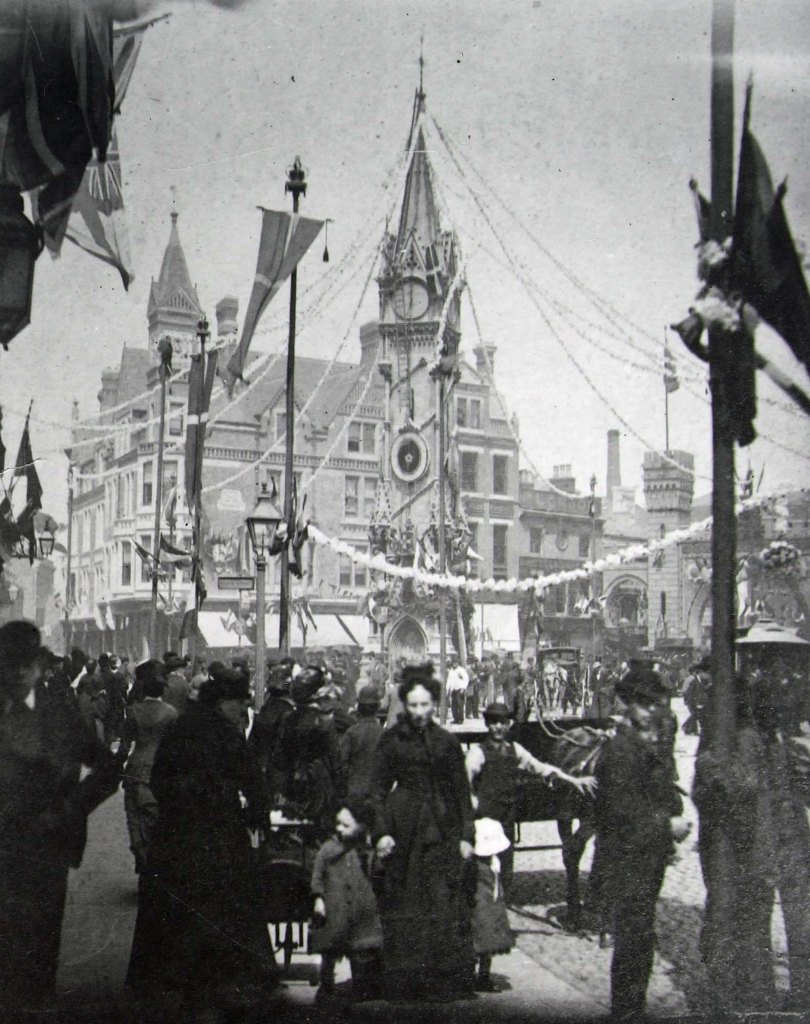
Okay, but this isn’t just any old Leicester – this is 19th century Leicester! Still not convinced about this holiday? What if I told you that, like many other towns during the second half of the Industrial Revolution, Leicester saw rapid population growth going from a population of just under 20,000 at the start of the century to about 167,000 by the end? Practically metropolitan! This bustling community was made up of many types of people: immigrants from the countryside seeking work, immigrants from other countries seeking new opportunities, long standing families and people just passing through, leading Oscar Wilde to quote: “I can resist everything except Leicester”* and Queen Victoria herself was overheard to complain frequently: “One cannot understand why London is not more like Leicester.”**

I know what those of you who grew up in Leicester are thinking: how would people in this new booming population find each other when they wanted to meet up? And so, to give the people of Leicester somewhere to congregate and listen to the Hari Krishna singers battle it out with the evangelical eschatologists (and also to ease congestion on the site of the former hay and straw market), the Haymarket Memorial Clock Tower was created in 1868. Now people could chant to their hearts content as they munched on Big Macs from the McDonald’s adjacent to the clock tower whilst puffing on their inhalers to combat the powerful aromas of the LUSH store (by law there should be one in every town centre). Truly, the whole system was a Victorian marvel.

She is fuming because she agreed to meet a friend at 11:00 but didn’t realise she was waiting for her on the other side of the clock tower.

All this growth and building work expanded the town significantly and as a result Leicester became a county borough in 1889. This brought wealth and prestige (well, wealth at least) to the city and in 1898 the Grand Hotel was opened to accommodate the flocks of (lost?) tourists and traders visiting the city. What would those tourists come to see? Well, in 1862 Joseph Merrick was born in Leicester and began touring in 1884 as “the Elephant Man“. So I suppose if you could quash your conscience you could go along to one of the ‘freak shows’. Those of you preferring gentler methods of entertainment might want to jump to 1880 to enjoy a show of male brutality at the newly formed Leicester Tigers Rugby Union Football Club.

But what I think you’ll really enjoy is the freedom to get out of the house and mingle with people again…if you can find them.

It would appear that for parts of the 19th century, much of the population of Leicester was quarantined. “How strange!”, I hear you cry. “You’ve brought us to a self-isolating town, of all places, in order to escape self-isolating! It’s almost as if you’d engineered it for blogging purposes.”

Would I do that?

Anti-Vaccination in Leicester

The thing about Leicester in the 19th century is that lots of people there held pretty radical views. They held these views very strongly and whilst the stubbornness and sheer force of will were excellent for propelling certain groups forward, such as the Leicester Secular Society (the oldest secular society in the world, founded in 1851 to challenge what it called ‘religious privilege’), sometimes the strength of feeling around certain topics could cause problems for the authorities.

One of these certain topics was vaccination.

In 1853 the government made vaccination against smallpox – a common killer disease of the 18th and 19th century – compulsory in the first three months of a child’s life. This law was known as the New Vaccination Act, because the first Vaccination Act of 1840 had, somewhat naively, only made vaccinations free and hoped that would be enough to compel people to get vaccinated. The New Vaccination Act was followed in 1867 by a decree that stated all children below the age of 14 must receive their smallpox vaccine. For the people of Leicester, many of them working class, being told to fall in line so rigidly by upper class politicians who had up to now shown little to no interest in the plight of the poor was a step too far. In 1869 the Leicester Anti-Vaccination League was founded.

Yeah, why would anyone want to vaccinate against smallpox?!

There were many reasons people in Victorian England opposed vaccination; religious grounds made up a large percentage of reasons (some felt the origins of the smallpox vaccine, which relied on matter from cowpox, mixed humans and animals together in an unchristian way whilst others suggested that smallpox was God’s punishment and to attempt a cure was to defy His will.) A fear of side effects and a mistrust of doctors accounted for other reasons (in 1841 the UK census suggested almost 1/3 of doctors were untrained and vaccines, new as they were back then, had not been tested safely which initially led to a number of deaths.) Along with these reasons, a feeling that vaccination was being forced on the working classes by those in power left a sour taste in a lot of people’s mouths.

In 1871, angry at being ignored, the government reiterated its position on the compulsory nature of vaccination and threatened fines on anyone who disobeyed. In Leicester the number of prosecutions for flouting the Act grew from 2 in 1869 to 1,154 in 1881 as parents refused to vaccinate their children. Furthermore, for the second half of 1883, only 707 out of 2,281 babies born in that half of the year were vaccinated.

Punishment for the people of Leicester was swift – in 1884, George Bamford was fined 10 shillings (half the average weekly wage) or told to spend a week in prison for refusing to vaccinate his fourth child – even though his mistrust of vaccines had been brought about by the death of one of his previous children following mandatory vaccination.

The Leicester Method

And yet smallpox, deadly and contagious though it was, failed to decimate the city. In 1877, a report by Dr W Johnson, Assistant Medical Officer of Health, showed that smallpox had appeared in Leicester but only caused six deaths.

Dr Johnson suggested that the low mortality rate was down to one main factor, which he termed ‘the Leicester Method’. This method relied on fast acting notification of smallpox to the local authorities and quarantine of those infected before the disease had a chance to spread. Dr Johnson urged parliament to grant Leicester a Local Act recognising the Leicester Method as an alternative to compulsory vaccination. In 1879, this Act was created in the Leicester Corporation Act.

Following the 1879 Act, Leicester became the only town to openly substitute the following measures for infant vaccination:

1. Prompt notification
2. The isolation and segregation of smallpox cases in hospital
3. Quarantine of all persons found to have been in contact with the patient
4. The vigilant inspection and supervision of all contacts during the incubation period of fourteen days
5. Cleansing and disinfection of clothes, bedding and dwellings
6. The burning of clothes, bedding, etc., when necessary

Not exactly unfamiliar to us today.

Despite the steps highlighted above, many authorities rightfully had concerns about the Leicester Method and continued to prosecute those who refused vaccinations. In 1882, 2,274 summonses were issued for people withholding from vaccination and by 1885 tensions between the authorities and people of Leicester were at an all time high (yes – even higher than that year Leicester council faced strong criticism for how it decorated the city’s Christmas tree.)

On 23 March 1885, contemporaries estimated that 100,000 people (although historians suggest it was more like 20,000) gathered in protest in the streets of Leicester, carrying banners with succinct messages such as “The President of the Local Government Board cannot deny that children die under the operation of the Vaccination Acts in a wholesale way” and equally snappy placards of solidarity from other corners of Britain: “Cordial greeting and sympathy to the heroic martyrs of Leicester”, as was sent from St. Pancras.

Children are fed to the disease ridden cow creature, representing vaccination. Images like this one appeared on banners at the 1885 protest.

The demonstration was every official’s worst nightmare: well organised, popular and held on a surprisingly sunny day. More and more people joined the crowds, both as supporters and general onlookers. As well as the marchers, there were movable stunt stalls – a particularly graphic one had rigged up a gallows and every 20 yards or so performed the execution of a dummy Edward Jenner – the man responsible for the smallpox vaccination. We do love a good show in Leicester.

Once the marching and dummy executions had been completed, the crowd met at the Market Place (thank god they’d finished the clock tower) to hear from anti-vaccination guest speakers. The whole event ended with rousing songs and a firm affirmation from the crowd to oppose vaccination in all its forms as much as any individual could. True to form, the following year at the next Guardian elections (think local elections), most of those returned were staunch opponents to compulsory vaccination who continued to petition and nag the governement relentlessly. Finally, in 1898 the people of Leicester achieved some of what they wanted in the 1898 Vaccination Act.

This Act removed some of the penalties imposed for resisting vaccination and included a conscience clause, which allowed parents to get a certificate of exemption if they did not wish to vaccinate their children. Now anyone with a suspicion of vaccination could cite the Leicester Method as a government sanctioned alternative and, as long as they followed the rules rigorously, theoretically couldn’t be sanctioned. Though the Leicester Method was used over 100 years ago when concerns over vaccinations and the manner in which they were carried out were legitimate, some anti-vaxxers still seek to uphold it as a viable alternative to vaccination today.

So, why is this wrong? Why can’t we just use the Leicester Method today? Why bother with a vaccine for coronavirus at all – apart from the fact it would mean staying indoors more often and for longer with those you’ve tried to escape from by reading this for the past 10 minutes?

I asked one of my oldest friends who is currently working as a doctor in New Zealand why the Leicester Method isn’t a reasonable alternative to vaccination. In between rolling her eyes in exasperation and requesting that she be referred to as my oldest ‘and most beautiful and intelligent’ of friends she managed to tell me, before popping off to save some more lives, that there are several reasons.

Firstly, the method relies heavily on everyone doing it properly. Under the Leicester Method, staying indoors means exactly that – staying indoors. No going out for a vague amount of exercise, no trips to the shops for essential bread, milk and M&Ms. You had medicine and provisions left at you door and you did not come out until an approved amount of time had passed. Given that people are still holding house parties it seems unlikely most of us would manage it.

Secondly, the Leicester Method doesn’t actually protect people from catching illness if they’re quarantined with an infected person. It’s a bit of a brutal fact that in quarantining an entire household with a sick member, you’re sort of guaranteeing it will spread within the household. Now, that’s pretty much where we are now because coronavirus is so new – but in the future, if a vaccine is created, you could stop the spread to family members and society wouldn’t have to shut down for an indefinite amount of time.

Thirdly, my beautiful and intelligent friend pointed out that we still don’t know loads about this virus. There are some studies to suggest it can live on some surfaces for three days. But the incubation period is longer than three days, so people could be asymptomatic and be spreading it around like butter on a hot crumpet before realising they have it. If there was a vaccine it wouldn’t matter if your 85 year old great aunt licked every outdoor railing she could find day after day, as long as she’d received the vaccination.

In short, the Leicester Method of the 19th century worked because people seem to have adhered much more strictly to the rules enforced at the time and because it’s easier to control the spread of disease in smaller populations. It’s worth also pointing out that once the Leicester Method had been approved for use, Charles Killick Millard, the Medical Officer of Health for Leicester from 1901 to 1935 advocated for the vaccination of medical and nursing staff who would treat patients, to stop the disease spreading further. This effectively created a bubble around the non-vaccinated citizens of Leicester where the disease was free to ravage as much as it could, but was prevented from escaping the city thanks to the protection of the voluntarily vaccinated.

Probably not the holiday you wanted or needed – a trip to self isolating 19th century Leicester. Sorry. But hey – that model of Edward Jenner getting hanged was good wasn’t it? And did you or did you not forget about how infuriating it is that your partner breathes that way?

Ultimately my friend’s advice is clear: stay indoors and when/if a vaccine is produced, use it if you’re advised to. And if you don’t want to use it then get used to the sound of your partner’s very loud and ever present breathing while you write your work emails from home as your colleagues celebrate their freedom with cake bought during non essential shopping trips and chat at the water cooler at a distance of less than 2 metres.

Oh and remember – I can make fun of Leicester because it’s my town. But if you do? Well. We’ll be ready to march in protest, all 100,000 of us. Meet us at the clock tower.

E x

*Not true.
** Also not true. Come on!

You Should Get Vaccinated: The Leicester Method – 19th century

Let’s take a break from lockdown 2.0 and go on holiday. Not a proper holiday, obviously, but an imaginary one. Better yet, a holiday through time – about 150 years ago – to, er, Leicester.

Like many other towns during the second half of the Industrial Revolution, Leicester saw rapid population growth going from a population of just under 20,000 at the start of the century to about 167,000 by the end.

In fact it was such a vibrant, bustling metropolis that Oscar Wilde quoted: “I can resist everything except Leicester”* and Queen Victoria herself, after being asked if London was exciting enough for her, was overheard to complain: “We are not amused – if only we were in Leicester, where everything is better.”**

She is fuming because she agreed to meet a friend at 11:00 but didn’t realise she was waiting for her on the other side of the clock tower.

But was it actually better?

It would appear that for parts of the 19th century, much of Leicester was quarantined. As in stay indoors, close shops, don’t mix with others. Sound familiar?

The reason for this? Smallpox. It was one of the biggest killers of the 18th century, killing up to 30% of its victims. Those that survived were often left physically scarred and mentally traumatised by experience.

You would think that once a vaccine had been developed people would flock to book their jabs. After all, this newly invented method of preventing disease promised to stop the disease in its tracks, freeing millions from fear and heartache.

The things is, vaccination was just that: newly invented (in 1796, if you were wondering.) Many people didn’t trust it as a method of prevention. This included some doctors who argued it was dangerous, under-tested, and (as the government offered it free of charge) would take away a source of their income at a time when people paid for medical treatment.

But no group argued against vaccinations as loudly or passionately as the people of Leicester. Now don’t get me wrong, as a Leicestershire girl myself I have an obvious soft spot for my county town. But it’s fair to say that the people of the city during the 19th century were, well, pretty stubborn when it came to vaccination.

Let’s get this straight: to distract us from the current pandemic you’re telling us about an anti-vax town in the grip of its own pandemic?

Sort of?

In 1853 the government made vaccination against smallpox compulsory in the first three months of a child’s life. This law was known as the New Vaccination Act because the first Vaccination Act of 1840 had largely failed to take off; despite being free, vaccination was also voluntary and, still a relatively new invention, many were yet to be convinced by its safety.

The New Vaccination Act was followed in 1867 by a decree that stated all children below the age of 14 must receive their smallpox vaccine. For the people of Leicester, many of whom were working class with no workers rights which allowed them to take time off work to get their children vaccinated, being told to fall in line so rigidly by upper class politicians was a step too far. In 1869 the Leicester Anti-Vaccination League was founded.

Yeah, why would anyone want to vaccinate against smallpox?!

Anti-vaccination sentiment wasn’t just a negative response to being told what to do, however.

There were many reasons people in Victorian England opposed vaccination. Religion accounted for a large number of excuses as some felt the smallpox vaccine – which relied on matter from cowpox -mixed humans and animals together in an unholy way. Others suggested that smallpox was God’s punishment of sin and to attempt an eradication of it was to overturn his will.

A fear of side effects and a mistrust of doctors accounted for other reasons. In 1841 the UK census suggested almost 1/3 of doctors were untrained, and vaccines, new as they were back then, had not been tested safely which initially led to a number of deaths. Along with these reasons, a feeling that vaccination was being forced on the working classes by those in power (who had previously done precious little to improve the lives of ordinary folk) left a sour taste in a lot of people’s mouths.

Back to Leicester.

In 1871, angry at being ignored, the government reiterated its position on the compulsory nature of vaccination and threatened fines on anyone who disobeyed. In Leicester the number of prosecutions for flouting the Act grew from 2 in 1869 to 1,154 in 1881 as parents refused to vaccinate their children, angry at what they perceived to be a curtailment to their rights. Furthermore, for the second half of 1883, only 707 out of 2,281 babies born in that half of the year were vaccinated.

Punishment for the people of Leicester was swift. In 1884, George Bamford was fined 10 shillings (half the average weekly wage) or told to spend a week in prison for refusing to vaccinate his fourth child. One of George’s other children had died not long after receiving their mandatory vaccination and George’s mistrust of vaccines was set in stone afterwards.

The Leicester Method vs. vaccination.

In 1877 a report by Dr W. Johnson, Assistant Medical Officer of Health, showed that though smallpox had appeared in Leicester, it only caused six deaths. Despite refusing vaccinations, the citizens of Leicester somehow seemed to have avoided mass infection.

Dr Johnson suggested that the low mortality rate was down to one main factor, which he termed ‘the Leicester Method’. This method relied on fast acting notification of smallpox to the local authorities and quarantine of those infected – as well anyone who lived with them – before the disease had a chance to spread. It really was the track and trace of the Victorian age, only with fewer glitchy apps. Dr Johnson urged parliament to grant Leicester a Local Act recognising the Leicester Method as an alternative to compulsory vaccination. In 1879, this Act was created in the Leicester Corporation Act.

Following the 1879 Act, Leicester became the only town to openly substitute the following measures for infant vaccination:

1. Prompt notification
2. The isolation and segregation of smallpox cases in hospital
3. Quarantine of all persons found to have been in contact with the patient
4. The vigilant inspection and supervision of all contacts during the incubation period of fourteen days
5. Cleansing and disinfection of clothes, bedding and dwellings
6. The burning of clothes, bedding, etc., when necessary

Despite the steps highlighted above, many authorities rightfully had concerns about the Leicester Method and continued to prosecute those who refused vaccinations. like today, the track and trace element of the rules, for example, only worked if people actually adhered to it.

In 1882, 2,274 summonses were issued for people withholding from vaccination and by 1885 tensions between the authorities and people of Leicester were at an all time high (yes – even higher than that year Leicester council faced strong criticism for how it decorated the city’s Christmas tree.)

On 23 March 1885, contemporaries estimated that 100,000 people (although historians suggest it was more like 20,000) gathered in protest in the streets of Leicester, carrying banners with succinct messages such as “The President of the Local Government Board cannot deny that children die under the operation of the Vaccination Acts in a wholesale way” and equally snappy placards of solidarity from other corners of Britain: “Cordial greeting and sympathy to the heroic martyrs of Leicester”, as was sent from St. Pancras.

Children are fed to the disease ridden cow creature, representing vaccination. Images like this one appeared on banners at the 1885 protest.

The demonstration was every official’s worst nightmare: well organised, popular and held on a surprisingly sunny day. More and more people joined the crowds, both as supporters and general onlookers. As well as protesters, there were movable stunt stalls to entertain the crowd. A particularly graphic one had a gallows and every 20 yards or so performed an execution of a dummy Edward Jenner – the man responsible for the smallpox vaccination. We love a bit of the macabre in Leicester.

The event ended with rousing speeches from guest speakers and promises to oppose vaccination in all its forms as much as any individual could. The following year at the next guardian elections (think local elections), most of the successful candidates were staunch opponents to compulsory vaccination.

The people of Leicester finally achieved some of what they wanted when the 1898 Vaccination Act was passed. This Act removed some of the penalties imposed for resisting vaccination and included a conscience clause, which allowed parents to get a certificate of exemption if they did not wish to vaccinate their children. Now anyone with a suspicion of vaccination could cite the Leicester Method as a government sanctioned alternative and, as long as they followed the rules rigorously, couldn’t be prosecuted.

So…what’s the problem with the Leicester Method?

Suspicion of vaccines is still rife among some communities today and there have been arguments for a modern day Leicester Method to be used like the one used to combat smallpox. With a “world beating” track and trace system, proponents of the Leicester Method argue, there’s no need for a vaccine.

I asked one of my oldest friends (who happens to be a doctor) why the Leicester Method isn’t a reasonable long term alternative to vaccination. In between rolling her eyes in exasperation and requesting that instead of “oldest”, she be referred to as my “most beautiful and intelligent” of friends, she told me that there are several reasons.

Firstly, there’s one key difference between smallpox and coronavirus: symptoms. There are no asymptomatic smallpox patients. In 100% of smallpox cases patients develop rashes and fevers. Putting aside whether or not the track and trace system we have in the UK could be accurately described as “world beating”, smallpox symptoms made it easy in the 19th century to identify who was infected and needed to quarantine. However, recent modelling suggested that in the best case scenario with an R rate of 2, 10% of patients with coronavirus could be asymptomatic, making it much harder to identify who needs to isolate.

Secondly, the method relies heavily on everyone doing it properly. Under the Leicester Method, staying indoors means exactly that – staying indoors. No going out for a vague amount of exercise, no trips to the shops for essential bread, milk and M&Ms. Medicine and provisions were left at your door and you did not come out until an approved amount of time had passed. Quarantine meant quarantine for everyone – school children and essential workers included. This was easier to do at a time when children didn’t attend school for as long as they do now and the overall population was lower (current estimates are that there are over half a million citizens of Leicester city, compared to well under 200,000 at the end of the 19th century.)

Thirdly, the Leicester Method doesn’t actually protect people from catching illness if they’re quarantined with an infected person. A bit of a brutal fact about quarantining an entire household with a sick member is that it’s sort of guaranteed it will spread within the house. Fine if your household is all generally fit and well, but for those living with a vulnerable person then the reality of being locked in an infected house for days on end is a lot grimmer and frightening.

And finally, my beautiful and intelligent friend pointed out that we are still learning about this virus. What role, for example, do children play in spreading the disease? How much is there we still don’t know about ‘long covid‘? We know the incubation period can be as long as ten days, and that people can be asymptomatic and spread it around like butter on a hot crumpet before realising they have it. Indefinite and repeated periods of lockdown following the Leicester Method won’t fix these issues, but are more likely to compound existing issues like mental health problems, poverty and unemployment.

Vaccination is the best method of prevention.

In short, the Leicester Method only worked 150 years ago because people seem to have adhered much more strictly to the rules enforced at the time. This is partly because it’s easier to control the spread of disease in smaller populations. It’s also worth pointing out that the method ended up being used alongside vaccination rather than just on its own. At the start of the 20th century, Charles Killick Millard, the Medical Officer of Health for Leicester, ordered the vaccination against smallpox of medical and nursing staff. The vaccination of key front line staff helped stop the disease spreading further and effectively created a bubble around the non-vaccinated citizens of Leicester.

Until the much hoped for vaccine arrives, a modern day version of the Leicester Method is all we’ve got. With a widely available, effective vaccine, though, it wouldn’t matter about asymptomatic patients or adhering to lockdown rules. It would mean we wouldn’t need to worry as much about track and trace, and your 85 year old great aunt could lick every outdoor railing or snog anyone who coughed within a mile of her, so long as she’d had her jab. You know, if she wanted to.

E x

*Not true.
** Also not true. Come on!

Jowtes In Almond Milk: 14th century

It’s easy to joke about lockdown, I think. A month ago if you’d told me I would soon be spending work days lying on the sofa wearing what I’m now calling my ‘work pyjamas’ and that my most difficult day to day decision would be deciding whether to crack open the custard creams or the bourbons first, I’d probably have thought you were some sort of genie. And I’d have been right – because everyone knows genies are awful manipulative bastards who give with one hand and take away a whole lot more with the other.

It also seems especially cruel of this Coronavirus genie to coincide everyone’s house arrest with what is likely to be our designated 5 days of summer before we return to grey drizzle and mud.

But don’t despair, my woefully imprisoned wretches, for I have a recipe to bring you joy in these days of pestilence. I can guarantee that at least one of the following accolades is true: it is a meal that is unapologetically bold in colour, powerfully flavourful, and guaranteed to be enjoyed by the whole family. The very definition of comfort food for these trying times.

Jowtes. In. Almond. Milk.

I know, I know. “Jowtes in almond milk?” you’re all thinking. “Does she think we come here for something as mundane as that? Who hasn’t tried jowtes before?!”

It’s embarrassing to admit this but I didn’t have a clue what a jowte was. At first glance I thought it sounded meaty, but not in a good way. I envisioned left over cuts from the jowls and jaws of unspecified animals boiled together in Alpro’s finest. Hardly an uplifting image. The recipe I used, from Maggie Black’s The Medieval Cookbook, stated that jowtes were basically herbs cut up fine and cooked in a soup or pottage. So, jowtes in almond milk wasn’t meaty at all.

But I was still quite unclear why herbs were called jowtes – was it a specific herb? Was it a method of cooking? I didn’t have time to find out myself because I had to make a very important work decision about whether to allow my daughter to watch yet another episode of Peppa Pig, or whether to usher her out into the garden for some Government Approved Fresh Air. I will also admit that I lacked the intelligence, skills and patience to find out, so I asked someone far cleverer than myself who is an absolute whizz at this sort of thing, Dr Christopher Monk.

He confirmed that a jowte wasn’t a specific ingredient, per se, but was just a word lost to history that referred to a stew, soup, pottage or dish itself of chopped up herbs and vegetables:

‘Joute’ is a borrowed word from Anglo-Norman (spelt variously: ‘jute’, ‘jote’, ‘joute’) where it is used both in singular and plural form to mean a soup or pottage made using vegetables or herbs. Ultimately, the derivation is medieval Latin (not classical Latin), where ‘juta’ means a soup/stew.

But Dr Monk also had an interesting theory of his own about the origins of the dish’s name – and it’s based on what the finished meal may have looked like. He speculated that since the medieval Latin word ‘jota’ meant ‘a pot herb’, there could be a link between the Latin ‘jota’ and the Greek word ‘iota’ (meaning ‘the least part’) possibly giving rise to the word ‘joute’ (spelled in my recipe ‘jowte’) as a description of the meal: “could the herbs, chopped up so fine as they are, allude to ‘iotas’…of vegetation floating in one’s pottage…?”

Dr Monk reiterated that this idea was purely his own speculation and needed more research into any possible connections but I feel qualified to state, as someone with no knowledge of etymology at all, that it sounds very plausible to me! (I warned you he was clever!)

So: what I was dealing with was a meatless soup where the herbs were chopped so fine that they appeared like dots floating around in the milk. Admittedly, it wasn’t an image I would have chosen when asked to describe the ultimate comfort food in the face of a pandemic, but it was something that now at least I understood.

Maggie Black described the soup as filling and speculated that, because of its meat free content, it probably made an ideal meal for monks during Lent. Perfect for monks and those adhering to a Lenten diet? Definitely not my idea of comfort food…

As per my post last week, I’m trying to only cook with things I have in. This suits me just fine; as someone who prefers to limit my time outdoors and with other people anyway, I’m secretly delighted to have a ready made reason not to go out, and it means I can save my go-to excuse of blaming last minute cancellations on my daughter’s imaginary illnesses for another time.

I used leeks, spinach and chives for the soup – all already in and slowly rotting in the bottom of the fridge; the remnants of good intentions past. I also had half a bag of ground almonds from a flourless cake experiment a month or two ago which suited the purposes of almond milk just fine. Technically I should have used whole almonds, blanching and pulverising them myself for a truly authentic experience, but sod that. I don’t think going to get a single bag of whole almonds would count as an essential trip to the supermarket anyway.

First, I made my almond milk – a medieval staple when a base was needed for a meal that contained no dairy, meat or egg. This sounds very grand, but basically involved tipping the bag of ground almonds into a pan of water and heating it slowly for 15 minutes until it thickened. Almonds were an essential ingredient in much medieval cooking, apart from meals for the very poor, and during the 14th century water could be used to create almond milk but wine or broth may also have been added to create a richer flavour. I thought back to the Lenten monks, abstemiously chanting in vegetarian tones in my imaginary monastery and thought that if I was going to do this properly it was probably best to use water. Besides, I’m currently trapped indoors with a toddler; I’m going to need all the wine in my house to remain in a completely unadulterated state, thank you very much.

Okay, so at this point it doesn’t live up to any of the three promises mentioned earlier, but just you wait…

Once it was thick and bubbling I strained the mixture and got rid of the boiled almond mush, leaving a grainy milk behind. It tasted not unpleasant, but wasn’t as strongly almond-y as I’d thought it would be. Perhaps using fresh whole almonds would give a better depth of flavour?

While the milk was thickening, I’d used my time to prepare the vegetables: two leeks chopped finely, 300g of shredded spinach and two tablespoons of chives. I added the vegetables to the finished milk and boiled them together until the mixture turned a faintly green colour. I wasn’t convinced that I’d chopped them small enough to be worthy of the ‘iota’ theory, so I ended up using a hand held blender (the first one was invented around 1350, by the way) to finish the job for me.

It went violently green.

Soup that resembles alien slime: I don’t understand how this couldn’t be considered comforting.

Yes, I know what it looks like. It wasn’t my idea of comfort food either. I was beginning to see why many monasteries made their monks take a vow of silence – imagine the protests and unionising abbots would face if monks were allowed to speak after being served this day after day. However, after one spoonful I was converted to the Way of the Jowte.

In the bowl, steam rising off it, it smelled very earthy and wholesome. It was also, as my husband put it, very green tasting. By which he meant that the first flavour was a sharp and unmistakable allium tang. It was refreshing and even zingy.

I had expected a watery-ness to this soup. Once the taste of the leek and chive had subsided, I thought I’d be left with a broth like texture and thin flavour but that wasn’t the case at all. Thanks to the almond milk the soup was very creamy and rich. It was a subtle flavour and I don’t think I would have guessed that the veg had been cooked specificially in almond milk if I’d not known already, but I didn’t find it watery.

It used up ingredients which meant I didn’t have to go out to buy anything ridiculous and frivolous, it was actually delicious with a bit of cheese sprinkled on top (sorry, fasting monks) and it was a healthy alternative to the steady diet of toast, biscuits and weetabix we’d all been living on for the past couple of days. When *all this* is over, I’d even make it again.

But for now, once during lockdown is enough. Nutritious and surprisingly tasty as it was, it wasn’t proper comfort food. Someone pass me the bourbons.

E x

Jowtes in almond milk

300g spinach
2 large leeks
2 tablespoons chopped chives
1.2 litres water
125g ground almonds

  1. Boil the water and almonds together until the mixture thickens (about 15 minutes).
  2. Chop the leeks, spinach and chives up finely.
  3. When the water and almonds have thickened, strain the almonds from the milk. Place the chopped vegetables into the almond milk and cook on a low heat with a lid on until the leeks are tender.
  4. Add more water if you prefer a thinner soup, and blitz in a food processor to get a finer consistency.
  5. Serve with grated cheese and crusty bread. Or don’t, if you’re a monk.

Entertainment: Tudor style

It would appear none of you listened to me last time when I told you to cease and desist emptying the shops of food and loo roll. I understand that some of you might have struggled to take Boris Johnson at his word when he asked people to stop panic buying and exercise more control in their social gatherings but what I find astounding is the number of you who ignored me. I’m very, very disappointed in you all. I want you to go away and think seriously about what you’ve done. You can tell your mum to expect a phone call later – on Mothers’ Day of all days! Do you think she’ll be proud of you?

Obviously, the implications of your actions are clear. Upset and broken by seeing yet more year 7’s arrive to school with apples and (and I can’t believe I’m having to write this), bananas in their lunchboxes instead of chocolate cake and doughnuts because the shelves continue to be emptied of these treats, schools this week have taken the very difficult decision to close. It’s for the best; the kids need time to recover the social humiliation of having no one willing to trade lunches with them, and teachers need therapy after finding cornucopia’s worth of rotting apple cores stuffed down the backs of radiators and mashed banana between the pages of textbooks. Hang your heads in shame, people.

A whole host of people are now going to be stuck indoors, possibly with small children (hopefully their own), for the foreseeable future. I may be one of them, because unfortunately my efforts to escape isolation with my family by hiding behind a big shelf of tinned tomatoes when we were out shopping was thwarted by the fact that people kept stockpiling the bloody things, so my husband and daughter found me pretty quickly.

So, here I am: in the house, awaiting emails from school to see if I’ll be called in to care for those who need support or whose parents are key workers heroes. So far, I’m not rota-d on for next week, which means I’m faced with the alarming prospect of having to do some Actual Mothering.

Fortunately, my child is too little to have a clue what’s going on so I’m spared the difficult conversations of explaining what’s happening or alleviating any fears or anxieties. All she knows is that we can only see grandma and grandpa over the computer and that if she smashes her fists into all the buttons on the keypad at the same time we can’t even do that anymore. Unfortunately, this means that she’s not of an age where she can entertain herself for any reasonable amount of time. Finding activities to fill the hours has therefore become something of a specialty.

The rainbow idea? Lovely! Heartwarming! A true show of community spirit in difficult times. Whose idea was it, and how do I contact them to pay for the dry cleaning to remove 7 different paints out of my carpet and off my walls? What about films? My daughter will snuggle up under a blanket and watch a movie as long as that movie is no longer than 7 minutes, contains only talking tractors and has a jingle she can shout at the top of her voice for several hours after it ends. She’ll clamour to watch it 3 times in row and will then have the mother of all tantrums when asked if she wants to watch it again. Nothing holds her attention apart from everything, immediately, and her skills at tidying up after herself leave much to be desired:

Scenes like this one have been achieved within in 10 minutes. Please, I am not joking: send help.

My husband and I have resorted to hiding under the stairs whenever we hear her coming. It’s the only place we can eat anything without having to share it. It’s not quite big enough to accommodate both of us and the Hoover and ironing board, so there’s always a bit of a Hunger Games tussle between us where one of us ends up sacrificed to the Insatiable and Ever Present Toddler, but today I managed to eat a half an Easter egg, a left over sausage and can of Diet Coke in blissful uninterruption, albeit in the pitch black (the light would give me away.) True, she was waiting for me when I emerged with an accusatory “chocolate?” but it was already gone.

I’m therefore having to temporarily change the focus of this blog. There will still be meals and snacks made of the historical kind however, with a tiny force of nature to care for more often than before, and with fewer and fewer ingredients on the shelves, it’s not possible to research, prepare and cook things that might not be able to be eaten by 1/3 of the household on a regular basis. With that in mind, therefore, I’m switching today’s focus on entertainment in Tudor England. What did people do to keep busy? Can I replicate any of it? Is there a precedent for sending my daughter off with a travelling theatre to tour Europe for several months so she can earn some money for us and ease our childcare woes (probably not, for multiple reasons.)

Before I began to transform all our free time into a plan of Tudor activities (a teacher without a timetable is a rudderless soul), I ran the idea past my husband, who has (mostly) suffered in silence while I’ve fed him dubious meals and cared for him according to pre-NHS standards. He was only too happy to share some of his misfortune with our daughter; “I don’t see why not – if she’s been spared most of what you’ve been up to so far it’s high time she experienced a little of it now”, was his response.

First up was dancing. This was a past time enjoyed by pretty much every strata of Tudor society, from formal choreographed dances enjoyed by the rich, to spontaneous drunken jigs danced by the poor. It seemed a good place to start the Timetable of Tudor “Fun”.

It’s a source of constant amusement to my family that my husband, who has two parents who were both professional dancers for much of their lives, has two left feet. For our first dance when we got married we employed the timeless cling-on-to-each-other-and-sway-aimlessly technique rather than risk choreographing what would just inevitably become an elaborate tumble into the wedding cake. Imagine my husband’s delight when I told him we were going to prepare a dance routine as our first activity.

I took my inspiration from this Key Stage 2 lesson which showed several people, all splendidly dressed up, very seriously glaring at each other as they hopped round in a circle and wagged their fingers to lute music. At one point they did a move that involved throwing their hands up (seemingly in despair), turning round and sort of skipping away a bit. Since this move was reminiscent to one I do whenever I try to reason with my daughter, I thought it would be perfect.

We stood in a circle, but since there was only three of us, it was more of a triangle, and held hands. My husband and I attempted to keep straight faces and my daughter wrestled with us as she sought to free her sweaty palms. At first, I had planned to just play the video on the TV so that we could copy the moves and use the music, but it became very clear that Tudor music wasn’t my daughter’s jam. We had to use Baby Shark instead.

There we were, holding hands, moving in a slow circle, stopping and clapping, while Baby Bloody Shark serenaded us. One of us couldn’t contain herself and broke rank to act out the moves to Baby Shark, whizzing round the room screeching ‘Mummy shark! Daddy shark!” as she did so. I tried to wag my finger at her, but I only ended up copying yet another of the ridiculous dance moves by accident so she didn’t take it seriously. Meanwhile, my husband had slightly twisted his ankle trying to replicate one of the twiddly jumps (or was he trying to run away?) and was demanding a break. It felt a bit silly to continue without her and with one of us injured (and besides, I think the neighbours across the road had spotted us through their window at his point) so we stopped.

Next up was hunting. This was a big thing for the rich in Tudor England, with larger animals such as deer being popular animals to hunt. For Henry VIII, hunting was a way to show his power and sporting prowess. In 1519, the Venetian ambassador commented that Henry VIII “never took that diversion without tiring eight or ten horses” and Henry considered hunting so important an past time to him that he ordered many hunting lodges to be built across England, including one in 1543 at Epping Forest, from which he could see the deer on the chase.

Obviously, hunting was something we couldn’t overlook if we were going to do this Tudor entertainment thing properly. However, we did have just a few teeny tiny ethical qualms – not least of which was the idea that rushing around our local town centre brandishing kitchen knives and catapults made of rubber bands might put the public in more danger than it already was, thus defeating the point of our social distancing. It was decided that a game of hide and seek would have to do instead, and my husband dutifully donned a pair of Rudolph antlers left over from Christmas to get into the mindset of a Tudor deer before going to hide upstairs, in the bed, under the duvet for half an hour.

Whilst rich people could hunt big game, poor people had to make do with fishing in certain areas (not everywhere, as the king still controlled many of the lakes and ponds in England, for which permission had to be sought to fish from.)

It’s a very special type of panic buying, semi-hysterical Tudor themed pet shopping is. The lady in the pet shop remained very calm when I told her I was looking for a goldfish “such as might have been kept in the ponds of Tudor England.” She implied quite heavily that it would be a pretty serious crime to use pet shop fish for fishing and that we couldn’t ‘just build’ a pond in our back garden by the end of the day. What we could have, however, was a starter tank with 6 little fish in and an aquatic plant, so we did that instead. I asked my daughter what they should be called and she just shouted “Bosh!” over and over again for a full minute, so we assumed that’s what she wanted them to be called. All of them. I have since learned that the 15th century artist Hieronymus Bosch, who painted at the time of Henry VII and Henry VIII, was famed for his scenes of doom and pestilence. How very fitting, and unnerving of my daughter.

Okay, so maybe the hunting and fishing was just an excuse to have a nap and go and buy some new pets. But that still left one more thing to try: dice.

Dice games were exceptionally popular in Tudor England. I suppose after a day of bashing your ankles together in dancing and getting gored by deer you’d want to do something that was primarily focused on sitting down. Between 1529 and 1532, Henry VIII lost £3,243 5s 10d because of gambling, showing how fond and popular gambling with dice was. By 1604, there were so many legal cases being brought that centred on the issues of loaded and false dice that legislation had to be brought in to prevent their manufacture and sale.

A dice game that could cost us thousands? That had the potential to lead to a law suit? What could go wrong? The High German game Glückhaus, known as Lucky Pig in England during Tudor times, was just the sort of game we needed. Once my daughter was in bed, we drew up the board and began to play.

A Lucky Pig board

We took it in turns to throw a pair of dice. If we threw a 3, 5, 6, 8, 9, 10 or 11, we had to place a coin on the King Space, the empty one with a crown on it. We settled on £1 coins initially, because we didn’t use our maths skills to see that most of the time we’d be placing coins on the King Space, before downgrading the £1s to any old coins, since it was all coming out of our joint piggy bank anyway. We decided that the winner would get to pick the takeaway for the evening. If we threw a 7, the coin was placed on the 7 space. This space was known as the Wedding Space. If we threw a 2, the Pig Space, we got to take all the coins on the board apart from the ones on the Wedding Space. If we threw a 12 then we got to keep all the coins on the board, including the ones in the Wedding Space. So really, this game should have been called ‘Lucky Pig, Greedy King’, but you’d probably have lost your head.

By the end (10 minutes or so) I was the winner with £3.47 to my husband’s £1.15. I picked Chinese.

Times are a bit rough at the moment and I still don’t know how to entertain my daughter any more than I did at the start of the day. Tomorrow my Tudor diary’s suggesting falconry followed by bear baiting, but I’m fairly sure they’ll be cancelled as they always attract a crowd. Back to drawing on the walls and eating lunch under the stairs it is, then.

Stay safe.

E x

Continue reading “Entertainment: Tudor style”

Potted Shrimp (or prawns): 1861

I’d hate to run a food blog right now. Especially a niche food blog with form for advocating the frivolous purchase of numerous ingredients to turn into unspeakable mush before declaring it all “inedible!” and washing it down the sink. Insensitive bastards.

I’m sure that eventually the shops will be able to restock without needing protective riot shields but that time isn’t quite yet. Be kind to store assistants, people, they’ll be carrying tasers soon (but also be kind to them anyway because they all seem so tired and fed up of repeating that no, Sandra, there isn’t more bread “out the back.”)

The kids at school appear to coping with things admirably. As I write this, it’s unclear whether or not schools will close at the end of the week, and even though it’s clear the students all desperately want them to (“Miss, I’ll pay you to say we can go home now!” “What if we promise we’ll only go on the X-Box after we’ve done all the work though?”) overall they’re doing a pretty good job of getting on with things as normally as possible. The only time I’ve seen a break in resolve is when one year 7 sadly told me that she had to have another apple in her lunch box instead of her usual chocolate muffin for pudding because her mum hadn’t got to the bakery aisle in time before everything was bought up.

At least panic buying has shown quinoa for the unwanted fad food it truly is. Actually, a late night wander round Sainsbury’s reveals in stark relief what the true essentials of British life seem to be; good luck getting a packet of mini rolls in South Leicestershire at 8:00pm is all I’ll say.

As the government releases new information by the hour and shops have today announced restrictions on buyer’s baskets, I began to think how people in the past coped with similar issues. Now, I know the food shortages that will be seen in supermarkets in the coming weeks are the result of numerous issues: problems in supply chains, closed borders and a nation that is newly out and proud about its compulsive fetish for toilet paper, whereas food supply issues of 500 years ago were usually to do with crop failures or wars, but I was still curious.

If you can hide a shelf’s worth of UHT milk under your loo roll, you’ve bought too much.

Unfortunately, it turns out that there were two main ways of coping with food shortages in the past: you had either managed to preserve enough food to eke out through the long hungry months, or you starved. There wasn’t a welfare state in medieval England. If you were a subsistence farmer who had been unable to grow enough grain to set some aside there wasn’t much hope for you, as the Great Famine of 1315-17 showed when approximately 5% of the population perished.

I know that’s no comfort to families who are currently struggling to find baby formula, or vulnerable groups who struggle to get to the shops in the first place only to find that every loaf of bread has gone. If people had realised that there was plenty for everyone if people had shopped normally then we wouldn’t even have a food shortage issue right now. I am exceptionally fortunate that for my family, the worst this food shortage is likely to get is that we’ll start eating more tinned food and my husband will have to self isolate within our own home to protect me and our daughter from the smells caused by his baked bean heavy diet.

So, I’m trying to do a little bit of my civic duty and avoid emptying the shops of things for this blog that others might need for their actual, real lives. It means more space to talk about history, and also involves a switch in how I usually research historical recipes. Instead of Googling “weird recipes from history – no mushrooms” (a standard research starting point, I’m sure historians everywhere will agree), I’m now going to have to look in the fridge or freezer for what we have in and search for things like “chicken nugget recipes from history – no mushrooms” instead.

Which brings me to the focus of today’s food – preserving. We have a freezer. Just the one, unlike some who, in the grip of panic buying mania, have reportedly taken to panic buying extra freezers – presumably to store all their toilet paper in. I can pack it full of frozen margaritas, ice cream, chips and burgers healthy and nutritious meals which won’t go off and means I don’t need to worry about other methods of preserving food for my family.

The history of the fridge (yes, we’re really doing this – I have more space to fill and less content to fill it with now, so buckle up) starts a lot earlier than I’d realised. In 1748, an Edinburgh professor called William Cullen developed the ‘vapour compression system’ and demonstrated its cooling power to other scientists, who were impressed in a science-y kind of way, but failed to see how it might be used commercially. 100 years later in 1834, American inventor Jacob Perkins showed off his wacky idea of a wooden box that could “cool fluids and produce ice” to some easily impressed Londoners on Fleet Street but, in a surprising turn of events for a city where £11.50 is now a reasonable price to pay for poached egg on toast, the people of London said the cost of the machine was too high and sales failed to take off.

In around 1890, refrigeration experts tried to improve the cooling process by adding methyl chloride gas as a refrigerant. Unfortunately, methyl chloride attacks the central nervous system and causes death if people are exposed to high enough doses of it for too long, which is what happened to several factory workers in Chicago when a faulty refrigeration unit began leaking at their workplace. An alternative was quickly sought and the compound Freon was created – great news for fridge businesses, terrible news for the environment.

In Britain up to the 1950’s, most housewives still preferred a cold marble slab in the kitchen to keep things chilled and people bought groceries to use every day, rather than every week, to ensure food wasn’t kept lying around the house for too long. In 1959, however, Britain experienced one of the hottest summers on record and lots of food struggled to last longer than a day or two. Meat bought in the morning wasn’t necessarily safe to consume by the evening and so Brits began turning to American fridge company Electrolux to store their food for them.

There were, of course, other methods of preserving food. Most people know that we have been making food last longer for millennia through the use of salting or sugaring and drying or smoking. As a deliberately jarring example of preservation, the ancient Egyptians used to pack corpses in natron salt for 40 days to dry the body out before mummifying it. In a similar vein, Herodotus – that most dubious of historians – indicates that the Assyrians used to embalm their dead with honey and after his death in 323BC, Alexander the Great was reportedly laid to rest in a sarcophagus filled with honey. Centuries later, in Victorian slums, racks of herring were sometimes hung up in the communal lavatory (think a wooden bench over a big hole inside a garden shed and you’ve pretty much thought of a slum loo), and smoked to turn them into kippers. The favourable effects of this would be threefold: firstly, the fish would last much longer after being smoked which allowed shopkeepers to put them on sale for longer, secondly the smell of smoked fish would go some way to disguising the smell of a rapidly filling cesspit, and thirdly the acrid smoke would cause people to cough and their eyes to water which would mean people wouldn’t take too long on the toilet – perfect if there’s a queue of 15 slum dwellers all waiting for their turn.

‘Alexander the Great on his way to Panic Buy Honey’ Unknown artist, c. 325BC.

There’s one type of food preservation that’s used less commonly today, and when it is used it’s usually for taste reasons rather than preservation ones: potting.

In the 16th century, cooks discovered that if you placed cooked meat in a pot, covered it with melted butter and let it set, it would last much longer than if it was left out. Sir Hugh Plat advised that potted meat would keep “sweet and sound” for at least three weeks, even in summer and thus a craze was born. Potting was quicker than salting or smoking, which took days to do properly, and it took up less space in a busy (or tiny) kitchen too. Plus, if you only had to worry about preserving enough food for your own family, there was less chance of getting faeces splashed onto the food than there was from the cesspit kippers. Odd as it may sound, not having human excrement smeared onto food has been a universal goal for all cooks, in all time periods, in all cultures.

It wasn’t necessarily cheaper, though. You couldn’t be stingy with the butter or else it wouldn’t work and you’d just be left 3 weeks later with bowls of rotting and particularly greasy meat. In very hot weather the butter could melt or turn rancid, which would cause the meat to spoil anyway and another downside was that it only tended to be useful if scraps of leftover meat were used, rather than an entire carcass, because you had to have enough pots (and therefore butter) in the first place.

The recipe I used for my potted shrimp comes from Mrs Beeton’s Book of Household Management which I’ve talked more about here. Mrs Beeton advises this recipe would set a household back 1 shilling 3 pence, equivalent to £3.70 today, so wouldn’t have been a recipe for those looking to preserve entire meals out of extreme poverty.

The only thing that I’ve changed in this recipe is substituting shrimp for small prawns. A few weeks ago, I was being forced to drone on to my form about the NHS Eat Well Guide as part of PSHE and we all had a horrible moment of realisation when it became apparent that microwave pizzas did not count as part of the Eat Well advice. That evening I vowed, as I had so many times in the past, to do better both for myself and as an example to my daughter. The next day I bought some frozen prawns that were on special offer to fling into healthy stir fries and curries. It will come as no surprise to any of you that I’ve made approximately 0 healthy stir fries or curries since that week, and if anything my consumption of microwave pizza has gone up. But the point is I had prawns in, not shrimp, and in the spirit of not doing any needless shopping, Mrs Beeton was going to have to deal with it.

I defrosted 1 pint of pre-cooked prawns, trying to ignore the whine of cognitive dissonance of un-preserving something in order to preserve it for a shorter amount of time in a riskier way, and placed them in a saucepan, to which I’d added 1/4 pound of butter, and a pinch of mace, cayenne pepper and nutmeg. This all cooked together for about 5 minutes and then the prawns were scooped out and placed in two ramekins.

After they’d cooled a little I poured the melted butter over the prawns (I had to melt a little more to cover both pots). I stuck some earplugs in to drown out the now siren-like wail of dissonance as I placed the ramekins in the fridge to speed up the preserving and setting process of the butter, and waited.

It took several hours until the butter was solidified, which meant these were ready just in time for a late lunch. Again, totally defeating the point of potting since we were eating them on the same day, but we’re in a time of National Crisis; people aren’t thinking straight and pyjamas now count as work attire – so what if a few potted prawns get eaten two days too early!

At this point my husband took this opportunity to tell me he didn’t actually like prawns at all and asked if potted baked beans were a thing?

A bit of prawn mashed up with butter, slowly melting on toast made a very pleasant lunch. Faintly warming because of the cayenne and nutmeg, and because it wasn’t something we would normally eat, it felt like a bit of a treat. It wasn’t better than a microwave pizza, but it wasn’t worse.

Hopefully you’re all safe and sound and have enough food, loo rolls and soap to last you just as long as you need without depriving others, especially innocent year 7’s who are being forced to suffer the indignities of eating fruit instead of muffins, for God’s sake! If you can, it’s worth checking that your neighbours are all set too and, if you can manage it, offer to help out with shopping or collections or dog walking etc for those who can’t leave their homes for a bit. Sometimes even just swapping numbers and having a phone conversation every couple of days with an isolated person is all that’s necessary.

Oh, and remember to wash your hands. Especially if you’ve been smoking herring in the public loos, you dirty beast.

E x

Potted Shrimp

250g prawns
120g butter (possibly more to cover)
Pinch of mace
Pinch of cayenne pepper
Pinch of nutmeg

  1. Cook butter, prawns and spices together in a pan until heated thoroughly and prawns are pink and cooked through.
  2. Using a slotted spoon, divide prawns between two ramekins.
  3. Pour over melted butter until it completely covers the prawns.
  4. Leave to set.