Beef Tingler and Stimulating Jelly: 1970’s and 1905

It’s okay – this is still a food history blog, despite the title it’s not become that sort of website.

The lurgy has struck our household but it’s not the One That Must Not Be Named. It’s just a general run down-end of winter-haven’t had a break since Christmas one. I should mention I’m talking about my husband here. He’s spent most of the day in bed, grunting at me when I offer him tea and saying things like “I couldn’t possibly eat a thing, you know I have no appetite” before scoffing half a packet of medicinal chocolate hot cross buns.

I’m not surprised he’s feeling rotten, and I’ve tried to be the very model of a dutiful and caring wife; I’ve made sure he has something to drink, opened the windows to let the fresh air in and fought a pensioner for the last packet of paracetamol and toilet roll for him in the shop (twas a bitter fight but I don’t reckon I’ll be seeing much of Doris again, because neither of us are allowed back into Sainsbury’s anymore.)

So imagine my surprise – no, my utter outrage – when, after I lovingly asked how much longer he was going to groan and flop about for because I had actually planned on changing the sheets today and he still had to bring the bins off the street because we were at risk of becoming those neighbours, he snapped back “you could show a bit of kindness, you know, I feel really poorly!”

Well. I retreated downstairs, his words ringing shrilly in my ears like Doris’ battle cry. Maybe he was right. Maybe I hadn’t been sympathetic enough. Maybe what he needed was some good old fashioned care (you know I love a tenuous link.)

History’s cookbooks are littered with recipes for ‘invalids’. These recipes are intended to be bland but nourishing, simple yet enticing, and fortifying without containing really containing any ingredients in any useful quantities that could propel someone from the sick bed fully recovered. One of the earliest records of food playing a role in recovery comes from the ancient Greek physician Hippocrates who is supposed to have said “let food be thy medicine and medicine thy food” (actually, it’s probably a misquote or a fanciful Renaissance scholar embellishing history, as no-one’s found any evidence for the saying in any of Hippocrate’s surviving works.)

Looking at Hippocrates’ understanding of illness, it’s clear that he felt food played an important role in health. For those afflicted with hemorrhoids, for example, Hippocrates recommends a lentil-heavy diet, and he suggested other legumes such as chickpeas could help with stomach ulcers and problems of digestion.

If we’re talking about Hippocrates we might as well mention Galen, who built on Hippocrates’ idea of the Four Humours (previously mentioned here) and added the Theory of Opposites. Galen was a big believer that all food had certain qualities (spicy, dry, hot, wet, etc) and that these qualities could cause or cure illnesses, depending on how they were mixed. To highlight this theory, Galen used the example of the cause of ‘hot’ diseases “[one cause of excessive heat] lies in foods that have hot and harsh powers, such as garlic, leeks, onions, and so on. Immoderate use of these foods sometimes sparks a fever…” Now, I’m not an expert at all but it seems pretty obvious that to keep coronavirus at bay, as well as frequent handwashing, all the greengrocers in the country should be forced to self-isolate as a matter of urgency.

Moving forward through time and one thing that begins to spring out of recipes for the sick is an emphasis on broth and gruel, presumably to ensure that the patient was genuine in their illness and not just faking it to get a day off school? One broth in particular stands out: beef broth. Mrs Beeton’s Book of Household Management contains no fewer than three recipes for it (though she calls it beef tea) under the chapter ‘Invalid Cookery’. The recipes are without fail bland and uninspiring: basically just boiling beef in water with a little salt. Mrs Beeton somewhat optimistically recommends that when caring for the sick, one should always have ready “a little beef tea, nicely made and nicely skimmed [so] that it may be administered as soon almost as the invalid wishes for it.” I imagined I would be waiting a fair while if I told my husband that was going to be lunch.

But what to make him? Every cookery book I consulted told me in no uncertain terms that food for the sick should be as plain as possible – an edible punishment for daring to succumb to various virus and bugs. And then – inspiration, in the form of the marvelously stomach churning 70s Dinner Party: Beef Tingler.

I have to work very hard not to get too Carry On Matron about this. Beef Tingler seemed to combine all of the beef broth elements of invalid cooking but attempted to zhush (how do you spell that?!) them up a bit, mostly through the misguided addition of whipped cream. Two things I have to confess here – one: unable to find any tins of condensed beef broth, I just used ordinary canned beef broth, and two: I halved the recipe because I didn’t want any more of this nightmare in my kitchen than was absolutely necessary.

First, I heated up a can of plain beef broth. As someone who feels caring for the sick should be made as quick and easy as possible, so that the caretakers might get on with other things (like recapping Inside Number Nine and occasionally texting spoilers to the invalid), it was a promising start. To this broth I added 1/8th of a tin’s worth of brandy.

While this was cooking I whipped up 1/4 of a tin of cream and added vanilla extract, nutmeg, cinnamon and orange zest. The soup was then poured into a bowl and a dollop of cream was placed on top, whereupon it immediately melted and rendered any chance of a photo impossible. Luckily I’m a bit of a pro by now and had suspected this might happen, so had reserved half just in case. I decanted the remaining soup into a glass tumbler, added on another spoon of whipped cream and cackled to myself that I wasn’t going to be the one to eat it.
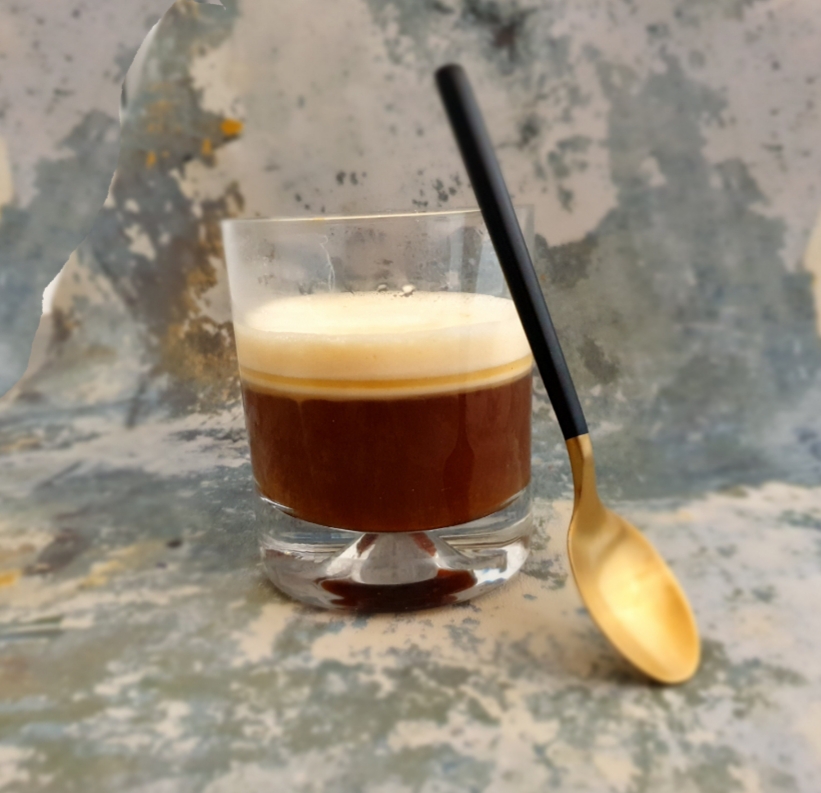
What was an especially appetising touch was the way the lipids in the cream separated out into a greasy yellow layer upon contact.

Even I felt this might be a step too far as I carried it up the stairs to my husband at 11.00am. The cream was sort of frothing about and the smells were confusing – hot meat and alcohol, cinnamon, vanilla, orange. There was a lot going on.

I think my husband sensed it wasn’t going to go well for him and was doing a fabulous bit of pretending to be asleep when I came to the bedroom. He opened one eye blearily.

“No, no, no, no…”

“It’s Beef Tingler -” (in hindsight, probably shouldn’t have opened with that.)

“No.”

“It’ll be good for you, possibly.”

“Please, just take it away. No. Dear God, what’s that smell?”

It was clear he would not sip even a little. It would have to come down to me. I managed two spoonfuls in total before it went down the sink. The cream was very odd – foamy but quite thin because so much of it had melted. It had mixed with the top part of the broth by now which was really quite alcoholic but not in a good way and tasted faintly cheesy.

I assume the brandy was meant to be the ‘tingler’ in this but who the bloody hell would know? No one, I repeat, no one, will have ever managed to swallow down enough of it to find out.

On to dessert and straight faces are maintained all around for the arrival of ‘Stimulating Jelly’ and its author, Fannie Farmer. I kid you not.

This recipe is from the 1905 edition of Ms Farmer’s American cookbook Food and Cookery for the Sick and Convalescent. I liked that title, it lent an air of occasion to the situation I was in. It made me feel almost like a real doctor consulting a manual – which food to help with this illness, which food to avoid for that. Ms Farmer’s approach to food in this book is nothing short of astoundingly scientific for its time. She starts off with a pretty impressive chapter on the classification of foods, including a diagram of a classification tree of organic and inorganic matter and the chemical elements of each type of food (carbon, hydrogen, sulphur etc) and makes a big deal of the fact that food for the sick should be both appetising to look at and not just variations on faintly flavoured water.

The book is broken down into sections depending on the type of meal one wishes to cook, so I flipped straight to chapter 24: ‘Jellies’. If beef broth was the quintessential convalescent’s meal, then surely jelly was the quintessential convalescent’s pudding.

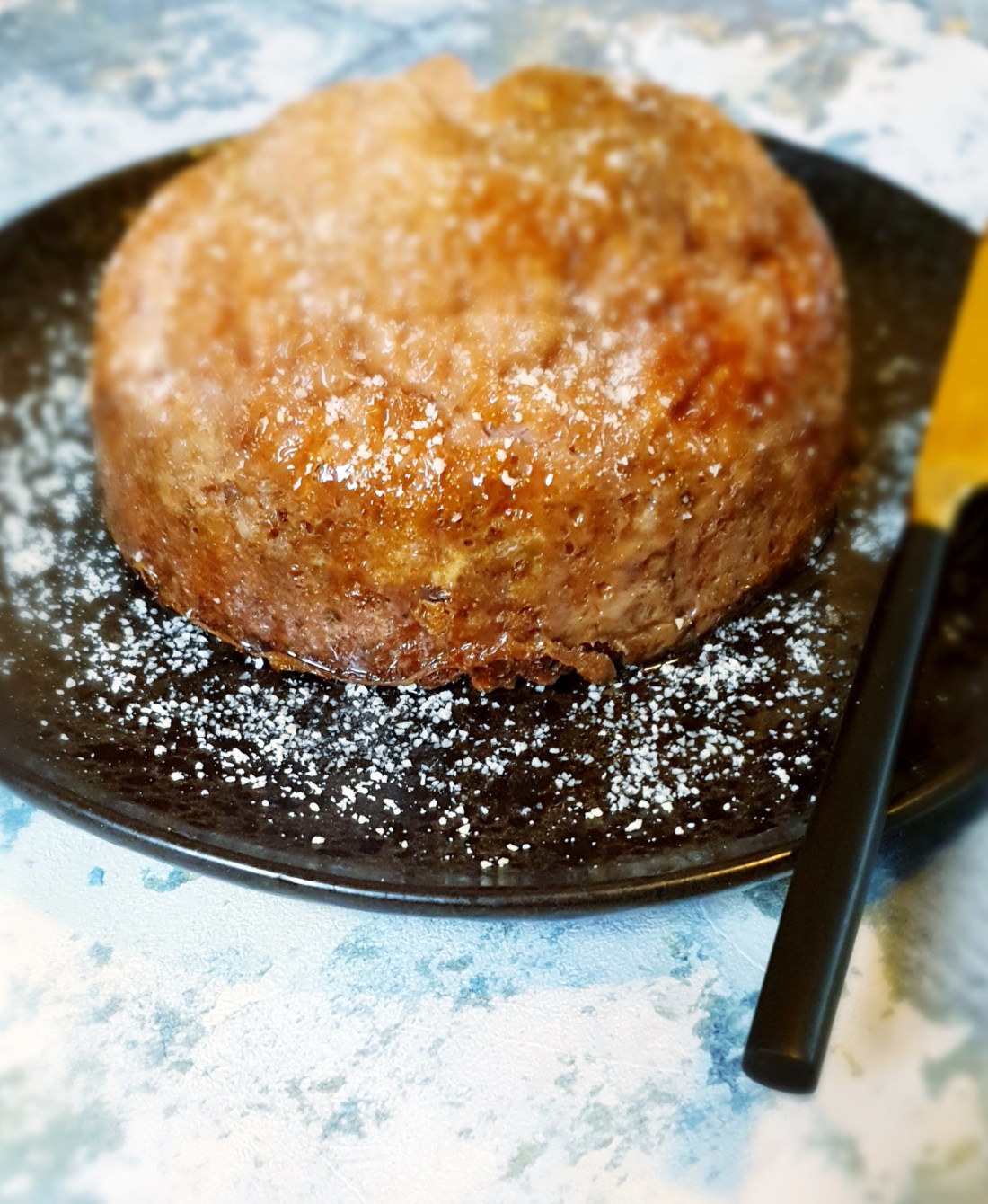
It started off normally enough and I flipped lazily past recipes for lemon jelly and orange jelly and milk jelly until I stumbled across the alcoholic jellies – which is where I found Stimulating Jelly. The main flavour in this was port, which we randomly happened to have in (possibly a gift a from some polite guest who clearly doesn’t know either of us?). I couldn’t see my husband objecting too much if I brought him a jelly made mainly of alcohol, so I ploughed on.

The port bubbled away for 10 minutes or so with half a cinnamon stick and one (Fannie was very precise about that) clove. After this had cooked, I added lemon juice, sugar, 3/4 granulated gelatin and – you guessed it – beef extract. This was essentially the liquid that had been squeezed out of a raw steak. Even in puddings, the belief that even tiny quantities of meat juice would perk you up was prevalent.

I poured the mixture into a ramekin, noting that Ms Farmer assumed there would only be one invalid in the household judging by the amount her recipe yielded, and popped it into the fridge.

At least it set…

I attempted to convince my husband (who had rallied enough for a chicken tikka sandwhich while I spluttered my way through Beef Tingler, by the way), to give this a try. I didn’t tell him about the beef juice at the time. Like all good nurses I eventually succeeded in trapping and exhausting my patient into submission and he took one tentative spoonful. And another.

“It’s not too bad,” he conceded. “I can’t finish it all though.”

He wasn’t wrong – it was a much stronger flavour than we might expect a jelly to be, because of the alcoholic nature, but it wasn’t unpleasant. It was even quite refreshing, dare I say – stimulating? The beef juice lent a subtle savoriness to it rather than being a taste of its own; as my husband put it “it’s not too overwhelming, I’m not like ‘oh my god what’s this cow doing in here?'”

I’m pleased to report that after a day cowering under the duvet from me and dishes of various wobbling shades of brown, my husband is feeling fit to work tomorrow. I may not know much about modern medical practices, but I reckon a return back to serving beef broth, in all its various forms, to invalids might ease some of the pressure on our hospitals. At the very least it would free up more time for NHS staff to watch some well deserved TV.

E x

Beef Tingler

1 can of beef broth
1/8 can of brandy
1/4 can of whipping cream
Zest of 1/4 orange
1/4 teaspoon vanilla extract
Pinch of cinnamon
Pinch of nutmeg

  1. Heat the broth and brandy in a pan.
  2. Whip the cream, vanilla, cinnamon and nutmeg together into soft peaks.
  3. Fold the orange zest into the cream.
  4. Dollop a spoon of the cream onto the soup.

Stimulating Jelly

3/4 teaspoons granulated gelatin
1/3 cup of port
1/2 cinnamon stick
1 clove
3/4 teaspoon sugar
1 teaspoon lemon juice

  1. Heat the port with the cinnamon stick and clove for about 10 minutes.
  2. Remove from heat and add the lemon, sugar and gelatin and stir.
  3. Pour into a mold and set in the fridge for 5 hours.

Zamzaganu: c. 1750 B.C.

No, it’s not a Dr Seuss character.

I’m fortunate that I’m able to teach topics that are often not covered in mainstream education. One of them is the early history of the Persian Empire. Oh, sure, none of the kids can pronounce or spell any of the names of the people without the help of complex mnemonics that take half the lesson to get through (Nebuchanezzar, anyone? Alright – how about Udjahorresnet?) and they all seem to think that finding a decent coach company is the main reason why we won’t be going on a school trip to the Iranian site of Pasargadae any time soon, but overall it’s a privileged position to be in.

Like all good ancient history, lots of our knowledge about ancient Persia is made up. Details of heroic feats and daily life have come to us from historians who either had an agenda to push at the time, or had an agenda to push a couple of hundred years later. You can usually tell when a historian isn’t being completely authentic when they quote, supposedly word for word, the private pillow talk that convinced a king to go to war. Of course, Herodotus could have had a time machine and a much more open relationship with Persian king Darius and his wife Atossa than other historians had previously understood, but evidence for that is limited.

Unfortunately, the historian Herodotus is pretty much all we have in terms of writing when it comes to the Persians. As he embellished a lot of his texts with anecdotes and stories, we have to take a lot of what he says about the history of Persia with an entire cellar of salt. Combined with other fragments of text and physical artefacts, though, historians who specialise in non-fiction are at least able to fill in some of the gaps about this ancient civilization (and Daniel, if you’re reading this – for the last time: no – that doesn’t mean you can just ‘make it all up in the exam’.)

However, since this meal isn’t really about the Persians, but rather the people of Babylon who came before them and ‘lent’ their land and people to the Persian empire, I’m not going to go into too much depth about them. Read it here if you’re desperate. What I will say is that Herodotus tells us that “there is no nation which so readily adopts foreign customs as the Persians” and so even if today’s meal wasn’t Persian per se, it’s likely that if a recipe was good enough to write down then it was good enough to ‘adopt’, and so may well have been enjoyed by founding father of the Persian Empire Cyrus the Great 1,000 years later as he and his army conquered Babylon in 539BC. In fact, the Persians seem to have been exceptionally fond of fine dining and consumed such excessive amounts of food that Alexander the Great, when conquering the Persian Empire, found a pillar detailing some of the details of Cyrus’ banquets and was so horrified by the levels of excess and gluttony that he ordered it to be torn down. Problematic as he is, Herodotus also tells us that costs for food for the Persian king Xerxes and his entourage were so enormous that the royal mob risked bankrupting the Greek cities they swept through if they stayed longer than one day.

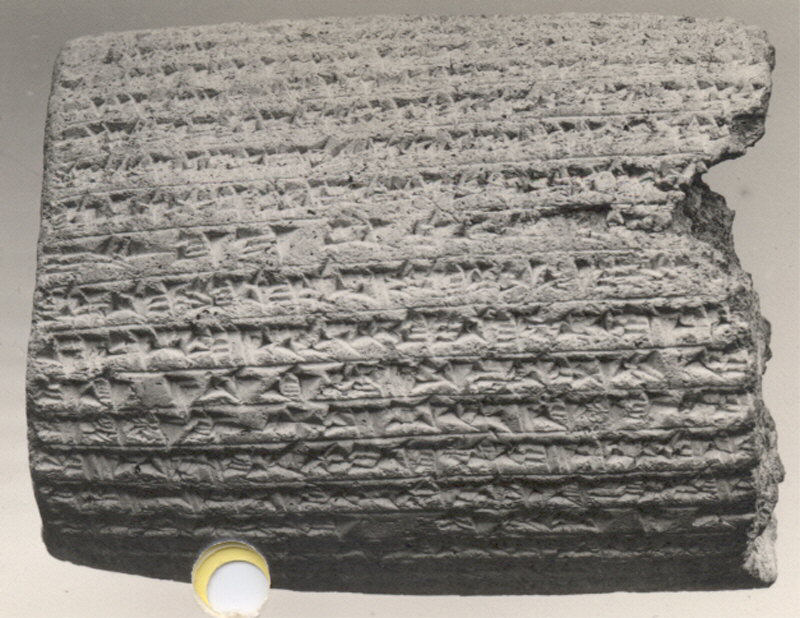
What I’ve attempted for this post is one of the oldest recipes ever found. It comes from a set of broken tablets from ancient Mesopotamia which the team at the Yale Babylonian Collection have been painstakingly repairing and translating from cuneiform – the oldest form of writing in the world. Unsurprisingly, it’s not been an easy task. There are words that have no modern day equivalent and whole chunks that are missing. Like many of the recipes that would follow, these read more as inventories of ingredients rather than clear instructions and assume a level of cultural understanding I don’t have. Despite every effort, sometimes a best fit guess has had to be used in order to glean an insight into what these people meant – for example the word suhutinnu, which seems to appear in almost every recipe found, has no description other than an indication it might be some sort of root vegetable as it’s referred to being “dug up”.

Historians were disappointed to learn that when translated, this particular cuneiform cylinder said “Oi Darren you’re dumped, I saw you kissing Chloe behind the chip shop, never contact me again.”

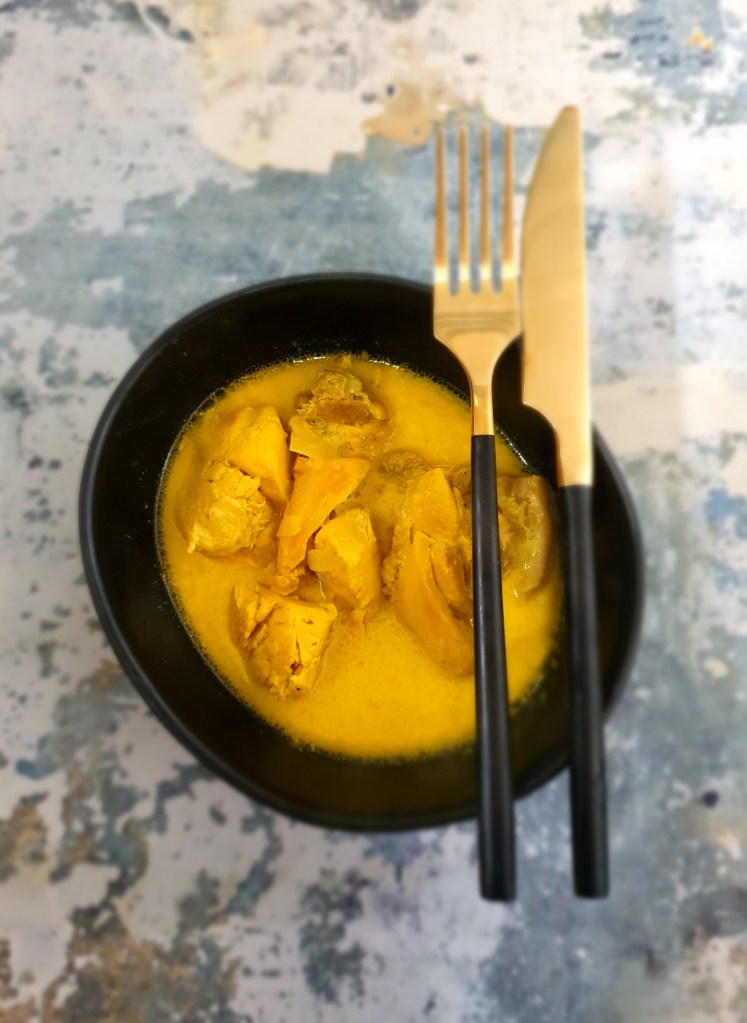
The recipe was taken from this blog. It was unclear exactly what meat should be used but Laura Kelley, author of The Silk Road Gourmet has conducted research into the dish’s name ‘Zamzaganu’ and discovered that it may translate as ‘field bird’. I chose guineafowl for the not at all academic reasons that it was currently on special offer, I’d never cooked one before and it sounded more interesting than chicken. The second problem was how to cook it. The recipe just said to ‘cast the meat in a kettle’ (not that kind) but I didn’t fancy de-boning a raw carcass that, even if it was on special offer still cost £6.50, just to boil it to death in plain water and end up with disappointingly bland chunks of meat like Mrs Beeton’s rabbit stew. Since the instructions were vague, I decided to employ some of Daniel’s imagination skills and chose to interpret this as a primarily roasted meat dish. Laura Kelley may agree with this choice as she states “the recipes allow for a great deal of creativity in using what is on hand or in reinterpreting dishes…” I cooked the guineafowl in the oven for just over an hour and after it had been cooked and rested tore it into lumps and placed them in a pan.

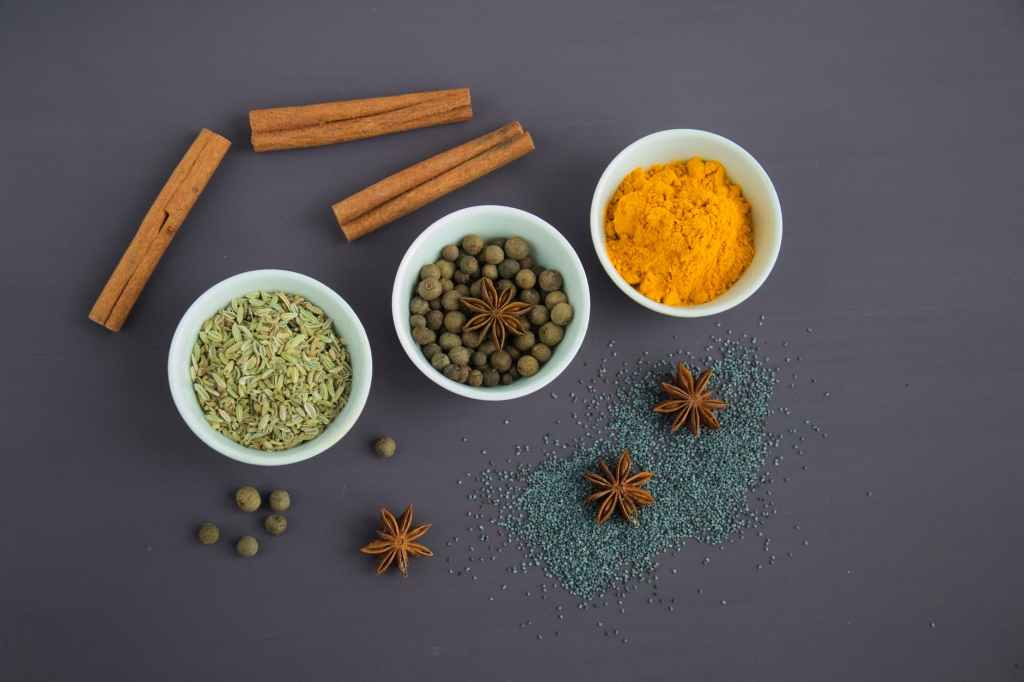
To this I added chopped dates, cumin seeds and coriander seeds and fried it all together in the juices of the roasted guineafowl and a little water until a fatty sauce had formed. Once that had been cooked through and the dates were softened, I strained the meat and dates from the sauce and placed it in a bowl. It was then time to work on the Babylonian equivalent of a side dish.

An absolute staple of Mesopotamian food appears to have been garlic and leeks, with most recipes found including these ingredients in some form or another. It’s amazing, actually, just how much garlic is mentioned in the tablets and so I became a bit blind to how much I was adding – it was like each time I read the word ‘garlic’ I thought I had to add to another clove, forgetting that I was reading about multiple recipes and techniques, and not just the one I was working on. This recipe called for mashed leeks and garlic to be cooked in the sauce of the meat, which sounded brilliant. The trouble was that I had become so emboldened by how well it was all going I ended up mashing about five or six cloves of garlic before I realised that I’d gone quite mad and just because the texts mentioned garlic a lot, didn’t mean they added that much to individual dishes. It was too late by this point and although the mashed leek and garlic looked strong and punchy it also smelt strong and punchy. Very punchy. To this I added slices of raw turnip – the suhutinnu mentioned earlier – and let it all cook for a few minutes.

Immediately had to go and wash everything I owned after this in case the smell of garlic lingered and year 11 made fun of me on Monday. You know they would.

That was it. The recipe gave no indication of whether the meat should be added back to the greens or not. Luckily for me, this fantastic blog gave me an insight into how Cyrus the Great might have enjoyed this meal if did survive the centuries between its creation and his conquest of Babylon. It would appear that dishes were served separately in the palaces of Cyrus, with meat, bread and vegetables all being brought out on individual platters from which guests could help themselves. I therefore decided not to add the guineafowl back to the bowl, but serve it as its own dish.

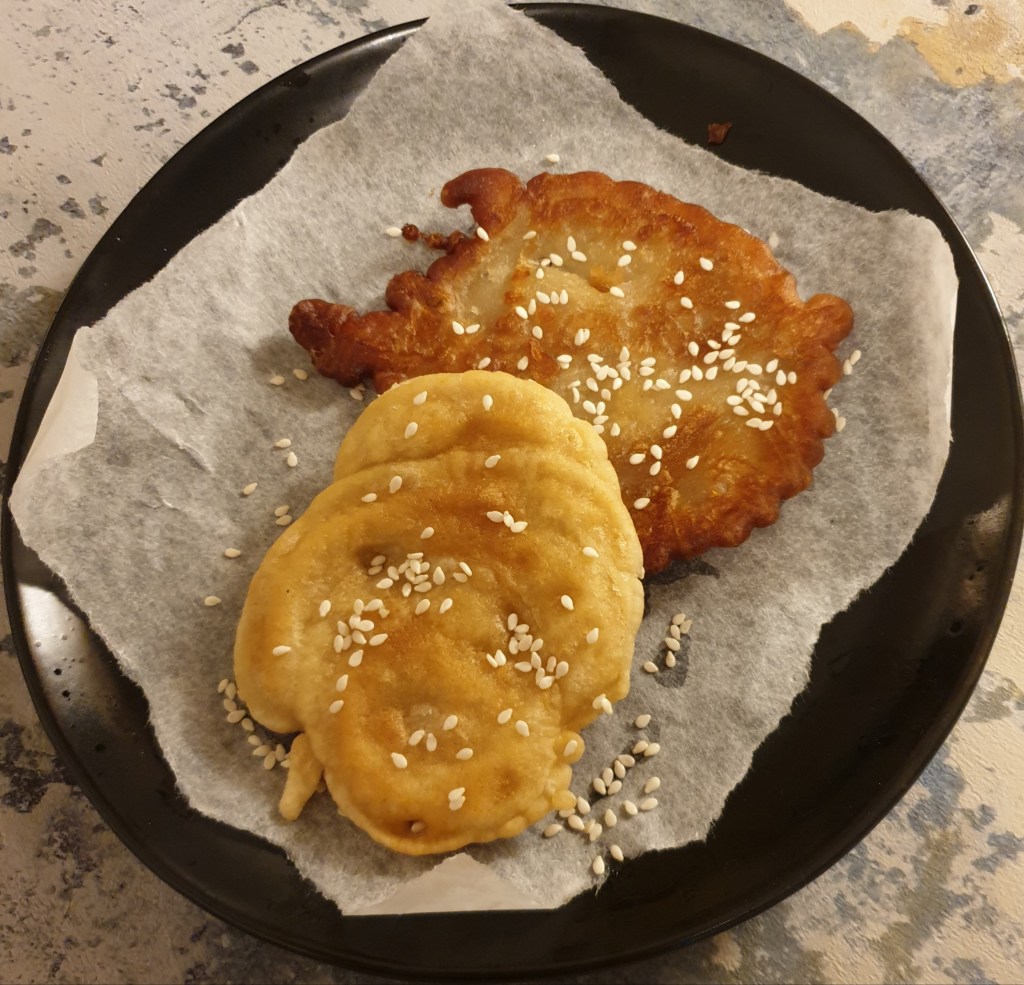
To finish off the Babylonian banquet I added a final staple of all ancient dinner tables: bread. Everyday Life in Babylon and Assyria states that there were four varieties of bread that were consumed in the ancient kingdom. The most common and widely eaten was a flatbread made of barley flour and would have almost certainly been consumed at the palaces of Persian royalty centuries later too: on Cyrus’ dining pillar that had so offended Alexander the Great there was a list of provisions for the king’s table, among which was barley flour. The flatbreads were likely cooked on griddles over open flames, or in domed clay ovens. I compromised and employed the same technique I used for my Anglo-Saxon bread: dollops of barley flour mixed with water on a griddle pan with a wok placed over the top to encourage some element of leavening from the steam.

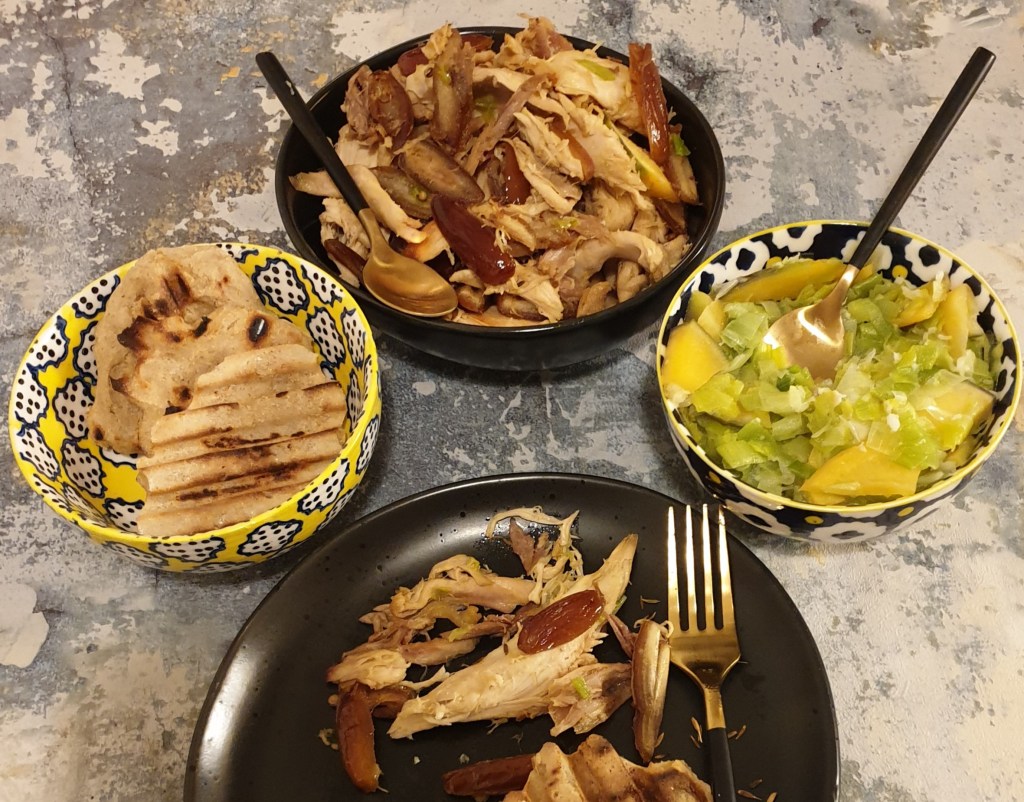
After a few minutes, the barley breads were done. I placed the various elements of the dish into individual bowls and summoned my husband with all the imperiousness of a Persian king.

Now I understand why they called him Cyrus the Great

Sod Cyrus, I was ready to invade Babylon myself when I plated it up. My husband liked it so much he’s taking the leftovers to work (not the leeks and garlic – we need him to keep his job.) If you get the quantities right there was nothing about this that was unpleasant and in fact most of it was absolutely delicious. I could see why the Persians kept it!

The guineafowl was very flavoursome, probably because it had been roasted before being fried with the dates and spices and the dates were sticky and sweet, but not overbearing. The coriander and cumin worked particularly well too. Each fork was a sticky, treacly mouthful – the only criticism I had was that it was slightly drier than I’d like, possibly because of the double cooking. I’d drizzle oil over it and baste the meat during the roasting stage next time – the only reason I didn’t this time round was to try and be as authentic as possible since the recipe didn’t mention using oil at all.

Obviously, the leeks and garlic were very, uh, garlicky but even so still delicious. The turnip was a bit odd because it was pretty undercooked, but I just ate around the slices. Because the leeks had been mashed with the fat from the meat it wasn’t an insipid side dish but almost rich enough to be a meal on its own – you could taste traces of fat and cumin and occasionally a touch of date syrup would trickle through too. In fact this was probably the part I enjoyed the most.

The barley cakes were excellent at mopping everything up once it was finished. The barley flavour gave a more nutty finish than wheat flour, which went well, and the fact they’d been grilled meant that the chargrilled parts added yet more flavour and texture.

I know I employed some of Daniel’s technique of ‘make it up and hope the examiner doesn’t realise’ when approaching this dish, but it was really tasty. Even if this Babylonian meal had been lost to time by the time the Persians rolled into town, I can absolutely see why flavours and combinations such as these survive in much of the foods consumed in the Middle East today.

E x

Zamzaganu

1 guineafowl
8 – 10 dates
Cumin seeds
Coriander seeds
1 leek
2 – 3 cloves of garlic
1/2 Turnip
5 dessert spoons of barley flour
Water

  1. Brush the guineafowl with a little olive oil. Roast at 190 degrees for 75 minutes, basting frequently.
  2. While the bird is cooking, chop and quarter the dates.
  3. When the guineafowl is cooked, tear the meat from the bones and place in a pan. Pour the fats from the baking tray into the pan and add the dates and cumin and coriander. Add a little water to the pan and cook until the dates are soft and sticky. You may need to add more water as it cooks.
  4. Strain the liquid and place the meat, dates and spices to one side, cover with foil to keep the heat in. In the pan of liquid, mash the leek and garlic and add slices of the turnip. Cook together for 10 minutes.
  5. While the leeks cook, mix the barley flour with enough water to form a thick paste and pour dessert spoon sized disks of the paste onto a hot griddle pan. Cook the dough disks on each side until cooked through (about 5 minutes per side).
  6. Serve!

Zamzaganu: 1600BC

No, it’s not a Dr Seuss character.

I’m fortunate that I’m able to teach topics that are often not covered in mainstream education. One of them is the early history of the Persian Empire. Oh, sure, none of the kids can pronounce or spell any of the names of the people without the help of complex mnemonics that take half the lesson to get through (Nebuchanezzar, anyone? Alright – how about Udjahorresnet?) and they all seem to think that finding a decent coach company is the main reason why we won’t be going on a school trip to the Iranian site of Pasargadae any time soon, but overall it’s a privileged position to be in.

Like all good ancient history, lots of our knowledge about ancient Persia is made up. Details of heroic feats and daily life have come to us from historians who either had an agenda to push at the time, or had an agenda to push a couple of hundred years later. You can usually tell when a historian isn’t being completely authentic when they quote, supposedly word for word, the private pillow talk that convinced a king to go to war. Of course, Herodotus could have had a time machine and a much more open relationship with Persian king Darius and his wife Atossa than other historians had previously understood, but evidence for that is limited.

Unfortunately, the historian Herodotus is pretty much all we have in terms of writing when it comes to the Persians. As he embellished a lot of his texts with anecdotes and stories, we have to take a lot of what he says about the history of Persia with an entire cellar of salt. Combined with other fragments of text and physical artefacts, though, historians who specialise in non-fiction are at least able to fill in some of the gaps about this ancient civilization (and Daniel, if you’re reading this – for the last time: no – that doesn’t mean you can just ‘make it all up in the exam’.)

However, since this meal isn’t really about the Persians, but rather the people of Babylon who came before them and ‘lent’ their land and people to the Persian empire, I’m not going to go into too much depth about them. Read it here if you’re desperate. What I will say is that Herodotus tells us that “there is no nation which so readily adopts foreign customs as the Persians” and so even if today’s meal wasn’t Persian per se, it’s likely that if a recipe was good enough to write down then it was good enough to ‘adopt’, and so may well have been enjoyed by founding father of the Persian Empire Cyrus the Great 1,000 years later as he and his army conquered Babylon in 539BC. In fact, the Persians seem to have been exceptionally fond of fine dining and consumed such excessive amounts of food that Alexander the Great, when conquering the Persian Empire, found a pillar detailing some of the details of Cyrus’ banquets and was so horrified by the levels of excess and gluttony that he ordered it to be torn down. Problematic as he is, Herodotus also tells us that costs for food for the Persian king Xerxes and his entourage were so enormous that the royal mob risked bankrupting the Greek cities they swept through if they stayed longer than one day.

What I’ve attempted for this post is one of the oldest recipes ever found. It comes from a set of broken tablets from ancient Mesopotamia which the team at the Yale Babylonian Collection have been painstakingly repairing and translating from cuneiform – the oldest form of writing in the world. Unsurprisingly, it’s not been an easy task. There are words that have no modern day equivalent and whole chunks that are missing. Like many of the recipes that would follow, these read more as inventories of ingredients rather than clear instructions and assume a level of cultural understanding I don’t have. Despite every effort, sometimes a best fit guess has had to be used in order to glean an insight into what these people meant – for example the word suhutinnu, which seems to appear in almost every recipe found, has no description other than an indication it might be some sort of root vegetable as it’s referred to being “dug up”.

Historians were disappointed to learn that when translated, this particular cuneiform cylinder said “Oi Darren you’re dumped, I saw you kissing Chloe behind the chip shop, never contact me again.”

The recipe was taken from this blog. It was unclear exactly what meat should be used but Laura Kelley, author of The Silk Road Gourmet has conducted research into the dish’s name ‘Zamzaganu’ and discovered that it may translate as ‘field bird’. I chose guineafowl for the not at all academic reasons that it was currently on special offer, I’d never cooked one before and it sounded more interesting than chicken. The second problem was how to cook it. The recipe just said to ‘cast the meat in a kettle’ (not that kind) but I didn’t fancy de-boning a raw carcass that, even if it was on special offer still cost £6.50, just to boil it to death in plain water and end up with disappointingly bland chunks of meat like Mrs Beeton’s rabbit stew. Since the instructions were vague, I decided to employ some of Daniel’s imagination skills and chose to interpret this as a primarily roasted meat dish. Laura Kelley may agree with this choice as she states “the recipes allow for a great deal of creativity in using what is on hand or in reinterpreting dishes…” I cooked the guineafowl in the oven for just over an hour and after it had been cooked and rested tore it into lumps and placed them in a pan.

To this I added chopped dates, cumin seeds and coriander seeds and fried it all together in the juices of the roasted guineafowl and a little water until a fatty sauce had formed. Once that had been cooked through and the dates were softened, I strained the meat and dates from the sauce and placed it in a bowl. It was then time to work on the Babylonian equivalent of a side dish.

An absolute staple of Mesopotamian food appears to have been garlic and leeks, with most recipes found including these ingredients in some form or another. It’s amazing, actually, just how much garlic is mentioned in the tablets and so I became a bit blind to how much I was adding – it was like each time I read the word ‘garlic’ I thought I had to add to another clove, forgetting that I was reading about multiple recipes and techniques, and not just the one I was working on. This recipe called for mashed leeks and garlic to be cooked in the sauce of the meat, which sounded brilliant. The trouble was that I had become so emboldened by how well it was all going I ended up mashing about five or six cloves of garlic before I realised that I’d gone quite mad and just because the texts mentioned garlic a lot, didn’t mean they added that much to individual dishes. It was too late by this point and although the mashed leek and garlic looked strong and punchy it also smelt strong and punchy. Very punchy. To this I added slices of raw turnip – the suhutinnu mentioned earlier – and let it all cook for a few minutes.

Immediately had to go and wash everything I owned after this in case the smell of garlic lingered and year 11 made fun of me on Monday. You know they would.

That was it. The recipe gave no indication of whether the meat should be added back to the greens or not. Luckily for me, this fantastic blog gave me an insight into how Cyrus the Great might have enjoyed this meal if did survive the centuries between its creation and his conquest of Babylon. It would appear that dishes were served separately in the palaces of Cyrus, with meat, bread and vegetables all being brought out on individual platters from which guests could help themselves. I therefore decided not to add the guineafowl back to the bowl, but serve it as its own dish.

To finish off the Babylonian banquet I added a final staple of all ancient dinner tables: bread. Everyday Life in Babylon and Assyria states that there were four varieties of bread that were consumed in the ancient kingdom. The most common and widely eaten was a flatbread made of barley flour and would have almost certainly been consumed at the palaces of Persian royalty centuries later too: on Cyrus’ dining pillar that had so offended Alexander the Great there was a list of provisions for the king’s table, among which was barley flour. The flatbreads were likely cooked on griddles over open flames, or in domed clay ovens. I compromised and employed the same technique I used for my Anglo-Saxon bread: dollops of barley flour mixed with water on a griddle pan with a wok placed over the top to encourage some element of leavening from the steam.

After a few minutes, the barley breads were done. I placed the various elements of the dish into individual bowls and summoned my husband with all the imperiousness of a Persian king.

Now I understand why they called him Cyrus the Great

Sod Cyrus, I was ready to invade Babylon myself when I plated it up. My husband liked it so much he’s taking the leftovers to work (not the leeks and garlic – we need him to keep his job.) If you get the quantities right there was nothing about this that was unpleasant and in fact most of it was absolutely delicious. I could see why the Persians kept it!

The guineafowl was very flavoursome, probably because it had been roasted before being fried with the dates and spices and the dates were sticky and sweet, but not overbearing. The coriander and cumin worked particularly well too. Each fork was a sticky, treacly mouthful – the only criticism I had was that it was slightly drier than I’d like, possibly because of the double cooking. I’d drizzle oil over it and baste the meat during the roasting stage next time – the only reason I didn’t this time round was to try and be as authentic as possible since the recipe didn’t mention using oil at all.

Obviously, the leeks and garlic were very, uh, garlicky but even so still delicious. The turnip was a bit odd because it was pretty undercooked, but I just ate around the slices. Because the leeks had been mashed with the fat from the meat it wasn’t an insipid side dish but almost rich enough to be a meal on its own – you could taste traces of fat and cumin and occasionally a touch of date syrup would trickle through too. In fact this was probably the part I enjoyed the most.

The barley cakes were excellent at mopping everything up once it was finished. The barley flavour gave a more nutty finish than wheat flour, which went well, and the fact they’d been grilled meant that the chargrilled parts added yet more flavour and texture.

I know I employed some of Daniel’s technique of ‘make it up and hope the examiner doesn’t realise’ when approaching this dish, but it was really tasty. Even if this Babylonian meal had been lost to time by the time the Persians rolled into town, I can absolutely see why flavours and combinations such as these survive in much of the foods consumed in the Middle East today.

E x

Zamzaganu

1 guineafowl
8 – 10 dates
Cumin seeds
Coriander seeds
1 leek
2 – 3 cloves of garlic
1/2 Turnip
5 dessert spoons of barley flour
Water

  1. Brush the guineafowl with a little olive oil. Roast at 190 degrees for 75 minutes, basting frequently.
  2. While the bird is cooking, chop and quarter the dates.
  3. When the guineafowl is cooked, tear the meat from the bones and place in a pan. Pour the fats from the baking tray into the pan and add the dates and cumin and coriander. Add a little water to the pan and cook until the dates are soft and sticky. You may need to add more water as it cooks.
  4. Strain the liquid and place the meat, dates and spices to one side, cover with foil to keep the heat in. In the pan of liquid, mash the leek and garlic and add slices of the turnip. Cook together for 10 minutes.
  5. While the leeks cook, mix the barley flour with enough water to form a thick paste and pour dessert spoon sized disks of the paste onto a hot griddle pan. Cook the dough disks on each side until cooked through (about 5 minutes per side).
  6. Serve!

Meat Pie: 1901

It’s that time of year again, the week we’ve all been waiting for: National Pie Week! Get your bibs on and gather round to sing the most festive and famous of all Pie Week carols:

It’s beginning to look a lot like Pie Week
Everywhere you go
Take a look at the five and ten
It’s glistening once again
With gravy stains and smeared on mashed ‘tato…

Johnny Mathis ‘It’s beginning to look a lot like Pie Week’

National Pie Week is the thoughtful contribution to British culture from the creative team at pastry manufacturers Jus-Rol who I’m sure had only public spirited reasons for coming up with this national holiday and no other ulterior motives whatsoever when they introduced it back in 2007. Since then, however, it does seem to have taken on a bit of a life of its own; this year has seen the topic of ‘Pie Week’ feature in several national newspapers and debates on morning TV about the best and worst pies. Truth be told I didn’t know National Pie Week was a thing until a few days ago when I was searching for inspiration on what to cook next for this blog. Don’t get me wrong – I’m very happy we have a National Pie Week, it’s just it’s not something that I’ve ever noticed up until now.

The notion of a ‘worst’ pie got me thinking, though. What would that look like? I wasn’t looking for mud pies of the sort I made when I was a child (which involved mixing compost and manure in a flowerpot before squodging it into frisbee and trying to force feed it to my sister when mum wasn’t looking – recipe below!), but something that was actually meant to be eaten. Did such a ‘worst’ pie exist? Would I be doomed to a Lord Woolton’s Pie fiasco again or would it be another apple pie triumph? Furthermore, what were the criteria for a ‘worst’ pie and who did they belong to? I didn’t know.

Someone who felt they did know what ‘the worst’ meant was Charles Dickens. Arguably his most famous work, Oliver Twist, deals with themes such as poverty though the lens of the Victorian workhouse and acts as a commentary on what Dickens perceived to be the failings of 19th century society towards its most vulnerable members: the poor. In Oliver Twist, a cherubic but immensely irritating young boy is cast into the brutal world of the workhouse where children are beaten, starved and forced to work all day long; they are just about as downtrodden as you can get before turning into complete caricatures. The most famous line of all – when Oliver asks for second helpings: “please sir, I want some more” – and the consequential beating given to the boy was a Dickensian tut of disapproval at those parishes which, during the 19th century, made it illegal to serve second helpings to workhouse inmates. By the way, I’m using the term ‘inmate’ deliberately – partly because that’s what members of a workhouse were called and partly as a reminder that however flippant this post gets, conditions were no better than in a prison and the people who voluntarily and out of complete desperation entered workhouses were stripped of all freedoms and dignity.

Southwell Workhouse. It’s probably a 5 star hotel now. Or a luxury block of flats.

The idea of a typical workhouse is something that everyone has some understanding of – either through the musical Oliver! (where the character Oliver is made so undeniably kick-able that one can’t help rooting for Mr Bumble) or from year 4 history lessons on the Victorians, or year 6 history lessons on the Victorians, or year 8 history lessons on the Victorians…

In fact, workhouses form so much of our understanding of Victorian poverty that there’s the risk of thinking that’s all they are: Victorian inventions designed to punish people for being poor. And that’s not true. Well, it is, but that’s not the whole truth. Like so much in history, the whole truth isn’t as black and white or easy as workhouses=bad and so the full truth has sort of been swept away in favour of songs about petty larceny and the rise of capitalism (I assume that’s the theme of ‘Who Will Buy’ – I stop listening when Oliver begins to sing in that dog whistle tone of his.)

The history of English workhouses is complex but stems back to as far as the medieval period, possibly further, when the Statute of Cambridge of 1388 placed heavy restrictions on the movements of beggars and sought to put some responsibility for the care and provision of such people on the community they came from. Although lack of thorough enforcement limited the success of such laws, the Statue of Cambridge became seen as the first Poor Law Act of many to come.

Efforts to control the poor (and more importantly establish who was responsible for them) continued throughout the centuries through various acts and laws and included efforts to define who counted as ‘poor’ and the types of provisions that should be offered to them. In 1722 Sir Edward Knatchbull drew up The Workhouse Test Act which gave guidance to parishes on how to set up workhouses and advised them that, as the idea of being sent to a workhouse should act as a deterrent to poor people, workhouses should only accept those in most desperate need. Sixty years later the utilitarian philosopher Jeremy Bentham (AKA that attention seeking oddball who had his body preserved and put on display after he died) went a step further and attempted an early form of privatisation in the form of a national company which would build and maintain 250 workhouses, financed by investors. The inmates would be put to work and fed a sparse diet thereby ensuring profit margins stayed fat and inmates stayed desperate (and thin). All for the greater good, eh, Jeremy?

Still, workhouses offered refuge to a range of people: the sick, elderly, impoverished and unlucky. If you had a great enough need, the workhouse was there to provide a roof over your head, a small amount of food and shelter from the dangers of living on the street. It wasn’t a caring place, however; unmarried mothers in particular were scorned and pregnant unmarried women were often treated harshest because the cost to keep them was considered disproportionately high in comparison to their “social worth” as England entered the era of the “deserving poor” vs the “undeserving poor”.

The image of workhouses most of us are familiar with peaked in the mid 19th century and coincided with the economic boom of the Industrial Revolution. It’s hardly a coincidence that the cramped, dark, disease ridden images of workhouses that fill history textbooks almost exactly mirror the cramped, dark, disease ridden factories from this time. In 1834 the government was becoming increasingly concerned that the cost of running workhouses would prove too much, so it created the Poor Law Amendment Act. This Act enabled the creation of the Poor Law Unions which grouped parishes together under the control of several appointed ‘guardians’ and encouraged them to think of workhouses as unofficial mills. Those inmates who were well enough to work in such workhouses were now forced to labour in silent factory style production lines; the focus was now on profiteering from people’s misery and misfortune rather than solving the problem of poverty. The government took a cut of whatever income the workhouse produced, and the workhouse guardians and shareholders split the rest. Families were split up according to the jobs they could do, with children usually separated from their mothers and forced to live and work in entirely different buildings often for several years or even, if their fates did not improve, separated for the rest of their lives.

By the end of the 19th century there was at least one workhouse in every parish and people were becoming increasingly uncomfortable with the idea that they were living in close proximity to such dreadful institutions. One reason for this cultural shift was the fact that a significant number of women were elected as guardians of workhouses and worked to highlight and improve current conditions through organisations such as the Workhouse Visiting Society, founded by Louisa Twining. Another reason was that in 1892 the property rental value of some workhouses was lowered to £5. This price drop allowed some working-class people to reach the threshold income needed to be elected as Board members and, as some of these Board members had experienced first hand the conditions inside workhouses, they sought to change things.

As attitudes around workhouse conditions began to change, so too did the function of the workhouses. By the late 19th century most of the people in workhouses were there because they were ill, alone and couldn’t afford medical care. Workhouses increasingly took on the role of unqualified hospitals and homeless shelters, with an emphasis on attempting to get inmates back on their feet if possible through nutritious food and a no-nonsense brand of Christian charity. With this in mind (and seeing a way out of a business model that had lost much of its profitability) the government released new legislation in 1929 which stated that local authorities could take over workhouses and use them as hospitals instead. It wasn’t a quick or ever fully completed change over, however, as Susan Swinton’s childhood spent growing up in a workhouse in the 1960’s and 70’s shows.

Anyway, time to put away the woe-is-me violin and get back to the food.

The recipe I’m using is from the Manual of Workhouse Cookery which was issued to guardians in 1901 and has been reprinted in Peter Higginbotham’s excellent book The Workhouse Cookbook. What immediately struck me about the recipes in this cookbook were that they sounded…okay. Not amazing – it was a workhouse after all, but definitely not just gruel. As Higginbotham reveals “[the] benchmark in formulating the workhouse diet was that on no account should it be superior or equal to the ordinary mode of subsistence of the labouring classes of the neighbourhood.” There were also different menus according to whether it was a meat day or not, and according to how ‘deserving’ you were of the workhouse’s charity – able bodied men in work received better food than unemployed women, for example.

The meat pie that I made today was basically meat and potatoes with a pastry topping (therefore not a true pie, in my opinion) but it used salt, pepper and dripping to add flavour. I could see no reason for the workhouse to add seasoning like this other than for the enjoyment of the diners, which suggests that in the workhouses of London parishes where this book was issued the guardians were at least partially concerned with something more than just the profits to be made out of the inmates. Okay, so maybe it was also partly because in some workhouses the cooks had to eat the same fare as the inmates and it’s true, there are stories of some of the more unscrupulous guardians mixing chalk and lower grades of flour in with pastry dough to make supplies stretch further, and the beef used in the recipe is described as being made up of “clods and stickings” left over from proper cuts, but the sentiment was there.

The recipe seems to give instructions for single serve pies – 5oz of meat and 4oz of potato per pie. Because I wanted to share the joys of the workhouse with my family, I multiplied the quantities by 3 to make one large pie instead.

Other than some mental maths, the instructions were really rather easy to follow, which I suppose was the point: the guardians weren’t running a 5 star restaurant here and the meals had to toe the line between being nourishing and an unintentional advertisement for an ‘easy’ life for those looking to dodge work.

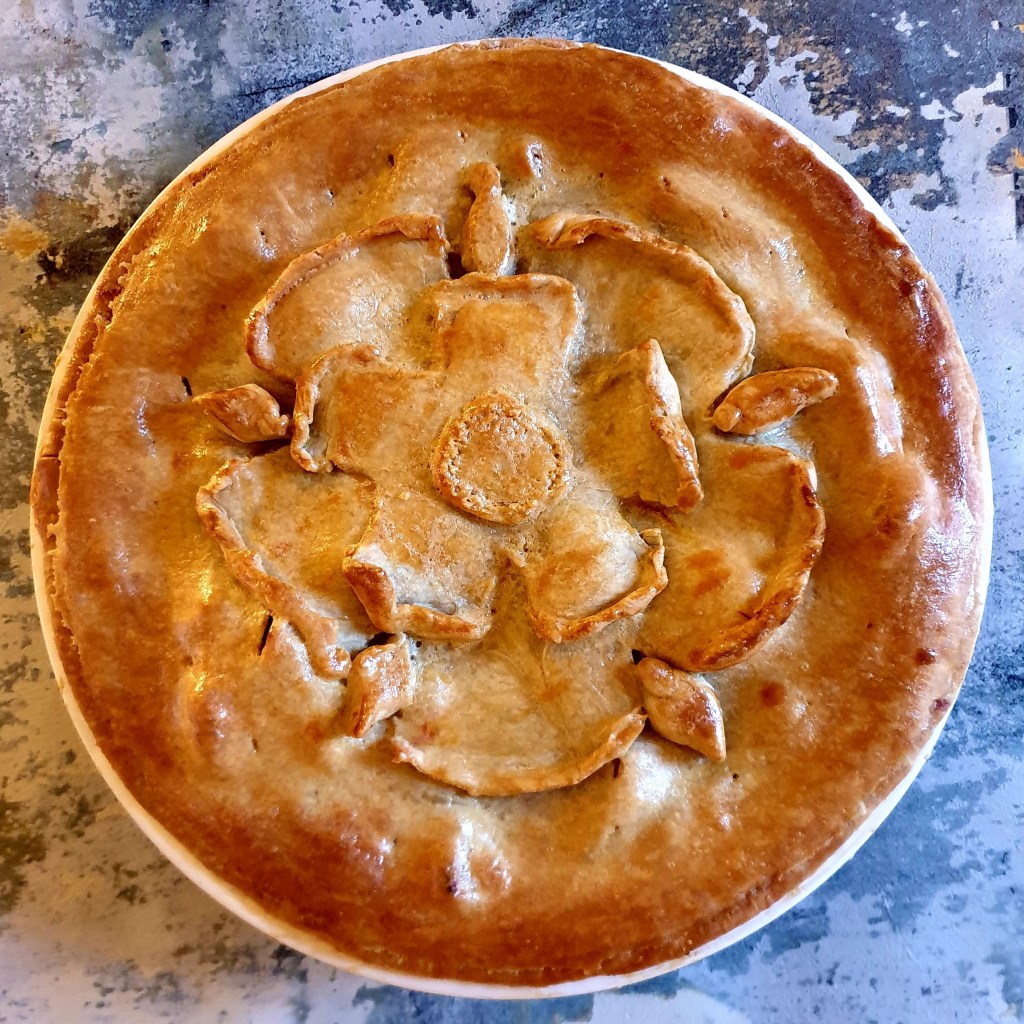
First I put the cloddiest looking beef chunks I could find in Sainsbury’s in a pie dish and seasoned with a good twist of pepper and salt. Then I laid sliced potato over the meat in a jaunty spiral pattern that I hoped would delight the two wretches who were going to eat it (my husband and daughter) whilst also inspiring them to better themselves, as all workhouse inmates should do. Honestly – I might have been fired if I’d been a workhouse cook because I felt that 12oz of potato wasn’t sufficient to cover the meat so I stole another 4oz from the pie of an imaginary workhouse inmate and added it to my own.

Making a recipe from a workhouse cookbook is the perfect excuse for not peel potatoes before cooking them – those paupers need all the nutrients they can get!

The pastry was made by rubbing beef dripping into flour and mixing it with water before lying on top of the meat and potatoes. Then it went into an oven at 160 degrees for just under two hours.

There were two main things that stood out about this pie: first – it was dry. It was a dry pie. Not inedible dryness, but definitely in need of additional gravy. Most of the water I’d added had evaporated and what was left was enough to provide a thin clear meat jus at the bottom. Fancy that, an inadvertent jus in a workhouse recipe.

Secondly – once you’d given your salivary glands a chance to recuperate, the meat tasted lovely. It’s amazing what a good amount of salt and pepper can do and I think because the seasoning had been sprinkled directly onto the meat but not stirred in with the water or potato, I could really taste it as if it were a salt and pepper crust. A jus and salt encrusted meat? No wonder Oliver wanted more.

The pastry case was underwhelming both in terms of taste and aesthetics – workhouse budgets didn’t stretch to egg washes or milk glazes so it was a bit pale to look at. Flavour wise I couldn’t tell the difference between a basic pastry made with butter and this one made with dripping – it was fine, but nothing spectacular.

It was clear that the aim of this pie was to be hot and filling (pastry and potato!) and inoffensive to even the most sensitive of stomachs (although again, I’m not sure workhouse charity would have cared that much if you didn’t like beef, or preferred a non-dripping pastry case). It fed my own workhouse mob nicely as a mid week dinner with some emergency Bisto and broccoli and those of you who may have been increasingly concerned for my daughter’s welfare with every new post will be pleased to know that when she demanded ‘more!’ she was only lightly beaten but was spared the singing.

Definitely not too GRUELling. Hilarious, I am.

Am I advocating a return to workhouse food? No, not really. But was it as bad as I’d been led to believe? No. Now, there is a caveat to that: my recipe is from the period when workhouses were becoming more socially aware and there are many accounts from the previous century of inmates being served mouldy bread and “milk porridge of a very blue complexion” instead of the relatively filling and nutritious pie I made. Additionally, this meal would not have been made available to everyone – unemployed but able bodied men, for example, could expect nothing more than the plainest of diets as punishment for their lack of work.

So, back to Pie Week. As the end of this glorious, much celebrated national holiday looms closer I’m wondering whether we should promote workhouse meat pie up there with all the other staples: beef and ale, chicken and mushroom etc. It certainly fits a lot of the criteria – meat filling, gravy (of a sort) and it even comes with its own serving of potatoes. The one problem? It’s not a pie, is it? Not really. Call me a Pie Purist if you must (just don’t let anyone hear you, you weirdo) but if it’s not got a crust all the way round it, it’s not a pie. And really, when all the evaluation of working conditions and family separation is done, that’s the real social injustice here.

E x

Meat Pie

400g beef chunks
400g flour
Salt and pepper
Water
125g dripping or lard
125g sliced potato

  1. Place the beef in the bottom of a pie dish.
  2. Add a little water and season with salt and pepper.
  3. Cover the beef with sliced potato.
  4. Rub dripping into flour until it is the consistency of sand. Add water to form a dough.
  5. Roll dough out and cover the potato and beef mixture.
  6. Cook at 160 degrees for 1.5 – 2 hours.

Orange Marmalade: 1600

My daughter has started waking earlier and earlier. I don’t mean 6:00am, which is still an unholy hour at the weekend but kind of manageable, I’m talking hours of the morning that shouldn’t be legal. 3:00am! 4:00am! Before having a child I didn’t know there was a 4:00am; it was like an urban myth. I’d heard Proper Adults talking about catching early morning flights for holidays, or doing shift work, or having to get up to let the dog out, but I always assumed they just had a really sick sense of humour.

But alas, my husband and I are now well acquainted with 4:00am get ups – the starless pitch black outside and the oppressive quietness punctuated only by our gentle sobs of defeat as we reload Baby Effing Shark onto the TV yet again. 6:00am has become the new lunchtime and by midday we aim to be back in pyjamas.

This morning I realised that, if our day is destined to start in darkness and fumbled panic as we usher our daughter downstairs to prevent her shouts travelling through the walls to the neighbours, we’d need some reinforcements. Usually this involves biscuits of some kind, but we didn’t have any in and neither of us fancied this idea too much because at the rate we’re going we’d get through several packets a day (actually I didn’t see a problem with that, but my husband – who is working towards his Proper Adult badge – pointed out it might not be very good health wise.)

So – biscuits were out. The second problem was that none of the shops near us would be open until 10:00am, it being a Sunday. This left an unacceptable six hours to go. What we wanted, what we really wanted, was a wholesome breakfast that wasn’t too much faff and felt healthy without being tediously ‘Instagram’: I wasn’t going to ‘enjoy’ a jog later, I don’t believe a bowl of mashed banana with a crescent of seeds tossed over it is a treat and at that time in the morning I was definitely not feeling #blessed.

Marmalade was what we needed. Even the word ‘marmalade’ sounds luxurious and inviting, especially when you imagine great spoons of it slathered on toast already dripping with butter. I also thought there would be something inherently comforting about big amber blobs of it glinting in the darkened living room as neon rays of whatever awful animated cartoon was now playing tried to penetrate through.

This scene of domestic chaos was probably not what Sir Hugh Plat had in mind when he wrote a recipe to ‘Preserve Orenges after the Portugall Fashion’. I imagine he envisaged women delicately nibbling at lozenges of it over fine needlework – not me wrestling with my toddler as I cut chunks of it out of her hair. Nevertheless, his recipe for marmalade (found in Sophie Lillingon’s excellent booklet A Recipe Book in the Tudor Fashion) was exactly what we needed this morning.

Published in 1600, the snappily entitled Delightes for Ladies: to adorn their persons, tables, closets, and distillatories with beauties, banquets, perfumes and waters was yet another collection of recipes and household tips written by a man to help women run their households more efficiently, whilst also remaining beautiful and fashionable in order to keep up with aristocratic Tudor society. Delightes for Ladies is therefore a bit of a maze of practical recipes, make up tips and hints on how to create the perfect Tudor banquet. It was therefore arranged alphabetically, which explains why advice on how to correctly perfume gloves is next to a recipe for boiled pike, and why tips to maintain oral hygiene immediately follow instructions for stewed duck.

Marmalade was introduced to England from Portugal where quinces – called ‘marmelos – were preserved in thick syrup and cut out into sweets. Orange marmalade in particular was a wintertime favorite of the Tudor elite. In 1560, Robert Dudley, would-be husband of Elizabeth I, purchased “a brick of marmalade” for a banquet to impress the Queen at a personal cost of 2s 4d – the equivalent of approximately half a week’s wages. Because the cost of of oranges was so high, recipes for marmalade preserve every aspect of the orange to get the best value for money, including flesh and rind. Rather than eaten on toast for breakfast, it seems marmalade was treated almost like a sweet and was set hard enough to slice into lozenges to be enjoyed at formal dinners.

Robert Dudley, Earl of Leicester and pioneer of the marmalade wooing technique

One hobby for rich Tudor gourmands was to disguise certain foods as something else; as part of the instructions for a brilliant banquet, Sir Plat gives recipes for sugar paste flowers and various sugar molds, including molds for plates, so that guests may be tricked into thinking sweet foods were savoury and crockery was, well, crockery. Tudor cooks in rich houses were nothing short of 16th century Heston Blumenthals (or should that be Heston Blumenthal is nothing short of a 21st century Tudor cook?) If all that food deception wasn’t exciting enough, Tudor hosts who could afford oranges and lemons and didn’t want to cook with them or eat them raw (thanks to a belief that uncooked fruit and vegetables were bad for you) would often have the rind carved into intricate decorations to adorn the table and delight guests with the patterns. Truly, the long winter evenings must have flown by.

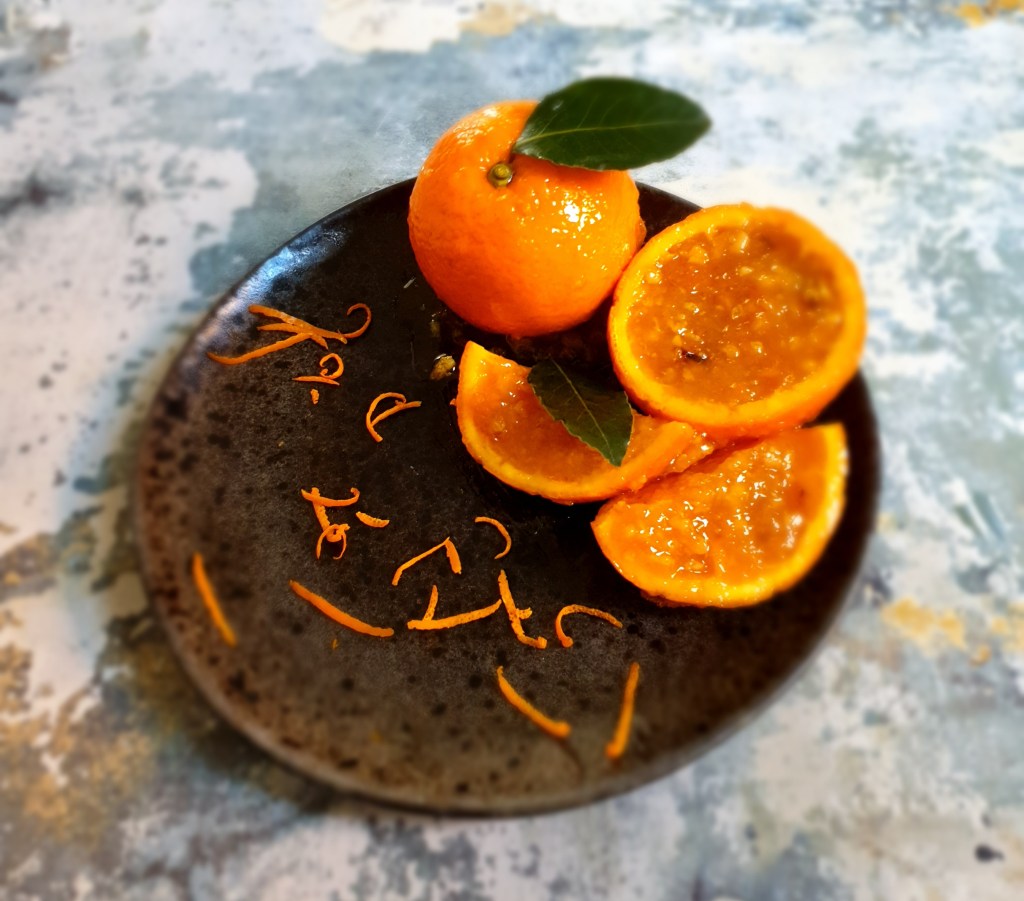
Sir Plat seems to have tried to incorporate the spirit of food trickery into his recipe, but went one step further by hollowing out an orange and filling it with marmalade – thereby succeeding in creating an orange disguised as…an orange: “then there will be marmalade of Orenges within your Orenges…” Orangeception.

My parents kindly came to relieve us of toddler duty mid morning so, having left them at the mercy of our daughter who was happily pushing playdough up her nose (hey – it was an improvement on mashing it into the carpet), I crept away to begin work on the marmalade.

I put two oranges, cut into quarters, in a pan and then added the hollowed out flesh of two more. I added enough water to just cover them (like all good historical cooks, Sir Plat gives no quantities) and boiled them together for half an hour until I could pierce the rinds easily with a fork. Then I removed the orange pulp, leaving the liquid behind and blended it until the rind was cut up fine. Instead of a food processor, Sir Plat recommended pulverising the oranges by beating them until they formed a paste, but time was of the essence here and my energy reserves did not stretch to mashing oranges by hand. Once the blended oranges had been put back into the liquid, the original instructions were ambiguous about how much sugar to add. Sophie Lillington recommended weighing the combined pulp and liquid and adding the same weight of sugar. For me, this was approximately 500g but will vary depending on the size of the oranges and how much water is added in the first place. Then it was time to boil the sugar and oranges up into marmalade.

I know that there are various stages to boiling sugar with suspicious names like ‘soft crack’ and ‘firm ball’ but I’ve not really had much need to dwell on them before. Desperate for this marmalade to be a firm success (in every sense of the word), and not trusting Sir Plat’s naive advice to just “boil [the oranges] in youre sirup: then there will be marmalade”, I resorted to using a very authentic Tudor sugar thermometer to measure when the mixture was up to 105 degrees – the setting point for jam. Even though oranges have a lot of pectin in them, in order to keep this authentic I wasn’t using jam sugar so I wasn’t going to take any chances.

Temperature reached, I spooned the thick amber goodness into four orange halves and poured the rest into a dish to keep in the fridge (show me one parent who has time to sterilise jars for God’s sake). After another half an hour or so the mixture was pretty much set and I was ready to create my own orange marmalade filled oranges.

Bloody. Hell.

Look at it. Look at it! Maybe I am a bit tediously ‘Instagram’ after all. After a lot of swearing and near disaster I managed to sort of glue two halves of an orange together and glazed them with a little of the syrup left in the pan in order to see how this might have looked when served in 1600. The other two halves I cut open to show just how successfully set the marmalade was – it was a bit like a soft jelly. Sir Plat had advised that when cut the marmalade should be “like an hard egg”, and it wasn’t far off. Admittedly the photos did have to be taken quickly but that was only partially to do with the fact that the marmalade oozed ever so slowly downwards the longer it was kept tipped up, and more to do with the fact that we couldn’t wait to try it.

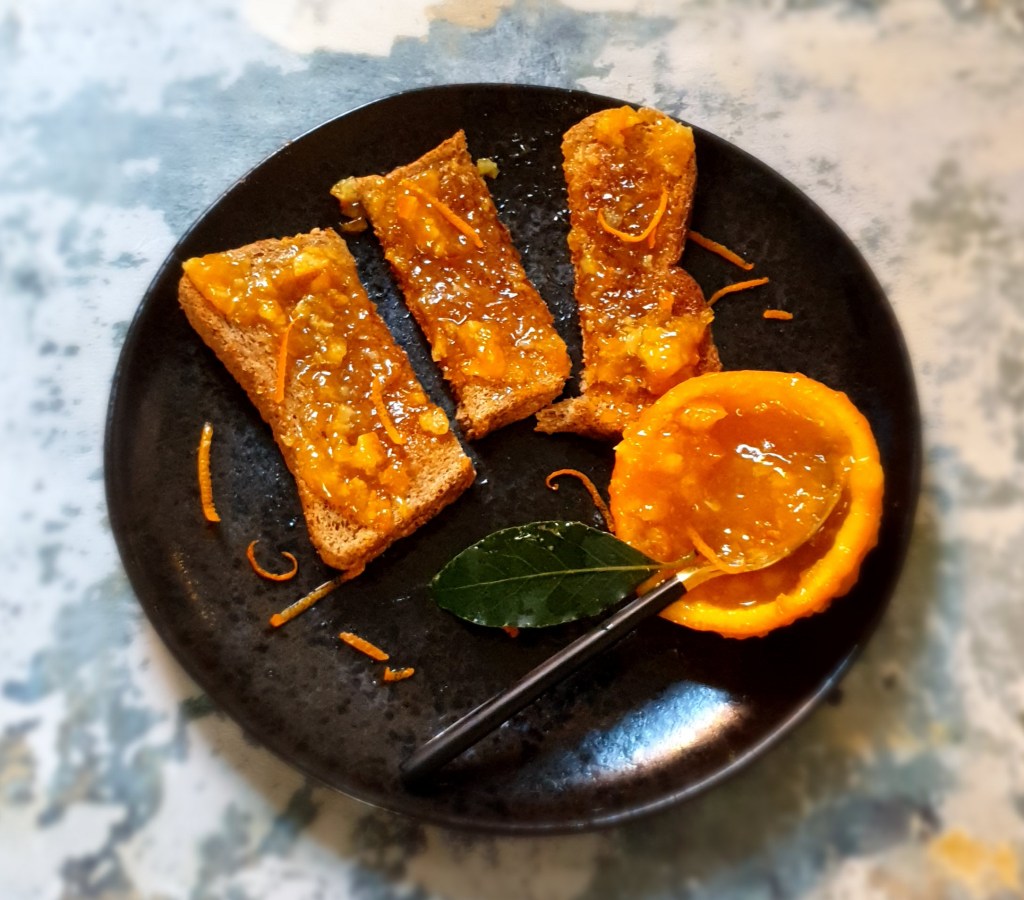
The marmalade tasted divine. I understand that there were various factors keeping Elizabeth from marrying Dudley, but I don’t get why she didn’t just abdicate the throne and run away with him if this was the sort of thing he was buying for her. It was sweeter than modern marmalade but still had a bit of the bitterness from the rind. Being exceptionally sticky it was soon clinging to every available surface but I didn’t care; I was in marmalade heaven.

Overall this was really straightforward to make (minus the orange stuffing bit at the end, which was one of the most stressful things I’ve ever done) and didn’t take half as long as I thought it would. It tasted far better than any shop bought marmalade too. I know I didn’t bother to sterilise any jars to keep this ‘cupboard fresh’ but to be honest it wouldn’t last long enough anyway – after twenty minutes all the marmalade in the oranges had gone and there were several teaspoon gouges in the stuff in the fridge.

Is it worth voluntarily getting up at 4:00am for? No. Don’t be stupid, nothing is. But does it make enforced 4:00am get ups bearable when nothing else so far has? Definitely.

E x

Orange Marmalade

4 large oranges
Enough water to cover the oranges
500g caster sugar

  1. Cut 2 oranges into quarters and place them in a pan. Add the pulp of the other two oranges (but not the rind) to the pan and cover with water.
  2. Boil for half an hour or until the rinds are very soft.
  3. Remove the orange rinds and pulp from the liquid and blitz in a food processor until the rind is chopped fine. Add this back to the liquid and weigh.
  4. Add the same weight of sugar to the orange mixture and boil until the temperature is 105 degrees.
  5. Spoon the marmalade into sterilised jars or containers.

Brazil Soup: 1909

It’s Lent. A time for abstaining from all that makes life worth living and doing large amounts of pondering all the awful things you’ve ever done while being increasingly sorry and mortified by them. As a species we’ve pretty much covered overthinking every mistake ever made and still being embarrassed by that time we called the teacher mum. Do we really need 40 days to dwell on it all – especially when all the chocolate’s been locked in the cupboard?

“Well,” one of my more philosophic friends told me when I announced my thoughts. “It’s not all about you, really.”

I asked her to repeat herself; in my head I’m used to hearing most of those words in that order most days, but the addition of the word ‘not’ was a new one.

“You’re meant to use the time to think about the things Jesus gave up for us and be reminded of the 40 days he spent in the desert, if you believe in that. Or how you can help people who aren’t as fortunate as you. And some people use it to kick start health regimes because it feels a more supportive time to start.”

I would hazard a guess that from the dawn of consumerism, Lent hasn’t been the most commercially profitable season. This is why you don’t see supermarkets getting themselves worked up over it; no matter how good your tagline, austerity just isn’t sexy: “This isn’t just any cabbage in plain boiling water; it’s M & S cabbage in plain boiling water.” Er, no thanks.

You know what is sexy? Chocolate. Slow motion shots of melted chocolate ribbons dripping off spoons and carefully curated piles of crumbly chocolate lumps, tumbling over each other in a carefree way. ‘Quick’, advertisers ordered, ‘get the Easter eggs out to stop people remembering they’re meant to be abstaining from shopping. Let’s spend these 40 days of Lent bombarding the suckers with almost indecent images of chocolate instead! We’ll tell them that they deserve to eat it all, even though we’ve just spent all of January telling them that they’re disgusting pigs who need to lose weight. Hide those diet pills – we’ll need them back on the shelves literally the day after Easter!’

Should probably have an 18+ certification
Photo by Marta Dzedyshko on Pexels.com

Nowadays, the reasons for participating in Lent may be countless and, as evidenced by supermarkets’ increasingly early Easter egg advertising, society’s attitudes to Lent might vary, but a few hundred years ago Lent was taken very seriously indeed. The early Catholic Church instructed its members that there were numerous ‘meatless’ days in the year which must be observed, including Lent but also Wednesdays and Fridays and various other fast days. The fasting was designed to encourage Christians to think about God, as well as show their unquestioning devotion to the Church. Early Lenten tradition was an amorphous mishmash of ideas about what could and couldn’t be eaten, and how often it may or may not be eaten, but by the 6th century the rule was to eat only one meal in the evening on fast days. That meal could contain no meat, butter, milk, cheese or eggs. This very severe set of rules lessened as time went on until Lent became a time to give up meat, but not necessarily limit oneself to one meal a day. To this day, the Church continues to instruct people on fasting protocol – in 1966 Pope Paul VI reaffirmed in the Paenitemini that Fridays were to remain penitential times where no meat (other than fish) could be consumed.

So, with my friend’s words ringing in my ears, I began to think about Lent a bit more and how I could selfishly twist it to suit my needs. I know, probably not what she had intended, but that’s what lazy proselytizing gets you. I decided that in honour of the first week of Lent, I would make a vegetarian meal from history. Not just a meatless Lenten recipe designed to make me repent my sins and long for the return of chicken dinners, but a truly wholesome vegetarian dish.

I was temporarily transported back to my primary school where the school dinners were amazing – proper Victorian style puddings and huge portions of mash and gravy, regardless of what the main meal actually was. The only trouble was my parents didn’t trust the safety of any meat that might have come into contact with beef, having endured the BSE outbreak of the 80’s and 90’s. As a result I experienced something I affectionately think of as ‘enforced selective vegetarianism’ but at the time I bitterly described as ‘mum won’t let me eat school dinners, even thought everyone else does and the meat isn’t that grey’. I vowed that this meal would be nothing like limp cheese sarnie lunch replacements and that it would be a meal in its own right.

Enter Mrs Jean Oliver Mill. In 1909 she wrote one of the first Scottish cookery books dedicated to promoting vegetarianism: The Reform Cookbook. At the time, there were some members of society who felt uneasy with certain common practices – eating meat and drinking alcohol, for example. These people were known as reformers and they had a problem with meat eating for various reasons: religious, ethical, monetary and health-related. Somewhat predictably, their call to ‘reform’ society’s eating habits were met with ridicule by many as Mrs Mill attests: “a vegetarian dare hardly sneeze without having one down upon him with ‘I told you so’ and ‘that’s what comes of no meat.'”

The Reform Cookbook was not only aimed at reformers looking to spruce up their diet, but housekeepers who wanted meat-free alternatives to summer lunches when the heat from the day would cause rotting meat to putrefy and stink. It was also a decidedly Scottish book; Mrs Mill commented that most of the cookbooks she had encountered were aimed at English audiences and though she bore no ill-will to the English, she was fed up of not understanding certain English phrases or quantities just as an English grocer wouldn’t understand a “Scotch lass who came in asking for a muckle broon pig tae haud butter.” I mean, she was right: first person to guess it right wins a fiver (unless you’re Scottish, in which case I’m not playing this particular guessing game with you!)

Brazil soup seemed to be the perfect starter meal for a fledgling veggie: it sounded unusual and more interesting than other veggie soups (yes, even the ones that think they’re exciting, like red pepper) and, most compellingly, it wasn’t just a meat-free version of a meal. Oh – and it didn’t contain mushrooms. Win-win.

It also, weirdly, didn’t contain that many vegetables either. In fact, it was fairly typical of the recipes in The Reform Cookbook in that Mrs Mill was genuinely concerned with promoting a healthy and nutritious lifestyle using as many available meatless resources as possible. That included veg, of course, but it didn’t limit it to veg alone. I think I’d been expecting the soup to have 80,000 different types of vegetables in it and served in a hollowed out pumpkin with spoons whittled from celery sticks.

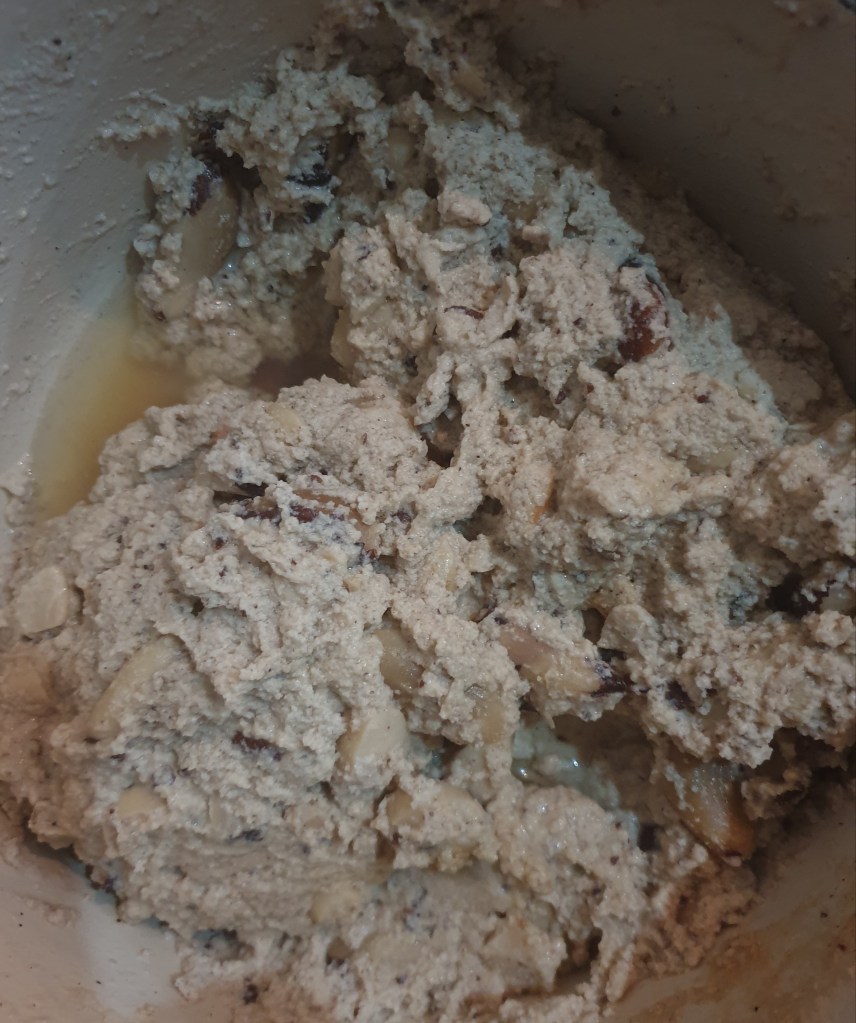
First, I roasted 500g of brazil nuts and then ground them in a food processor. Well – I say I ground them, but really I ended up just chopping most of them up because my food processor is old and blunt and I felt a bit sorry for it – the brazil nuts just laughed in the blades’ faces and wouldn’t grind down into anything more than gravel size. Mrs Mill says you should pass the nuts through a ‘nut mill’, whatever one of those is, to achieve a nice sandy consistency but Argos didn’t have any nut mills in stock in the half hour window I had between getting to a shop and picking my daughter up from nursery, so half-hearted gravel it was. I added the brazil nuts to a stock of haricot beans, celery and onions and let it cook for six hours. What?! Did early 19th century vegetarians not have social lives? Did they not work? Surely they had better things to do that watch a pan of boiling nuts bobbing around for a quarter of the day?

Apparently not. I actually fell asleep while this was cooking, only to be woken by my husband later with the worried face of a man who knew that if he wasn’t careful with his wording there’d be two types of nuts boiling in the pan.

“I know you asked me to keep checking on it, and I did. But I left the lid off for a bit and when I went back…well…I’m sorry, but it’s turned into a bit of a gruel…”

Introducing a new and exciting type of food: regurgitated gruel! Coming to a bin near you!

It really had. I’ve never written a cookbook, least of all a cookbook designed to convert the doubting masses to a new style of eating, but I’m fairly sure using the word ‘gruel’ to describe a dish is advertising suicide. No matter, it wasn’t finished yet. Maybe this was meant to happen, remember I had been meant to leave this to simmer for six hours (though I’d only managed four) – what did Mrs Mill expect to happen?!

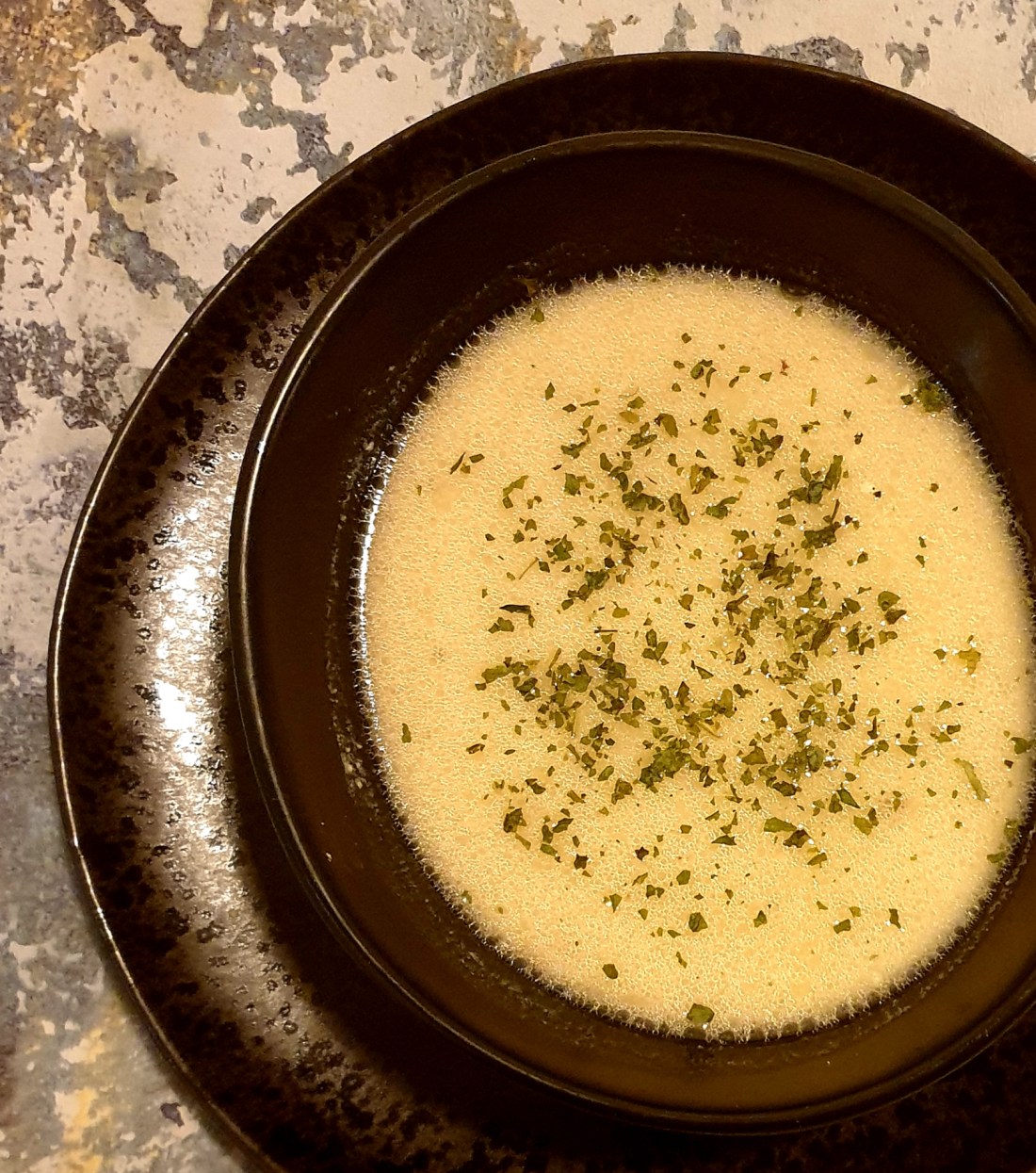
To the gruel I added a pint of whole milk and gradually stirred it in. As I did so the gruel eased up a little and became much more like a thick stew. I added a bit more milk so I could strain it through a colander and added some chopped parsley. Though the soup now looked a whole lot more appetising and I was fairly sure this would taste quite pleasant, I made my husband try it first as his punishment for gruel-ifying it in the first place. He took a sip…

…and pulled a face.

It turns out that when you roast and then simmer brazil nuts for four hours they take on a distinctly mushroom-y flavour. Kind of earthy and rich. I felt a bit betrayed by Mrs Mill; I’d deliberately picked this soup because it was meant to be a new taste and more importantly contained no mushrooms. But here it was, slopping about in the bowl acting like the world’s most successful mushroom soup understudy.

It was also quite gritty, which was entirely my fault, but still a bit off putting nevertheless. If you wanted to try this I’d recommend putting the effort in to grinding the brazil nuts as finely as possible. It was also quite oily even though I’d not added any oil to the mixture. I’d sort of anticipated this, but was still surprised by just how much oil there was.

More like brazil NOT soup (sorry)

Overall it wasn’t a disaster. In fact, if you like mushroom soup it actually might make a bit of an interesting alternative. I could even see this being something delicious if there was some garlic, salt or chili added to it. Ironically, once the mushroom flavour had gone it even had a faintly meaty/savoury aftertaste, which I’m not sure the reformists would approve of. I’d serve this as a small starter, though, rather then a main course as the oil might put people off and, like I said, mushrooms are disgusting so who’d want a whole bowlful?

I don’t think I’ll be giving up meat for good for Easter, but I’d be willing to sacrifice brazil nut soup. Sorry, Mrs Mill – this household will just have to suffer the stench of rancid meat in the summer after all.

E x

Brazil Soup

1 litre vegetable stock
500g brazil nuts
Chopped or dried parsley

  1. Roast the brazil nuts in an oven for 10 to 15 minutes.
  2. Grind the roasted nuts to as fine a powder as you can.
  3. Add to the vegetable stock and cook on a low heat for 4 hours, or until most of the liquid has evaporated.
  4. Add a pint of whole milk and incorporate. Add more milk if you prefer a thinner consistency.
  5. Strain soup through a sieve (or colander if you prefer more texture.)
  6. Add parsley and/or croutons.

Pancakes through time

I know – I’m late to the party. It seems the world and its wife have been posting about pancakes and their histories recently but work has been busy and I missed the chance to cook them all yesterday, so I hope you’re ready for another Pancake Opinion Piece today instead.

Let’s be honest right from the start – there are two types of people in the world: those that like their pancakes thin with sugar and lemon, and those that are wrong. You were all thinking it (and if you weren’t you need to take a good hard look at yourself in the mirror.)

Oh, pancake fads may come and go – and yes, I’m counting Nutella in this, deal with it – but the eternal Queen of pancakes is a paper thin lacy crepe absolutely drowning in fresh lemon juice and rapidly dissolving mountains of sugar. I have known people who swear by abominations such as fresh fruit and cream or melted chocolate with a glug of Baileys or Cointreau and have even met truly twisted souls who say they enjoy a ham and cheese pancake (it’s pancake day not galette day!) Since I don’t have time for that sort of nonsense in my life I try to spend as little time with these people as possible and will deny all friendship with them if directly asked. Sorry, mum, but some of us have standards.

I didn’t want to add to the mountain of information about why we celebrate pancake day – Shrove Tuesday – as there’s really only a limited amount to say about it but you know the drill: last day before Lent to use up all the food you actually want to eat before embarking on a miserable 40 days of hiding in the pantry secretly stuffing crisps in your mouth when you should be fasting instead. I’m sure I don’t need to tell you that all this is in preparation for gorging on chocolate at Easter as a celebration of the time Jesus returned from the dead as a man-sized bunny and performed the miracle of handing out candy eggs to children who happened to be visiting Golgotha that day on a school trip. Or something like that.

Shrove Tuesday may be a distinctly Christian celebration but it has roots that are much, much older. There’s evidence to suggest that before Christianity arrived in Britain, pagans enjoyed pancakes at the start of spring (because the round shape symbolised the returning sun) in a celebration a bit like the Eastern Slavic tradition of Maslenitsa. Before that, pancakes were enjoyed by Ancient Roman soldiers as they ate their breakfast before returning to their station to keep guard over the portions of Britain they’d conquered. And before that too, high up in the Italian Alps the 5,300 year old Stone Age man Otzi enjoyed pancakes as part of his last meal – traces of charcoal in the grain found in his mummified stomach indicate that he cooked and ate something that may have resembled a pancake before he died.

Go on – find another pancake blog that would lead with an image of a mummified corpse

So you’d think that this foodstuff – which spans millennia, religions, countries and customs – would have undergone some pretty radical changes. The pancake Otzi munched on as he hunkered down from the snow and tried to dodge skiers must have looked unrecognisable to the one my daughter kindly left festering on the floor under the table, right?

And yet, not so. Okay there may be some differences in thickness and the laciness so evidently required for a pancake to be truly worthy of its title, and some of the basic elements may have become more refined over the years, but the fundamental principle of what a pancake is doesn’t seem to have changed: flour and liquid (and sometimes eggs) mixed together and fried in a pan in fat.

For this pancake day I had planned to do something spectacular – attempt the original Crepe Suzette. Despite having no previous experience of flambéing or the ability to speak French beyond ‘le weekend, je vais à la piscine’ (a phrase I haven’t needed to use as much as my French book made me think I would) I did not immediately foresee a problem with this. No, it was only when it became apparent that there was no definitive first Crepe Suzette that I began to question whether it was possible.

One of the most popular origin stories of Crepe Suzette relates to a teenage waiter Henri Charpentier in 1895. The story goes that whilst working at the Maitre at Monte Carlo’s Cafe de Paris, he was called upon to prepare a dish of pancakes for the Prince of Wales and his entourage. As he sensibly mixed the alcohol together next to a naked flame, it accidentally caught fire and he thought the dessert was ruined. Fearing the loss of his job, he tasted it in the hope it could be salvaged and to his delight found it was “the most delicious medley of sweet flavors I had ever tasted.” The Prince thought so too, and when he asked what it was called the suck-up Charpentier told him that in honour of His Royal Highness he had named it Crepe Princesse (because like chairs, police stations and socks, all French pancakes are apparently girls.) The Prince asked that since there was a lady present in his entourage, could Charpentier rename the dessert after her – and so Crepe Suzette was born. Soon after Charpentier published this tale in his autobiography, the Maitre restaurant released a vehement response calling his version of accounts a lie because, given his young age at the time, there was no way he’d be let loose as the waiter to royalty. Other less self-aggrandizing stories tend to give versions that link Crepe Suzette to the French actress Suzanne Reichenberg, or the chef Monsieur Joseph’s desire to wow his diners and keep the food warm at the same time.

Whatever the truth was, it was clear that I was going to struggle with this one. Actually, it’s probably good that I didn’t attempt it as one restaurant critic wrote that the flames reached heights of 4 foot – and that was in the hands of an expert. So instead I decided to look at pancakes from three distinct time periods: Ancient, Medieval and Georgian.

Teganitai: 2nd century

Our first pancake comes courtesy of Galen, a man who’s well known as a 2nd century physician and philosopher in the Roman Empire but who somehow manages to escape the well-deserved title of ‘twit who helped halt medical advancement for a thousand years’ thanks to his promotion of the 4 Humours. History is full of twits like this so to be fair it’s not solely Galen’s fault that for years people thought that if someone was really sickly draining them of their blood would somehow cure them, but he definitely had key role in the tenacity of this belief.

When he wasn’t inadvertently contributing to humanity’s demise, Galen liked to write his thoughts down. He liked it a lot. In fact, he wrote so much down that even though an estimated two thirds of his works have been lost, the surviving texts we do have account for almost half of all the extant works of ancient Greece. One of these texts is called On the Properties of Foodstuffs and is a sort of treatise on various foods and their perceived attributes and abilities to cure or cause illness. For example, Galen advised boiling lentils once and seasoning with garlic to give a laxative effect (known as ‘purging’ in Humoural Theory) and that onions should be eaten by people with colds to thin the phlegm and restore the balance of the Humours.

On the Properties of Foodstuffs also contains one of the earliest written pancake recipes which Galen calls ‘teganitai’. It’s a very simple dish of wheat flour and water mixed into a paste the consistency of thick cream and then fried in olive oil. Galen mentions that there are two main flavourings that people added to the mixture – sea salt and honey. So, once my daughter had hoovered up her pancakes and set a new world record for stickiest toddler, I set about making my own teganitai.

Having just eaten binned my daughter’s rejected floor pancakes (as well as being deeply disappointed that the two flavourings weren’t lemon and sugar), I only made enough to make one of each type of teganitai. The batter was a doddle to mix up and heating the oil wasn’t exactly a minefield either. It’s interesting, then, that Galen writes about the production of these as if it were intricate surgery, going so far as to give detailed instructions on how to flip the pancake once it was cooked: “…the cook turns it, putting the visible side under the oil, next to the pan, and bringing the sufficiently fried side, which was underneath at first, up on to the top, and when the underneath is set they turn it again another two or three times till they think it is all equally cooked…” I mean I know I complain about a lack of detail in older recipes but that was too much.

After my basic kitchen competency had been sufficiently challenged, I tasted them. They. Were. Delicious. I take back everything I said before about Galen being a twit – who cares that his party piece was performing live dissections on squealing pigs? – the man knew how to make a pancake. I had been a bit wary of frying them in olive oil because I thought, given how few ingredients there were, that fried oil would become the dominant flavour and they would be limp and greasy but they weren’t at all. They were very reminiscent of doughnuts in that they were soft on the inside but crunchy outside but because of their smaller and flatter size they weren’t as greasy or heavy. Because they had been fried all over they weren’t soft and flexible, and of the two I preferred the honey pancake (the sea salt one was a little bland) because I naturally associate pancakes with sweeter tastes. The sea salt pancake cooked quicker and easier than the honey one because the batter was thicker whereas I found the honey one dripped a bit when I first flipped it (thus bringing the sufficiently fried side, which had been underneath at first, up to the top – cheers for the tip, Galen.) Although they cooked for the same amount of time, the honey one came out a couple of shades darker than the sea salt one, but it didn’t affect the flavour; I would genuinely make them again.

Teganitai – because Splodgeroos doesn’t sound Greek enough

Crespes: 1393

And so on to the medieval pancakes. Or should that be crepes?

I still really wanted to pay homage to my original idea of Crepe Suzette, but I also wanted to keep my eyebrows in tact. It was then that I was struck by the pancake gods of inspiration – why not make the first documented version of French crepe instead?

Enter the Goodman of Paris – a man who needs to thank his lucky stars he’s been dead several hundred years because the #MeToo movement would definitely want to have words with him. Written in 1393, Le Menagier de Paris (‘The Parisian Household Book’) was written by an anonymous 60 year old man for his very new and very young bride – an anonymous 15 year old girl. The central purpose of the book is to instruct the young girl on how to run a household and perform her wifely duties (gross) and, surprise, surprise, it comes off exactly as nobbish and pervy as you’d expect.

“Each night, or from day to day, in our chamber [I would] remind you of the unseemly or foolish things done in the day or days past, and chastise you, if it pleased me, and then you would strive to amend yourself according to my teaching and corrections, and to serve my will in all things, as you said.”

The Goodman of Paris to his wife

Dodgy relationships aside, one of the things the Goodman of Paris is concerned with is making sure his wife knows how to supervise and instruct her cooks in the correct preparation of fine food. Being a woman of some means (no, actually, a girl of some means – again: he is sixty years old, she is fifteen), she wasn’t expected to cook the food herself but should ensure her cooks knew how to. One of the many things her cooks should be able to prepare was ‘crespes’ and it appears that this is the first recorded recipe of something resembling modern day crepes.

This recipe was a step up from Galen in that it contained eggs and wine, but the general method was still the same: mix flour and liquids together and fry in sizzling butter. The difference was that this mixture was clearly meant to have higher quantities of liquid to flour, given that the Goodman says the mixture should “run around the pan”.

In an uncharacteristic bit of forward planning, I checked the recipe before I went out for the morning. I had to take my daughter to the dentist and figured that I could stop off at the shops beforehand to pick up anything I needed. Unfortunately it turned out the only thing I needed for this was white wine. No matter, I thought, I think I can style this out. Let me tell you now – I couldn’t. There can be little that’s more awkward than sitting in a dentist’s waiting room at 9:30 in the morning clutching a single bottle of Sauvignon blanc in one arm and a wriggling, shouty toddler in the other; I’m pretty sure that the receptionist called social services when we left.

In spite of the slight embarrassment, the wine was necessary because the recipe didn’t use any milk and only called for enough water to ‘moisten’ the egg and flour mix if it got too thick. I measured 150ml out and added it to the flour and eggs, which had been beaten into a smooth paste. The consistency was exactly the same as modern crepe batter and it cooked exactly like a crepe too, in a blob of butter. I felt delighted at the prospect of getting some real pancakes after all! Maybe, like his name implied, the Goodman of Paris wasn’t so bad after all?

Proper pancakes

These were also lovely. I could definitely tell there was alcohol in them but because they were so thin it was a background flavour rather than a key element. They had the texture of modern crepes and were just as satisfying. The only disappointment was that the Goodman served his with powdered sugar and made no mention of going one step further to add lemon juice, without which they were slightly dry.

I’d like to imagine that after a couple of years of putting up with him his young wife wrote her own version of Le Menagier de Paris filled with amendments and notes for him to improve on, but I suspect she didn’t. Maybe she just spat into his batter occasionally.

Rice pancakes: 1755

Someone who would have dished out criticism to the Goodman of Paris with the same relish as my daughter eating pancakes, was the English writer Hannah Glasse (of Curry ‘the Indian Way’ fame.) Hannah Glasse does not seem to have suffered fools gladly and wrote against French cooks specifically for being (as she saw it) wasteful and pretentious in their cooking: “I have heard of a [French] cook that used six pounds of butter to fry twelve eggs; when everybody knows…that half a pound is full enough, or more than need to be used: but then it would not be French. So much is the blind folly of this age [people] would rather [use] a French booby, than give encouragement to a good English cook!” Yikes. Also, what were 18th century French cooks getting up to in their kitchens?!

Glasse first published The Art of Cookery Made Plain and Easy with the modest tagline ‘which far exceeds any thing of the kind ever yet published’ in 1747. It sold quickly and went on to run to over 40 editions, each with new recipes in it. Lots of these recipes were plagiarised, but Glasse was on to a good thing and simply swiped criticism away with a well manicured hand.

The 1755 version of The Art of Cookery contains several recipes for pancakes ranging from “a fine pancake” which contained an insane 18 eggs and which Hannah ensures us “will not be crisp, but very good” to an equally decadent pancake containing orange blossom water and sherry. The one that caught my eye, however was rice pancakes.

I’d never cooked with rice flour before but expected these to be very gelantinous and imagined they’d be reminiscent of scotch pancakes in their thickness and size. Hannah implied they should too as she described the mixture as being the consistency “of pap” and just as appetising. A quick analysis of the pap batter in more depth shows that it’s based on exactly the same principle as the previous two pancakes – the main ingredients are flour and a liquid (eggs and cream or milk in this case) fried on a pan. The one difference with this recipe is that the fat is incorporated into the batter before frying.

The American Dream

Okay – these do look like the quintessential fluffy American pancakes – all that’s missing is a blob of butter and syrup. I admit they’re the most photogenic of all three pancakes and are probably what most people incorrectly think of when they think of pancakes. However, they were a pain to cook.

The recipe started off well enough and smelled lovely, kind of creamy and semolina-ish, thanks to the rice flour. As someone who loves a milk pudding, I was all over the idea of them at this point. I also found the rice flour really pleasant to work with, it just sort of dissolved into the milk as I stirred – unlike its temperamental plain flour cousin who always throws a hissy fit and clumps if I take my eye off it for even a second.

The trouble came when it was time to cook them. I don’t know if the measurements were off slightly, but it was hard to flip these. They kept disintegrating, so what you see in the photo is actually only about two thirds of the total, the rest ended up in fluffy piles in the corner or shovelled into my daughter’s mouth who now thinks it’s pancake day every day.

Taste wise, they were also the most disappointing of the three. Because I’d only put in a little sugar and Hannah doesn’t suggest serving them with any accompaniments they were a bit bland and underwhelming. Very fluffy and light, but just a bit…meh. Unlike American ones, these rice pancakes wouldn’t hold up against maple syrup – the liquid would just make them disintegrate even more. Amazingly and against all my natural instincts, I found myself thinking that would would really work would be melted chocolate and fruit, so I guess that in that respect they were a success.

Overall, it’s easy to see why the basic recipe for pancakes is so unchanged – they’re easy and quick and can be adapted to be as classic or as flamboyant as needed. I may not quite have achieved pancake nirvana in any of these recipes, but I’m glad they paved the way for my beloved lemon and sugar variety – and to anyone reading who still thinks there’s a better topping: flip off.

E x

Teganitai

120g plain flour
225ml of water
2 tablespoons of honey or a pinch of sea salt
Olive oil for frying

  1. Heat enough oil to cover the base of a pan
  2. While the oil is heating, mix flour and water together. Add either honey or sea salt.
  3. Spoon two tablespoons of mixture into the oil at a time, or until you have a pancake the size of your palm. Fry on one side for 1 minute.
  4. Flip the pancake and fry on the other side for 1 minute.
  5. Continue flipping over until evenly cooked.

Crespes

3 dessert spoons of plain flour
2 eggs
150ml of white wine
Dessert spoon of water
Butter to fry the pancakes

  1. Mix flour and eggs together.
  2. Mix water and wine and gradually add to the flour and egg mix.
  3. Melt butter in a pan and when it is bubbling, add enough batter to the pan, making sure it thinly covers the entire base.
  4. Cook for 1 or 2 minutes and flip the crepe over.
  5. Cook for 1 minute and then serve. Makes 5 or 6.

Rice pancakes

500ml whole milk
5 dessert spoons of rice flour
125g butter
Grated nutmeg
Sugar to taste
2 eggs

  1. Slowly heat the milk and 4 spoons of flour together until the mixture has thickened completely.
  2. Stir in the butter and let it melt.
  3. Grate the nutmeg into the mixture.
  4. Beat the eggs.
  5. Leave the mixture to cool a little before stirring in another spoon of flour and the beaten eggs and enough sugar to suit your taste.
  6. Cook in thick dollops on a hot frying pan for a couple of minutes on either side, turning when bubbles form and pop on the surface.

Green Apple Pie: 1574

One of the topics I’ll soon be starting with year 10 is the American West. It’s the study of how and why people in the 19th century moved westwards to settle across the vast landmass that is now the United States of America – pausing periodically for the odd massacre of the people who already lived there, moving again, pausing again to have a civil war and moving on.

When I ask my students what they think of when they think of modern day America the responses are varied and predictable: patriotism, flags, eagles, guns, baseball, fast food and big cars. But that’s not all America is to 15 year old British kids, is it? What about the values – the ideas – that make America similar and different to us?

Usually we manage to steer the conversations away from Donald Trump’s hair and on to more academic things like why the idea of ‘freedom’ (whatever it may mean) is so important to many Americans. The American West course isn’t just about looking at the actions of 19th century Americans and European migrants, but what their motivations were too. It’s about analysing the decisions and events which came to develop American beliefs such as personal liberty and patriotism into the forms we know today (including Donald Trump’s personal right to wear his hair however inexplicably he wants to.)

But when I take my teacher hat off and stop trying to think too deeply about it all, I always come back to food when I think of America. Hot dogs, fries and that weird plastic cheese that my mum made me think was worse than drinking a gallon of bleach when I was growing up, but that melts like nothing else on a burger. And I think of the food I’ve never tried but really want to: corn dogs, biscuits and gravy (which sounds like an abomination to the average Brit), kool-aid, grits… But the most American food of all – the quintessential American dessert – is apple pie.

Or is it?

Before the first settlement in Jamestown had even been dreamed of, the Tudors already had several varieties of apple pie and apple tart. In fact, pies of all kinds were an absolute staple of the Tudor dining table. Whilst hunting for the perfect apple pie recipe I also found recipes for pear pies, quince pies, peach pies, citron pies, gooseberry pies, prune pies (though why anyone would feel the need to make multiple versions of this is anyone’s guess) and cherry pies.

Only slightly disturbingly, pie crusts were known as coffins and their primary function was just to hold the delicious meat or fruit filling in place, sort of like a baking tin. The pastry itself wasn’t necessarily meant to be consumed, although it could be.

Pies were a favourite of that most rotund of Tudors: Henry VIII. He was reportedly particularly fond of quince marmalade and orange pies and in 1534 his household records the purchase of an orange strainer – an exotic and rare piece of equipment for both Tudor kitchens and my own kitchen. As part of the vast kitchens at Hampton Court there was a dedicated department known as The Pastry whose job was to produce the tart cases and coffins for Henry’s meat or fruit of choice. Such was the popularity of pies at Henry’s court, one of Hampton Court’s four great pastry ovens measured twelve feet in diameter. Most of the pastry cases made at The Pastry were wholemeal, but the king’s would have been made of the finest white flour. For more information on this definitely check out Alison Weir’s Henry VIII: King and Court.

This recipe is taken from A Proper New Booke of Cookery which the British Library tells me was one of the first books to include practical instructions of the kind we might recognise today: measurements – spoonful, ladleful – and cooking times. Like a pro, I’ve managed to eschew such helpful recipes and have instead succeeded in selecting one of the few that seems to contain neither measurement nor timings.

Imagine how pissed off you’d be to have painstakingly set the type on the printing press for this book, only to have someone rubber stamp it in 0.5 seconds
Copyright: British Library

For this recipe I felt it was time to call in some reinforcements so I gave my dad a call. Big mistake. He is a very good cook, but struggled to accept that this 500 year old recipe might be slightly different to his beloved Delia one.

“What on earth is it talking about: take your apples and core them as ye will a quince?” he frowned. “When was the last time you cored a quince?” he asked, like I’d personally written the recipe to spite him. “Do quinces have cores?”

We agreed to slice the apples thinly and sprayed some lemon juice over them to stop them going brown, even though the recipe didn’t call for it, because I actually think the man would have had an aneurysm if I hadn’t have let him. While he looked at a picture of Delia’s Complete Cookery Course to calm down, I got on with the coffin.

I had assumed that this pastry would be like a Tudor version of a shortcrust, but upon closer inspection it wasn’t anything like it. First I melted butter with water in a pan and added saffron to it. Then, I added the whites of two eggs and enough flour until the pastry formed a thick and smooth dough. It ended up a little like choux pastry, but much thicker.

I got dad to roll the pastry out onto my forever-ruined wooden worksurface while I added “enough” sugar, cinnamon and ginger to the apple slices. As with many other Tudor recipes, the quantity “enough” served as an indication to add ingredients in quantities that the master’s palate preferred. I calmly added as much sugar and spices as I desired and then my dad decided it was time we had an argument about butter.

“You should definitely butter the pastry dish,” he told me.

“It doesn’t mention it in the recipe, and the pastry has a lot of butter in it already. Anyway, we already added lemon to the apples and that wasn’t meant to be there either.”

“I would. Delia would.”

Long story short, we ended up compromising with an amount of butter that was neither negligible enough to match the butter-less recipe nor large enough to do anything useful in Delia’s eyes. Lose-lose all round!

The apple mixture encased in its coffin, I got on with the decoration. Since I used fine white flour, such as would have gone in a pie for the king, I felt that my apple pie should have some decoration befitting the royal table.

After his defeat of Richard III, and to stop any rebellions or power grabs from relations of Richard, Henry Tudor (father of Henry VIII) married Elizabeth of York who was Richard’s niece. In order to show that the two families were now one, Henry, master of propaganda that he was, combined one of the symbols of his house of Lancaster – a red rose – and one of the symbols of Richard’s house of York – a white rose to create that well known motif: the Tudor rose. He wasted no time in slapping this not at all subtle symbol everywhere – on doorways, building arches, bridges and wall panels. Anything that stood still enough for long enough was at risk of having the image carved into it. What could be more fitting for a Tudor pie than to decorate it with a Tudor rose?

Not ones for realism, the Tudors

I have to stop playing the ‘gormless dad’ angle at this point though because after seeing me struggle with freehand pastry carving he was the one who suggested drawing a stencil on grease proof paper and cutting round it. Instantly my roses were transformed from the sorts of splodgy modern art-esque designs that might have had me beheaded for treason into something that semi-resembled Henry VII’s emblem. The recipe then called for a rose water and sugar glaze to be pasted onto the top of the pie with a feather, but I felt that this would take too much time and since we’d already adulterated the original method with lemon juice and buttered dishes, I thought using a pastry brush wouldn’t matter now. The pie glazed, I put it into the oven for 1 hour and waited.

I was a bit worried that the pastry might not hold its shape, being a bit wetter than a bog standard shortcrust, but I was delighted to see that I’d be keeping my head when I pulled the pie out of the oven and saw that the rose was still in tact! In fact, the whole pie looked pretty damn delicious.

The pastry held its shape well when cut and the apples still had a bit of crunch to them, which I quite like. It was also neither too sweet nor too spicy because the quantities of sugar and ginger had been added according to my personal taste. I do have to grudgingly admit that the areas of the dish which had been greased well offered up the bottom of the pie crust a lot more easily than those areas that had only had trace amounts of butter smeared over them, but it wasn’t a huge effort to get it out. The only slight issue was that there was a lot of liquid in the pie, but that was quickly mopped up and could be drained out by making a small hole in the crust once cooked.

I don’t want to be presumptuous but I’m absolutely certain I would have become wife number seven if I’d presented this to Henry VIII

I had wanted to serve this with clotted cream and had found a 1594 recipe for it: “Clowted Cream after Mistres Horman’s Way” (whoever she is.) However, since the recipe begins “Once you have taken the milk from the cow…” and all the cows in Britain are currently underwater thanks to storm Dennis, I just bought some instead. Either way it was delicious!

E x

Green Apple Pie

5 bramley apples
285g caster sugar
1 teaspoon ginger
1 teaspoon cinnamon
Few strands saffron
125g butter
350g plain flour
2 egg whites
Rose water or egg wash
Water

  1. Peel and core the apples, then cut them into slices.
  2. In a pan melt butter with a tablespoon of water and saffron. When melted, add the egg whites and flour gradually, stirring until incorporated and smooth.
  3. Roll out dough to 1cm thickness and place in a pie dish.
  4. In another bowl, toss the apples with the sugar, cinnamon and ginger. Lay on top of the pastry in the pie dish.
  5. Cover the pie with a pastry lid and brush with rose water with a little sugar mixed in or an egg wash if you prefer. If you have dough left over you could make your own design and add it to the pastry lid. If you do this make sure you stick the design to the lid with a beaten egg.
  6. Bake at 160 degrees for 1 hour.

Nut Custard or ‘Aliter Patina Versatilis’: 1st century AD

What do you get if you mix old socks, cat vomit and honey? Something that smells like patina, looks like patina and tastes like like patina. Mmm, delicious!

Actually, I’m going to hold my hands up to this one and say I’m pretty sure it’s my poor skills that led to the kitchen abomination you’re about to bear witness to. For a patina that you’d actually want to eat check out Farrell Monaco’s pear patina, also from Apicuis. I know – it’s a bold move to usher all 2 of your readers off to the blog of someone who’s absolutely nailed what you were trying to do when your own attempt at it has failed so badly, especially only 2 paragraphs in, but you deserve to see what a good patina looks like. Once you’ve seen Monaco’s amazing creation you’ll understand that I can’t compete for culinary ability, or historical accuracy, or photo skills but damn it I won’t be beaten on amateur enthusiasm and not knowing when to quit.

I’ve attempted an Apicuis recipe already, but haven’t yet really looked into the background of who or what Apicuis was. Turns out that it’s not particularly clear but some historians think the recipe book Apicuis was possibly linked to a famous gourmet called Marcus Gavius Apicuis who it turns out is famous for a couple of things: sailing round the Med looking for the biggest prawns he can find (I like him already) and poisoning himself at a banquet when he realised he’d spent most of his money on food and dining; clearly he preferred to die rather than live a life where he couldn’t have big prawns whenever he wanted. In fact, such was his devotion to food and excess that Roman authors such as Seneca frequently used him in moralizing contexts as the archetypal glutton. At some point the book Apicuis became linked with Marcus Gavius Apicuis, although there isn’t concrete proof that he himself wrote it.

And so on to the dish itself – what is it actually called? In Apicuis itself it’s described as ‘another dish, which can be turned over’. Helpful! Google translate, that falsest of friends, says that Aliter Patina Versatilis means “otherwise pan shifting”. Doubly helpful. As you can see I didn’t need any assistance with translating this dish, but I felt I should double check with Sally Grainger’s Cooking Apicius just to see what she thought. Grainger indicated that a patina is a type of cooking dish – a bit like a modern day pudding steamer – as well as a meal, and that the patina mixture could be cooked over heat in the patina bowl either like an omelette or in an oven like a baked custard – hence ‘nut custard’.

Also helpfully, none of these are patina bowls

The version of Apicuis I used had a footnote attached to the patina recipe. It said: “It is characteristic of Apicius for incompleteness and want of precise directions, without which the experiment in the hands of an inexperienced operator would result in failure.” Inexperienced operator? Me? I scoffed at the possibility and ploughed on.

First, I toasted 100g chopped walnuts and hazelnuts in a frying pan – an arbitrary number which happened to match up to 50% of the packet of nuts I had in anyway. I admit, I had to do this twice because I burned the first lot while watching a trailer for This Country, which I admit isn’t a problem Marcus Gavius Apicuis had, but was totally worth it. Once the second batch had toasted (to perfection), I added honey.

True to form, there were no quantities given. For a moment I wavered as the editorial Words Of Doom whispered around the kitchen: “Inexperienced Operator…operator… Failure…failure… Hands…hands…” I pulled myself together and went back to Grainger. She used a tablespoon for her version, with more poured on once cooked, so I followed those instructions.

This actually looked and smelled pretty good! I was excited; so far, everything appealed to me. On to the next part – the liquamen. For those who don’t know (she said, as if she herself did), liquamen was a type of fish sauce. In the last Apicuis dish I made I used a fish stock pot for a broth, but I’ve since learned that liquamen is very different. It was made by layering anchovies and salt in a pot and then leaving the mixture to ferment for several months, before skimming off the layer of clear liquid that rose to the top. The closest thing we have today is nam pla, which to be fair is pretty bloody close – the ingredients are literally just ‘anchovy, salt, sugar’.

I’d never used nam pla before. I felt so cultured that I walked home holding it in my hand rather than putting it in a shopping bag, just in case some high end foodie spotted me and we could share a knowing nod of pomposity. As per Grainger’s advice, I added a tablespoon to my heavenly smelling nut and honey mixture. And stopped. This new smell was intense. Nam pla may do wonders in terms of being the ‘umami’ flavour once incorporated into a meal, but while it was just sitting in the bottle it smelt like the inside of my toddler’s shoes.

Still, the Romans thought liquamen was good and nam pla remains a staple ingredient in much East Asian cuisine so clearly the problem was with me. Peg on nose, I stirred it in, trying not to care too much as my much loved toasted nut flavour evaporated fast.

To the nutty, fishy mixture I added pepper, milk and 4 eggs and then poured it into a pyrex bowl that had been lightly greased with olive oil and put it all in the oven for 30 minutes at 180 degrees. By this point I was actually looking forward to trying this – I knew that the nam pla wouldn’t be a key flavour on its own once cooked, but I had no idea what it would taste like or how it could enhance the dish without just making it taste of fish. After half an hour, the bowl was ready to take out and be upturned onto a plate – a Roman egg blancmange.

Well. I mean, you can see the photos yourself. As soon as I saw it on the plate I booked myself the best divorce lawyer I could, knowing full well that I had just baked my way to the end of my relationship. If you look up ‘Reasonable Grounds’ in the divorce lawyer dictionary, it’s just a picture of this. I tried every light available to me and my limited skills to save my marriage and make this look less like a mound of reconstituted dog food. In previous dishes I’ve tried not to add my own plate decorations and garnishes so that you can see what the actual food looks like, but with this one I feared Google would ban it under ‘Offensive Images’ if I didn’t do something – hence the ground walnuts and pointless knife.

I was trying to be very positive, but I do have to admit that there was still a scent of cheesy feet coming off the steam. Taking a big breath – figuratively! – I cut a slice and bravely waited for my husband to try it first.

If you didn’t look or smell this, you would probably think it wasn’t too bad. It was not great – probably because it was mainly just overbaked scrambled eggs – but it had some subtleties to it. The honey, for example, gave it just a hint of sweetness and the pepper a definite spiciness. The nuts were still a prominent flavour, which I was glad of, but if you tried to pass this off as a ‘custard’ in a restaurant you’d get your license taken away for mislabelling.

As predicted, the nam pla wasn’t a flavour on its own. I can’t really describe what it did to the meal, other than lend a very meaty/savoury element to the dish. It seemed to work with the flavours in the patina rather than against them, without trying to take over. Unfortunately, though, this dish has taught me that I’m one of those people who tastes with their eyes and nose and I couldn’t escape the smell. Even after I moved to a different room, to be sure that it wasn’t just a bit that had splashed on a surface I was smelling, I could still smell it – an olfactory indication of my newly certified status as Inexperienced Operator. I guess one positive is that once you have the quantities, whatever the hell they’re meant to be, sorted you could easily adjust the recipe to feed as many people as you need. Good news for someone recently single.

E x

Honey nut custard

4 eggs
1 tablespoon of honey
1 tablespoon of nam pla
50g finely chopped walnuts
50g finely chopped hazelnuts
pepper
100ml milk
Olive oil (to grease a pyrex or oven proof bowl)

  1. Toast the nuts in a pan.
  2. Add the honey to the nuts and stir.
  3. Add the nam pla and pepper and stir.
  4. In a bowl, beat the eggs and milk together and add to the pan.
  5. Pour the mixture into a greased pyrex or oven proof bowl
  6. Bake at 180 degrees for 30 minutes or until the top is firm to the touch and a wooden skewer comes out clean.

Curry ‘the Indian Way’: 1774

My daughter loves colouring in. She loves it so much, easily more than she loves me or her father. She will colour in anything at all: books, bank statements, walls, sleeping cats – if it sits still enough she will colour it in. We’ve tried giving her crayons and chalks, figuring that these may leave fewer marks or be easily rubbed off, but there’s only one tool she ever wants for the job: highlighters.

What started out as a cute game of help-mummy-mark-essays has now become a frenzied version of hide and seek whenever she approaches the desk; me desperately scraping up papers with one arm and throwing a rainbow of pens over her head to my husband as I shriek “hide the highlighters! For the love of God, hide the highlighters!”

Alas, she remains in the thrall of neon. Our carpets are dotted with fuschia and blue spots, our dining room table is streaked with fluorescent yellow which, especially when eating dinner, looks unnervingly reminiscent of cat piss.

It’s important you understand all this so that you’ll also understand why, from a toddler’s point of view, after today’s experiment I don’t have a leg to stand on when I try to take the highlighters away.

Curry is one of those things that everyone seems to enjoy without ever really understanding what it is – a bit like Derren Brown. Just as with Derren, Britain loves a curry. So much so that there’s an official National Curry Week every October and in 2001 Britain’s then foreign secretary Robin Cook called chicken tikka masala “a true British national dish”.

In truth, ‘curry’ isn’t a dish on its own. The word itself is an anglicised form of the Tamil word kaṟi which roughly translates as ‘sauce’. We kind of know that to be the case in Britain because we distinguish between the different types of curry such as vindaloo or korma, but I think lots of us think these dishes are also widely eaten in India, when they aren’t. As someone with Indian heritage through my dad, it’s shamefully only recently that I’ve learnt more about the differences between British and Indian curries. As one of my friends put it – “just sticking turmeric in something does not make it Indian!’

Searched ‘curry’ and predictably this is what came up. Hi, turmeric!
Photo by Mareefe on Pexels.com

The entrepreneur Dean Mahomed is often credited with serving the first curries to the British masses in the early 19th century when he opened the first Indian restaurant in London called the Hindoostane Coffee House. He is rightfully celebrated as a champion of the fusion of Anglo-Indian culture in an altogether more peaceful way than the earlier method employed by the East India Company which involved invading parts of India and basically saying ‘all this is ours now’ whilst holding guns.

In truth, curries were known about in Britain before Dean Mahomed set up the Hindoostane Coffee House. Cooks in the rich households of the East India Company men, who missed the flavours of India when they returned to England, had been experimenting with new recipes designed to mimic the food enjoyed by the ‘nabobs’ (as the East India Company men were known after the Indian word ‘nawab’, meaning governor.) In 1733, curry was even served in the Norris Street Coffee House in Haymarket.

But it wasn’t until 1747 that an English writer thought to write a recipe for curry that could be easily replicated throughout the land. Hannah Glasse’s The Art of Cookery Made Plain and Easy was intended to be a manual for servants – the “lower sort” of people, as she charmingly called them. In this edition there are 3 recipes for pilau rice. Over the years more recipes were added in each new edition and it is in the 1774 version of her book that the first known English version of curry appears. Glasse was not a professional writer; she was a housewife and her main aim was to make money. Taking inspiration from the actions of the East India Company, many of the recipes in her cookbook aren’t her own and are in fact stolen from other cooks and writers. In total, 342 of the 972 recipes found in her pages are directly lifted from other sources. Hannah got away with it though because her writing style was engaging and straightforward, written in simple language that ordinary people understood – a welcome relief to those “lower sort” of maids who were “at a loss to know what [the original recipes] mean.” In fact, her book was so eloquent that for decades after its publication many thought it had been written by a man, not believing that a woman could be capable of such a feat.

Entitled “How to make Currey the Indian Way”, the recipe falls foul of my friend’s curry test because it contains a fair bit of turmeric and not much in the way of other spices. I’m happy to forgive Ms. Glasse, though, because what it lacks in authenticity it makes up for in the fact that unlike some of the other Georgian and Victorian recipes I’ve tried, (yes, Mrs Beeton I’m looking at you) it contains butter. Lots and lots of delicious, flavourful butter and, oh my goodness, cream too.

Blessed are the onions that are to be fried in butter and not just boiled in plain water

It did start off a bit worringly when I saw I had to boil chicken that had been cut “as for a fricassey”, but thankfully this was only for 5 minutes or long enough to make a sort of weak chicken stock, which was drained off and used later.

With the chicken parboiled (can you parboil chicken?) I added 3 large onions and 2 ounces of butter to the pan and fried it, with tears of joy (and a little bit onion related) streaming down my face as I realised that this was actually going to taste good.

Once the onions were soft, I added the chicken back to the pan and cooked it all together until it was just starting to brown. I had a lot of chicken to cook, so I had to add it in rounds which was a bit of a pain but also my fault for not having the foresight to scale the recipe back – in the recipe below I’ve scaled it back so it should be enough for 4.

While all this was cooking I set to work on the component that I thought was what qualified this dish, in Hannah’s mind, to be a curry: the spices. There were 3 – ginger, pepper and turmeric. I used fresh ginger because the recipe called for the ginger and pepper to be “beaten together” in a way that suggested it had to be broken down in a pestle and mortar. Unhelpfully, it wasn’t until the end of the instructions that she mentions that all the spices should be “beat very fine” such as one would find in ground ginger, so to make it easier for anyone wanting to recreate this curry I’ve changed it to ground ginger in the recipe below. To the chicken and onions I added the 3 spices of variously beaten and ground states and poured the pathetic excuse for chicken stock back over everything before leaving to simmer for 30 minutes.

To an 18th century cook, this must have been quite an exciting dish to prepare. Spices were already well known in Britain and had been used extensively since the middle ages, but the colour in this dish was amazing – vibrant yellow. I mean, it’s true that was the only colour – Hannah wasn’t one for garnishes in an ‘eat the rainbow’ sort of way, but if she had been, the yellow part of the rainbow was well and truly covered here.

When it was time I added the juice of 2 lemons and the most exciting addition of all – 1/4 pint of cream, stirred it and then served it for lunch. I informed my husband, who felt that he had been stung one too many times by my culinary experiments, that since it contained butter and cream it was bound to taste good, and tucked in.

No, I hadn’t experimented with medium-rare chicken – it’s just thigh meat which looks too pink in the light

This was, as expected, not what you think of when you think of curry. It wasn’t spicy at all, for a start. It also wasn’t a thick sauce – the chicken was just lumps of meat in a yellow broth. But do you know what – in some ways that’s more representative of what ‘curry’ means. In traditional Indian cuisine the sauce is supposed to mingle with the rice and add flavour, not sit on top being heavy and stodgy like so many curry sauces today do.

The chicken itself was a bit bland. Not unpleasant, but just not really saying anything important here. What was the stand out was the sauce. It was delicious. Slightly tangy because of the lemons, but with a richness that left a pleasant aftertaste because of the cream. You could taste the turmeric and the ginger, but they complemented each other very well with neither one being the dominant flavour. In fact, I went back after half an hour when it had all cooled in the pan a bit and just stood slurping the sauce from a spoon – if anything it tasted even better having had a bit more time for all the flavours to marinate into each other. Curry masochists who enjoy losing all sense of taste and smell may scoff at the lack of spiciness, and maybe my tastes are a bit boring, but I found this delightful.

The only tiny problem I found was when I went to clear the plates away. Some of the sauce must have splashed onto the table and left a neon yellow ring around the base of the bowl that wouldn’t come out no matter how much I tried. On cue, my daughter came barrelling into the room and stopped when she saw me scrubbing the surface. She looked from the stain, to me and then to the highlighters, a look of mad triumph flooding her face as it dawned on her that there was now no way I could refuse her request. She held out a palm, victorious and smugly demanded “draw.”

Draw is right, I thought, as I conceeded and handed her the highlighters.

E x

Curry ‘the Indian Way’

4 chicken breasts
500ml water
3 onions
5g turmeric
Teaspoon of ground ginger
Teaspoon of pepper
70ml of double cream
30g of butter
Juice of 1 lemon

  1. Simmer the chicken in the water for 5 minutes. Then remove the chicken and pour the water into a jug for later.
  2. Chop 3 onions finely and add them to the pan with the butter. Fry until soft.
  3. Add the chicken to the onions and fry all together until browned.
  4. When the chicken is browned, add the turmeric, ginger and pepper and pour the water back over. Mix all together.
  5. Cook for 30 minutes.
  6. Add the lemon juice and cream and serve with rice or naan bread.