‘A New Year’s Gift’: Sugar Ginger Bread, 1824

Happy New Year.

I’m a bit of a New Years Grinch. The idea that at the start of the year that we must nurture artistic skills within ourselves, or start jogging, or learn to speak French just well enough to ask a Parisian if they, too, enjoy playing football at the weekend with their brother just seems like too much effort and pressure too soon after the effort and pressure of Christmas. I just want to relax and I don’t see the point in forcing myself to do something I have minimal interest in when I know I will give it up before midnight on 2nd January. I did once set myself the goal of being the type of woman who can do her bra up behind her back rather than employing what I like to call the ‘coward’s method’ (or frontus swivellus, to give it its Latin name.) It was a silly but achievable goal which I nevertheless failed to achieve because my elbows don’t work that way.

If, however, you find the fresh slate of a new year the boost you need to nurture your inner Caravaggio or if you can only dust off those running shoes by the wan light of a new year sun, crack on. And if you do hope to one day play football at the weekend with your brother in France before having a ham and cheese sandwich and asking a stranger where the toilets are despite the fact that the ‘WC’ symbol for public toilets is the same as it is in Britain as it is in France, then you go ahead and download that Duolingo, girl.

Merry Christmas?

There is one New Years tradition I could possibly embrace, however: gift giving. “But Ellie you greedy cow”, I hear you cry in frankly an overly hostile way, “you’ve just had your annual visit from Father Christmas!”

Hear me out, though. Traditionally within Christian culture the new year was a bigger deal than Christmas, and was therefore when all the biggest feasts and merriment happened. Christmas was just the day when some guy* was born; 1st January was the day when that guy was given the holy name of Jesus (and was also circumcised as per Jewish tradition.) This was obviously a Very Big Deal and became known as the Feast of the Circumcision of Christ.

*I mean, he was still the son of God.

Apparently Jesus hated this painting, but Mary kept it above the mantlepiece nevertheless.

Jesus’ circumcision was so important that it affected dating methods throughout Christian Europe. New Year in England was actually celebrated on March 25th until 1087 when the Normans began to use the not at all creepily entitled circumcision dating which placed New Year on 1st January. In 1155 the people of England, presumably concerned by the gross breech of GDPR associated with organising an international calendar around one individual’s intimate surgical procedures, went back to celebrating New Year on 25th March. This was known as annunciation dating, when the Archangel revealed Mary’s pregnancy to her, and it stayed that way until 1752 when we forgot our shame and went back to circumcision dating. Not that people took much notice between 1155 and 1752; although the change of date affected certain legal aspects of society, it appears most people still thought of the new year as beginning on 1st January.

And just to cement January’s status over Christmas – it was actually 6th January, which was when the magi arrived to meet Jesus, which was the big celebration. In the Tudor era, for example, Christmas was a time for feasting after four weeks of fasting, but it came with a sense of restrained awareness of the significance of the holy birth. By the 6th January however, any semblance of restraint had been carelessly tossed aside as if it were a Messiah’s foreskin, and decadence reigned. In 1532, Henry VIII hosted a Twelfth Night banquet which contained over 200 dishes and had to be housed in a temporary banqueting hall which was erected in the grounds of Greenwich palace specially for the occasion. I’ve written more about Twelfth Night here.

Get to the gifts

Okay, so: gift giving was front and centre of all these New Year’s revelries. People would exchange gifts small and large with loved ones to celebrate the day. During the Christmas of 1616, the playwright Ben Jonson wrote a masque for King James I to celebrate the festivities (and take the piss out of Puritans who would have had such entertainment banned if they had their way…)

In this play one of the characters is called New Years Gift and is presented thusly:

NEW-YEAR’S-GIFT, in a blue coat, serving-man like, with an orange, and a sprig of rosemary gilt on his head, his hat full of brooches, with a collar of ginger-bread, his torch-bearer carrying a march-pane with a bottle of wine on either arm.

Masque of Christmas, Ben Jonson

Later on in the masque another character makes reference once again to New Year carrying gingerbread gifts. So what better inspiration for this year’s first experiment?

Design by Inigo Jones for a masque costume representing a star. Credit

Sugar Gingerbread

Because I am not completely immune to the New Year’s nonsense of achieving unreasonable goals, I decided to try and find a gingerbread recipe written in a year ending with 24, in honour of 2024.

I could find only one. Well, three, technically, although they all came from the same source: The Virginia Housewife, by Mary Randolph published in 1824. The first one, Ginger Bread, seemed a little too austere given the celebratory occasion. Ms Randolph’s second recipe seemed even more frugal judging by the title Plebeian Ginger Bread. But, like Goldilocks, the third option was perfect: Sugar Ginger Bread.

Take two pounds of the nicest brown sugar, dry and pound it, put it into three quarts of flour, add a large cup full of powdered ginger, and sift the mixture; wash the salt out of a pound of butter, and cream it; have twelve eggs well beaten; work into the butter first, the mixture, then the froth from the eggs, until all are in, and it is quite light; add a glass of brandy butter shallow moulds, pour it in, and bake in a quick oven.

The Virginia Housewife, Mary Randolph

The instructions and measurements were a mess. Pounds thrown in with cups? Quarts of non liquid products? Twelve eggs?! Flicking through the rest of the book I was inclined to think Ms Randolph perhaps didn’t try all of her recipes herself, as the recipe ‘To Make The Stuffing for Forty Melons’ proves, being a rather long recipe which finally concludes with a mango getting stuffed (?!) rather than even just one of the forty (?!?!) nominated melons:

Wash a pound of white race ginger very clean; pour boiling water on it, and let it stand twenty-four hours; slice it thin, and dry it; one pound of horse-radish scraped and dried, one pound of mustard seed washed and dried, one pound of chopped onion, one ounce of mace, one of nutmeg pounded fine, two ounces of turmeric, and a handful of whole black pepper; make these ingredients into a paste, with a quarter of a pound of mustard, and a large cup full of sweet oil; put a clove of garlic into each mango.

To Make the Stuffing for Forty Melons, Mary Randolph

The verdict

I muddled along as best I could with this hodgepodge of a recipe (the gingerbread one, not the fever dream melon one), and noticed that even though the recipe was called sugar gingerbread, the sugar was vastly outweighed by the ginger. In fact, dry ingredients in general outweighed wet ones so that the mixture was exceptionally thick and claggy, leading me to think I’d converted something incorrectly given that I was supposed to “pour” the mix into the baking tin at the end. Nevertheless, I persisted.
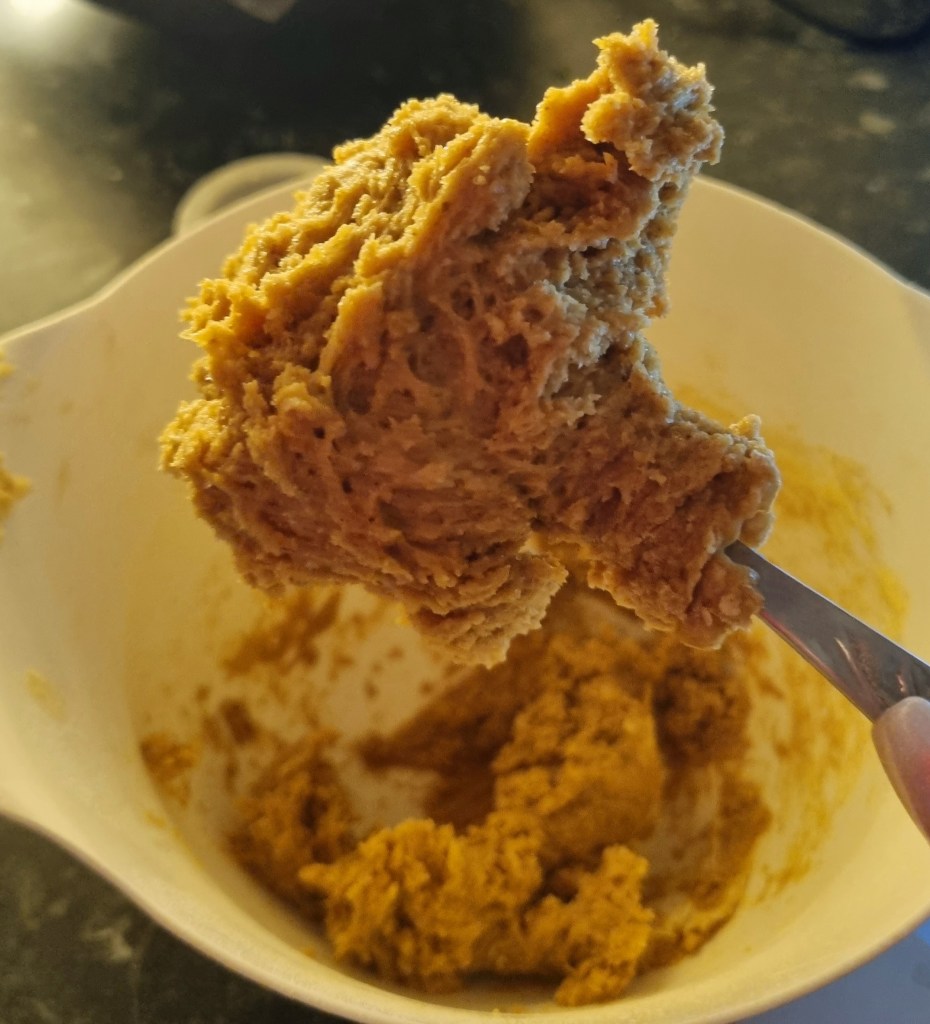
Less ‘pour’ more ‘apply with a cement trowel’.

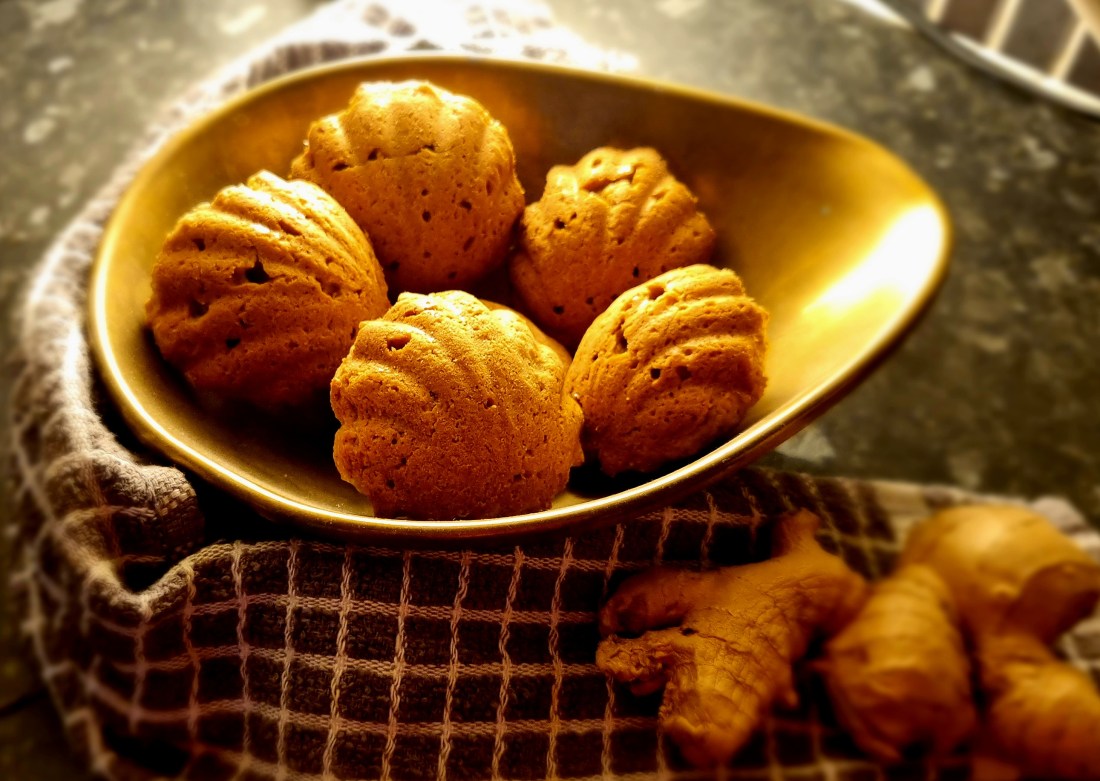
They baked for approximately 25 minutes or so, filling the room with a very festive scent indeed. Once cut open and tried the verdict was that they 1) were not overly sweet, 2) would go well with a sharp cheddar, and 3) packed so much of a spicy gingery punch that they could scare away a threatening New Years cold.

I made enough for a batch of six and honestly, I could have done with more – particularly to adequately fulfil point 2 with the amount of Christmas cheese we had left over.

The wise men came bearing gifts of gold so have some gingerbread in a gold bowl

Whatever your feelings about New Year traditions, I hope this year brings you happiness and health and plenty of New Year gifts this coming week.

E x

Won’t somebody think of the politicians?: Fat Rascals, 19th century

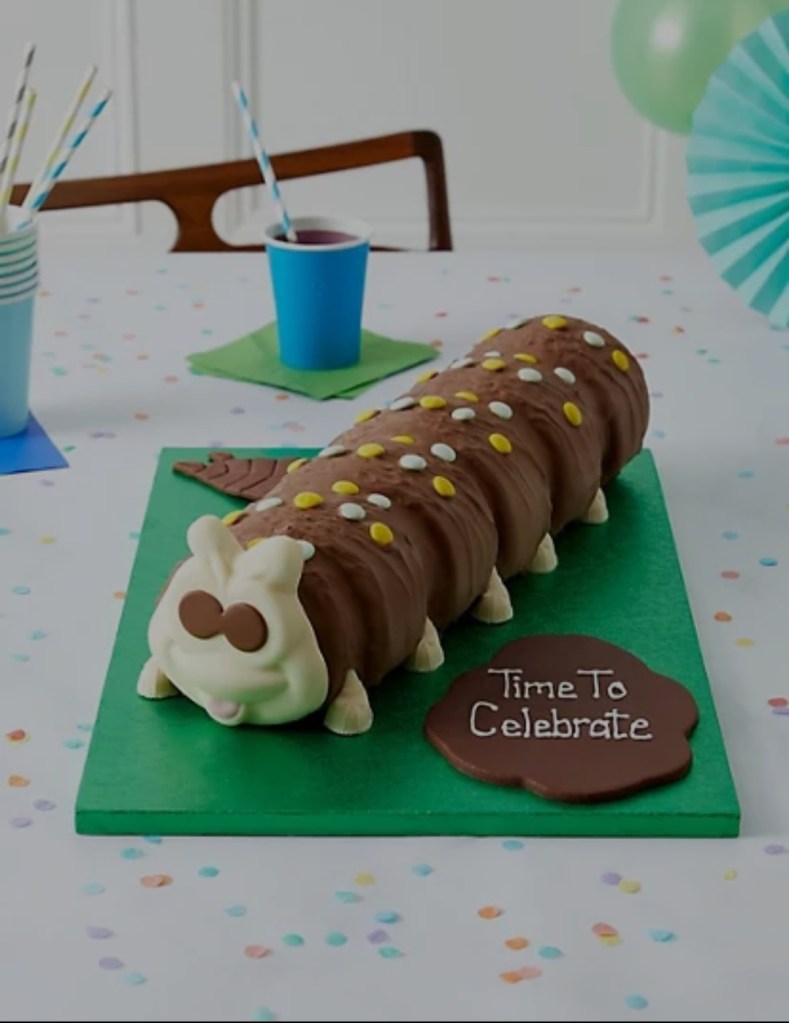
What a bad week it’s been for Boris. Who would have thought that a man who built an entire career out of appearing to be nothing more than a benign buffoon would be so cruelly brought down by some party hats and the arse-end of a Colin the caterpillar cake.

The poor man claimed he didn’t know he was attending a work party during the lockdown. That plate of cake in his hands? He was just holding it for a mate. The assembled crowd of friends and colleagues with the rictus grins on their faces listening to his speech? Never met any of them before in his life.

Then: fine, so maybe it was a party, alright? But he only stayed for 0.3 seconds and he thought he was following the rules the whole time he was there. The rules that said you couldn’t congregate with other people indoors? Yeah, those ones. Look, he’s a smart man, he went to a £46,000 a year school and he’s got a degree from Oxford in professional clownery, okay? For God’s sake, he was the bloody PM during all this time, he was on the telly every night with those apocalyptic rhymes telling us all to keep our distance. Fuck, he was in a Whatsapp group with all the boffins who were texting him all the time saying “you mustn’t meet indoors with other people, Boris, please” so I think he, of all people, would know what the rules were, thank you very much.

And now this innocent man is the victim of a witch-hunt. Afforded no true opportunity to defend himself except for a 1000-word tantrum letter published across every major news organisation in the country and the inevitable parade of key-note speeches at political dinners and addresses. And thank God for these engagements, I say, because at least they’ll be financially lucrative for the poor man after he was forced to speak out about his paltry £160,000 a year salary as PM during the pandemic while the rest of us got to stay at home, isolated, away from our loved ones, unable to visit each other for months on end – no, not even for a fucking Colin the caterpillar cake whether it was at a work do or our gran’s funeral – because we were following the actual rules, properly.

It’s been a bad week for Boris, that’s true. Sadly satire waits for no man, be he benign buffoon or malignant moron. So without further ado I present this week’s experiment: fat rascals.

“Time to celebrate” indeed. I hope he’s proud of himself.
Credit: Marks and Spencer.

‘Rascal’

These are round scone like cakes with dried fruit baked into them. A Yorkshire delicacy, the Foods of England website states that the origins for the recipe are obscure, but the earliest recorded version appears in 1855.

The ‘fat’ part of the name is obvious: these treats are made with lard, butter and cream. What seemed less obvious to me was the ‘rascal’ part.

Nowadays, a rascal might refer to someone who is a bit cheeky but ultimately still likeable. This meaning is relatively modern, however, and it used to be that to call someone a rascal was to render them utterly base and worthless. The earliest mentions of the word in English survive from the 14th century and seem to originate from the Old French term rascaile

Today, fat rascals are most commonly known as being a popular treat at Betty’s Tea Room. Apparently they make millions from the almost 400,000 of them they sell every year and Betty’s owns the trademark name. I think we’re okay to make them ourselves, though…

The method

I began by mixing flour, butter and lard together until it was like sand. Unfortunately, while satire waits for no man, it also waits for no experimental food historian either (a lesser known version of the already misquoted phrase…) and in order for my introductory paragraphs to stay relevant, I had to make these rascals today. In 30 degree heat. By the time I was done mixing my fats and flour I already had a pretty cohesive paste rather than the dry sandy texture I think I was after. Oh well.

To the fatty paste I added dried fruit, sugar and baking powder. And then, just to really amplify the richness, a good glug of double cream. The dough was rolled out into a very sticky sheet about 3/4 inch thick and cut into circles. Each one was decorated with a glace cherry and some almonds and then baked at a high temperature, rendering the kitchen hotter than all of Dante’s circles of hell combined.

A party of fat rascals

These weren’t too bad. They were actually quite light and flaky, probably because of the addition of lard to the dough. I’m not a huge dried fruit fan, but if you like fruit scones and want something a little bit more indulgent, these could be a great alternative.

And Boris, if you’re reading: chin(s) up, love. It might be you that’s the butt of the joke now, but by next week I’ll have got bored of politics and will probably go back to focussing on Great British food classics instead, like Eton mess and spotted dick.

E x
Fat rascals (credit to Foods of England website)

Makes 12-16

56g butter
56g lard
280g plain flour
85g currants
56g mixed candied peel
85g sugar
170g double cream
1 teaspoon baking powder
glace cherries and almonds to decorate

  1. Rub the fats and flour together until sand like.
  2. Add the dried fruit, sugar, and baking powder to the mix and combine.
  3. Add the cream and mix together to form a wet paste.
  4. Roll out to about 3/4 inch thick and cut into circles.
  5. Decorate each one with the cherries and almonds.
  6. Brush with milk.
  7. Place in an oven at gas mark 7/425 F for 12-15 minutes.

OFUC: Egg Mince Pies

My marriage ended.

That’s not a super funny opening line, sorry. I typed a few puns out – some basic stuff about nuptials turning into nopetials or whatever – but it all sounded a bit like telling someone I was doing fine, no really, really fine, just fine!!! And as this is not an online documentation of a breakdown, I thought it best to start with minimal British awkwardness and get straight to the point (anyway – you can tell it’s all okay by the use of only three exclamation marks rather than four. Four’s the tipping point, isn’t it? Four’s when people start to worry, but three is okay.)

Genuinely: it’s fine. J continues to be the perfect father to both our daughter and our Le Creuset set, and we speak regularly (mostly to tell the other to get off Netflix so the other can have a turn – AND IF YOU DOB US IN TO NETFLIX FOR THIS I WILL HUNT YOU DOWN).

Fine or not, though, Christmas promises to be a bit shit this year. Worse than the year my parents misjudged my love of unicorns (and misjudged my sense of humour), and bought me a tin of ‘unicorn meat’ thus ruining Christmas morning for everyone. Worse than the year dad didn’t buy mum any gifts because she said she didn’t want anything and he believed her, which was somehow my sister and my’s fault. Even worse than the year we ran out of bread sauce because mum only made double the recipe…

Wasn’t funny at fifteen twelve; isn’t funny now, mum.
Credi

I managed to deny the inevitability of Christmas 2022 until about Halloween, but as soon as 31 October rolled over into November, reality descended and, like a tsunami of excrement breaking through sewer floodgates, the festive jollities of a nation flooded my every sense.

Every trip to Sainsburys came with pre-battle talks as I mentally prepped myself to march past the walls of Quality Street without giving in to the urge to kick them over, I reveled in imagining I could fix my heating bills by setting fire to all the Christmas trees that suddenly sprouted from shopfronts two weeks ago, and I’ve dithered in writing my list to Santa for so long now that, what with the Royal Mail Strikes, it’s unlikely to reach him in time.

(Keep it light, Ellie)

Yeah, yeah.

Because we are a society obsessed with Christmas, I cannot ignore that Doomsday is just around the corner, nor can I pretend I’m excited. I could start new traditions, but honestly, screw that shit – it might work for 20-something wellness gurus with sunlight in their veins, but I’m a 30 year old woman with a wardrobe of impractical clothes she bought in a fit of post-breakup mania, and mostly good old vitriol and wine coursing through in my veins. The point is I don’t want to build new memories or “embrace the differences” this year; I want to Fuck Up Christmas.

Specifically, Christmas Dinner.

If ever there was a year to flip through retro recipe books for genuine festive inspiration, rather than gagging in disgust at the horrifying delicacies, this is it. To hell with your family-sized roast turkeys, and screw your flambéd Christmas puddings; my showstopper will be the state of the bathroom after my guests’ digestive systems buckle under the unrelenting diet of Unspecified Things in aspic.

This seems like a healthy way to deal with things…

The first experiment in Operation Fuck Up Christmas (OFUC) comes courtesy of the 19th century, from a work called ‘A New System of Domestic Cookery’ by the anonymous A. Lady. Technically she wasn’t anonymous; we know that ‘A Lady’ was actually Maria Rundell, a writer of recipes and general household maintenance of little fame, who first published Domestic Cookery in 1806.

My copy is from 1842, I think.I do not look after it as I should.

The recipe is called ‘Egg Mince Pies’ and it was a great start to get me into the Grinch spirit. While I was familiar with traditional mince pies, which had meat in them, meatless, egg-heavy pies were new to me.

Boil six eggs hard, shred them small; shred double the quantity of suet; then put in currants washed and picked one pound, or more, if the eggs were very large; the peel of one lemon shred very fine, and the juice, six spoonfuls of sweet wine, mace, nutmeg, sugar, a very little salt; orange, lemon and citron, candied. Make a light paste for them.

Domestic Cookery, A Lady

The thing is, most of the recipe seemed pretty mundane and as I was mixing everything together part of me wanted to give up, livid that I’d been tricked into making what was essentially a normal mince pie when what I’d wanted was a Frankenstein’s monster of a yuletide pastry to make kids cry. The kitchen smelled like Christmas, the radio kept threatening to play All I want for Christmas is You before I managed to hurl my Sonos across the room, the mixture looked exactly like mixtures I’d grown up with when the world wasn’t so spiky.

And then. And then. The eggs, boiled so hard they could break through mortar, were duly added and a kind of gently threatening festive mayhem descended, shattering the saccharine scene I’d built up.

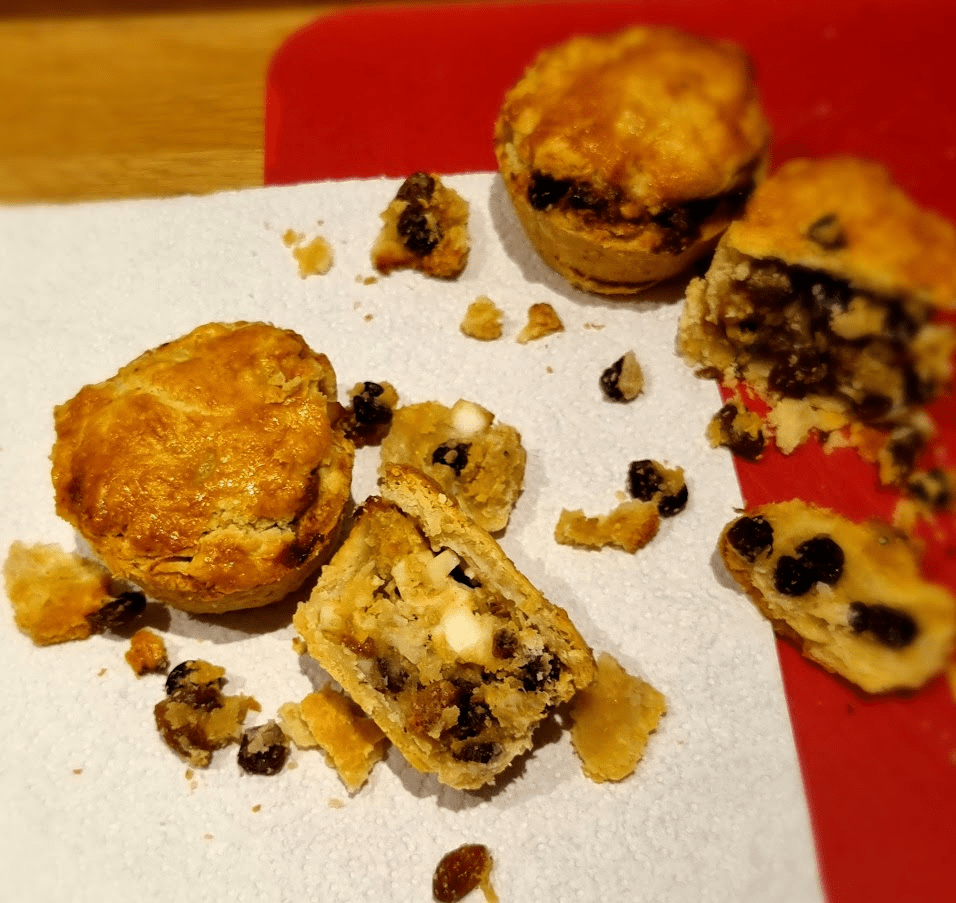
The dubious combo went into some pastry cases of equally dubious quality (but still made with increasingly diminishing amounts of energy love), and baked for – I don’t know, 30 minutes? Somewhere between 30 and 47 minutes.

I looked round the kitchen, furious that I was expected to clean up my own mess, and went for a nap instead, drifting off to suspiciously pleasant smells.

The verdict

Pastry looks good though…

These were actually not that bad. By which I mean they were quite good, which for the purposes of OFUC makes them bad??? One pie on its own was pretty filling, in part thanks to the combination of suet and butter in the recipe, but also because I don’t own any mince pie tins so I had to use American cupcake pans instead, meaning that one pie was big enough to feed a small city, maybe Ely, for about a week.

However, there was no getting away from the fact that it was very eggy, albeit in a deliberate yet inconsistent way. Because the eggs were diced and mixed in as if they were currants, each mouthful was hit and miss as to whether it would be egg free or egg heavy. It felt nicely passive aggressive: munching down on what seemed to be a normal, boring mince pie only to be confronted with a slightly sulphuric, chalky egg lump half way through.

Will these Fuck Up Christmas? Not on their own, no. They’re too aesthetically pleasing and err just a touch on the side of ‘normal’ to be powerhouses of my Christmas dinner this year. However, as a first foray into alternative provisions for this festive season they worked pretty damn well.

Finally, I do want to express my thanks to people who have reached out over the past months, mostly to ask if I’m still alive or if I succumbed to the ever-present threat of food poisoning. Thanks. And to those who have been reading this and think this post has been the blog equivalent of updating my location on social media as ‘At Hospital’ in the expectation that people will comment “DM me babe”, “OMG hun, are you OK?” and just loads of crying emojis, you’re absolutely right – fucking DM me, babe.

E x
“A bowl of stale bread and stewed fruit keeps the doctor away…” Hydropathic pudding: 1894

It’s the start of the summer holidays, and what a year it’s been for teachers and students!

By 6pm on the last day of term I’m usually arse-deep into a profusion of cocktails of unhealthy quantities of alcohol and sugar (sorry for that image). But this year felt a bit different.

For one, it felt like a less triumphant end to term than previous years. After weeks of sanitising upon entering the classroom (“one squirt’s enough, Ryan!”), mask wearing (“for the last time, it goes over your nose, Ryan”) and learning ‘zones’, (“I don’t care if the year 7 toilet area is nicer than year 10’s, Ryan, you still can’t use it!”) the final day felt more like a hobble over the finish line rather than a victory parade. Maintaining COVID protocol and encouraging 1000 kids to as well had been truly exhausting, but somehow* our school managed to avoid the tsunami of cases that overwhelmed many other local schools by the end.

The second reason the end of term felt a little flat was because it was my last one (as a teacher at least). From September I’m off to become a student again and get my Masters. Will I return to teaching? Possibly (probably?) – it’s a career I’m passionate about and I really believe there are very few other jobs that will fulfil me like teaching did. But for now I’m going to try something else – wish me luck!

So I spent Friday evening reading my goodbye cards (“my favourite lesson was when we drew castles” – a supply lesson, as I was away that day…) and generally moping. Until my husband pointed out that with the longest summer holiday ahead of me, I had more time than ever before to focus on historical cooking.

Summer pudding…

He was right, and summer was making its presence felt with a week-long heatwave, so I decided my first foray into summer-hols-historical-cooking should be distinctly sunshiney. Summer pudding, anyone?

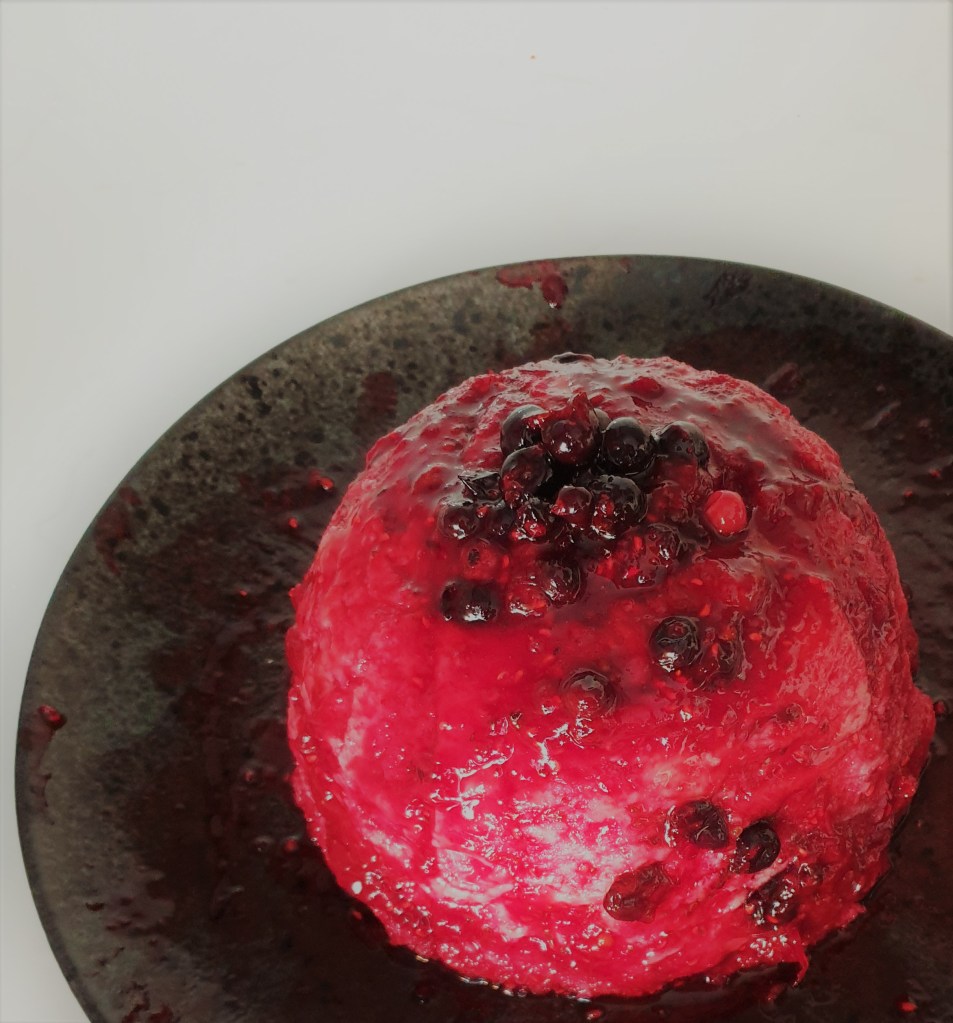
Summer pudding is something I remember eating once or twice as a child. I recall being in a gloriously sunny garden aged six or seven, sitting on a stripy deckchair and being handed a bowl of purple and pink bread with vanilla ice cream and thinking it was the oddest jam sandwich I’d ever seen. For the uninitiated: summer pudding is essentially stewed fruit which has been left to soak into a mould of stale bread. It should resemble a bright red/pink/purple dome which when cut into spills forth oozing summer fruits. It’s been decades since I last ate summer pudding and I’d come to associate it with other old fashioned desserts that are slowly dying out.

summer pudding with berries on blue table
The ideal, I’d say. Copyright: BBC Good Food.

Of course it’s not true that summer pudding is completely dying out; Nigella Lawson, pinnacle of modern British baking, includes an updated recipe in her most recent cookbook. Search ‘summer pudding’ in the BBC Good Food website and you’ll get a fair handful of decently reviewed recipes. But for some reason when I think of summertime desserts I think of lemon tart, choc ices and eton mess before I think of summer pudding.

Perhaps it’s the name. It’s too eager, isn’t it? Too full of hope, and if there’s one thing a Brit knows not to trust, it’s the promise of summer of any kind. So come July, we eschew summer pudding for something that can be enjoyed with less irony as the gazebo and BBQ collapse in gale force winds, and hypothermia sets upon Uncle Alan.

But as poor as it may be now, summer pudding’s branding problem is nothing compared to what it was.

…or hydropathic pudding?

Let’s be clear: summer pudding’s reputation and history is murky at best. How do you sell a dome of stale bread drenched in stewed fruit, which has spent 24 hours being squashed down by a plate laden with the heaviest kitchen objects you could find – a cafetiere of stale coffee and a bottle of ketchup balanced precariously atop a kilogram bag of sugar?

To find the first truly identifiable summer pudding reference I had to move my research to the 19th century, when summer pudding went by many different names, including the infinitely less marketable name ‘hydropathic pudding.’ Today’s experiment is from the earliest reference I could find to anything resembling summer pudding and comes from Lizzie Heritage’s 1894 work Cassell’s new universal cookery book.

Hydropathic Pudding

This has many names. It is very nice when properly prepared, and the pudding served very cold. Required: fruit, sugar, and bread. Cost, variable; generally moderate.

The nicest fruits for this are raspberries or currants, or a mixture, or strawberries, with or without a few red or black currants; plums are sometimes used. Take a plain mould, and cut a piece of bread to fit the bottom; then put fingers of bread round; the sides should be bevelled a little so that they overlap and prevent the escape of the fruit. The latter is stewed with enough sugar, and poured in, and a cover of bread put on. A plate with weights on is put on the top, and the pudding put in a cold place to set.

Another way is to line the mould, and then fill up with layers of bread and fruit; and if the bread is cut very thinly, this will be generally liked better than the first mode, as there is less fruit, and it suits the majority better. For a plainer dish a basin may be used, and slices of bread put to line it entirely; then either of the modes can be followed. These should be turned out with care, and may be served plain, or with a simply made custard. They are useful for those who cannot take pastry or rich puddings, and for children.”

Cassell’s New Universal Cookery Book, 1894.

As you can see, the recipe above is almost identical to summer puddings today, further cementing my feelings that it was a very old fashioned dessert. But I wondered: if nothing had changed, ingredients wise, then why the name swap?

References to “those who cannot take pastry” and the suggestions to serve it plain suggest that the pudding was offered as a healthy alternative to heavier steamed puddings that were popular at the same time.

Even more compelling to the ‘healthy’ origins of summer pudding is the original name: hydropathic pudding.

Hydropathy is/was a belief that water alone can cure ailments – be it through drinking particularly pure water or through the use of water therapies like bathing. Now, no one’s disputing that getting plenty of H20 in your system is a good thing, but believing that Radox and a rubber duck will cure you of your gluten intolerance is nonsense. While immersing yourself in water will certainly alleviate certain symptoms (e.g. joint pain or muscle inflammation), it’s unlikely to actually cure you of the actual illness.

The rise and rise of hydropathy

Hydropathy experienced a boom during the 19th century thanks to Austrian farmer Vincent Preissnitz who apparently cured his own broken ribs by wrapping his chest in damp bandages and drinking a lot of water. Inspired by the seemingly miraculous healing properties that clean water, stripped down diets and regular exercise had on patients abroad, English Captain Richard Tappin Claridge popularised hydropathy in Britain.

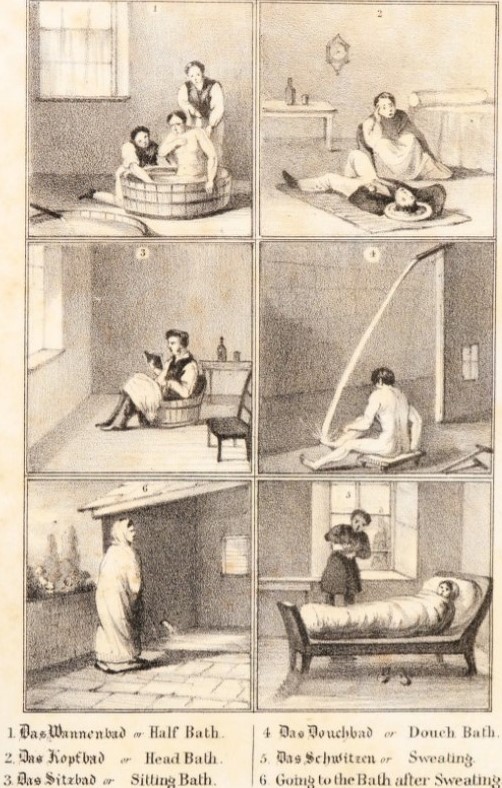
In 1842 he published Hydropathy; or The Cold Water Cure, as practiced by Vincent Priessnitz, which was an instant hit and ran to multiple editions within a few months. Hydropathy dealt mainly with the various forms of bath invalids could take**, but one chapter explained the diet that hydropathic spas should offer to their customers.

Ah, bottom left corner – my favourite: stand on a balcony wearing a sheet, looking into a bath.

Unsurprisingly, Claridge recommended a diet of water and cold foods. He explicitly stated that hot food or food that had “stimulating properties” such as spices or rich sauces should not be served. Furthermore, he states that the ideal breakfast consist of bread, cold milk (or water), and fruit. Fruit should be eaten cold and regularly, but only the types of fruit that grow naturally in Britain; according to Claridge, exotic fruits were often particularly juicy “to refresh the blood [of those who are] parched up by a burning sun” which is hardly an issue in Britain, so fruits such as mango or pineapple were thought to overstimulate the temperament of the average Brit, undoing the good work of previous hydropathy treatment.

Summer pudding – or rather, hydropathic pudding – fit the bill perfectly: cold, wet, bready and British summer-fruity, it must have had a prominent place on the dining tables of hydropathic spas.

But while holidays to spas were all well and good for the social elite of Europe, when it came to home dining frugal health food wasn’t something you necessarily wanted to serve to guests. Hydropathic pudding might sound enticing to someone who had survived four days on tepid mineral water and raw carrots, but in real life – where the cakes and buns exist – it just sounded… naff.

Hence the name change; by the early 20th century, hydropathic pudding had fallen out of recipe books and had been replaced with identical instructions for summer pudding instead, which was infinitely more appetizing and far less reminiscent of urine-filled pools and eggy smelling water.

Today’s experiment

Whatever you want to call it, the 1894 recipe I followed was delicious. Yes, I had to pour over extra syrup when I turned it out because not all the bread had soaked the juice up. And yes, I did get a tiny bit of ketchup on the bottom of my pudding because someone hadn’t screwed the cap on properly before I used it as a weight. But despite this, my summer pudding was divine: tart and sweet, spongy and, above all, summery.

I stuck mostly to blackcurrants and raspberries as per Heritage’s instructions and added a couple of extra layers of bread inside the pudding itself as she suggested, which went down very well. Rather than plain, as I suspect Claridge would have liked, we ate ours with clotted cream – healthiness be damned.

Would I make it again? Absolutely, and to be honest I don’t know why I don’t make it every summer. Perhaps it’s because it takes a little bit longer than other desserts because it has to be left for quite a while to soak. Perhaps it’s because it seems like a bit more of a faff than ripping open a Vienetta and going to sit in the paddling pool. But I suspect, really, it’s because of the reason I mentioned before: its name is too gloaty, too self-confident; the day after I made this the heatwave ended and the heavens opened. Summer pudding indeed.

Extra juice may or may not have been poured on top…

E x

*It wasn’t really “somehow”; it was down to exhaustive, careful planning by SLT – who worked really hard to keep everyone safe – and sheer luck. Also the fact that Ryan went on holiday the last week of term helped stop the spread within year 10.

**I couldn’t not tell you about one of Claridge’s specific types of bath: the douche bath. Here, he says people can find relief for afflicted parts of the body by stripping off and exposing themselves to the “powerful action” of running water. Now, I’m sure that some people genuinely used these douche baths for purely medicinal purposes, but Claridge’s slightly disapproving instruction to stop using them “when it produces feverish excitement” and that, for some reason, the average duration of a douche bath “is from three to fifteen minutes” and that “most of the patients…are very much pleased with this part of the treatment” suggests many hydropathy spa patients weren’t finding complete relaxation from drinking twenty glasses of water a day alone…

Pancake Day…with a twist

Yesterday was pancake day – a day as good as Christmas, if not better.

Think about it: there’s no wrapping or unwrapping to be done. There are no strange men clambering down your chimney to judge you for being bad or good. Most importantly – for me, at least – there’s a distinct lack of glitter or loud toys for my daughter to rip into and play with for hours and hours.

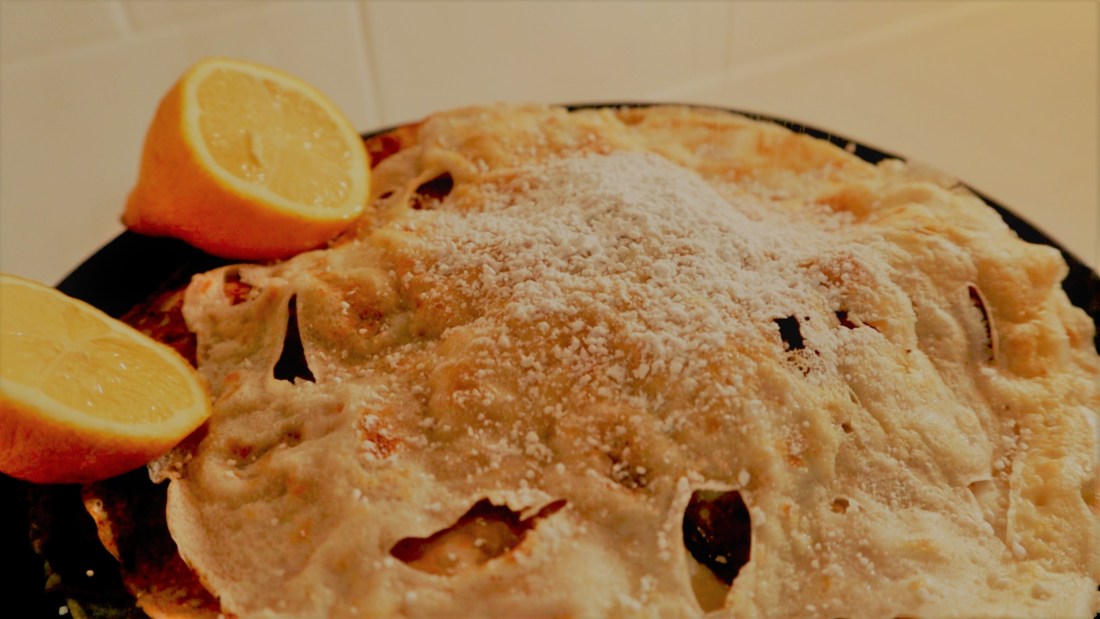
Instead there’s just warm pancakey goodness. Topped with sugar and lemon (the only acceptable way to eat them, in my not-so-humble opinion), or golden syrup, pancakes are one of my favourite foods and pancake day is one of the best days of the year.

This year I tried a new type of pancake – a 19th century recipe that used snow instead of eggs. I managed to collect a bowl of (clean!) snow from the garden before it melted away and spent a day experimenting. In another twist I videoed my experience, which you can watch below if you have nothing better to do with your time.

Don’t worry, fans of the written word (and fans who can put their love of the written word to one side in order to support this blog), I’ll still be writing. I’ll probably write about food history a little more often than recipes, but the odd one may slip in occasionally.

In the meantime, enjoy my dulcet tones and enjoy any leftover pancakes!

E x

“The principal season for the killing of hogs”: Christmas-Pyes 1728

We had a Christmas tradition when I was growing up. Perhaps tradition is the wrong word; superstition might be better. Mum would bring the mince pies out around the first week of December and they’d sit on the plate patiently while we all ignored them and ate biscuits and chocolate instead.

Eventually the yule log and gingerbread men would be gone and we had no option but to acknowledge the pies’ existence. The superstition went like this: you could eat as many as you liked, but you couldn’t speak a word until the last crumb had been licked from your lips. Each pie you ate silently bought a month of good luck for the coming year.

And…as I type that I realise it may have been a superstition invented by my mother to buy herself some peace and quiet during the school holidays. Regardless, mince pies seemed an obvious choice for my first ever Christmas post!

The secret is to use real Englishmen.

Why ‘mince’ pies?

The earliest recipes for mince pies (or pies that us modern folk would call mince pies) contained minced or shredded meat, as well as fruit and spices. Meatless mince pies are a relatively modern concept and began around the start of the 19th century, although suet was still a popular ingredient. Traditionally these pies would have been all kinds of shapes and sizes, often quite intricate but have today become boringly round.

Today’s mince pie experiments are of the meat-and-fruit variety and appear as ‘Christmas Pyes’ in Richard Bradley’s The Country Housewife and Lady’s Director. This was intended to be a useful manual for farmers and their families and contained not only recipes but practical farming advice and jobs to be done in each month. December, if you’re interested, is “the principal season for the killing hogs” – perfect for when you’ve run out of board games and need a festive family activity.

Killing hogs in December was all well and good and no one seemed to have a problem with this. The thing that seemed to really divide people, that seemed to get them properly foaming at the mouth, was the name of the pastries: Christmas pies.

Christmas pies – cute name or sign of the devil?

It all depended on who you asked.

Check any history textbook and it’ll show: the Puritans banned Christmas. It’s probably the only thing most of us remember from year 8 history lessons. Unfortunately, like most historical facts, it’s false. Or hugely exaggerated, at least. As Foods of England shows, nothing was outright or nationally banned at all; at some local levels certain individuals attempted to ensure 25th December was business as usual but these miserable souls were, for the most part, roundly ignored.

In 1650 – three years before before Oliver Cromwell became Lord Protector – the writer Robert Fletcher made fun of Puritans and their supposed hatred of Christmas – and fear of Catholic conspiracies – by writing an imaginary dialogue between two Puritanical “zealots” on the topic of Christmas and, yes, Christmas pies:

Christ-mass? Give me my beads: the name implies
A plot by its ingredients beef and pyes.
A feast Apocryphal,
A popish rite, kneaded in dough in the night…
An annual dark-lanthorn Jubile:
Catesby and Vaulx baked in conspiracie [sic]…”

Robert Fletcher, ‘Christmas Day; Or the Shutle of an inspired Weaver bolted against the Order of the Church for its Solemnity’

In 1720, just to really cement the idea that Christmas pies were to Puritans what bulbs of garlic are to vampires, Thomas Lewis wrote that fanatical Puritans in the civil war had decried Christmas pies as “abomination[s]”.

Then, in December 1733, The Gentlemen’s Magazine published an essay on Christmas pies by the curiously named Philo-Clericus. Despite proclaiming a “love” of them, he suggested Christmas pies were only “in vogue” during winter “owing to the barrenness of the season and the scarcity of fruit and milk to make tarts, custards and other desserts…” And as someone who would rather lick the crumbs from the yule log plate before eating a whole mince pie, I can kind of see his point.

Philo-Clericus goes on to describe how it wasn’t just Puritans, but Quakers too, who hated these festive treats. According to Phil, Quakers viewed Christmas pies as “an invention of the scarlet whore of Babylon, an hodge-podge of superstition, popery, the devil and all his works.”

I mean, how could I resist?

The recipe.

Take an Ox-Heart, and parboil it, or a Neat’s-Tongue, boil’d without drying or salting, or the Inside of a Surloin of Beef; chop this small, and put to each Pound two Pounds of clean Beef-Suet, cleaned of the Skins and Blood, and chop that as small as the former; then pare, and take the Cores out of eight large Apples, and chop them small, grate then a Two-penny-Loaf; and then add two or three Nutmegs grated, half an Ounce of fresh Cloves, as much Mace, a little Pepper and Salt, and a Pound and a half of Sugar; then grate in some Lemon and Orange-Peel, and squeeze the Juice of six Oranges, and two Lemons, with half a Pint of Sack, and pour this into the Mixture.

Take care to put in two Pounds of Currans to every Pound of Meat, and mix it well; then try a little of it over the Fire, in a Sauce-pan, and as it tastes, so add what you think proper to it: put this in an earthen glaz’d Pan, and press it down, and you may keep it till Candlemas, if you make it at Christmas.

Memorandum: When you put this into your Pyes, press it down, and it will be like a Paste.When you take these Pyes out of the Oven, put in a Glass of Brandy, or a Glass of Sack or White Wine, into them, and stir it in them.

Richard Bradley, The Country Housewife and Lady’s Director.

The method.

Ox heart and ox tongue were quite hard to come by. I don’t know how easy it is to get hold of them usually but for some weird reason, on the week of the 14th December, the shops and butchers were all more preoccupied with selling turkeys, ham or big joints of beef instead, so I used the inside of a sirloin steak for the meaty part of these.

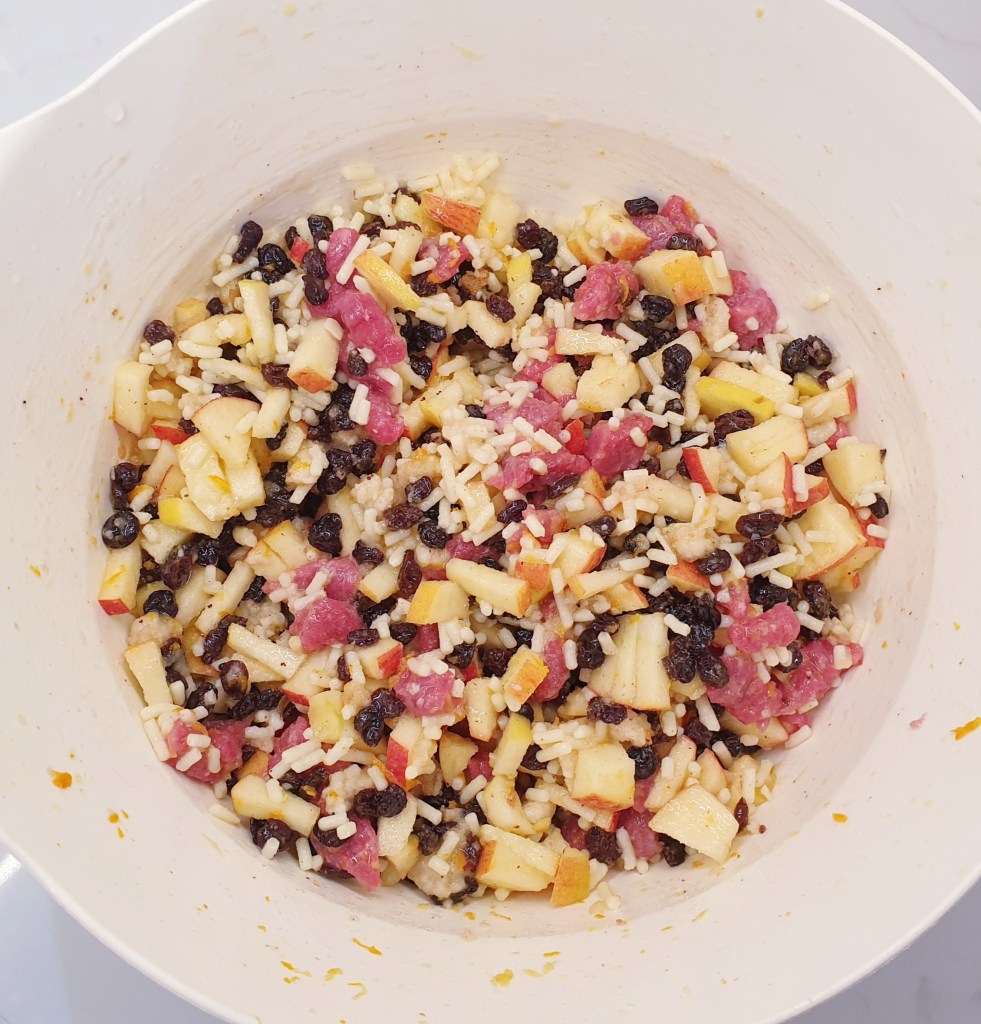
I added beef suet, chopped apple, breadcrumbs, spices, lemon and orange peel and a good glug of brandy to the chopped sirloin and then left the mixture overnight to mingle.

It looked a bit worrying, but it smelled amazing.

The second half of the recipe made it sound as though these pies were meant to be open to accommodate the addition of more alcohol after baking, but I chose to bake mine with a crust on top because, as I’ve stated numerous times before, I don’t believe a pie is a pie unless it has a full crust (top and bottom). The additional alcohol, I decided, would just have to be drunk as an accompaniment.

The recipe wasn’t clear which type of pastry should be used. By the 18th century, pastry had moved on a bit from just a basic flour and water mixture and, given the richness of the filling, I thought I needed something special.

Luckily, Richard Bradley had included a pastry section in his recipe book, and I selected the one I thought would go best – “sweet paste”.

If you would have a sweet Paste; then take half a pound of butter, and rub it into about a pound of flour, with two or three ounces of double-refined sugar powder’d, and make it a Paste, with cold milk, some sack and brandy. This is a very good one.

Richard Bradley, The Country Housewife and Lady’s Director.

A very good one it was indeed, with its sugar and double helping of yet more alcohol. As the smells of brandy and mincemeat and, er, minced meat mixed and wafted round the air as the pies were baking, I began to feel very merry. Perhaps it was the festive atmosphere or the several glugs of sherry I’d drunk to check it was okay to serve alongside the pies (always best to double check, I think), but I suddenly felt more Christmassy than I had done all December. By the time the buzzer went off I was practically ready to open the presents and carve the turkey.

The verdict.

My husband, lured downstairs by the smell of festive baking, couldn’t wait to get started.

“Don’t tell me what’s in them, I don’t want to know,” he said as he took a bite. “They smell better than anything else you’ve made so far and I don’t want you to ruin it for me.”

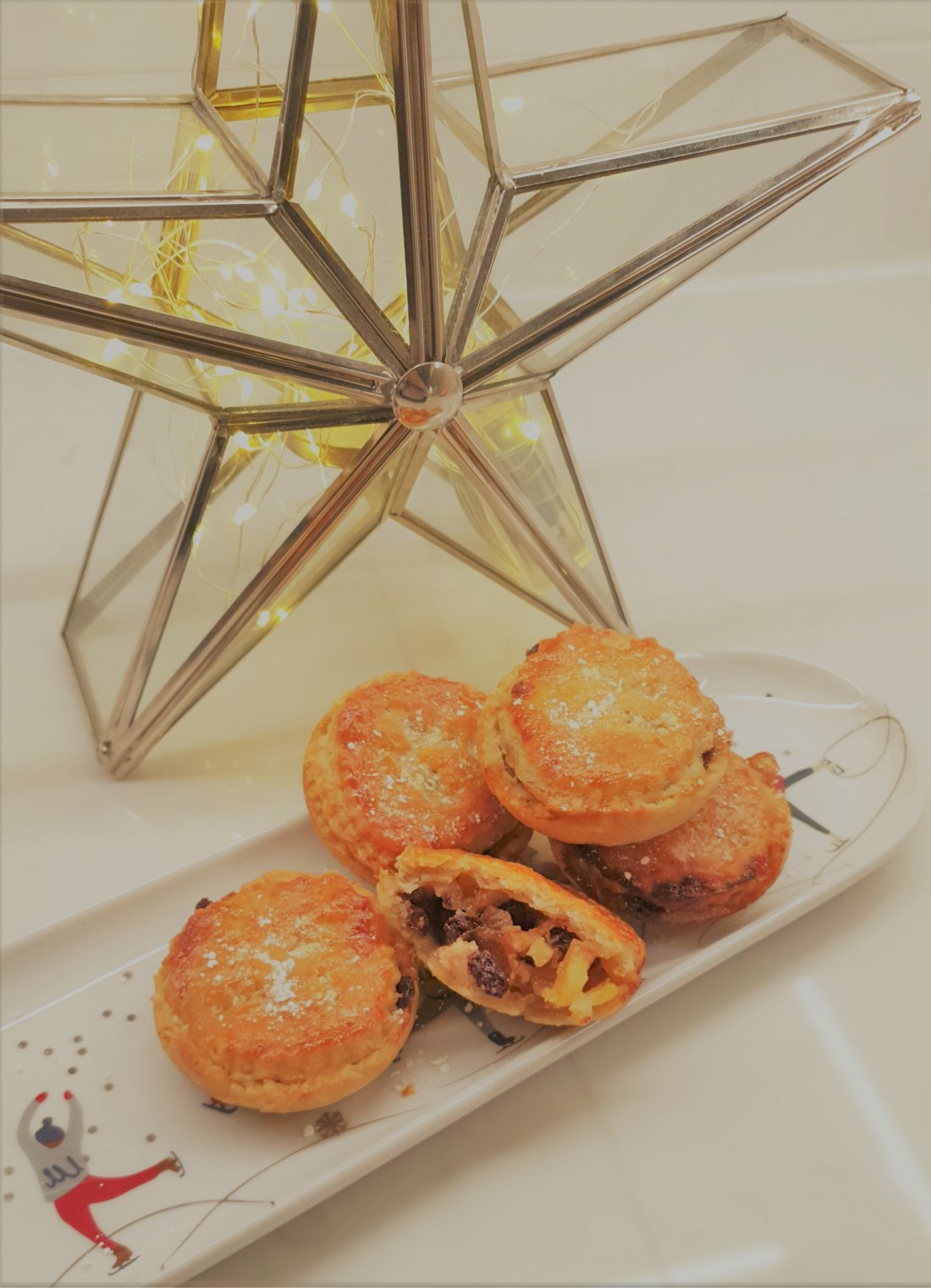
They didn’t just smell great, they tasted great too. Like, unbelievably good: buttery, spicy, fruity. The meat was more of an aftertaste rather than a flavour on its own, and the pastry was glorious – flaky and rich as Christmas pastry should be.

The abundance of spices and sugar and meat probably made these a treat to be enjoyed only by the rich at this time of year and, frankly, the alarming amount of butter and suet used which melted and bubbled up out of the pan as they cooked meant that modern day folk probably wouldn’t want to eat these all year round, either.

I made about 14 and even though I’m not a mince pie fan, they were all gone 48 hours later. I’m not 100% sure what the meat added, other than a slightly more savoury element than usual, but the addition of sirloin certainly didn’t detract from the pies either.

Even the little skater on the plate’s dancing with joy at how well these turned out.

Merry Christmas (in more ways than one…)

It’s unclear exactly when mince pie recipe writers dropped the meat element. Recipes in Mrs Beeton’s 1861 version still contained meat although it appears meaty mince pies were on the decline by this point as subsequent editions only printed versions for her meatless mince pies.

If like me you’re struggling to get properly ‘into’ Christmas this year – if you’ve had plans cancelled at the last minute, or the year’s been, frankly, a bit shit and you just want it all over with – but you want to give the Christmas spirit one last kick up the bum to try and get it going again, you could do a lot worse than giving these mince pies a go. And if they don’t manage to bring back the festive feeling they will at least get you a little too tipsy to mind! Merry Christmas!

E x

Christmas Pyes

For the mincemeat:
500g currants
200g shredded beef suet
160g sugar
2 apples, peeled, cored and diced
Zest of 1 lemon and its juice
Zest of 2 oranges and their juice
1 sirloin steak
1 small cob, grated into breadcrumbs
1/2 teaspoon mace
1 teaspoon nutmeg
Salt and pepper
4 or 5 cloves, crushed
5 or 6 tablespoons of brandy or sherry

For the pastry:
150g plain flour
75g butter
28g sugar
Milk or brandy or sherry

  1. Chop the sirloin steak up as small as you can.
  2. Add the steak to a bowl with the other mincemeat ingredients and mix. Leave to stand in a fridge overnight.
  3. For the pastry, rub flour, butter and sugar together.
  4. Add as much milk, brandy or sherry as you like to form to a sticky but still pliable dough.
  5. Roll the dough out on a floured surface to as thin as you can.
  6. Butter a mince pie tin or a standard muffin tin and cut out circles of dough to fit into the holes.
  7. Place a few spoons of mincemeat in each pastry case.
  8. Cut out slightly smaller circles to fit on top of the mince pies and place them on, pushing down at the edges to seal them.
  9. Brush with egg wash, slash a hole in the top of each pie with a knife and bake at 180 degrees for 25-30 minutes until golden brown.

Lumpy Tums: 1857

I love cereal. I wanted a cereal bar at my wedding rather than an actual meal, but reactions ranged from laughter followed by “oh, you’re not joking?” to “I will literally take my gift back if you do that.”

I’m not talking any old cereal, though. Offer me a bowl of muesli and I will end our friendship right there on the spot. Same goes for plain Shredded Wheat, Special K or Fruit and Fibre (actually, anything with ‘fruit’ in the title.) No, good cereal has to be so sweet it could melt my face and it has to come in small pieces (piss off, Weetabix). There are many lists online ranking the top cereal choices but I have yet to find one that is truly accurate and so I present a world wide exclusive: the first correct ranking of the top five UK cereals.

The top 5 UK cereals…

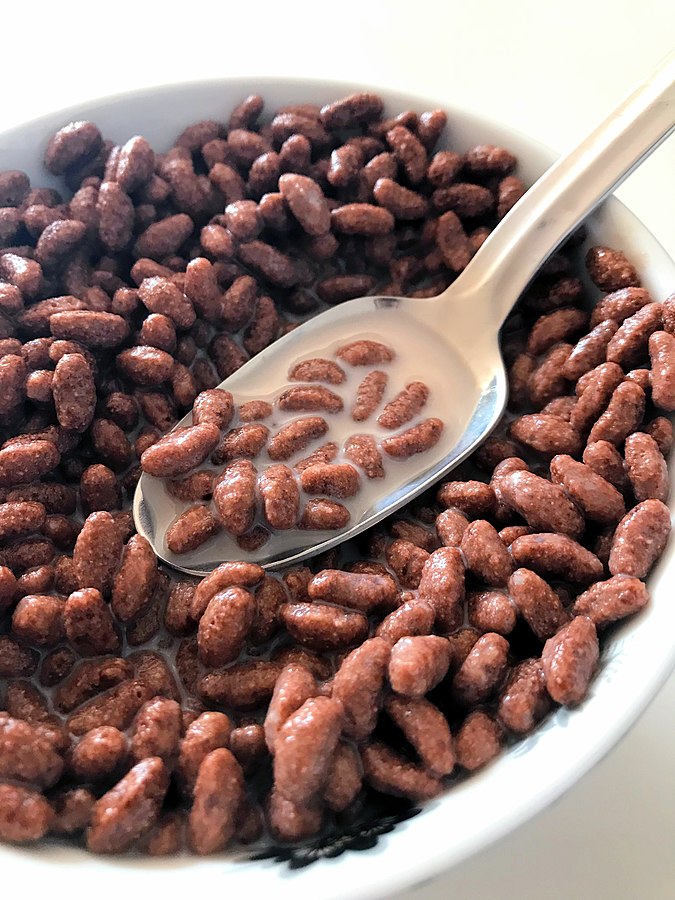
  1. Cocopops. It’s a surprise to no one; this cheeky little contender has been top of my list since I could eat. I have never met a person who doesn’t like Cocopops – and I don’t want to. Cocopops are so small you can eat a half a family sized box in one go without feeling too bad, they transform your milk into chocolate milkshake and if you drizzle a spoon of double cream over the top of them they clump together and you get a mouthful of delicious chocolatey, creamy goodness.
  2. Frosties. I’m happy with branded or unbranded to be honest. These are my go to when I crave a sugar hit. I eat them straight out of the bag, standing over the sink like a first year undergrad student and not like the 28 year old married mother I am.
  3. Crunchy Nut Clusters. Here’s the thing – no one knows what these are. No one knows what makes the clusters taste like that. On the packet it just says ‘wheat and rice flakes’, but I’ve been eating wheat and rice for a long time now and I’ve never known them to taste as good as whatever these are. They could be little balls of crack cocaine for all I know. They probably are little balls of crack cocaine given how addictive they are.
  4. Bran Flakes with sugar and sprinkles. A controversial choice but hear me out. People love rebelling, right? Me too. But I don’t love actually getting into trouble. The most rebellious thing I’ve ever done is press the bell on a bus and then not get off when it stopped (and that was an accident anyway.) So here’s what you do: take the most boring, grown up cereal available – nothing more than dehydrated cardboard, really – and you slather it in full fat milk. Now it’s marginally more edible. Then you get a bag of really cheap uber refined white sugar and a ladle and you go to town on it. Once the Bran Flakes have mostly been covered, dig out some cake decorations: hundreds and thousands, silver balls, jelly diamonds – whatever you like. Decorate and serve. This one WILL get you in trouble with your dentist but you only have to see them twice a year anyway.
  5. Frosted shreddies. Not as good as their bog standard Frosties cousins, because once the sugariness has melted into the milk you are essentially just left with a bowl of pap, but still good in a pinch.

Runners up include Cinnamon Grahams (I will not call them Curiously Cinnamon – not now, not ever), mini chocolate Weetabix and Cookie Crisp (when eaten dry – as soon as you add milk to them they’re ruined.)

The king of cereal. Credit here.

…The worst UK cereals.

For balance I have also included the top 5 worst cereals.

  1. Muesli. There isn’t one adult alive who disagrees, no matter how zen and clean eating they are.
  2. Bircher muesli. See above.
  3. Literally anything with dried fruit. Dried fruit is really sugar dense, so why do these cereals try and market themselves as a healthy option? If you’re getting your sugary kicks from freeze dried strawberries or teeny tiny raisins then please stop, have a look at yourself, and get hold of some Frosties instead.
  4. Sugar Puffs. You’d think I’d be all about these, right? Nope. They taste burned, they’re too chewy and the monster on the front looks like a perv.
  5. Golden Nuggets. Just thinking about how soft and melty they go round the edges makes me feel a bit sick. It’s like eating foam.

What’s the point of this?

Just doing my job as an educator.

Sadly for them, the people of 19th century Britain didn’t have access to Cocopops or Frosties. They were lucky if they could get hold of some muesli. Imagine! Lucky!

The first ready to eat breakfast cereal was an American creation called Granula, in 1863. In Britain, ready to eat cereal didn’t appear until 1902 when Force brought Wheat Flakes over to the country from America. But that didn’t mean that the idea of eating something wholesome in milk in the morning was non existent until this point; evidence of porridge like meals have been found in Britain dating from 2500 years ago.

The secret to his sunniness is gin instead of milk. Credit here.

This is where Lumpy Tums comes in, with possibly the cutest name ever. The first reference to it is in Thomas Wright’s Dictionary of Obsolete and Provincial English: Containing Words from the English Writers, where it is called Lumpy-Jumms. In 1881 it crops up again in the Exeter and Plymouth Gazette Daily, being described as “the porridge of our forefathers”. Both references imply it is an incredibly simple but wholesome dish.

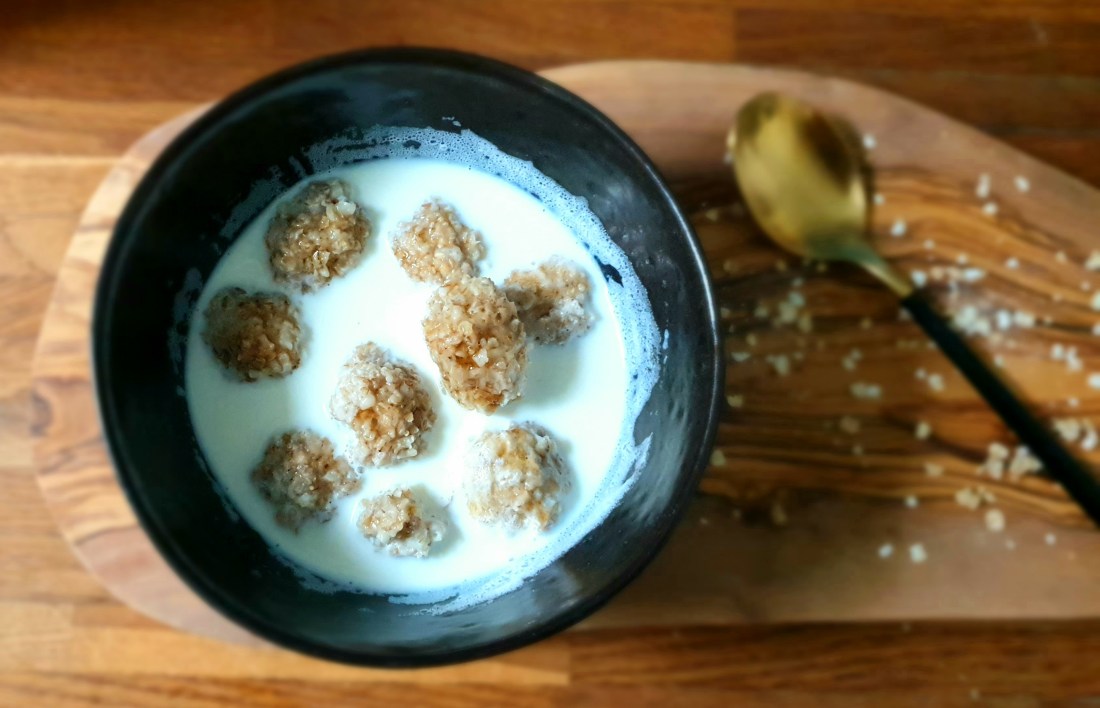
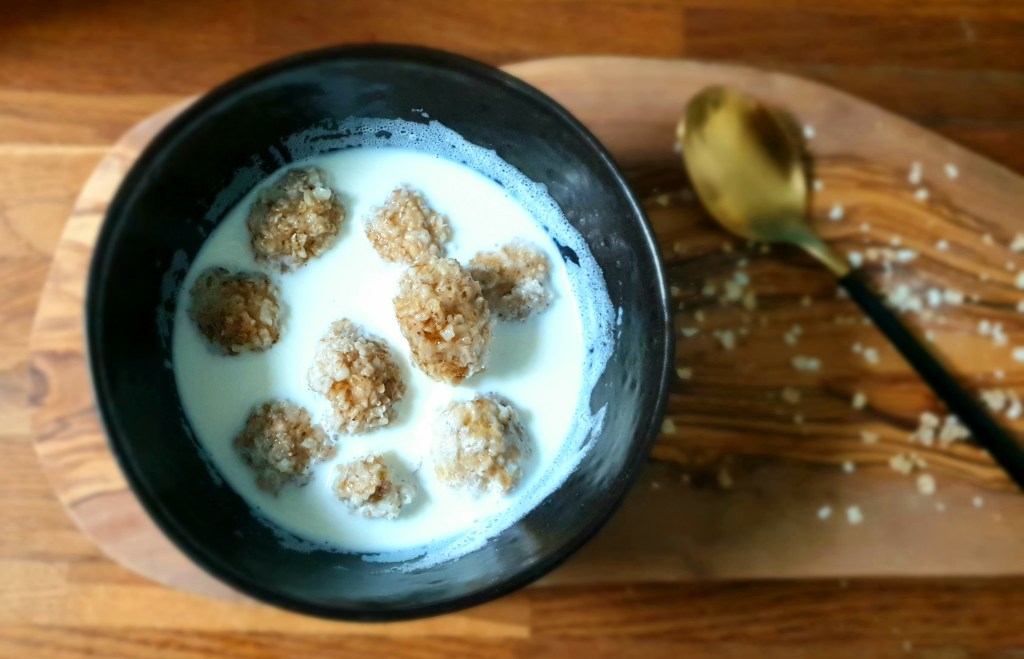
Lumpy Tums, still eaten in some parts of the UK, are made of oatmeal which is sprinkled with water, squeezed into firm balls and then boiled before being served in pools of hot milk. They were originally from the Peak District, where oats grew particularly well, but filtered down to the Midlands over time – anywhere where farming communities needed sustenance on a budget. The beauty of Lumpy Tums was that they were adaptable depending on individual circumstances; you could eat them with honey, butter, treacle or plain, but the core ingredients always stayed the same: oats and water.

I wonder what the collective noun for Lumpy Tums is. A lumpening? An oatery?

I have to admit that a bowl of boiled oat balls without anything added to it sounded like it belonged on my worst UK cereals list. As I read more of the Gazette’s opinion on Lumpy Tums, my concern grew: “It is not too much to say that we should not have subdued India, or peopled the Colonies, or destroyed the Armada, or won Gibraltar, or conquered Napoleon, charged at Balaclava, or stormed the gates of Delhi, but for porridge!” I didn’t have the desire to do any of this, but I appreciated the flex it took to attribute some of the brutalities of the British Empire to a hearty breakfast and not, say, pathologically racist ideologies of the time.

Anyway. I began tentatively (lest I became overwhelmed with an urge to invade South Asia or declare war on France) by weighing out 100g of Scottish oatmeal and adding 3 tablespoons of water. The mixture took some squidging, but eventually I was able to form small balls the “size of a nut”, as suggested. I had already heated a pan of water to boil so I cooked these in batches of five for about four or five minutes. Trying to remain positive about how simple and tasteless these seemed, I considered that they had already met one of my criteria for Good Cereal – small pieces.

I heated a bowl of milk to just below boiling and plopped the boiled Tums into it. They sat, a little underwhelming, in the pool of steaming milk. I deliberately chose full fat milk as this was closest to the type people would have had in the mid 19th century and I hoped adding a little creaminess would help improve the blandness.

The verdict.

An interesting way to eat porridge.

There’s not a lot to say about the taste; it was like eating balls of plain porridge. Inoffensive and warming, but not exciting. The texture was more interesting than the taste. I’d expected these to disintegrate in the boiling water but they held their shape well and could even be sliced clean in half. They were far chewier than regular porridge, which I quite liked. Eating them with hot milk was far better than eating them with cold milk – it just felt more right, somehow. Perhaps it was because the heat added another element to an otherwise fairly boring meal.

Fortunately for me, Lumpy Tums could also be enjoyed in ways other than plain. I experimented with honey and treacle, finding a good drizzle of honey improved the taste significantly, and eventually ended up on Paul Couchman – The Regency Cook‘s excellent Twitter account, which had fortuitously posted an excerpt of Hannah Glasse’s 1747 recipe for Hasty Pudding, another oatmeal and water concoction.

At the bottom of the excerpt, Glasse recommended eating Hasty Pudding with sugar and wine. I quickly spooned a liberal helping of sugar onto the Lumpy Tums (abstaining from wine as it was still fairly early and I was unsure whether a glass of wine mixed into a bowl of milk would work well or not) and finished them up.

As interesting a way to eat porridge as these were, I think at the end of the day (or the start of the day?) I’d still rather have a bowl of Cocopops.

E x

Lumpy Tums

100g oatmeal
3 tablespoons of water
A cereal bowl of milk
Sugar, honey or any other alternatives you prefer

  1. Bring a pan of water to the boil.
  2. Pour 3 tablespoons of cold water into the oatmeal and mix until it is combined and you can form solid round lumps by squeezing it in your hand.
  3. Roll the oatmeal into balls and gently place into a pan of boiling water.
  4. Cook each ball for four to five minutes and then remove with a slotted spoon. Leave to drain for a minute or two on a plate.
  5. Heat the milk to just below boiling and add it to a bowl.
  6. Place the Lumpy Tums into the boiling milk and add whatever toppings you like. Eat.
  7. Declare war on France.

Apricot Ice-Cream: 1747

In under two weeks September will be here and autumn will be just around the corner. It seems strange to think that summer will be over in a month when it feels like it never really got going: No festivals, no big getaways abroad, school holidays that seemed to be welcomed mostly by worn out parents exhausted from pretending they knew their 12 times tables off by heart or what a fronted adverbial was.

I’m looking forward to autumn in a month, but I’m not ready for summer to end yet. For that reason I wanted to make something sunny and bright and quintessentially summery while I still could: ice cream.

Actually, I don’t like ice cream that much. It’s not that I won’t eat it – I’m not a total weirdo – but it’s not my go-to treat food. If I’m having ice cream it’s usually because other people are having it and I’ve bowed to a peculiar form of creamy peer pressure. I thought my aloof detachment would help me be objective, then, when reviewing the end result of today’s experiment. My husband just hoped it meant there’d be more for him.

The recipe I’m using today comes from Hannah Glasse’s The Art of Cookery (more about the background here). I almost missed it as I flicked through the book because it was sandwiched between a recipe for Mock Turtle Soup and Jellied Turkey – I don’t know why.

Hannah’s signature is at the top. Credit here.

Pare and stone twelve ripe apricots, and scald them, beat them fine…add to them six ounces of double-refined sugar, and a pint of cream…

The Art of Cookery, Hannah Glasse

It seemed delightfully simple. Almost like cheating. I decided to follow Hannah’s method word for word in order to allay my feelings of fraud; there would be no electronically aided blending, no fridge-freezing, no automatic churning here. Instead, I would endeavor to copy out both her ingredients and method as closely as possible.

The first step was to peel the apricots. I had never tried to do this before and the knife kept slipping as juice ran over my fingers.

“Hey, Google,” I said out loud to my ever present master. “How do you peel an apricot?”

“The perk of using an apricot is that most recipes don’t require the smooth skin of the apricot to be peeled,” Google recited back to me.

Wanting to bank some brownie points in preparation for the day technology rises up and overthrows us, I quietly thanked Google for its time and research instead of doing what I wanted to do which was hold the device under water in frustration.

It turns out that if you scald apricots in hot water and then transfer them to ice water, the skin becomes marginally easier to peel off. It still took ages and I still ended up slicing my finger with a knife, but I actually think that lent a pleasant pink colour to the ice cream…(joking.)

I mashed the hot apricots in a mortar until they were pulpy and added a pint of just boiling double cream and six ounces of sugar. Then I strained the whole lot through a sieve into a tupperware box with a lid.

Tupperware wasn’t invented until 1946.

I checked the instructions again.

Put it in a tin with a close cover, and set it in a tub of ice broke small, with four handfuls of salt mixed among the ice. When you see your cream grow thick round the edges of your tin, stir it well, and put it in again till it is quite thick…

The Art of Cookery, Hannah Glasse

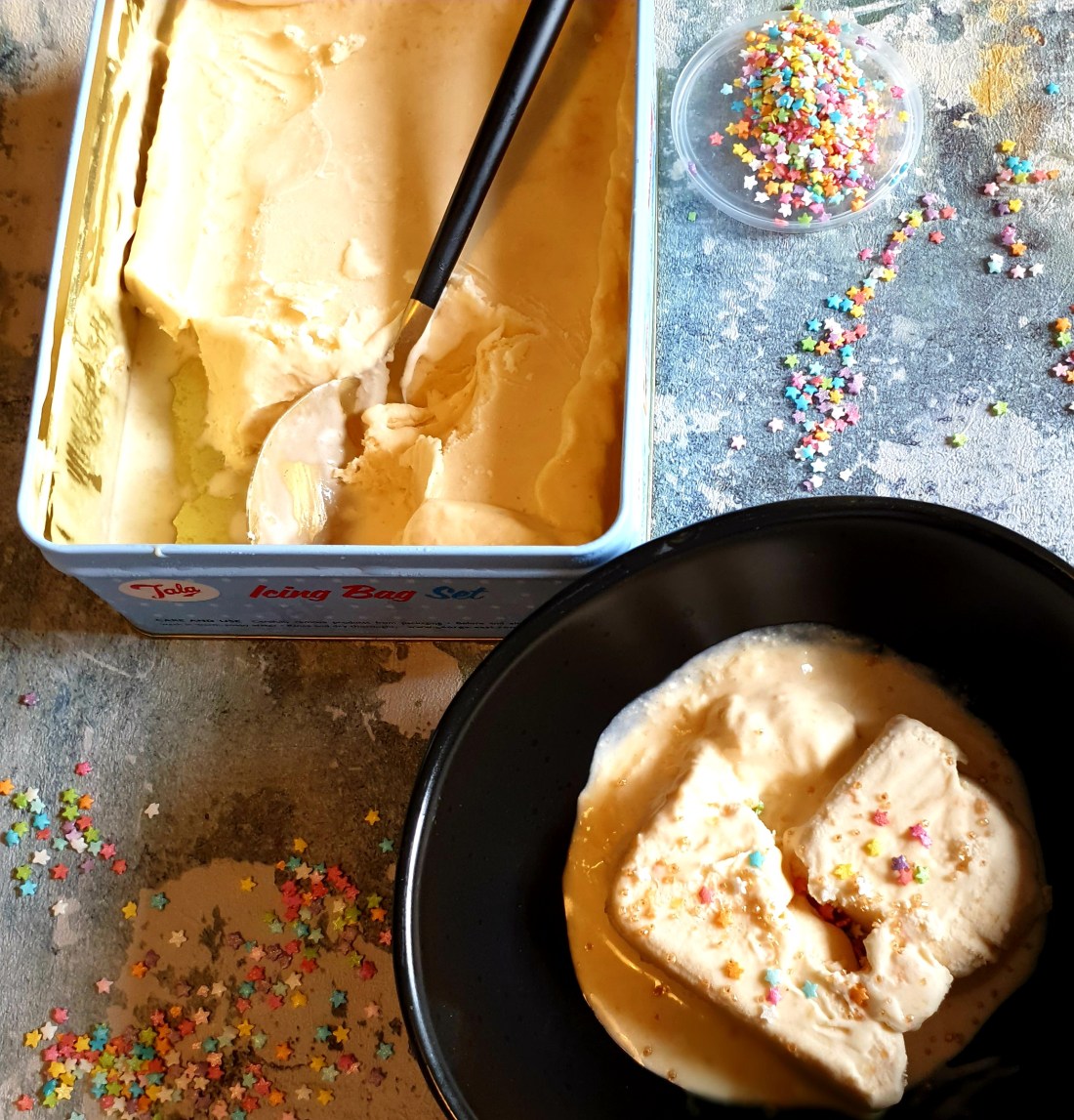
It implied the use of a metal tin, which would also help to lower the temperature too once surrounded by ice and help with the freezing process. I tore the kitchen apart looking for something metal with a lid and found a tin with an icing bag set in it I’d been given as a gift. Having tipped the nozzles and bag out of the tin to meet their fate as ‘detritus on the bottom of the baking equipment drawer’ I carefully poured the mixture from the tupperware to the tin.

With the tin filled, I piled a large salad bowl (I know, I was amazed I owned one too) full of ice which I then sprinkled with coarse salt and placed the tin in. This was a common way of making ice cream before the invention of freezers and the principle behind it was based on the fact that salt lowers the freezing temperature of water, which aids the production of ice cream. I dropped all science subjects as soon as I could in school, so here’s a little more about the physics (or is it chemistry?) behind that for boffins people who like that sort of thing.

Ice cream on ice.

I left the the tin of cream, nestled in ice and salt, for twenty minutes to thicken. After that time, I returned, stirred the mixture and recovered with more ice and salt. Hannah Glasse stated that if I liked I could pour the ice cream into a mould at this point, to create fancy displays, but since I’d had to search high and low for something as simple as a metal tin, the chances of finding a fancy ice cream mould were slim. I made the decision that my ice cream would be served straight out of its tub.

In 1885 Agnes Marshall – the Queen of Ices – patented one of the first British ice cream makers. This was a wooden device with a metal bowl in the middle that cream was poured into. Crushed ice and salt were added to the wooden bowl and a handle was turned to churn the cream round. It dramatically reduced the wait time for home made ice cream and was a pioneering invention at the time. Unfortunately, Mrs Marshall’s invention came over 100 years too late for me, and I was forced to wait for four hours before my ice cream was anywhere near done.

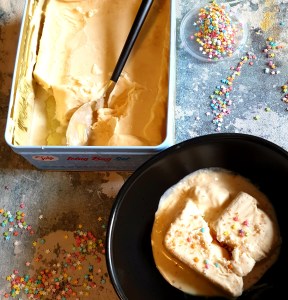
After what felt like an age I was able to spoon it into bowls.

It was the consistency of a Mr Whippy, if Mr Whippy served ice cream from the pits of volcanoes. I had succeeded in making a very thick, very creamy soup, but it definitely wasn’t cone worthy. You could drink it through a straw, for God’s sake. How on earth this was ever meant to have held its shape in a fancy mould was beyond me. Perhaps somewhat tellingly, Hannah Glasse had added an instruction to “never turn it out [of the mould] till the moment you want it…”

Clearly, I had gone wrong somewhere and closer inspection showed me that the likely culprit was melted ice, which had leaked through the tin lid over time. I was crushed, as earlier inspections had been so promising. Nonetheless, I dutifully tried the liquid concoction anyway. Cream was the main flavour, with a subtly fruity aftertaste. Though it clearly contained fruit, it was a delicate flavour and not immediately recognisable as apricot – guesses ranged from greengage to peach. It was also not too sweet, which was at least a refreshing and welcome take on Mr Whippy.

Despite the somewhat disappointing structure, it was delicious. How could it not be when all it contained was fruit, cream and sugar? My husband polished off two bowl in one sitting, arguing that since it didn’t look like “proper ice cream” it couldn’t be as unhealthy.

Overall, though I am grateful to Hannah Glasse for showing me an ice cream alternative to the saccharine sweet offerings in my local Sainsburys, I have to admit that it looked far better after a few hours in the freezer, when I could actually scoop great lumps of it out of the tin. However, if anyone was after a very labour intensive milkshake, then this is the recipe for them.

Hannah Glasse would be turning in her grave if she could see this…

E x

Apricot Ice-Cream

12 apricots
1 pint of double cream
170g sugar
Rock salt
3kg ice

  1. Peel and stone the apricots
  2. Plunge the apricots into boiling water for 30 seconds, then remove.
  3. Pound the apricots in a mortar and pestle until they form a pulp.
  4. Add cream and sugar to the apricots.
  5. Push the mixture through a sieve into a metal tin with a tight fitting lid.
  6. Place 2kg of ice and 4 big handfuls of salt in a large bowl. Place the tin among the ice, trying to cover the sides and top.
  7. After 20 minutes, stir the ice cream. Replace the ice.
  8. Replace the ice with the remaining kg as it melts.
  9. After no less than 4 hours, check on the ice cream. It should be thick and able to be scooped. Eat it immediately, as it it will melt fast.

Domino Cake: 1898

What’s pink, plump and smells faintly of booze?

Hopefully you’ve given the correct answer – Domino cake – and not the answer that my soon to be ex-husband gave when I asked him: “you”.

What I’m trying to recreate today is probably better known under its modern day name “Battenberg cake”. Or rather, it’s a close variation of it. Or rather rather, it’s the cake that Battenberg cake is based on.

The origins of Battenberg cake are hazy to say the least. An oft-repeated story goes that Battenberg cake was created in 1884 to celebrate the marriage of Prince Louis of Battenberg to the Queen’s granddaughter, Princess Victoria. The novelty cake was supposedly presented to the happy couple with the alternating coloured panes representing the bond and unity between the groom, Prince Louis, and…his other Battenberg brothers. We don’t have a record of Princess Victoria’s reaction to being given a cake celebrating her husband and his family – but not her! – on her own wedding day, but the gift serves as an important reminder that, when it came to royal weddings from the past, the bride wasn’t necessarily the most – or even second most – important person there.

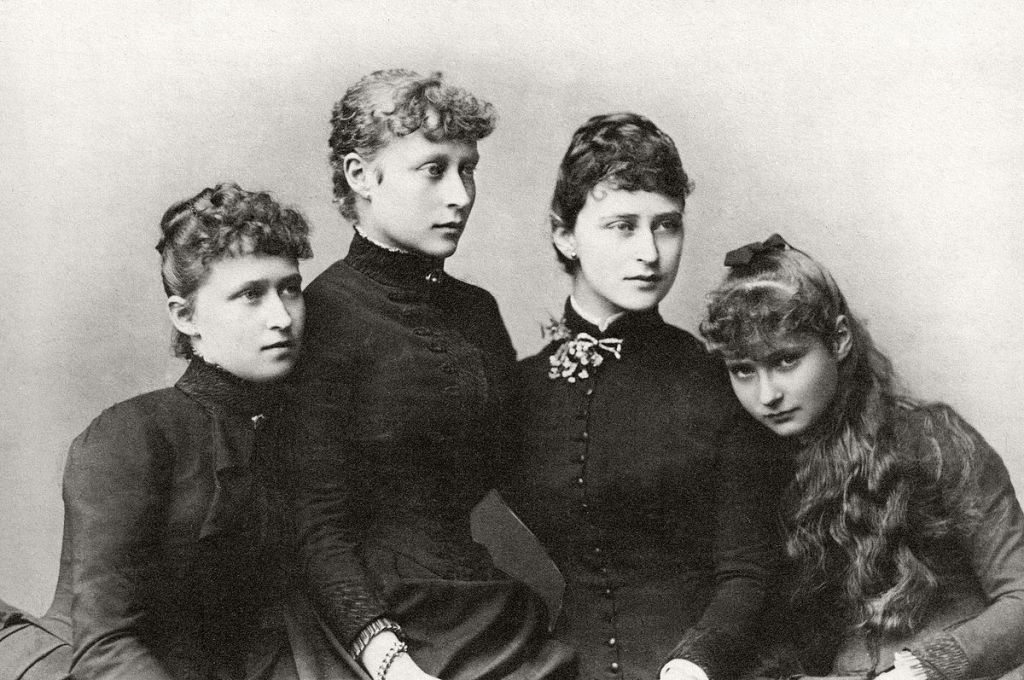
Princesses Irene, Victoria, Elisabeth and Alix: where was their bloody cake?!

Deep seated though this origin story is, there’s actually very little contemporary evidence to support it. Even the eminent food historian Ivan Day (who has written not one but three excellent blog posts about the history of Battenberg cake) could find little in the way of conclusive proof of the provenance of this cake.

Day points out that recipes for cakes with coloured sections wrapped in marzipan were published in England towards the end of the 19th century, but that the earliest cakes going under the name “Battenburg cakes” (with a ‘u’, not an ‘e’), originally had nine panes, which casts the whole four-Battenberg-brothers tale into doubt. Perhaps there were five extra secret brothers history is unaware of – in which case the cake maker should have been recognised as the most important wedding guest (have you ever tried to make an original nine panelled royal wedding cake?!) – but it seems unlikely.

In another blow to fans of the wedding cake theory, these nine sectioned “Battenburg” cakes didn’t appear until 1898 – a full fourteen years after the royal wedding took place. Queen Victoria – grandmother to the newly wedded bride – was considered something of a trend setter in her day. It seems unlikely that a brand new cake, created to honour the marriage between a member of the British royal family and a German prince (and his eight siblings?!) wouldn’t, therefore, have been copied in high society.

Whatever the truth is, the scaled-down four paned Battenberg cakes we’re familiar with today don’t appear to have been produced until the early 20th century when Lyons & Co. began to mass produce them. Again, the oracle Day suggests that the switch from nine panels to four may have been a decision based on what was easier to mass produce.

A four paned cake was going to be tricky enough to recreate in one morning, but nine panes was going to be a challenge. Furthermore, Domino cake wasn’t just content to up the cake content, but included additional ingredients like alcohol – making it a sort of grown-up version of Battenberg.

Domino Cake

The original recipe can be found in the Victorian magazine The Table, which was edited by Mrs Agnes Marshall: “Queen of Ices” and author of four highly successful books dedicated to the production of ice cream (which sort of makes it a shame she didn’t pick the better nickname “Ice Queen” instead.) As well as publishing cookbooks, Mrs Marshall was an successful entrepreneur and inventor, patenting a design for a machine which could freeze cream in five minutes and starting a business with her husband selling cookery products. Food historian Emma Kay called Marshall “one of the fiercest, most ambitious and successful women of her generation” and Robin Weir placed her on a par with other celebrity chefs of her time.

Despite her moniker, public knowledge of Mrs Marshall’s works is slim. This is partly because when she died in 1905 the rights to her works were bought by Ward Lock, the company that published Mrs Beeton’s Book of Household Management. This publishing house was, unsurprisingly, not interested in publishing another Victorian cookbook and jeopardizing the lucrative market they’d cornered by promoting Mrs B’s relatively bland offerings at the expense of other 19th century cooks, so they let the collective works of Mrs Marshall fall into obscurity. The final nail in the coffin for Mrs Marshall’s reputation came in the 1950s, when a fire destroyed the archival collection of her works.

In the July 1898 edition of The Table, the recipe for Domino cake is under the fancy French name “Gateau à la Domino” and it appears to be an original Marshall creation, long before the time of mass produced cakes from Lyons & Co.

Mrs Marshall’s cake featured the classic nine paned pattern wrapped in marzipan, but it was decidedly more upmarket than similar “Battenburgs” of the time. For one thing, the marzipan contained maraschino and vanilla essence. The quantity and quality of ingredients were also greater than the average Battenberg, with lemon peel and almond essence being incorporated into the genoese sponge and an extra sweet apricot glace (rather than bog standard apricot jam) being used to hold the cake sections together.

I began by making the sponges, which Mrs Marshall called Genoise Paste. First, I mixed butter and lemon peel together then hand beat the mixture with sugar for ten minutes, or until my arm fell off. I added five eggs, baking powder, almond essence and 8oz of plain flour to the batter before dividing it into half and colouring one half red. Mrs Marshall called for “carmine” to be used to colour the mix red, which during her time would have been from the cochineal beetle. Despite my most lacklustre efforts, I couldn’t find enough beetles to squeeze a really good measure of liquid from and a promisingly juicy worm turned out to be an old pink shoelace. I had to use “Red Red” food colouring instead which was, in fairness, more red than any beetle could have produced anyway. And less…crunchy.

Once the batter was baking in the oven I started work on the marzipan – or almond paste, as Mrs Marshall referred to it. This was pretty straightforward but after ten minutes of vigorous butter-beating my arm was tingling in a peculiar way and I could hear my wrist click with every gesture, so I snorted at Mrs M’s suggestion to hand knead ground almonds (as a true entrepreneur, she advised using her own brand of ground almonds), icing sugar, maraschino and egg white into a stiff paste, and bunged it all into the blender.

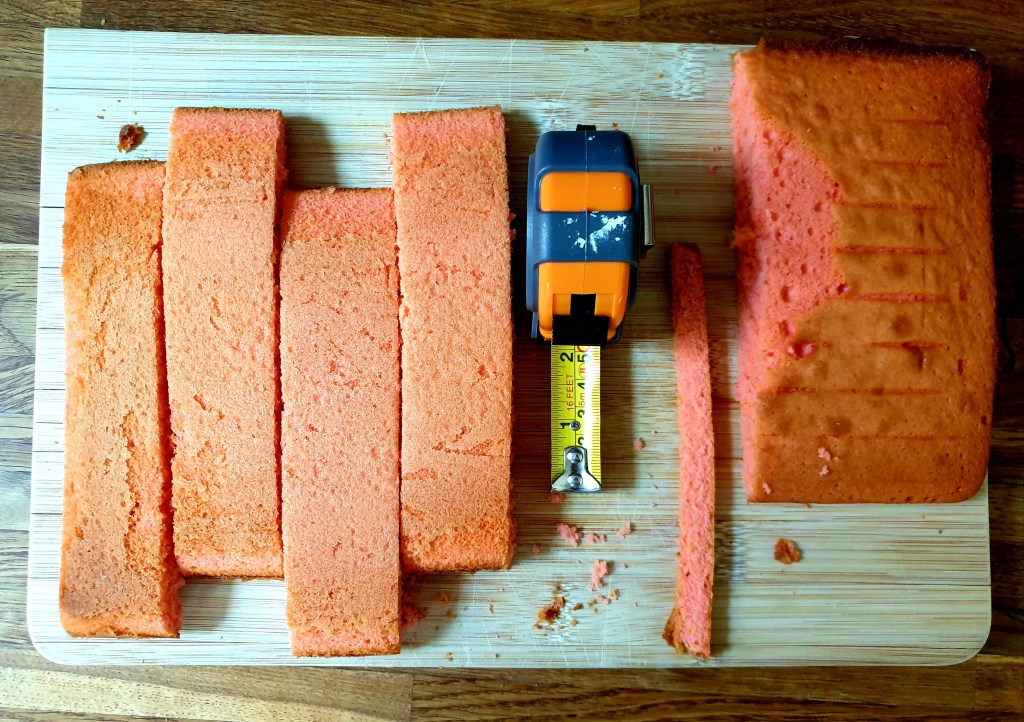
When the cakes were cool, I cut them into 6×1 inch rectangles: four pink and five white. This meant we had a bit of spare cake left over, but I’m not sure anyone in my household saw that as a problem. At least, not one that wasn’t easily overcome.

The moment you need a tape measure to make a cake is the moment you have gone too far.

With the cake rectangles arranged in a checkerboard pattern on top of the rolled out marzipan, I heated half a jar of apricot jam with 2oz of caster sugar and a little water until all the sugar had dissolved and pushed the mixture through a sieve. This was the apricot glace which would stick the cake bits together.

Once each cake piece had been given a coating of glace, the marzipan was gently rolled up the sides of the cake and smoothed down. The edges were trimmed off – Mrs M was very insistent that the ends of the cake should not be covered – and the whole thing was given a light dusting of icing sugar.

Actually, not a bad wedding gift after all.

I stepped back. It actually looked like something resembling a Battenberg cake! In fact, it looked better than a Battenberg cake because of the extra five panes and for a mad minute I thought about applying to Bake Off; after all, hadn’t they used Battenberg as a technical challenge before? And here I was more than doubling the amount of squares like it was no big deal.

“Yeah, but that was a celebrity Bake Off,” my husband informed me. “It’s like the pre-school version of Bake Off where you get marks just for knowing how to use a spatula.”

Celeb Bake Off or not, I reckon Paul would have given me a handshake for this one; it had nine identifiable and pretty much identical squares, the marzipan was of an even thickness and, most importantly, there was no trace of a soggy bottom.

Though it looked very much like a pimped up Battenberg, the taste and texture was a little different. Despite containing sugar, icing sugar and sweetened jam it was still far less sweet than I was used to which I suppose just goes to show how sugar laden mass produced cakes can be. I was a bit worried the cake would be dry, but the apricot glace helped prevent that and the sweet apricot flavour went well with the other fruit and nut flavours.

What I was most surprised by was the marzipan, which was far less almondy than I expected. Instead, the primary flavour was a sort of bitter cherry thanks to the maraschino – not at all unpleasant, but not what I was used to. I found myself picking off the marzipan coating and eating it without the cake to try and pinpoint the exact flavours.

Overall, for a cake that required the use of a measuring tape, this wasn’t as complicated to make as I thought it would be. It was also really interesting to make something that looked so similar to a modern day favourite, but with just enough differences to make it slightly unfamiliar – it was like looking at another piece of a puzzle you thought you’d already completed.

In the end I have to take back my earlier, snarky comments about this being a wedding present. I don’t know how Princess Victoria might have felt upon receiving a cake celebrating her husband and his eight brothers on her wedding day, but if it had been me I wouldn’t have cared at all – as long as I didn’t have to share it with them.

Domino Cake

225g butter
225g plain flour
225g caster sugar
5 eggs
Lemon peel
Almond essence
Baking powder
Red food colouring

For the marzipan:
1 egg white
280g icing sugar
140g ground almonds
Vanilla essence
Dessert spoon of maraschino

For the apricot glace:
150g apricot jam
50g sugar
Dessert spoon of water

  1. Preheat the oven to 180 degrees C.
  2. In a bowl, mix butter and lemon peel until smooth and white.
  3. Add the sugar and beat well.
  4. Add the eggs, baking powder and flour, a little at a time, and incorporate.
  5. Add 8 drops of almond essence and mix.
  6. Divide the batter into two halves. Leave one half plain and colour the other half red with a few drops of food colouring.
  7. Portion the batter into two small baking trays (I used 25x17cm) and bake for 15-20 minutes.
  8. Place the ingredients for the marzipan into a blender and blend until they form a stiff paste.
  9. Place the marzipan into the fridge to firm up.
  10. Once the cakes are baked, allow them to cool and the slice them into rectangles 6x1inch. You need 5 white and 4 red.
  11. Heat the apricot jam with the sugar and water and when it is dissolved, push the mixture through a sieve.
  12. Roll the marzipan out into a sheet about 1cm thick and brush a little apricot glace onto the centre of it.
  13. Arrange the first layer of cake on top of the apricot glazed marzipan: white, red, white.
  14. Brush the sides and top of the cake layer with apricot glace and arrange the second layer: red, white, red.
  15. Brush the sides and top of the cake layer with apricot glace and arrange the second layer: white, red, white.
  16. Brush the sides and top and then roll the marzipan up over the cake layers, smoothing it down at the sides until it covers the cake.
  17. Flip the cake over so that the marzipan join is hidden along the bottom and trim off the excess marzipan.
  18. Dust with icing sugar and serve with a cup of tea.

Chocolate Soufflé: 1861

It was world chocolate day yesterday, apparently. Normally these celebrations pass me by a bit – there’s a world meatball day, a coffee day, a hamburger day and a porridge day. Obviously I’m looking forward to 24th October – world tripe day – but mostly I’m a bit cynical and imagine that behind the merriment and random recipes there’s a big fat corporation greedily counting its money.

But it didn’t escape my attention that 7th July was designated world chocolate day. Call me boring, call me clichéd but that’s one food day I can get behind and you’ll be happy to know that I made sure to celebrate by eating as much of it as I could – chocolate biscuits, chocolate bars, chocolate cake, hot chocolate. All enjoyed with appropriate solemnity for the occasion, of course, and not at all gorged with reckless abandon as I attempted to prove the “share” part of a family sized bag of Buttons was more a guideline than a rule.

I’ve not done too many chocolate recipes, mostly because the glorious stuff wasn’t known about in Europe until the 16th century and so recipes containing it (in a modern format) are fairly limited. Its history is fascinating, though.

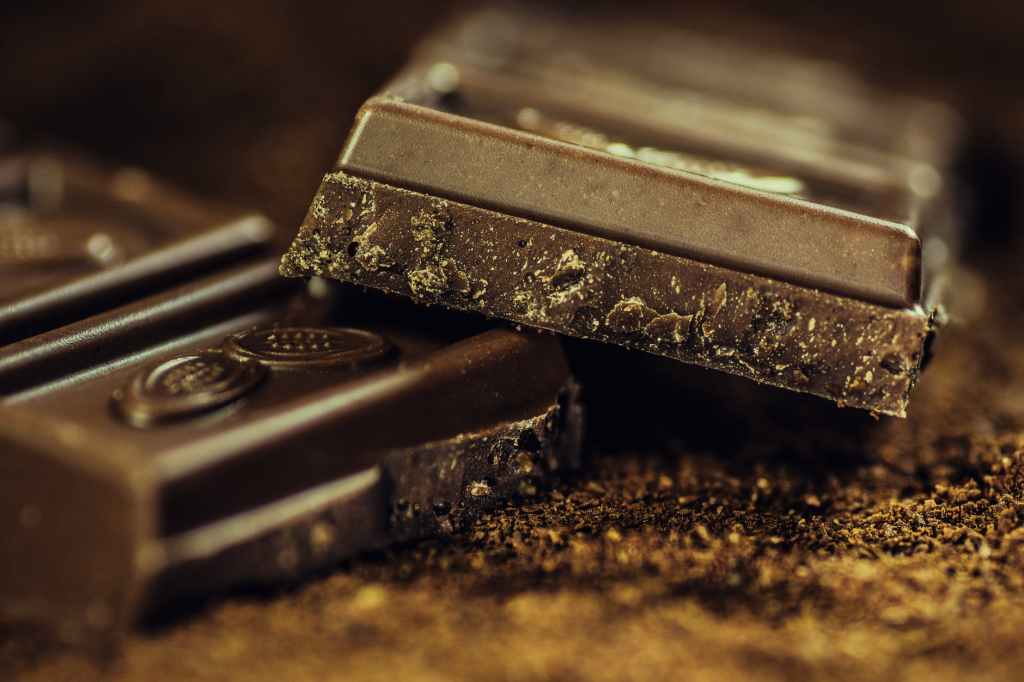
Who are these people that get paid to take photos of chocolate and how can I get that job?
Photo by Pixabay on Pexels.com

There’s a lot of terminology around chocolate but modern experts tend to refer to cacao as the unprocessed plant or bean while chocolate is the word for anything made from the processed beans. Whatever you call it, chocolate in all its forms was a highly prized item. In pre-colonial Mesoamerica, where it originated, cacao was used as a symbol of wealth; when Cortés arrived to plunder Tenochitlan in 1519, he and his men witnessed a ceremony where Montezuma II was served over 50 jars of chocolate to drink. Cortés and his men might not have fully grasped the awesome display of wealth they were seeing, but to other Mesoamericans the excessive amount of chocolate drink would have signified Montezuma’s extreme power because of the number of beans needed to make so many drinks. Similary, a 16th century document tells us that cacao was valuable enough to the Aztecs to use as currency – in 1543 40 cacao beans were paid daily to workers in maguey fields.

The Spaniards didn’t think much of chocolate at first, describing it as “a bitter drink for pigs“, but brought it back to Spain nonetheless where it continued to be largely disregarded until someone realised that if you added cane sugar or honey to it, it suddenly became an indulgent sweet drink. By the 17th century sweetened chocolate drinks were being enjoyed by the rich all over Europe for its taste but also for its supposed medicinal and aphrodisiac properties (Casanova was apparently a great fan.)

It wasn’t until 1828 that Coenraad van Houten invented the cocoa press, which separated out the cocoa fats from the bean and left a powder which could be added to milk, much like a modern day hot chocolate. This process also meant that chocolate could be mass produced, making it cheaper and more available to the wider public. In 1847 J. S. Fry and Sons realised that combining the fat and liqour from pressed cocoa and adding sugar could create a mouldable solid and voila! the chocolate bar was born.

These early bars were dark and were enjoyed in small quantities as the taste was still fairly strong and bitter. Cadbury’s had some initial success in 1861 with boxes of luxury chocolates, branded ‘Fancy Boxes’. The small chocolates in these boxes were branded as indulgent gifts and were designed to be enjoyed in small dainty mouthfuls (a scientific impossibility as experts* on chocolate consumption have since discovered.)

Eventually, in 1875, the Swiss chocolatier Daniel Peter had the novel idea of adding milk powder (after trying and failing with liquid milk, which caused the chocolate to seize) and created milk chocolate, which was an instant hit. Rival chocolate firms scrabbled around to imitate the creamy taste and in 1905 Cadbury’s released the first Dairy Milk bar, which boasted a higher percentage of milk than any other competitor brand.

Is all this background info just your excuse to try different types of chocolate?

No, actually.

I don’t like dark chocolate. It’s high up on the list of sophisticated tastes that adult palates are supposed to enjoy that I don’t, along with red wine and liquor, blue cheese; strong coffee. In theory I should be a beacon of health, right? In reality I’ve overcompensated for not liking these foods by developing a palate as fond of sugar and fizz as that of a child – frosted cereal, milkshakes, entire jars of Nutella on one slice of toast. Okay, fine – it’s the palate of a child with irresponsible parents. So what? I had a great childhood and my fillings light up a room when I smile.

Because of this I was only sort of excited to try Mrs Beeton’s recipe for chocolate soufflé, given that it was published in 1861 – a full 14 years before anyone had successfully manufactured milk chocolate. My husband, who’s a certified signed up Adult(TM), was, however, delighted by the idea of this experiment (even though I made it for breakfast in rebellious solidarity with my inner child.)

First I separated four eggs and added a few teaspoons of sugar and flour to the yolks. Mrs Beeton then told me to add 85g of “best chocolate”, which unfortunately meant dark chocolate. I used Bournville because even though it wasn’t sold until 1908 – and it definitely isn’t the best quality – it was what was most readily available at 8:00am when I decided to make soufflé. I just had to hope that the average bar of 2020 Bournville chocolate was as good as a very good bar of 1861 chocolate. It took forever to grate, but eventually I had a small pile of very finely grated chocolate, which I mixed into the egg yolks.

My next deviation from the original recipe was to use an electric whisk to whip the egg whites into stiff peaks. Stiff peaks formed, I folded the egg whites into the yolk and chocolate mixture trying not to beat all of the air out of it. The soufflé was then portioned out into buttered ramekins and baked for 20 minutes.

Little fluffy clouds in a pool of sewage.

Once they were in the oven I found I was filled with dread that they wouldn’t rise and I’d be left with two deflated eggy messes. I started to do initially nonchalant but increasingly neurotic soufflé inspections: I began by wandering into the kitchen every couple of minutes to check on the oven, pretending that I’d left the milk out or the hob on. Then there were a couple of innocent peeks through the door to check that they were rising properly and before I knew it I was kneeling on the floor, face pressed against the hot glass, hissing “rise my beauties, rise!”

And rise they did. The second wave of dread washed over me as I read “the proper appearance of this dish depends entirely on the expedition with which it is served…if allowed to stand after it comes from the oven, it will be entirely spoiled, as it falls almost immediately.”

Entirely. Spoiled.

Has a more terrifying phrase ever been written? And what was worse is that it seemed totally unavoidable – I could have absolutely nailed the recipe, even use the very best of best chocolate – and it would all be for nothing if I shuffled instead of sprinted to the table when serving it.

I prepped myself for the worst, took a deep breath and whisked the soufflé’s from the oven so fast I was at risk of breaking the sound barrier.

“Stand back!” I roared at my husband as I ran to the table to photo them before they deflated.

In the end Mrs Beeton had maybe exaggerated the delicate nature of soufflé; yes, they sunk slightly within a minute or so of being out of the oven, but they were hardly “spoiled.” At least, not spoiled enough to render them inedible for breakfast.

Totally forgot to add powdered sugar when they came out of the oven which entirely spoiled them.

Not only did they look like chocolate soufflés, but they damn well tasted like them too; rich and dark without being too sweet. My husband particularly enjoyed this aspect to them because he said it made them feel “healthier”. Inside they were light and airy, but as they deflated they got a bit gooier and more unguent.

I didn’t finish all of mine because, well, dark chocolate. But my husband, buoyed by the seemingly wholesome nature of these, managed to finish off his own and the rest of my ramekin. Dark chocolate soufflé for breakfast: approved by Real Adults.

World chocolate day might be over, but I’m already counting down the days to next year when I can make a (milk chocolate) version of these again. Also, if someone could tell me the shortcut for the acute accent so that I don’t have to keep copy and pasting the “é” every time I write “soufflé” in the future, I would be forever indebted to you.

E x

* It’s me; I’m the expert on chocolate consumption.

Chocolate Soufflé

85g dark chocolate, finely grated.
1 teaspoon plain flour
3 teaspoons caster sugar
4 eggs

  1. Preheat an oven to 160 degrees C.
  2. Separate the egg whites from the yolks.
  3. Whisk the egg yolks and add the grated chocolate. Mix.
  4. Add the flour and sugar to the chocolate and egg yolk and whisk together until fully incorporated.
  5. Whisk the egg whites to stiff peaks.
  6. Fold the egg white into the egg yolk. Make sure not to over-fold to prevent the air escaping.
  7. Butter two large ramekins and divide the soufflé mixture between them.
  8. Place the soufflés into the oven and cook for 20 minutes. Do not open the oven door during cooking.
  9. Remove the soufflés and dust with icing sugar. Serve immediately.