‘A New Year’s Gift’: Sugar Ginger Bread, 1824

Happy New Year.

I’m a bit of a New Years Grinch. The idea that at the start of the year that we must nurture artistic skills within ourselves, or start jogging, or learn to speak French just well enough to ask a Parisian if they, too, enjoy playing football at the weekend with their brother just seems like too much effort and pressure too soon after the effort and pressure of Christmas. I just want to relax and I don’t see the point in forcing myself to do something I have minimal interest in when I know I will give it up before midnight on 2nd January. I did once set myself the goal of being the type of woman who can do her bra up behind her back rather than employing what I like to call the ‘coward’s method’ (or frontus swivellus, to give it its Latin name.) It was a silly but achievable goal which I nevertheless failed to achieve because my elbows don’t work that way.

If, however, you find the fresh slate of a new year the boost you need to nurture your inner Caravaggio or if you can only dust off those running shoes by the wan light of a new year sun, crack on. And if you do hope to one day play football at the weekend with your brother in France before having a ham and cheese sandwich and asking a stranger where the toilets are despite the fact that the ‘WC’ symbol for public toilets is the same as it is in Britain as it is in France, then you go ahead and download that Duolingo, girl.

Merry Christmas?

There is one New Years tradition I could possibly embrace, however: gift giving. “But Ellie you greedy cow”, I hear you cry in frankly an overly hostile way, “you’ve just had your annual visit from Father Christmas!”

Hear me out, though. Traditionally within Christian culture the new year was a bigger deal than Christmas, and was therefore when all the biggest feasts and merriment happened. Christmas was just the day when some guy* was born; 1st January was the day when that guy was given the holy name of Jesus (and was also circumcised as per Jewish tradition.) This was obviously a Very Big Deal and became known as the Feast of the Circumcision of Christ.

*I mean, he was still the son of God.

Apparently Jesus hated this painting, but Mary kept it above the mantlepiece nevertheless.

Jesus’ circumcision was so important that it affected dating methods throughout Christian Europe. New Year in England was actually celebrated on March 25th until 1087 when the Normans began to use the not at all creepily entitled circumcision dating which placed New Year on 1st January. In 1155 the people of England, presumably concerned by the gross breech of GDPR associated with organising an international calendar around one individual’s intimate surgical procedures, went back to celebrating New Year on 25th March. This was known as annunciation dating, when the Archangel revealed Mary’s pregnancy to her, and it stayed that way until 1752 when we forgot our shame and went back to circumcision dating. Not that people took much notice between 1155 and 1752; although the change of date affected certain legal aspects of society, it appears most people still thought of the new year as beginning on 1st January.

And just to cement January’s status over Christmas – it was actually 6th January, which was when the magi arrived to meet Jesus, which was the big celebration. In the Tudor era, for example, Christmas was a time for feasting after four weeks of fasting, but it came with a sense of restrained awareness of the significance of the holy birth. By the 6th January however, any semblance of restraint had been carelessly tossed aside as if it were a Messiah’s foreskin, and decadence reigned. In 1532, Henry VIII hosted a Twelfth Night banquet which contained over 200 dishes and had to be housed in a temporary banqueting hall which was erected in the grounds of Greenwich palace specially for the occasion. I’ve written more about Twelfth Night here.

Get to the gifts

Okay, so: gift giving was front and centre of all these New Year’s revelries. People would exchange gifts small and large with loved ones to celebrate the day. During the Christmas of 1616, the playwright Ben Jonson wrote a masque for King James I to celebrate the festivities (and take the piss out of Puritans who would have had such entertainment banned if they had their way…)

In this play one of the characters is called New Years Gift and is presented thusly:

NEW-YEAR’S-GIFT, in a blue coat, serving-man like, with an orange, and a sprig of rosemary gilt on his head, his hat full of brooches, with a collar of ginger-bread, his torch-bearer carrying a march-pane with a bottle of wine on either arm.

Masque of Christmas, Ben Jonson

Later on in the masque another character makes reference once again to New Year carrying gingerbread gifts. So what better inspiration for this year’s first experiment?

Design by Inigo Jones for a masque costume representing a star. Credit

Sugar Gingerbread

Because I am not completely immune to the New Year’s nonsense of achieving unreasonable goals, I decided to try and find a gingerbread recipe written in a year ending with 24, in honour of 2024.

I could find only one. Well, three, technically, although they all came from the same source: The Virginia Housewife, by Mary Randolph published in 1824. The first one, Ginger Bread, seemed a little too austere given the celebratory occasion. Ms Randolph’s second recipe seemed even more frugal judging by the title Plebeian Ginger Bread. But, like Goldilocks, the third option was perfect: Sugar Ginger Bread.

Take two pounds of the nicest brown sugar, dry and pound it, put it into three quarts of flour, add a large cup full of powdered ginger, and sift the mixture; wash the salt out of a pound of butter, and cream it; have twelve eggs well beaten; work into the butter first, the mixture, then the froth from the eggs, until all are in, and it is quite light; add a glass of brandy butter shallow moulds, pour it in, and bake in a quick oven.

The Virginia Housewife, Mary Randolph

The instructions and measurements were a mess. Pounds thrown in with cups? Quarts of non liquid products? Twelve eggs?! Flicking through the rest of the book I was inclined to think Ms Randolph perhaps didn’t try all of her recipes herself, as the recipe ‘To Make The Stuffing for Forty Melons’ proves, being a rather long recipe which finally concludes with a mango getting stuffed (?!) rather than even just one of the forty (?!?!) nominated melons:

Wash a pound of white race ginger very clean; pour boiling water on it, and let it stand twenty-four hours; slice it thin, and dry it; one pound of horse-radish scraped and dried, one pound of mustard seed washed and dried, one pound of chopped onion, one ounce of mace, one of nutmeg pounded fine, two ounces of turmeric, and a handful of whole black pepper; make these ingredients into a paste, with a quarter of a pound of mustard, and a large cup full of sweet oil; put a clove of garlic into each mango.

To Make the Stuffing for Forty Melons, Mary Randolph

The verdict

I muddled along as best I could with this hodgepodge of a recipe (the gingerbread one, not the fever dream melon one), and noticed that even though the recipe was called sugar gingerbread, the sugar was vastly outweighed by the ginger. In fact, dry ingredients in general outweighed wet ones so that the mixture was exceptionally thick and claggy, leading me to think I’d converted something incorrectly given that I was supposed to “pour” the mix into the baking tin at the end. Nevertheless, I persisted.
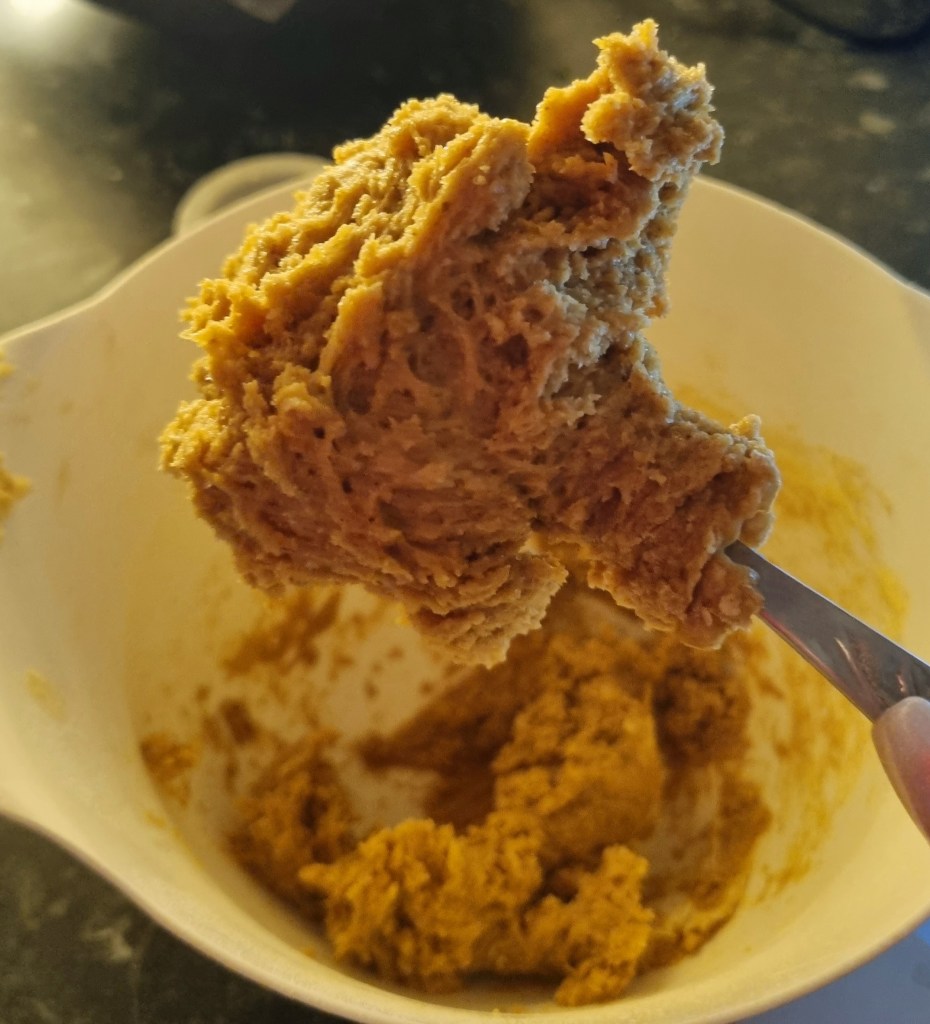
Less ‘pour’ more ‘apply with a cement trowel’.

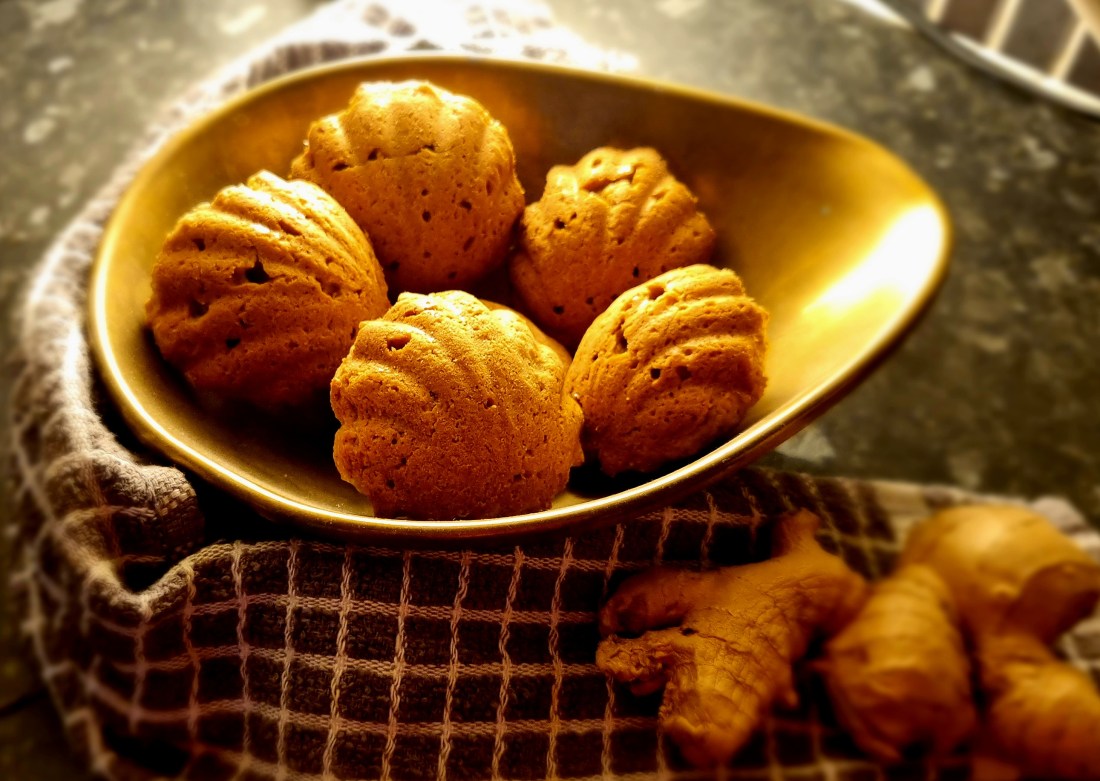
They baked for approximately 25 minutes or so, filling the room with a very festive scent indeed. Once cut open and tried the verdict was that they 1) were not overly sweet, 2) would go well with a sharp cheddar, and 3) packed so much of a spicy gingery punch that they could scare away a threatening New Years cold.

I made enough for a batch of six and honestly, I could have done with more – particularly to adequately fulfil point 2 with the amount of Christmas cheese we had left over.

The wise men came bearing gifts of gold so have some gingerbread in a gold bowl

Whatever your feelings about New Year traditions, I hope this year brings you happiness and health and plenty of New Year gifts this coming week.

E x
“Tooth decay for the whole family!” White Gingerbread: 1591

Today’s experiment is for those who enjoy the sweeter things in life. Quite literally, because if you eat too much of this recipe your teeth will melt and fill the leftover indents in your gums with brown tooth-and-sugar sap which will eventually dribble down your chin and onto your chest, ruining your favourite shirt.

Quite an image.

I’m only half joking, too. No, there isn’t some sort of bone dissolving ingredient – but the recipe is about 75% sugar, so you have been warned: eat in moderation.

I bought Sam Bilton’s book First Catch Your Gingerbread late last year and have wanted to do something gingery ever since. If you haven’t got it yet, you should; it’s a really thoroughly researched, well written and accessible read which covers the history of gingerbread not just in Britain but the rest of Europe as well as Asia too. Plus it has loads of recipes to try out, from sweet to savoury and modern to ancient. Most of the info for this post comes from her, so thank you Sam!

When did people start eating ginger?

I don’t have an answer to that.

In fact, I’m not sure anyone does really. Ginger has been used in food for millennia: the Romans had a dish called tractomelitus which was a paste of honey and ginger and could be used in sweet and savoury dishes. Apicius, the 1st century writer, also lists ginger among the spices that should be kept in every kitchen store cupboard, along with myrtle berries and Indian spikenard (I don’t know why I’m telling you this; I’m sure these are everyday staples for all of us, right?)

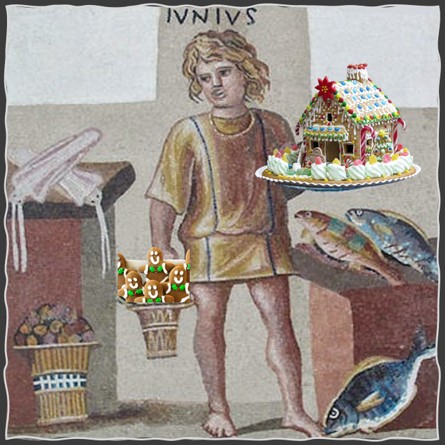
As well as aqueducts and roads, the Romans also popularised gingerbread men and candycane houses.

Ginger was also used in medicinal remedies. According to ancient Greek thought, the body was made up of four humors: black bile, yellow bile, phlegm and blood. Sickness was caused by one of these humors becoming unbalanced, and there were certain foods that could redress the balance because they stimulated the production of specific humors. Galen, the 2nd century physician who developed the 4 humor theory, stated that ginger could help reduce the amount of phlegm in the body, for example.

Ginger was thought to increase the amount of blood in the body. This isn’t a completely illogical conclusion to make; being hot and spicy, fresh ginger could cause the skin to flush slightly red when eaten raw. And, because the human mind has always loved the gutter, people throughout time have associated this physiological reaction to carnal attraction. Yes, ginger earned its place as an aphrodisiac fairly early on; the 1st century Persian physician Avicenna recommended mixing ginger and honey into a thick, sweet paste as a cure for impotence and by the 13th century the intriguingly named “Sultan’s Sex Potions” by Nasir al-Din al-Tusi included a ginger-based recipe to “strengthen the sperm and invigorate[s] intercourse.”

Okay, but what about the origins of gingerbread?

You’re not going to like this either, but yet again, I have no answer.

That’s partly down to etymology. The word ‘gingerbread’ isn’t to do with baking; our English word has roots in Old French gingebras which has roots in Latin zingebra: ginger – nothing to do with bread at all. Even more confusingly, once we had the word ‘gingerbread’ it wasn’t used as a description for one specific type of food, but rather alluded to any kind of preserved ginger treat: cakes, biscuits, sweets, pastes and sugarwork. Finally, and just as confoundingly, some of the earliest gingerbread recipes we have don’t contain any ginger.

A 14th century recipe for gingerbread in Curye on Inglysch gives a delicious recipe using breadcrumbs and honey – but is conspicuous in its omission of ginger. Similarly, a 15th century manuscript for ‘Gyngerbrede’ includes spices such as saffron, pepper and cinnamon – but again, no ginger.

My very first historical cooking experiment was the ginger-less gingerbread in Forme of Cury. Modelled here on my kitchen floor. Ah, the early days!

These recipes (as well as others that contained ginger) were often made in large slabs which then sliced into strips or lozenges, rather than baked as individual cakes. In fact, they often weren’t baked at all, meaning that the texture was a sticky, treacle-tart like consistency rather than a hard biscuit.

Some gingerbreads were more like sweets – a 14th century recipe for ‘Pynite‘ (pine nut tarts) has a ‘gingerbread’ filling which is essentially a toffee made from honey and spices.

By the 16th century, banquets had become fashionable for the rich. Contrary to every historical film where Henry VIII tears into chicken legs with his bare hands and rich ladies bat their eyelids over plates of unidentified meat, banquets were sweet-only affairs and referred to a particular course rather than the entire meal itself. These sugar banquets, laden with marzipan constructions, candied fruits, crystallised flowers and sugared nuts, were an opportunity to demonstrate the skill of the household cooks as well as the vast wealth of the host.

Why ‘white gingerbread’? Can you answer that at least?

Yes!

It’s at banquets that we find the type of gingerbread I’ve attempted here. By the 16th century there were two main types: red gingerbread (often a dough like mixture containing breadcrumbs) and white gingerbread (a marzipan/sugarpaste combination). Red gingerbread included sandalwood which gave it a deep red colour, whereas white gingerbread used the whitest sugar a cook could source, hence the name. Today’s experiment, which is in the 1591 work A Book of Cookrye by the anonymous ‘A.W.’ is of the white variety.

To make White Ginger Bread

Take Gumma Dragagantis half an ounce, and steep it in rosewater two daies, then put thereto a pound of sugar beaten and finely serced, and beate them well together, so that it may be wrought like paste, then role it then into two Cakes, then take a fewe Jordain almonds and blaunch them in colde water, then dry them with a faite Cloth, and stampe them in a morter very finely, adding thereto a little rosewater, beat finely also the whitest Sugar you can get and searce it. Then take Ginger, pare it and beat it very small and serce it, then put in sugar to the almonds and beat them togither very well, then take it out and work it at your pleasure, then lay it even upon one of your cakes, and cover it with an other and when you put it in the mould, strewe fine ginger both above and beneath, if you have not great store of Sugar, then take rice and beat it small and serce it, and put it into the morter and beat them altogither.

A Book of Cookrye, ‘A. W.’

Making 16th century gingerbread

First of all, I was surprised to see that gum tragacanth was used. I’d only seen it in the specialities section of supermarkets with the likes of glycerin and had therefore assumed it was a relatively modern invention. Perhaps in its highly refined powdered form it it, but it appears the Tudors were well aware of gum tragacanth and its benefits to sugar modelling.

Truth be told, I wasn’t sure what it did. A quick Google threw up some worrying results to do with leatherwork and cigar-making and I almost backed out of this experiment. Once I read a few more pages I saw that as well as being used for some pretty macho activities, gum tragacanth was also used in cake decorating to make sugarpaste more elastic and malleable.

It’s likely that the gum tragacanth used in the recipe was in a more solid form than the fine white powder I had, hence the instructions to leave it steeping in rose water for two days, presumably to soften it. As it was, I ended up leaving my powder to absorb some rose water for 1 day, by which time it had swollen to breadcrumb sized granules and could be pressed into a hard paste with the back of a spoon.

Dried gum tragacanth (Sainsbury’s didn’t stock this so I had to use powdered instead.) Credit here.

The sugar paste was very straightforward and identical to the kind of sugar paste you get on Christmas cakes (only, ironically, without glycerin – have I used ironically correctly? Probably not.) Once it was made I split it in two and sandwiched a delicious paste of ground almonds, icing sugar and fresh ginger between the two halves. Then it was time to set it in a mould.

Gingerbread moulds were an artwork in themselves. Often quite large, intricate and carved from wood, they would be left by the fireplace to allow the gingerbread inside to set. This presented me with two main problems: one, I didn’t possess a large, intricate gingerbread mould and two, I didn’t have a fire.

File:Traditional gingerbread mold 2 (Piotr Kuczynski).jpg - Wikimedia  Commons
Imagine biting the head off one of these.

Always resourceful, I shaped my gingerbread in what I did have: a silicon cake tin, shaped like a dinosaur. I think it was a Stegosaurus. Instead of a fire I popped it into my boiler cupboard and left it to dry out over a day or two. Hey, it wasn’t authentic but I got points for effort.

Once it had completely dried out I turned my gingerbread out and daubed it with edible gold paint. Tudor sugarwork, including gingerbread, was impressive not just because of the fiddly shapes, but because they were often beautifully gilded with gold leaf and suchlike. Once I was finished my steggy shone like the regal gingery reptile it was.

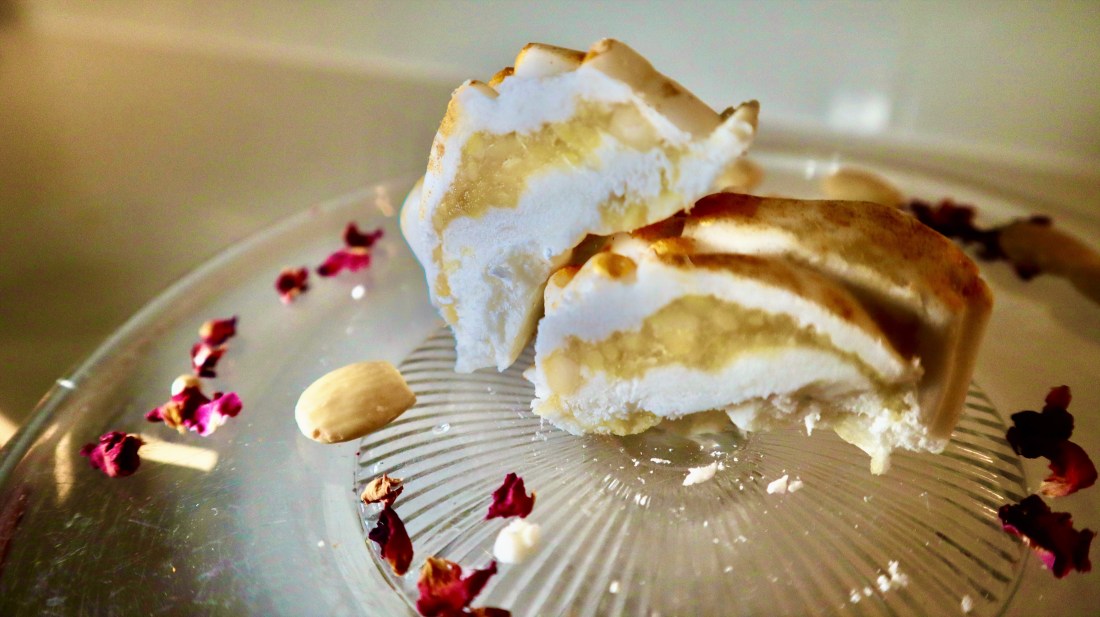
And there it was! It looked great and tasted good too. The icing shell was toothachingly sweet (and perhaps a tad too thick) but the filling was amazing. Fresh ginger and creamy almonds combined well to make a tangy, punchy frangipane like filling that I could have eaten all day. As it was, the block I made was too large for one person to finish in one sitting, but these could work well in smaller sizes – perhaps made in chocolate moulds.

If you don’t feel you’ve wasted enough of your time reading through my nonsense and have another 10 minutes you never want back, why not head over to my Youtube channel to have a look at the process in full glorious technicolour?

E x

White Gingerbread

100g or 1/2 cup icing sugar (plus an extra spoonful)
25g or 1/8 cup blanched almonds
A medium piece of ginger (about the size of your thumb.)
Teaspoon of rose water
Teaspoon gum tragacanth
50ml or 1.6 fl. oz. water

  1. Put the gum tragacanth in a bowl and add half of the rose water. Leave it to sit for 12 – 24 hours to allow the tragacanth to absorb all the rose water.
  2. After the tragacanth has absorbed the rose water, sieve the icing sugar into a bowl and add the water and tragacanth. Knead to a solid, smooth ball of icing.
  3. Grind the almonds in a pestle and mortar. Transfer to a bowl.
  4. Peel the ginger and crush it to a pulp in the pestle and mortar, along with the remaining rose water.
  5. Combine the ginger and almonds and add a spoon of icing sugar and combine to form a stiff paste.
  6. Split the icing ball in two and roll out into two discs.
  7. Spread the almond paste on one of the discs and then place the other disc on top, sealing them together.
  8. Push the gingerbread into a mould and leave to set in a dry place for 24 hours or until it has gone hard.
  9. Turn out and decorate with edible gold or whatever you fancy.

Medieval gingerbread? (hold the ginger…): 1430’s

I’m back to work on Monday having enjoyed an entire 2 weeks of Christmas holiday (perks of being a teacher!) and, well, I’m not sure I’ll be going back. No real reason, it’s just I’ve become so used to only wearing pyjamas and eating chocolate for every meal that I don’t think I can remember how to be a functioning adult, let alone a functioning adult in charge of the future generations of this country. I’ve also had a cold all Christmas and I am pretty sure that if part of your holiday is spent lying on the sofa being poorly instead of lying on the sofa drunk on mulled wine, then you’re allowed to redo the whole thing. I mean, I need to double check it, but I’m fairly certain the law is on my side with this one.

Anyway, in an effort to prolong the festivities I decided to make some gingerbread. This is actually something I’ve wanted to do for ages and every year I tell myself that I’ll make one of those gingerbread houses and decorate it with smarties and jelly tots just like a Hansel and Gretel fever dream. And yet every year I never get round to it. Eggnog always seems to happen instead. So I thought my first dip into the pantry of history could be one that fulfils my wish for a biscuit house and gets post number 1 done in one go!

Except… it turns out that 15th century medieval cooks didn’t quite go in for candy cane picket fences and soft snap biscuit walls. In fact, their whole concept of gingerbread was totally different to ours. For a start: no ginger was needed. In gingerbread. Gingerbread. I actually did some research into this recipe and from what I can gather it was either left out because the other ingredients were believed to fulfil the job of the ginger (more on that in a second) or because the author just forgot to add it in. He had one job! Either way, we aren’t sure why a recipe daring to call itself ‘Gyngerbrede’ would so boldly flout the trade descriptions act, but there we go.

The actual ingredients are honey, powdered pepper, saffron, cinnamon and bread. Always helpful, the author of this recipe didn’t really specify any quantities other than a ‘quart of hony’ which is roughly equivalent to a modern day litre. This is absolutely outrageous decadence for a recipe written at a time of famine, war and plague, so this recipe must have been aspirational and only for the rich (as if the presence of spices hadn’t given that away). I substituted a quart for 250ml instead.

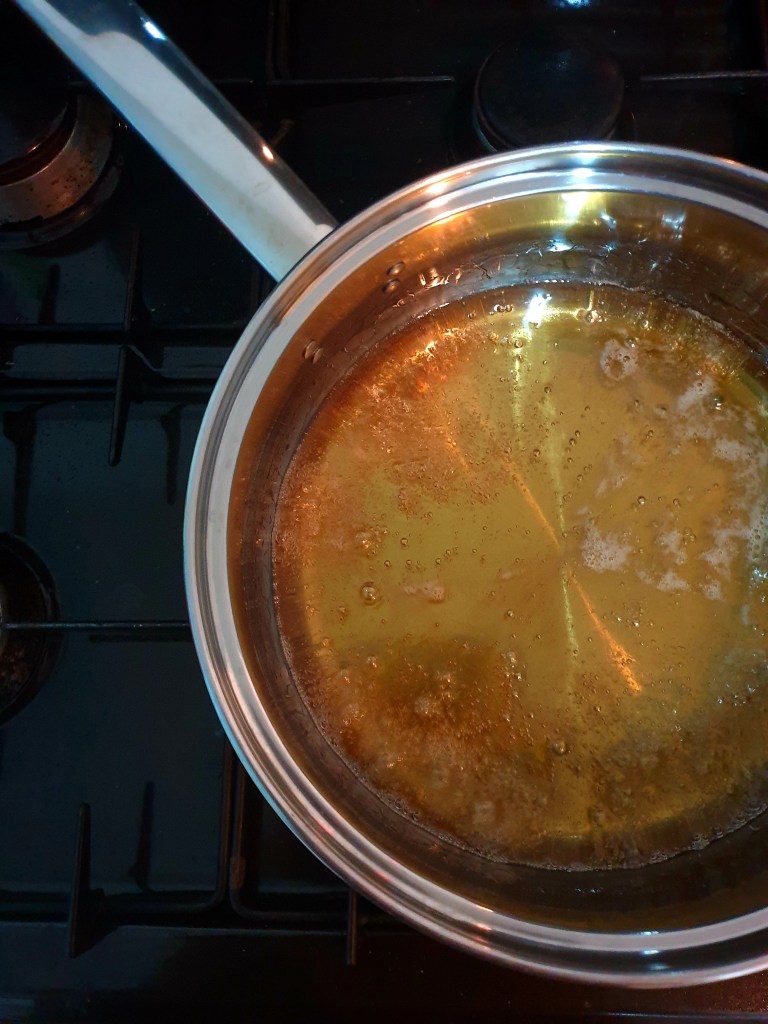
First, I had to take my honey and boil until a scum formed, then skim this scum off. This was pretty easy and smelled quite good. There was minimal scum to get rid of because I guess modern day honey manufacturing methods have taken out a lot of the impurities for us, but I sort of swirled a spoon around the pan for the spirit of the thing.

Then I added powdered pepper, (which I hand ground in a pestle and mortar that I found in the cupboard that neither myself or my husband bought but which I’ve learnt is one of those things that all kitchens must generate themselves, like cinnamon sticks and batteries) and stirred it. This was a bit trickier because there were no quantities given in the recipe so I just put in a teaspoon of ground peppercorns and hoped for the best. Then I added a few strands of saffron (did you know that saffron was so highly prized that in 15th century Germany, merchants who cheated their customers by adulterating their stock could be arrested and executed?) and gave it all a quick stir.

So far, so good. I think Dulux would call this colour ‘Moderate Dehydration’

Next I risked my marriage by grating a quarter of a loaf of white bread all over the kitchen counter less than 15 minutes after my husband had lovingly tidied and wiped down all the surfaces and swept the floor. I suppose if I was doing this properly I would have made my own medieval loaf, but as it was I couldn’t be arsed and my toddler was now very curious about the pan of bubbling honey, so I just used a plain wheat loaf instead. Ordinary medieval peasants would only have access to rougher grains for their breads, for example rye, as wheat was a ‘cash crop’ and usually only for the wealthy. However, given that I’d already established this recipe was written by a lunatic who presumably had enough cash to sink a litre of honey and saffron in one go, I assumed using a simple shop bought cottage white loaf would be close enough to the fine wheat bread of the wealthy medieval classes. I grated the bread into as fine breadcrumbs as I could using a cheese grater because the curious and slightly insomniatic (is this a word?) toddler was now in bed in the room above the kitchen so using the food processor to make breadcrumbs was out of the question, and tipped the mass into the honey mix.

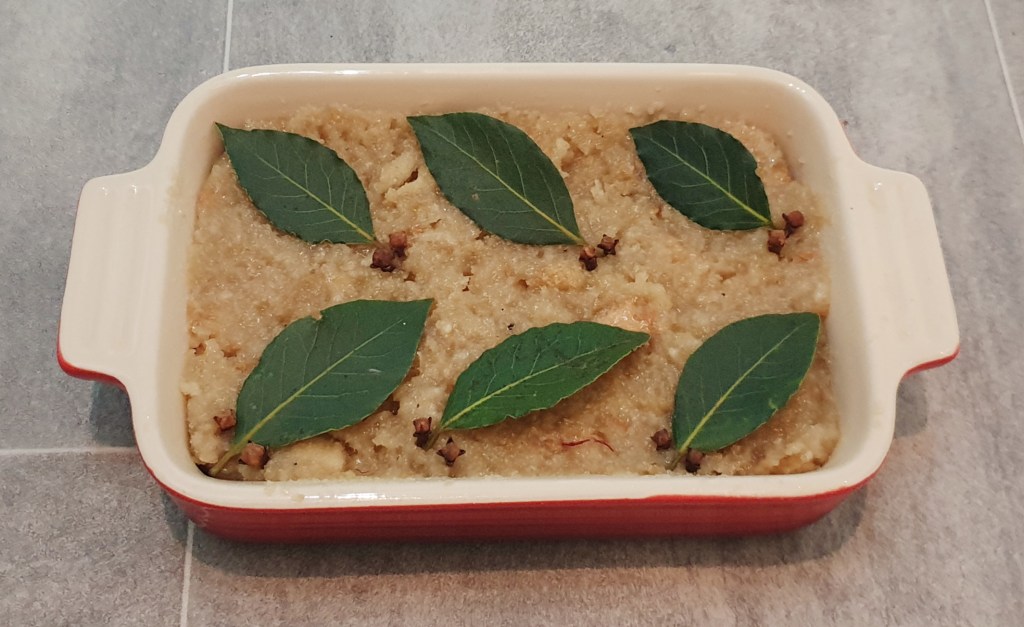
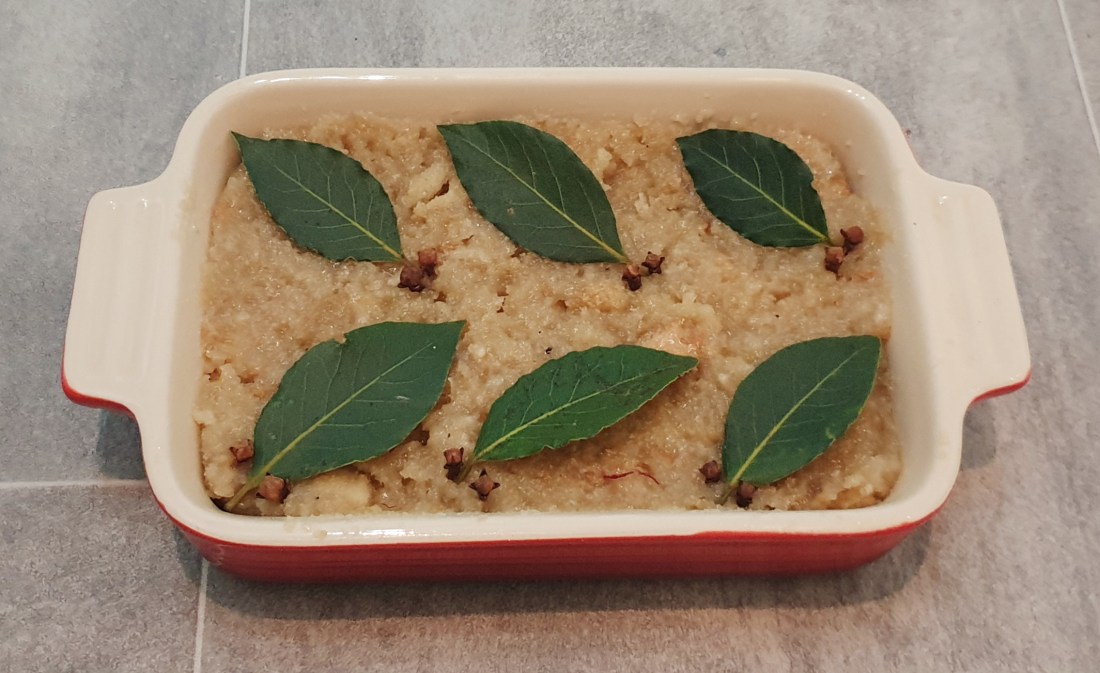
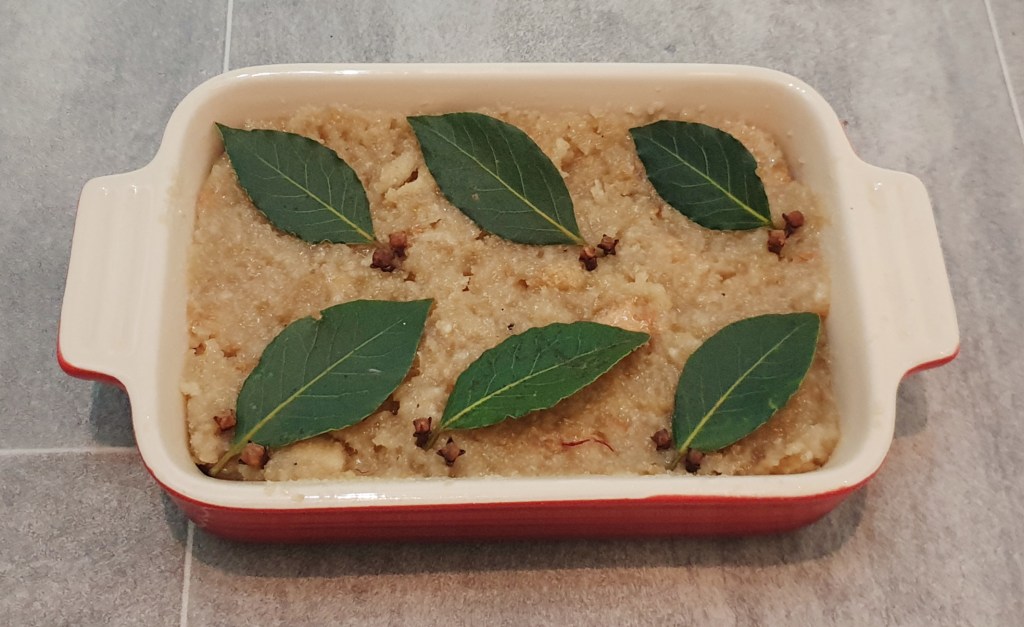
It all began to smell very medieval. Sort of ferment-y and sweet and musty. I stirred it all together until it was basically a thick paste and tipped it into a dish to squidge down. It had a grainy texture, like homemade fudge. At this point the recipe suggested adding sandalwood for a red colour, and I can see why; once I had patted it into all the edges and smoothed it down it resembled less cookie-cutter house of dreams and more regurgitated cat food. The author must have thought the same because he practically begged me to add evergreen leaves and cloves for disguise decoration.

I mean, who wouldn’t want to eat this?

Realised at this point that I’d forgotten to add the cinnamon, which by medieval standards would have been a big no-no. Remember I mentioned earlier that one possible reason for the lack of ginger in this recipe was because it was believed the other ingredients would have done ginger’s job for it? Medieval people believed in the theory of the 4 humours – that the human body was made up of 4 essential liquids: blood, black bile, yellow bile and phlegm. Illness was caused when the humours became corrupted or misaligned and because each humour shared attributes with the 4 elements (hot, cold, wet, dry) a sick person could have their humours realigned by taking a medicine with elements in it which would generate more of the humour they were lacking, or cause them to purge some of the humour they had too much of. Ginger, with its spicy kick, was associated with the element of heat and therefore would have been seen as a medicinal ingredient for those whose illness was caused by a lack of bile and who needed to create more by warming up their insides. Other ingredients with similarly spicy qualities, such as cinnamon, did the same, which is why a medieval person using this recipe as more of a medieval version of a chakra cleanse rather than a sweet treat might have been distraught by my forgetfulness. Although the teaspoon of pepper, another spicy addition to the recipe, may have made up for it. Either way, whoever the author was they must have really been lacking in yellow bile…

After a couple of hours in the fridge I cut it into slices and sprinkled on some of the forgotten cinnamon. It didn’t taste as bad as I thought it would! It’s not as painfully sweet as I expected but is very sticky and kind of nougat like. I had chilled mine in the fridge before cutting it because I’m a sucker for an anachronism, and I think that made it more palatable. A teaspoon of pepper is maybe too much as it definitely had a kick to it, although that may also have been overeager cinnamonning at the end. All in all I definitely wouldn’t call this gingerbread, but I can see why someone who had the misfortune to live before chocolate and gummy bears were invented might think it was a decent treat.

E x