I’ve been practising my imaginary teleportation. For the uninitiated, this is a technique I use where I imagine myself transported to another place, or time, as a few seconds of escape from reality. Usually I only have to use it half way through the last lesson on Friday with year 11, but, well, y’know…
Trouble is I’m not amazing at it. I tend to find the thud of scrunched up paper balls bouncing off the whiteboard and the sounds of Ryan’s dulcet tones as he shouts “Miss, have I told you that I’m not doing any revision cos mum says there’s no point to it – she’s written you a letter”, a bit distracting (although who know Ryan’s mum would be right this year?!)
So, I’ve had a bit more time to hone my skills, and I’d like to share the technique with you. Besides, I think we could all do with a break from tending to the sourdough starters we all began back when being stuck indoors with partners was an opportunity to learn new skills together rather than a legitimate reason to consider mariticide.
For one or two minutes we’re going to take a break from the background drone of the TV and the incessant smothering proximity of our nearest (literally) and dearest, and go on a virtual holiday. Somewhere exotic, somewhere exciting. Somewhere so good you’ll forget all about how loudly and annoyingly your partner breathes while you’re trying to work and then if you do remember, it’s only for long enough to send a ‘Wish you Weren’t Here’ postcard. The holiday of a lifetime.
Close your eyes. Let the sounds of your house wash over you, lulling you into a trance like state. Feel your body sink…sink…sink down deeper into the couch and allow your mind float away…
…to Leicester.
(I did tell you I wasn’t very good at this, sorry.)
Okay, but this isn’t just any old Leicester – this is 19th century Leicester! Still not convinced about this holiday? What if I told you that, like many other towns during the second half of the Industrial Revolution, Leicester saw rapid population growth going from a population of just under 20,000 at the start of the century to about 167,000 by the end? Practically metropolitan! This bustling community was made up of many types of people: immigrants from the countryside seeking work, immigrants from other countries seeking new opportunities, long standing families and people just passing through, leading Oscar Wilde to quote: “I can resist everything except Leicester”* and Queen Victoria herself was overheard to complain frequently: “One cannot understand why London is not more like Leicester.”**
I know what those of you who grew up in Leicester are thinking: how would people in this new booming population find each other when they wanted to meet up? And so, to give the people of Leicester somewhere to congregate and listen to the Hari Krishna singers battle it out with the evangelical eschatologists (and also to ease congestion on the site of the former hay and straw market), the Haymarket Memorial Clock Tower was created in 1868. Now people could chant to their hearts content as they munched on Big Macs from the McDonald’s adjacent to the clock tower whilst puffing on their inhalers to combat the powerful aromas of the LUSH store (by law there should be one in every town centre). Truly, the whole system was a Victorian marvel.
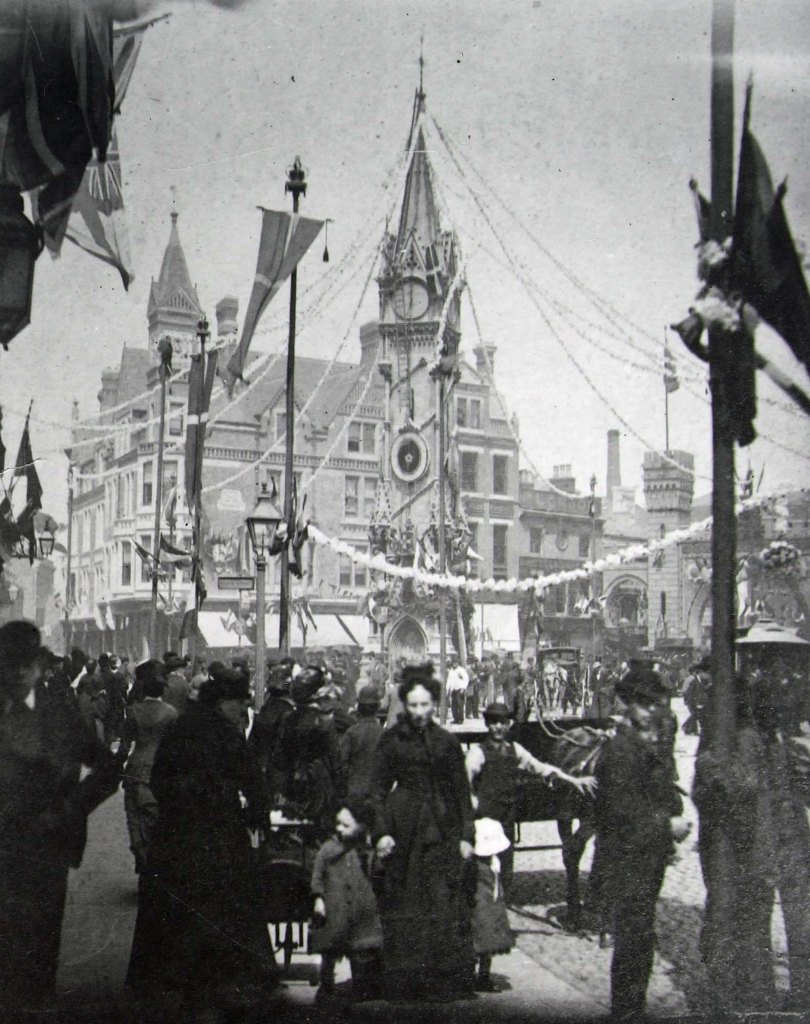
All this growth and building work expanded the town significantly and as a result Leicester became a county borough in 1889. This brought wealth and prestige (well, wealth at least) to the city and in 1898 the Grand Hotel was opened to accommodate the flocks of (lost?) tourists and traders visiting the city. What would those tourists come to see? Well, in 1862 Joseph Merrick was born in Leicester and began touring in 1884 as “the Elephant Man“. So I suppose if you could quash your conscience you could go along to one of the ‘freak shows’. Those of you preferring gentler methods of entertainment might want to jump to 1880 to enjoy a show of male brutality at the newly formed Leicester Tigers Rugby Union Football Club.
But what I think you’ll really enjoy is the freedom to get out of the house and mingle with people again…if you can find them.
It would appear that for parts of the 19th century, much of the population of Leicester was quarantined. “How strange!”, I hear you cry. “You’ve brought us to a self-isolating town, of all places, in order to escape self-isolating! It’s almost as if you’d engineered it for blogging purposes.”
Would I do that?
Anti-Vaccination in Leicester
The thing about Leicester in the 19th century is that lots of people there held pretty radical views. They held these views very strongly and whilst the stubbornness and sheer force of will were excellent for propelling certain groups forward, such as the Leicester Secular Society (the oldest secular society in the world, founded in 1851 to challenge what it called ‘religious privilege’), sometimes the strength of feeling around certain topics could cause problems for the authorities.
One of these certain topics was vaccination.
In 1853 the government made vaccination against smallpox – a common killer disease of the 18th and 19th century – compulsory in the first three months of a child’s life. This law was known as the New Vaccination Act, because the first Vaccination Act of 1840 had, somewhat naively, only made vaccinations free and hoped that would be enough to compel people to get vaccinated. The New Vaccination Act was followed in 1867 by a decree that stated all children below the age of 14 must receive their smallpox vaccine. For the people of Leicester, many of them working class, being told to fall in line so rigidly by upper class politicians who had up to now shown little to no interest in the plight of the poor was a step too far. In 1869 the Leicester Anti-Vaccination League was founded.

There were many reasons people in Victorian England opposed vaccination; religious grounds made up a large percentage of reasons (some felt the origins of the smallpox vaccine, which relied on matter from cowpox, mixed humans and animals together in an unchristian way whilst others suggested that smallpox was God’s punishment and to attempt a cure was to defy His will.) A fear of side effects and a mistrust of doctors accounted for other reasons (in 1841 the UK census suggested almost 1/3 of doctors were untrained and vaccines, new as they were back then, had not been tested safely which initially led to a number of deaths.) Along with these reasons, a feeling that vaccination was being forced on the working classes by those in power left a sour taste in a lot of people’s mouths.
In 1871, angry at being ignored, the government reiterated its position on the compulsory nature of vaccination and threatened fines on anyone who disobeyed. In Leicester the number of prosecutions for flouting the Act grew from 2 in 1869 to 1,154 in 1881 as parents refused to vaccinate their children. Furthermore, for the second half of 1883, only 707 out of 2,281 babies born in that half of the year were vaccinated.
Punishment for the people of Leicester was swift – in 1884, George Bamford was fined 10 shillings (half the average weekly wage) or told to spend a week in prison for refusing to vaccinate his fourth child – even though his mistrust of vaccines had been brought about by the death of one of his previous children following mandatory vaccination.
The Leicester Method
And yet smallpox, deadly and contagious though it was, failed to decimate the city. In 1877, a report by Dr W Johnson, Assistant Medical Officer of Health, showed that smallpox had appeared in Leicester but only caused six deaths.
Dr Johnson suggested that the low mortality rate was down to one main factor, which he termed ‘the Leicester Method’. This method relied on fast acting notification of smallpox to the local authorities and quarantine of those infected before the disease had a chance to spread. Dr Johnson urged parliament to grant Leicester a Local Act recognising the Leicester Method as an alternative to compulsory vaccination. In 1879, this Act was created in the Leicester Corporation Act.
Following the 1879 Act, Leicester became the only town to openly substitute the following measures for infant vaccination:
1. Prompt notification
2. The isolation and segregation of smallpox cases in hospital
3. Quarantine of all persons found to have been in contact with the patient
4. The vigilant inspection and supervision of all contacts during the incubation period of fourteen days
5. Cleansing and disinfection of clothes, bedding and dwellings
6. The burning of clothes, bedding, etc., when necessary
Not exactly unfamiliar to us today.
Despite the steps highlighted above, many authorities rightfully had concerns about the Leicester Method and continued to prosecute those who refused vaccinations. In 1882, 2,274 summonses were issued for people withholding from vaccination and by 1885 tensions between the authorities and people of Leicester were at an all time high (yes – even higher than that year Leicester council faced strong criticism for how it decorated the city’s Christmas tree.)
On 23 March 1885, contemporaries estimated that 100,000 people (although historians suggest it was more like 20,000) gathered in protest in the streets of Leicester, carrying banners with succinct messages such as “The President of the Local Government Board cannot deny that children die under the operation of the Vaccination Acts in a wholesale way” and equally snappy placards of solidarity from other corners of Britain: “Cordial greeting and sympathy to the heroic martyrs of Leicester”, as was sent from St. Pancras.

The demonstration was every official’s worst nightmare: well organised, popular and held on a surprisingly sunny day. More and more people joined the crowds, both as supporters and general onlookers. As well as the marchers, there were movable stunt stalls – a particularly graphic one had rigged up a gallows and every 20 yards or so performed the execution of a dummy Edward Jenner – the man responsible for the smallpox vaccination. We do love a good show in Leicester.
Once the marching and dummy executions had been completed, the crowd met at the Market Place (thank god they’d finished the clock tower) to hear from anti-vaccination guest speakers. The whole event ended with rousing songs and a firm affirmation from the crowd to oppose vaccination in all its forms as much as any individual could. True to form, the following year at the next Guardian elections (think local elections), most of those returned were staunch opponents to compulsory vaccination who continued to petition and nag the governement relentlessly. Finally, in 1898 the people of Leicester achieved some of what they wanted in the 1898 Vaccination Act.
This Act removed some of the penalties imposed for resisting vaccination and included a conscience clause, which allowed parents to get a certificate of exemption if they did not wish to vaccinate their children. Now anyone with a suspicion of vaccination could cite the Leicester Method as a government sanctioned alternative and, as long as they followed the rules rigorously, theoretically couldn’t be sanctioned. Though the Leicester Method was used over 100 years ago when concerns over vaccinations and the manner in which they were carried out were legitimate, some anti-vaxxers still seek to uphold it as a viable alternative to vaccination today.
So, why is this wrong? Why can’t we just use the Leicester Method today? Why bother with a vaccine for coronavirus at all – apart from the fact it would mean staying indoors more often and for longer with those you’ve tried to escape from by reading this for the past 10 minutes?
I asked one of my oldest friends who is currently working as a doctor in New Zealand why the Leicester Method isn’t a reasonable alternative to vaccination. In between rolling her eyes in exasperation and requesting that she be referred to as my oldest ‘and most beautiful and intelligent’ of friends she managed to tell me, before popping off to save some more lives, that there are several reasons.
Firstly, the method relies heavily on everyone doing it properly. Under the Leicester Method, staying indoors means exactly that – staying indoors. No going out for a vague amount of exercise, no trips to the shops for essential bread, milk and M&Ms. You had medicine and provisions left at you door and you did not come out until an approved amount of time had passed. Given that people are still holding house parties it seems unlikely most of us would manage it.
Secondly, the Leicester Method doesn’t actually protect people from catching illness if they’re quarantined with an infected person. It’s a bit of a brutal fact that in quarantining an entire household with a sick member, you’re sort of guaranteeing it will spread within the household. Now, that’s pretty much where we are now because coronavirus is so new – but in the future, if a vaccine is created, you could stop the spread to family members and society wouldn’t have to shut down for an indefinite amount of time.
Thirdly, my beautiful and intelligent friend pointed out that we still don’t know loads about this virus. There are some studies to suggest it can live on some surfaces for three days. But the incubation period is longer than three days, so people could be asymptomatic and be spreading it around like butter on a hot crumpet before realising they have it. If there was a vaccine it wouldn’t matter if your 85 year old great aunt licked every outdoor railing she could find day after day, as long as she’d received the vaccination.
In short, the Leicester Method of the 19th century worked because people seem to have adhered much more strictly to the rules enforced at the time and because it’s easier to control the spread of disease in smaller populations. It’s worth also pointing out that once the Leicester Method had been approved for use, Charles Killick Millard, the Medical Officer of Health for Leicester from 1901 to 1935 advocated for the vaccination of medical and nursing staff who would treat patients, to stop the disease spreading further. This effectively created a bubble around the non-vaccinated citizens of Leicester where the disease was free to ravage as much as it could, but was prevented from escaping the city thanks to the protection of the voluntarily vaccinated.
Probably not the holiday you wanted or needed – a trip to self isolating 19th century Leicester. Sorry. But hey – that model of Edward Jenner getting hanged was good wasn’t it? And did you or did you not forget about how infuriating it is that your partner breathes that way?
Ultimately my friend’s advice is clear: stay indoors and when/if a vaccine is produced, use it if you’re advised to. And if you don’t want to use it then get used to the sound of your partner’s very loud and ever present breathing while you write your work emails from home as your colleagues celebrate their freedom with cake bought during non essential shopping trips and chat at the water cooler at a distance of less than 2 metres.
Oh and remember – I can make fun of Leicester because it’s my town. But if you do? Well. We’ll be ready to march in protest, all 100,000 of us. Meet us at the clock tower.
E x
*Not true.
** Also not true. Come on!
 The Past is a Foreign Pantry
You must be logged in to post a comment.